Transcript
Speaker: Hey everybody, this is Nick Torres here and in this episode of Shaping Your Pottery, I got to interview Marissa Childers. Marissa has been featured in Ceramics Monthly 2022 Edition as a rising artist.
Speaker: In this episode, you will learn how Marissa makes her pottery, how going to grad school really pushed her pottery and the power of getting out of your comfort zone. Marissa, welcome to Shaping Your Pottery and share with me one thing you believe potters should be doing to be successful in pottery. Hey Nick, thanks for having me. I just, I think one thing that potters really need to do to be successful is
Speaker: just learning how to be self motivated. I think that that's one thing being fresh out of grad school that I've learned is not the easiest thing to do. Because you don't have that person there telling you like, hey, like go to the studio, you need to do this, you need to get this done. So I kind of keep this running tab of just like kind of small goals for myself for throughout the year, whether that be like little exhibitions that I'm applying to or just
Speaker: Maybe it's larger goals like setting up certain days and times to do shop updates or trying to plan for solo exhibitions. I think always having something on the list to work towards is always a good motivation, kind of push yourself so that you're successful in the end. That is amazing. We're going to have a great show today. We're going to talk about your experience with grad school, doing a residency at Addison Wright Ranch Arts, and we're also going to talk about how you make pottery.
Speaker: So could you tell me about your time as an intern at Anderson Ranch Art Center? Yeah, so Anderson Ranch Art Center, if you're not familiar with it, is a little art center up in Snowmass, Colorado. So that's right outside of Aspen. And artists from all over the world are coming to this one art center to either teach workshops or take workshops and really just kind of spread the knowledge around. So I had the privilege of going there a few summers ago just
Speaker: freshly out of undergrad and I was a ceramic intern there. So it was a lot of like learning the in and outs of the field, tons of hard work, very little sleep. But at the end it was very rewarding because you got to meet with all of these artists that you like became familiar with their work on Instagram. You're actually meeting those people in real life. You got to kind of pick their brain for all of that knowledge. So I got to meet people like Trey Hill and
Speaker: Michael Klein and Bobby Scroggins and the list goes on and on but all summer just basically assisted these artists and learned their processes and you know just learned their thoughts and ideas and how they formulated certain things. So at the end of it you're just absorbing all this information and it's really great for me
Speaker: to be able to use that in my own work or since I've been teaching recently, I was able to kind of pass that along to my students as well. How did this help you with developing your style? So I think that when I was developing my style, that was something that I really struggled with going into grad school. And I think that it's probably something that a lot of people struggle with. So basically just talking to all these different people and realizing that
Speaker: Everybody comes from different walks in their life, and they're all coming to Clay at different points in their life. There's not one set path. And just figuring out what kind of set me apart from other people and what was unique to me, I think is what really helped me start developing that style a little bit when I went to grad school.
Speaker: So we're going to talk about more about your style later on. But for now, what is something that you learn from the Anderson Ranch Art Center that you still use today? So this is going to sound a little weird, but it's one of the smallest things that I learned while I was there was A, always be nice and respectful to people because that attitude and the way that you present yourself will really follow you around in your career. So regardless of if you are just
Speaker: you know, talking to someone at lunch or you're talking to someone in passing or assisting a workshop, you really want to make sure that you're leaving a good impression behind. But then the other thing was when I first started at the ranch, this was probably two days into me being there for my internship, we were talking about things that were like expected of us and we had to do these morning like check -ins with them. And we were all given this tiny little notebook and we were told that we'd better never be caught without it.
Speaker: And so we were like, oh my goodness, what is this notebook for? And that was just a way for us to take note of what was going on during the day if somebody needed something. That was always with us so we could take note to make sure that we didn't forget things. But I've kind of implemented that into my own practice of things where now I carry around a notebook to, A, keep me on track, but also it's to just have something there to jot down new ideas as they come to me because I typically have
Speaker: my newest ideas come to me like when I'm doing weird things like shopping or running errands in town. And I don't always have my sketchbook on me. So the notebook is kind of a real, really nice thing to refer back to and just be able to have handy. I absolutely love the notebook because it keeps you like all your thoughts organized in one. It's like journaling on. Right. So that you don't have so much chaos going around up there. So you are very inspired by domestic spaces. Can you explain this to me some more?
Speaker: Yeah, I think just as a child when I was growing up, I was very intrigued by different things that were in domestic spaces. So growing up in the 90s, and this may be a southern thing, I don't know if this is for everyone, but my house was super covered in floral prints. So we had floral wallpaper, carpet, rugs on top of the carpet. Everything was in floral. I don't know why, but that's just the way it was. And so that's one of the key things that I remember from my home growing up.
Speaker: And I was always drawn to like different textures of like the fabric and different little embellishments on the furniture and things like that that just like would really draw my attention in. So I've tried to kind of pull from all of those aspects of like what I remember being in my home and then what I see kind of reoccurring in like homes that I go into with like my friends and different family today. So I kind of just pull from all of that and then implement that into my work
Speaker: to create a cohesive piece of art. What do you mean by cohesive piece of art? So I guess when I'm creating things, I don't want things to just look like they are randomly picked and put in places. I want things to flow really well. So when I'm creating, I'm thinking about, okay, what fabric am I using? For instance, if I'm using a sweater fabric or a corduroy fabric,
Speaker: what embellishments are going to go with those. So I start picking through my brain on what I remember as far as what my childhood home looks like, what things were paired with those certain fabrics. And I go through maybe department stores or thrift stores. And I see what type of buttons or cording or embellishments are paired with those fabrics. And then those are kind of the things that I'm bringing into the work so that I'm not just mixing and matching random things because I want there to be
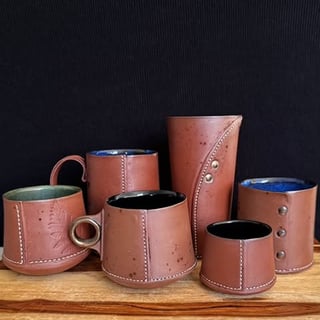
Speaker: this really nice feel to the work. Can you give me a simplified version of like how you would actually make your pottery? Yes. Um, so my work is anything but simple. We will simplify this as easy as possible. Um, so the texture on my work is a big thing. So when I'm making the texture, I'm actually going and either getting fabric from my family, like their whole clothes, I'm going to thrift stores and like buying things
Speaker: and making plaster molds of those. And everything that I make is slab built. So I will actually roll the slabs out on that plaster mold to get the texture. And then I built things from templates. So you can kind of imagine how you would put together clothing from a sewing template. I'm kind of recreating that template process with tar paper. And so once I have my form built, I'm just cutting that out on the slab and then folding the form together.
Speaker: And then once that's all together, that's when the, I think the really fun part starts because I get to add in all those smaller details like the buttons or the stitching or the cording that's on the pieces. And so certain times I will like, I really like to decorate the bottoms of the pieces. That way it's kind of like this intimate moment between the person holding the piece and then like the maker or the piece itself. So you can think about like if you're purchasing a piece online,
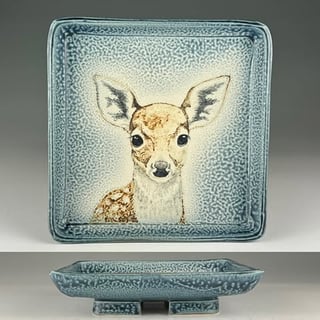
Speaker: and you're looking at that, you're only seeing what's on the outside, but you're not really getting to handle that and feel the texture. And you're especially not seeing the bottom. So I like to add little embellishments on the bottom, like maybe like a frayed edge on the fabric or an additional button or some decals on the bottom so that when that artist does purchase a piece and they flip it over, they can kind of see that little small moment that no one else got to see. So when I'm done making these, they're all soda fired to content.
Speaker: And then once they're soda fired, I then take them and that's when I put the decal application on and I embellish with gold bluster and then they get fired again at cone 18. Why do you use a soda firing for all your pieces? So I started out doing when I first got to grad school, I started doing I was doing like low fire in the electric kiln and I was doing a lot of underglaze decoration.
Speaker: But things got weird in grad school and we had a wood count that I tried and I didn't really care for the wood count too much. So I was like, what are some other options? And we had just finished building a soda count at the school I was going to. And I put my pieces in and it was just something that I really connected with the process of it and the way that the glaze flowed on the surface.
Speaker: So it's just like really nice to see kind of how the atmosphere interacts with that surface on the pieces. It also gives me some like little subtle kind of inconsistencies that help me in the decoration process afterwards. Now can you tell me what is something you hate to see other potters doing or you hate doing in pottery?
Speaker: See, I don't know if there's anything that I technically hate that other people do, but for myself, something that I hate doing is just glazing itself. Like I absolutely cannot stand glazing. And I think that it's just maybe because the way that I have to glaze, I have to spray my glaze on because of the way that I've applied the texture on the surface. And so I will just be in there for like three and four hours just holding a sprayer and spraying glazes.
Speaker: And it's hard for me to get really excited about that. Um, but I probably, I, I did it to myself with trying to pick something super complicated for my process. So before you got into ceramics, you were focusing in on being an accountant. Can you tell me how you transitioned from focusing on being an accountant to going into ceramics? So when I first graduated high school, I was like, you know, any 17 year old, you're like, what can make me money?
Speaker: So I was really good at math at the time and really enjoyed like numbers and that whole aspect. So I naturally kind of gravitated towards that. And I was like accountants make good money. So I just started in schools like this is what I'm going to do. I can get this done quickly. And so it was about my junior year, maybe the end of my junior year in college where I was like, this is absolutely not what I want to do.
Speaker: You know, I've gotten a little bit older. I realized like me sitting at a desk is not ideal like that sounded absolutely terrible so I actually dropped out of school for four years and went and bought a house and did all the adult things and was working multiple jobs and then I was like, you know, I don't like this either like there's gotta be like another option here and so I had been working with my dad a lot and my dad and
Speaker: He's a pretty crafty guy. He's got his own business and he builds cabinets and does flooring and home remodeling and all sorts of things. And so when I was working with him, I realized that like I really liked working with my hands and having that like physical sense of working. So when I enrolled back into college, I was like, no, I knew that I wanted to enroll in an art class, but because I had enrolled so late,
Speaker: All the art classes were full except for ceramics. And at the time, remember, I had no idea that ceramics was a thing. I didn't know what clay was. I had no idea what I was getting myself into. So I signed up for it and I showed up on the first day and they literally just plucked this large lump of clay in front of me. I'm like, what am I supposed to do with this? But I found myself really connecting
Speaker: uh, with that medium really quickly. So, and that was the first time that it ever happens. And so on the first day of class, like I seriously sat there for like five straight hours, just like making things. And it was like an instant connection. So I knew that that was kind of where I needed to go with my career. And you never look back. So can you tell me how did attending grad school for ceramics help you grow as an artist?
Speaker: So grad school's interesting. It was interesting for me because it was, as soon as I started, COVID hit. So I was, my whole grad school experience was just during COVID, which is weird. I feel like it's a little bit different than typical people's experiences. So that was interesting enough. But then I really, I had the privilege of working with Doug K. Spear. Again, he was a visiting artist professor at OU.
Speaker: And I also worked with Stuart Haspry and Jamie Bates -Lum. So I kind of had a lot of their guidance throughout my whole, you know, three years there. And it was maybe my third semester into grad school where they sat down with me and was like, okay, like we need to talk. Like you're not allowed to use underglaze anymore. And at the time I was like, you've got to be kidding me. Like you can put these stipulations on my artwork. I was like, this is insane.
Speaker: Um, so for a while I felt really discouraged because I didn't know where to push my work from there because the underglaze was what was like my comfort zone at that time. Um, but looking back at it, it's really interesting because at the time you don't see the growth. Um, and I thought that they were just being mean to me, but looking back on it, it's really nice to like see that progression really unfold with the work. Why did they say you couldn't use underglazes?
Speaker: Um, because it was like really hindering what I was doing. I had gotten in this groove of just, I was making work out of low fire clay and I was decorating the surface with underglaze and firing it in the kiln with a clear glaze and like that was it. And at the time, like I was really proud of the work and I wasn't, um, taking a step back and really looking and seeing how I could push that further.
Speaker: And so looking back at it, I don't think that they would have kept the underglaze from me forever. But it was something that they were like, this is essential right now for you to really start experimenting because we're three semesters in and I hadn't really made any improvement with anything. So I think it was just a way to push me and get me to try new techniques and experiment more and start getting weirder with my work.
Speaker: because we shouldn't be 100 % comfortable with our work. That puts us in this realm where we're not growing as an artist. So I think that that was really helpful. For those that are listening, if you are uncomfortable with your work, good. That means you are starting to grow and you're starting to see progress with your work. So can you tell me, when did you start developing your voice with your pottery? Not that long ago, I feel.
Speaker: Like that is something that is definitely still in progress. You know, like going to grad school, knowing that I had to develop a style or a voice, that was like really scary for me. I knew that I had, I had what it took for the technicality aspect of things. But when you go into grad school, like you have to have that conceptual side of things too.
Speaker: And I was not there. I didn't know what I was doing. And I honestly, I didn't feel like I had anything that important to say. And I felt like there was a lot of other things going on in the world at the time that was more deserving of people's time and just more deserving of being hurt than what I had to say. And so that was something that I really struggled with a lot when I first went to grad school. And so
Speaker: That's something that would kind of keep me up at night. Like I would stay up all night, like worrying about it. I would go to critiques worrying about it. I'm like, what questions are they going to ask me today that I'm not going to have the answers to? And it wasn't until I stopped worrying about it that things sort of fell into place. So I kind of sat down and just, you know, really figured out exactly how I wanted my thesis show to look. I knew the work that I was making and I just started making as much work as possible.
Speaker: And then I installed all of that work back in April of this year for my thesis show. And honestly, I installed it. We had the opening of the show and then I was supposed to present my work and do my defense a week after. And it wasn't until I sat down in the gallery by myself and just kind of removed myself from the work and really looked at it, did I start connecting those dots and kind of start finding my voice a whole week ahead of me defending my work.
Speaker: I mean, I really pushed it to the last second there, but I think that that's also just something that is going to progress as you grow as an artist. Things are always going to be changing, and the things that I am thinking about and talking about with my work currently may be different in two years from now, and that's totally fine. And I think that that is something that you really have to come to terms with, is just being okay with not knowing all of those answers to all the questions that people are going to ask.
Speaker: That was really powerful. That was amazing. So can you tell me when you started developing your own voice with your pottery, what changed? Like what started changing just overall? So I think overall it was more so my confidence level. Um, because you know, when you're not confident in what you're saying or you don't know what you're saying and you're just making things up, um, you don't have that level of confidence.
Speaker: Because not only are you trying to make other people believe what you're saying, you're trying to believe it yourself. And so I think once you get to a point where you actually know what you're trying to say, there's that level of confidence there. And it just makes it a little bit easier to talk to other artists about what it is you're trying to say, and it makes you a little bit more confident in the work. And so I think that that helps a lot once you get to that point. Now, what advice would you give to someone looking to find their own unique voice with their pottery?
Speaker: So if you're looking to find your own unique voice, I think the best advice that I had gotten when I was in school trying to figure out the same thing was just being authentic. And I struggled with that for a while because I didn't understand. I was like, I thought, you know, I'm making the work. How much more authentic can I be? Like, there's no one else making this work for me. So I didn't fully understand that. And so I think
Speaker: Now looking at it, it's kind of just the thought of figuring out who you are as a person because you can't be authentic with your work if you don't even know who you are. So kind of taking some time to just be with yourself and understanding what it is that you're passionate about and what your beliefs are and things that interest you and excite you. And once you can kind of answer all of those questions,
Speaker: and you truly know who you are and what you stand for. I think that's when your voice kind of naturally starts coming out. For those that are listening, the better you know yourself, the more you're gonna be able to develop your own voice. So as we're coming to a close here, what is one thing you want to hammer home with my audience today? So I think it's really important to experiment and try out new ideas to really push yourself
Speaker: to try and get to that next level and push yourself outside your comfort zone. Because I know me as an artist feeling stuck, pushing myself outside the comfort zone is when I have had the most success with things. And just knowing that it's like okay to fail. I know that that is like a big fear with everyone is failure, but you become a better artist through failing and experimenting.
Speaker: you never know when that failure is going to kind of set you down a new path. So I think as long as you're like really committing to being an artist, then it doesn't matter how much you're failing, you're going to kind of motivate yourself and push yourself to get there. And in the end, things are just going to end up working out and you're going to end up being in that place that you need to be without even thinking about it.
Speaker: I absolutely love it. Marissa, I really enjoyed our chat today. And where can my audience go and check out your work? So I have a website. It's Marissa Childers .com. Or I'm also on Instagram under Marissa underscore ceramics.
Speaker: Thanks for listening to this episode of Shaping Your Pottery. If you would like to learn how to discover your voice, I put together a free six step guide that will help you discover your voice and so that you can make your pottery stand out. Go to shapingyourpottery .com forward slash voice to get this free guide.