Transcript
Speaker: Welcome to Shaping Your Pottery with Nick Torres. Today, I am interviewing Dalen Weber, however you want to say it. And he makes some amazing pottery using sculptures to add to his wheel thrown pottery. And it makes it look truly fascinating, his work. Dalen, how are you today? I am doing great. Thanks for having me. Thank you for hopping on. I appreciate it a lot. Now,
Speaker: I know this is kind of a weird way to kind of start this, but you're a fan of Avatar and I'm a fan of Avatar and I wanted to know what is your favorite scene from this show? Favorite scene from Avatar the Last Airbender. Wow, that is a doozy. That's a hard one. Let's see. Oh, there's so many. Okay, so actually I think my favorite one is
Speaker: probably in the Tales of Ba Sing Se, just the whole Uncle Iroh sequence, him going about his day, helping people. I think it's beautiful. I really love it. My favorite episode, however, is Zuko alone. And I just really like the storytelling in it. I don't know, I think it's beautiful. The final Agni Kai between Azula and Zuko also, just the animation is,
Speaker: stunning and the storytelling there as well, you know, it's, those are probably my top ones. I don't know if I could pick just one favorite. I feel you there. There's so many great scenes, especially the Ankara hour one where like it's, yeah, I think it's going to be happy. And then it's just like, wow, his son like breaks your heart. Yeah. Yeah. I totally agree. I don't know. I feel like that's what makes it so impactful is, you know, he was going about doing all of these awesome, you know, kind things, these little like acts of service.
Speaker: And then it's like a really hard day for him. You know, like that's, I thought it was beautiful. Yep. I agree. I like that scene a lot too. So now you make these avatar kind of theme mugs. How often do you make those? Um, so I don't own any kind of like,
Speaker: copyright or any permission to produce and sell them. So I usually just make them if it's something that I want to do for myself. I don't do them as often as I would like to. I usually just make them when I'm getting sick of the everyday production pottery, making things that I can sell. And so I'm like, I want to shake things up a bit. I'll do something that's just for me. And that's when I will usually break out some kind of avatar -inspired
Speaker: piece. Do you make, so other than Avatar, do you make other things just for yourself too? Like other like themed pottery, I guess? Yeah, every once in a while. So I, I'm not much of a video game player myself, but I grew up with siblings that loved playing, loved playing video games, and I loved watching them. I still actually, I don't know why I still love watching people play video games. I think it's more fun than
Speaker: TV show. It's like a TV show, but the characters listen to what you're saying. So if you're like, no, don't go in there, they don't go in. But Legend of Zelda, sometimes I'll do Legend of Zelda inspired things just for me, just because I like the storytelling and the worlds and the games there. I think they're fun.
Speaker: Other than that, it just kind of depends on what I'm feeling. I've made a few pieces for myself that were pretty different from what I normally do. And it was just because I had an idea and I wanted to experiment with it. And I ended up liking it. Sometimes I make something and I'm like, yeah, this is not the move. And you know, I check it or give it as a gift to someone. Yeah. But yeah, just every every so often, I just need to
Speaker: need to kind of branch out and get my creativity running. And does that help you like get refocused like when you start production again? Yeah, oh, absolutely. Being able to take a break and make something that is just fun, you know, it kind of keeps me like excited and happy to do pottery. I feel like it's really easy sometimes if you're an artist, it doesn't, not just pottery, but any kind of
Speaker: art or creative career, it's really easy to kind of turn it into just a job and you start to lose the love and excitement for it because you're only you know doing things that have like a little bit of stress tied to it you know you're like trying to make enough for the next show or you're trying to you know pay rent with your work and
Speaker: that can take a lot of the joy and excitement out of it, I feel like, for me at least. And so being able to just do something that there's no pressure to sell it. I'm not trying to make a commission piece. I'm not worried if a client is going to like it or not. I'm just making it to make it. I feel like that kind of helps keep me excited, get me re -centered. And then when I do need to buckle down and start working on stuff again, I've kind of gotten that
Speaker: rejuvenation, I don't know the word recharge. I totally agree with that because I definitely will go to like, but I guess like processes where I'm not like, not enjoying as much and then when I do make something like kind of creative, oh yes, let me do some more of these. And that sparks more creativity. Yeah, definitely.
Speaker: So now the next thing I want to talk about was tell me the story on how you started adding sculpted pieces to your pottery. You will throw pottery. Yeah. So I have been adding little animals to my pottery from
Speaker: almost like day one. I remember some of my high school like I started when I was a sophomore in high school some of my first pieces I was either carving stuff and I've always loved the ocean always loved the tropics and so most of my sculptures and carvings were kind of kind of inspired by that kind of you know tropical flora and fauna.
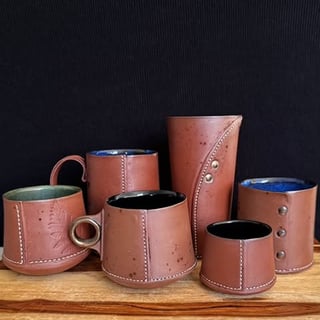
Speaker: But yeah, we had little press molds of animals. And that's what I started with in high school, is I would just do a little press mold. And then I started getting into sculpting and started adding stuff there. I started doing it a lot more and having that be my focus, my niche, I guess. In the last maybe four -ish years, I started to push a little bit more that direction. I started adding the indents to my mugs.
Speaker: Um, and the first indent mug that I did was actually, uh, it was a suggestion from my brother. Um, cause he had asked, he wanted a little nativity mug. Um, so little Mary Joseph.
Speaker: I, uh, I was like, yeah, I could probably like do that. And he was like, is there any way you could like push it in so that it's not like sticking out of the mug, but it like feels kind of like flush with the surface. And I was like, Oh yeah, I can try that. And so I kind of messed around with that thought it was super fun. And then from there started going into more of my, uh, you know, kind of incorporating my ocean animals and stuff. And. You know, I started hand sculpting the coral that took forever.
Speaker: and I hated it. I was like, this is literally the pits, I hate this. So I started trying to think of ways that I could make the coral faster and eventually landed on piping it using the icing tips for cupcakes and cakes to pipe the coral. So could you explain the piping the coral a little bit more? Sorry, hold on. I think I maybe asked that question one more time.
Speaker: Could you explain the piping the coral part a little bit more? Yeah, for sure. Um, I think my headphones died. Okay. So with piping the coral, um, yeah, so my sister owned a cupcake company. Um, and so I would help her pipe flowers and whatever onto onto the cupcakes just using frosting. Right. And one day I was blending up some slip, right? Which is just basically really, really wet clay. And I was like, you know, I think,
Speaker: This is basically the same consistency as frosting. I wonder if I could use some of the frosting tips to make roses or things like that. So I practiced doing that, just basically taking the clay, adding a little bit of water, and then I have a clay powder. And I just add that until the clay has been blended up to a consistency that's similar to frosting.
Speaker: And then I just bought a bunch of tips on Amazon and practice with them until I found ones that I was like, oh, this looks like a coral that I've seen, or this looks like an anemone or whatever, and I can pipe those. I just pipe them directly onto the mug, mix the clay, put it in a bag and pipe it on. And how did that speed up your process with the corals?
Speaker: Yeah, so it sped it up a lot, actually, because before I was, you know, I would just like take off a little chunk of clay and I would hand sculpt it to be the coral that I wanted with the piping.
Speaker: If I try to do just like one mug at a time, it's not that much faster because I have to mix all the clay and everything. But if I'm batching, right, so I've got 10 or 15 mugs that I'm doing at one time, I can just mix up a big batch of slip. And then I sit down and I've got six or seven different piping bags with the different tips on them that I want. And then I can just go through and do all of the shelf coral on the mugs and then go do all of the anemones on the mugs. And then I'll do, and when I'm doing it that way,
Speaker: cuts my time probably more than in half, I'm sure, from hand sculpting, because hand sculpting really took so long. I never timed myself when I was doing the hand sculpting, but once I've got everything set up, it only takes me a couple minutes to add the coral to each, to each mug. That's amazing. I love how you found that solution to make it easier for yourself. It's, it's really nice. I remember I was like, I don't know if I can keep doing this. If I have to hand sculpt on this coral, I guess it was a pain.
Speaker: I bet. So now could you walk me through the process of from like making the mug and then adding the sculpting on there too? Yeah.
Speaker: Yeah, so I throw the mugs on the wheel and I use a little bit more clay than I think I'm gonna need always because while it's on the wheel, right? So I've thrown the mug form, I push in the indent. And usually when I do that, it will, if the mug is too thin, it'll split or break through, but it also warps the rim a little bit. So if I'm trying to make like a 12 ounce mug,
Speaker: I'll make like a 14 ounce mug, add the indent, and then I'll just cut the warped rim off so that it's flat on top. So then finished product is closer to the 12 ounce range that I'm looking for.
Speaker: And after that, I wire it, take it off the wheel head, I let it dry. Usually that same day I'll pull handles and I'll cover those so that I've got handles and mugs ready to go the next day. And then the next day I'll come in and I will put the mugs back on the wheel, I'll trim them, I'll sign the bottom and everything, I'll add the handles. And once the handles are all added, that's when I start sculpting the animals and piping the coral.
Speaker: And the order has kind of shifted. I used to pipe the coral first and then add the animal. But I found that I was starting to add the coral in pretty much the same kind of like fashion on every mug. And that limited how like my composition basically limited where I was able to put animals. And depending on the animals, sometimes it didn't look very good. It looks kind of off balance or whatever.
Speaker: So I've started adding the animals first, and then I can pipe the coral around that so that compositionally it feels a little bit stronger and feels less awkward, I guess. And I don't know, I'm pretty picky, I guess, with myself sometimes when I'll put something, I'm like, ah, that doesn't look, for some reason it looks off balance, but always trying to find ways to make my designs a little bit better.
Speaker: But yeah, so then once I've got the animal sculpted, I attach it to the mug, add the coral. I usually let it dry a day or two wrapped up in a plastic bag with all those added parts. If it dries too quickly, things will crack and fall off. So they got to dry really slow. And then I use underglazes to paint them. So when using underglaze, do you paint the coral and the sculpted pieces as well?
Speaker: Yeah, so actually with this last batch, instead of painting the coral, I added mason stains to the slip as I mixed it so that when I piped the coral, it's already colored. I don't have to worry about painting it later. And that's another thing that's saved some time. But this last batch was the first time that I've done that. Before that, I painted the coral as well. But yeah, I use underglazes and stains colored slips to paint.
Speaker: pretty much every animal that I do. So now when it comes to glazing, how do you think about the background of the whole piece?
Speaker: Uh, usually I just stick with a nice blue color. Whatever blues and turquoises are available, right? Cause you know, I want it to be kind of an oceany tropical color. Um, I've done a lot of glaze tests, right? So I'll take the colors that I have available. I'll see what they look like layered, you know, with this one on top, this one on bottom. Okay. Reverse this one on top, this one on bottom. Um, and then I just go through and I say, okay, these colors look the most like tropical ocean for my coral mugs.
Speaker: If I'm doing like humpback whale and orca mugs that I want to look more arctic, then I'll, you know, find blues that maybe are a little icier, you know, fit that a little bit better.
Speaker: And that's, that's pretty much it. I don't do much glaze, like making, I haven't made my own glazes very often. I usually just use commercial glazes, but I'll almost always layer them so that they have a little bit more depth or there's some variation or, you know, interaction between the glazes on the mug. Right. So now I know you use, instead of wax, you use latex. Could you tell me the story behind that?
Speaker: Yeah, um, actually I was like pretty surprised when I started using it and so many people didn't know that it was a thing because my local pottery supply
Speaker: Sorry. My local pottery supply actually just had liquid latex on their shelf. So when I was first getting started, I guess it was like a couple of years after I getting started when I was trying to figure out new ways to glaze and things, I found the latex and I started using it and I was like, oh, this is super bomb. Especially when I was first starting out because with wax, right? If you accidentally get wax on a piece of your pottery that you don't want wax on,
Speaker: The only way to get rid of it is to re -fire the piece, right? It's really hard to sand it off. You can't scrape it off. But with latex, if you accidentally mess up, you just wait for it to dry peel it off and then you can try again. So I really liked that because it was really forgiving. I also like latex because
Speaker: you can you can peel it off right so you can layer things so I could do a base layer of glaze I can latex the design pull the latex off and then spray another glaze over it um with a different latex you know pattern or whatever and you can do some really cool layering and
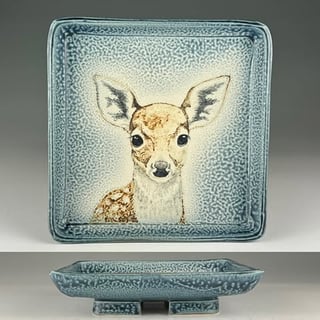
Speaker: I just think it's a little bit more versatile than wax. Does it help you make, like make, so you don't always do like sculpted things. And then you have seen like somewhere where you do like a turtle, a sea turtle on a plate. Does that latex help with that design? Yeah. Yeah. Latex helps with that. So with that one, I just put the latex in like a little squeezy tube. Um, and I just draw the animal right in that case, the sea turtle I've done orcas and things like that. Um, I just draw that with the latex.
Speaker: let it dry, dip it, and then peel the latex off. And then you've got this little relief, you know, sea turtle painting, drawing, whatever you want to call it. That is amazing. I had no idea even latex was a thing. And so like I saw your, on your Instagram, I was like, what the heck? That's cool. Yeah. I love, I love using it. I think everyone should, I mean, there's some things that wax is probably a still a little bit better for, you know, depending on what you're doing, but I love using latex. Plus it's so satisfying to peel it off. It's, you know, I bet.
Speaker: That's a great idea. Now, so correct me if I'm wrong here, but you're in your last year of college, right? What do you plan to do, I guess, pottery -wise after college?
Speaker: Um, you know, uh, yeah, so I'm, I'm studying graphic design and I enjoy it for the most part for the longest time. I thought I was like, I want to be a graphic designer. Like this is what I want to do. Um, pottery was just kind of a side hustle. I've definitely shifted. Um, I've realized that graphic design is not.
Speaker: I mean, I don't hate it, but it doesn't just get me excited as much as pottery does. So I'm trying to find options, things that I can do to keep doing pottery. Right now, I'm looking for a space that I could open my own studio. I'd love to do lessons, but then also just have my own space to keep producing and selling my own work.
Speaker: It's kind of up in the air right now, just depending on if I'm able to get a space and where that ends up being. Right now I'm living in Hawaii, but I might move somewhere else, you know, try the scene back in Utah or I thought about Texas or Colorado or Florida or I don't know, just kind of up in the air right now. There's a lot of ideas and opportunities and I haven't quite settled on one.
Speaker: Right. So now, you live in Hawaii. How has living in Hawaii helped you with your overall design of your pieces, of your pottery? Yeah. So like I mentioned before, even before moving here, I loved the ocean, loved the tropics. My grandparents lived in Hawaii when I was a kid.
Speaker: And I had an ant that worked for Delta. So we would get really cheap flights, right buddy, past flights. And then we always had a place to stay. So Hawaii was like our cheap vacation because we could get these dirt cheap flights and had a place to stay. So I grew up going to Hawaii. I would go there in the summers, stay with my grandparents. So I feel like it's always kind of, you know, it's always had an effect on me. I love it. I love nature. I love animals.
Speaker: Um, and it's been really cool since, you know, living here. Um, but even when I was a kid, being able to go out and snorkel, um, free dive, things like that and see, see the animals. And then, you know, and, and now I try to take.
Speaker: I try to take video and photo, reference photos, reference videos. And then anytime I'm sculpting something or drawing something, I try to use a photo or video that I have taken myself as the reference for that animal. Now there's some that I haven't seen. My whale shark mugs, I've never seen a whale shark in real life. So Google those images, but as often as possible, I try to use my... And I think that that...
Speaker: has actually helped one. It helps me to be more aware when I'm out snorkeling, which is really fun, right? I'm looking around, I'm going, oh, that's like a new shape of coral I haven't seen. I wonder if there's a way that I could incorporate that into my mug or
Speaker: Oh, look, those turtles, how they're swimming. Oh, their fins are more shaped this way. This whole time I've been sculpting them like this. And I think it's helped just in fine tuning my process. I mean, I don't do anything super hyper -realistic anyways, but I think being able to go out and experience the things that I'm creating with my art,
Speaker: I think it shows. I think you can kind of see it and feel it in the art. At least I can when I'm making it. Yeah. I think it kind of like, at least to me, it looks like your passion is coming out from looking at all the different potters or all the animals and applying it to your pottery. Yeah, for sure. There's definitely, I would agree with that. It's a lot of fun and I love it. And it's exciting for me every time I sit down to do it. So now,
Speaker: The next thing I wanted to talk about was you sometimes add these like gold luster onto some of your mugs on some of your animals. Is that an actual gold? It is, it is real gold. I would have to double check on what kind, but I believe it's 22 carat. So the, the luster is from Duncan ceramics. It's a company. They do different glazes and under glazes and things, but they also have these lusters.
Speaker: And I use the premium gold luster. So it's 22 karat gold that's sold in little two -gram bottles. My bottle's like, I don't know, it's like that big, it's teeny. And it's pretty expensive. So it definitely adds a little bit to the price of the mugs when I add the gold. But yeah, it's real gold. Basically the gold is suspended in a little, like an oil, and you paint the oil on, and then when you fire it,
Speaker: the oil burns off and the gold is left. And so you've got this really thin layer of gold over the top of wherever you painted it. Now, do you have to fire it multiple times or do you just fire it the same way?
Speaker: Uh, multiple times. So you do your, your, your bisque fire, right? Your glaze fire. And then the gold would be a third firing. Um, and it's a really, really low temperature compared to, compared to what a typical glaze fire is, I guess, um, fire to cone Oh, 18. So it's like 1800 degrees. Yeah. It's less than a bisque fire. Wow. Yeah. Less than a bisque fire by, by quite a bit.
Speaker: That's crazy. So now how does it help you with your overall selling your pottery? Does it make it easier? Does it make it better, more pricier I guess?
Speaker: Yeah, I mean, I definitely add a little bit to the price when I do the gold just because it is an extra firing, so there's extra cost there. And then the gold luster itself is a little bit more expensive. As far as selling more, I think it just attracts a different crowd.
Speaker: I don't know. Uh, I, I feel, I haven't done it a ton, right? So it's not like I've made a batch of 45 pieces to see how fast they sell out or anything like that. But, um, usually when I do it, I do pretty well. People, people like it. Um, it's nice cause it, it kind of sparkles and it shines. And so it's fun, fun in that way. But I don't know. I, I haven't like really done any, you know, market testing to be like,
Speaker: Is it more advantageous for me to just do these simpler pieces with the gold or is it better to do the coral pieces? It's probably a smart thing to do kind of figure out. Yeah. Especially if you plan on like, uh, opening your own studio, that might help a little bit. Yeah. Yeah, for sure. Now, when it comes to selling your pottery, how do you approach it? Um,
Speaker: I have a sister that I call every single time I'm pricing and I go, I don't know how to price this. Help me. She, and she's awesome. No, she's actually, she's super helpful. Every time I make a piece, I'm always like, okay, I don't want to charge so much that I seem like I'm
Speaker: I think I'm cooler than I am, but I also don't want to charge so little that I can't afford to keep doing it. And finding that sweet spot is kind of tricky. But what I started to try and do is time myself at each step of the process. So how long it takes me to make the mug on the wheel, how long it takes me to push the indent, how long it takes me to sculpt the animals, pipe the coral, paint them.
Speaker: um the firings the glazing you know so that at each step of the way i can say okay all together one mug takes me x amount of hours um it costs this much in materials and if i want to get paid this many dollars per hour then my mug has to be priced here and and being able to break it down that way one helps make sure that i'm not under paying myself but also that i know what is kind of a fair a fair price and a fair expectation um for price there
Speaker: I agree with that totally because you're putting your work out there and it's your work and it takes time. So you need to have that balance. Yeah. So actually, I think that was my last question. Alrighty. I enjoyed this conversation a lot. Thank you for taking time. Yeah, no problem. Thank you. No, it was lots of fun at any time.
Speaker: Anytime. I love, yeah, this is fun. This is my first podcast. I love it. I'm addicted. No, it was lots of fun. It was nice to meet you. You too. Talk a little bit. I hope you have a great rest of your day. Have a good one. You too. See ya.