Transcript
Speaker: There might be better ways to make things and get you to your idea quicker. If you have more abstract imagery, someone might see something in it that you would never expect. The best advice I could give, especially to anyone else that identifies as a perfectionist or has those tendencies, is to... Adrian, what shape your pottery? Share with me, what is something that has helped you the most along your pottery journey so far? You know,
Speaker: I think just realizing that it is a journey and that it's going to take a very long time to get to where I want to go and say what I want to say with my art. Everything kind of like informs the next set of making. And so once I started looking at it like there was truly no destination in that journey, it's just about the time you spend with the material and the things that you learn from it and the things you're able to make with it. It kind of opened me up to
Speaker: a little more free with how I work with clay. And it was really validating and knowing that failure gets you there just as quick as success sometimes. So once I gave myself permission to view it as a journey, I think that was the most powerful thing for my practice. So you mentioned that each step leads to the next step. Tell me more about that. Well, you know, there's a lot of planning you can do when you do art. I think about
Speaker: Putting my art in out into the world is like a type of visual communication, right? I'm really dyslexic. I'm really bad with writing and reading. I mean, I've gotten better over the years with a lot of practice, but it's always been easier for me to communicate visually. And so.
Speaker: I kind of look at it as this like ongoing research practice where I try some things out and then I reflect on them, see how they were working. Usually with ceramics, I have to wait till everything's finished and fired and I'm actually able to interact with the work more because my work is functional. And I think using it is kind of the final part in the making process.
Speaker: without that kind of give and take of the material and really listening to what it wants to do and reacting to how I want to shape it, I just had such a hard time with it when I was like trying to put all my agency on the material and not having that kind of discussion or discourse with it more.
Speaker: So now I look at it as I'll make some decisions. I'll test I'll try some things out and then you grab what works. You bring that to the next body of work and then you make some pivots and some adjustments from there to see where it can grow.
Speaker: So it's almost like a science experiment, which is why I like ceramics more than other media, because there is so much science in it. You know, there's the firing, there's the glaze chemistry. There's all of these things that cause an effect from very real.
Speaker: things that you can research and understand. But then there's also this beautiful intersection of that with all of the conceptual development you can do with ceramics and really what you're trying to put out there. And I think that's why it's kept me engaged for almost 20 years, actually 20 plus now as an art form and why I haven't wanted to move on to other things because there's just so much to learn with ceramics and there's so much that it can teach you if you're open
Speaker: to learning those things and seeing them. I absolutely love that. Shaping Nation, each step you take in ceramics, whether you are a beginner now and experiment with something new, each step you take along the way is going to lead you to new discoveries. And just don't be afraid to fail. I'm a perfectionist. I hate failing, but I learn so much more from my failures than I ever do from my successes. They are great teachers, so learn to embrace them.
Speaker: and nobody that's successful hasn't failed before. There's a lot of failure within success.
Speaker: Absolutely agree. So tell me the story how you got started making pottery. So like I said, I've been making pottery for 20 plus years now, which most people that meet me can't really wrap their heads around that because, you know, I think maybe I started it in the womb or something. I didn't. I started when I was 17 in high school. I was always really fascinated with working with my hands and art. My mom
Speaker: was not an artist by trade but she's a wonderful artist and my dad is a chef so there's a lot of creative inspiration in my upbringing just like how we lived our lives I suppose and
Speaker: I always was really fascinated with like painting and drawing when I was younger and making little clay busts of people and just, you know, little like clay animation movies and just being creative in that way. And then when I went to college, I ended up going to UNC Wilmington in North Carolina, which has an incredibly rich tradition of clay, North Carolina in general, right?
Speaker: And I was a math major for a while. And then more and more, I just started gravitating towards the clay studio. And I think that really was sparked by this class that I took in high school.
Speaker: was a mixed media class taught by our computer teacher actually, but he is a potter and still is and now teaches ceramics up in Pennsylvania. And so he got some funding for some kilns or like a kiln probably and some wheels. And he created this really engaging class where we could learn clay and we could learn some other
Speaker: different media because there weren't enough wheels for everyone. But he had these Thursday night making sessions because there wasn't enough time to be on the wheel in class. He created this community around it. And I think I've always fallen in love with the Clay community and just the kind of tether that that awards all of us, right? Like we are fast friends just because we're in love with this material and we want to learn from each other and we want to
Speaker: be each other's friends and see each other's work. And I was just so enamored by like how a material could bring people together like that. And I had that same experience in college once I gravitated back towards the ceramics studio where I just felt accepted and it was okay. Whatever I was making, it was okay who I was. I showed up as me and I was, I was just, you know, accepted for
Speaker: what I was trying to do and who I was in that moment. And that was a really lovely feeling and something that I didn't always feel as a kid. So I just kind of fell into this space of like these really generous, lovely artists in North Carolina. My program also let senior citizens take class for free. So it wasn't just college kids. There was like this mix of people in the studio. And that's what I found kind of every time I've moved, every time I've
Speaker: taught at a new place or taught a workshop at a new community, you just make fast friends with the clay community. We're really open as a group. And I think that's lovely. I think that's not the case in a lot of other art media. And even though there can be some gatekeeping things, obviously with people and the way they make things or their glazes or whatever,
Speaker: It's just been a safe space for me whenever I enter a studio. It's where I felt the most at home, no matter if I'm visiting or I've lived there or if I'm just going to be there for a couple of months. And I really, really owe a great debt to my high school teacher for being the first person to introduce me to that idea. I've actually been reconnected with him. In recent years, I was doing a demo at Encica, which is the national conference for the ceramic arts that happens every year.
Speaker: And I was demoing for Amico's booth in the Expo Center and I looked up and he was just standing there and I recognized him right away. And I had the opportunity to thank him and tell him all I've been up to. And I just saw him in Nsika again this year. We're connected on social media and stuff. It's just really nice to still have him supporting me in my corner. And that's just more evidence to the fact that there is this amazing clay community that exists
Speaker: Absolutely love that. So now you've had the great opportunity to do a residency in Denmark. Tell me the story how this came to be. Well, this is a funny story, actually. In grad school, I did summer at Penland to get some credit for grad school, which was a great option. And I took a class
Speaker: With Susan Philly and Leah leads in and they are both wonderful functional potters that live in North Carolina. It was a wonderful, wonderful class. And the way that I was working, it was a class all about porcelain. And, you know, that was like my beginning in porcelain and.
Speaker: Obviously I was struggling a bit with the material. I wanted to make these really tight forms and the material likes to warp and crack and do all those things. And so I think it was Susan Philly that just kind of came up to me one day and was critiquing my work because I was taking a class for credit, right? I mean, they do that if you ask anyway in a workshop or a craft school, but they actually had to give me feedback because they were giving me a grade.
Speaker: And she just looked at me and said, like, I don't know why you're not slip casting all these things. You should learn to slip cast, like, and then you could focus on decorating, which seems to be maybe more where your joy is. And so I really took that to heart and I left and I applied to this program called project network. And it's the residency in Denmark at Golda guard and.
Speaker: I didn't get it. They bring a bunch of kind of college age or graduate school age people together for this, like, immersive conference residency thing. And, you know, obviously I was a little crushed when I didn't get in you, you always.
Speaker: Rejection sucks, whether you're good at taking it or not. And what happened though is that they offered me a regular residency in lieu of that. Like they just had so many people that applied to Project Network. They couldn't house us all, but they said, we'd love for you to come here another time.
Speaker: And, you know, residencies like that can be quite pricey. So I took it upon myself to then apply for the Warren McKenzie Advancement Award through Northern Clay, which is a completely different organization altogether, and try to get this residency funded. And luckily I got that grant and was able to go over to Denmark and essentially teach myself how to slipcast. I don't know that I would recommend teaching yourself that. It's a very technical thing that probably is best if you have a teacher that
Speaker: can guide you through that process, but this residency in Denmark is very well known for its slip casting facilities. And so I was very set up in terms of being there with everything I needed. And there was a tech that worked there that was very good slip caster. So I had some technical advice when I needed it as well. And I just, I gave myself this prompt that I was going to go to Denmark for six weeks.
Speaker: I was going to teach myself how to slipcast and I was not allowed to get on the wheel once while I was there. Cause it's like a crutch, right? Like if something's hard, you're always going to go back to what you know. And while I did not become a slipcaster from all of that, I do slipcast pieces and parts like handles, things that take a long time to make and then started getting a lot of attention.
Speaker: for working in that way. I got another residency at the Bright Angle in Asheville, North Carolina, which is a slip casting, a small batch slip casting business. And they offered me a design residency and all these things started to kind of domino from there. Just, you know, me promoting myself and saying I'm in Denmark doing this thing and also getting the award from Northern Clay
Speaker: and having to write about that experience and be in an exhibition from the work I made. So it just kind of ballooned into all of these different opportunities that helped me with my career path. And it was really from that one comment that Susan Philly made to me of just like, why aren't you slip casting these things? Why have you never learned this? And, you know, it feels like a really lovely full circle moment right now because that was 10 years ago.
Speaker: I'm going to be teaching at Penland in the fall in the same studio. And I've invited those two artists, Leah Leatson and Susan Philly to come teach for the program that I run out in California to teach that workshop concept. So, you know, it's nice to still be connected with all these people. And I thanked Susan for giving me that nudge and kind of the path that it set me on all these years later. So really nice too.
Speaker: kind of have these people mentor and show back up in your life later.
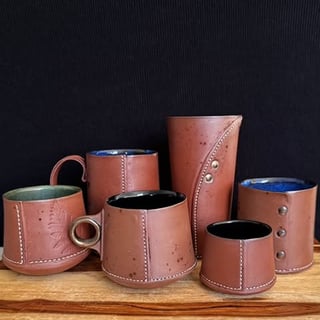
Speaker: I absolutely love that. And we're going to talk more about your pottery technique a little later, but for now, how did this experience impact the way you make your own pottery today? I think it just taught me that I should not be stuck to one way of making. A lot of the times when I introduce myself now, I say like I'm a Franken potter because I hand build, I throw, I slip cast on one of my mugs. I do all of those processes.
Speaker: So I think that experience and other residencies I've done have opened me up and taught me, like, you can get off the wheel. There are other ways to make things. There might be better ways to make things and get you to your idea quicker. If you're not so stubborn, there are people from all over the world at that Denmark residency.
Speaker: And part of the reason that I wanted to be there is because we had these communal dinners. Everybody had to take turns making dinner for everyone else. So every week you'd make dinner for maybe 14 people that were in residence with you. Because I come from like a restaurant family background that felt very, you know, very normal to me to be feeding a large group.
Speaker: And I, part of the reason I wanted to go to that residency was for that experience and just having these meal times with people. And I use some of that inspiration and the work that I was making of what they made of the conversations we had of those experiences at the dinner table, essentially. And so, yeah, I mean, it's helped me grow as an artist for sure. Those residencies getting you out of your comfort zone, away from your normal materials, away from
Speaker: every obligation you have in life, like you don't have to walk the dog, you don't have to clean your house, you don't have to feed yourself sometimes at these residencies. So there's so much more time to be creative, but it's also made me be a more empathetic human to other people's experiences and bringing those into my own world grasp. So I've really enjoyed being in residency situations for that reason.
Speaker: absolutely love it. So let's talk about your pottery. Tell me the story how you started making the pottery that you make today. That was definitely a journey. You know, it's not something I came up with overnight. And it kind of goes back to that comment I made about one thing informing the next. I started working, I mean, I've made pottery all my life, right, or all my clay life, which is from 17 on.
Speaker: And it's always where I found my joy, probably because my father was a chef by trade. I grew up in his restaurants. I was very much around like eating and dining culture and different dishes and service styles and things like that. But, you know, as I grew into my own self as an artist or I was trying to find my voice, I found it very hard because you're kind of this collection of everything you've seen.
Speaker: So it's very hard to make something that feels unique to you when you have all this art history in your head, all of these other people's pots that you're seeing and looking at and being inspired by. And sometimes you're mimicking them or copying them and don't even realize it until it's done. In grad school, I felt like I got completely torn apart because I was not making work that was unique to me. I was just making kind of
Speaker: I was trying to figure that out still, right? And so grad school was really hard for me in that way. There was like some skill building that I missed as well. Not to say that any of those obstacles can't be overcome just with hard work, which is essentially what I had to do. I had to just work a little harder than everyone else not having that background. But I started working kind of in this way in grad school where I was making pots with more color and more pattern.
Speaker: And that was largely because I used to be a soda fire potter. That was like my thing. That was my language. I went to University of Florida because they had atmospheric kilns, all of it, and a history of good people that had come out of there. But the kiln was in really bad repair. And I got funding and permission to rebuild it with the tech there, which was an amazing experience. And it's one of a few kilns that I've helped build at this point.
Speaker: Even though I don't gas fire anymore, I still like to do that. I still like to build kilns. And during that time, because there was no kiln to use, I had to keep making work. I was in grad school. I still had deadlines. And that's when I started, well, first gas firing and trying to get more color and then realizing like,
Speaker: content and color don't really mix. So why don't I go a little lower and then I started using underglazes and pattern and all of a sudden these pots felt
Speaker: like they were expressing me in object form. And I had this moment because we taught at University of Florida. We were the instructor of record for one class every term. So I had my students in the critique space and we had all set up for an open house. One of my students, this really sassy, lovely student I used to have,
Speaker: came up to my piece and said, this is you, right? And that just like made my heart melt. I was like, just from knowing me, and you can see my work out in the world and know that I made it. Like, that's what we all want, right? We want to be representing ourselves.
Speaker: in some way, in some form in objects. So yeah, grad school was like the tip of the iceberg with that, but it wasn't until I got out, I did a couple of residencies and I finally kind of cleared everyone else's voice out of my head and was just able to be in my own studio making and reflecting and not having to defend the work.
Speaker: That was like my least favorite part of grad school, just constantly having to defend my choices. Like, you can't just make a pretty pot because it's pretty. It has to be more than that in grad school and I get that. But yeah, that's when I became really excited about it. And I remember having this moment in my studio where I was slip casting handles. I was trying to make it fit on this body.
Speaker: And I came up with a design solution that was so exciting to me. I could like feel it inside. And I remember taking a picture of it and posting it on Instagram. The amount of reaction I got to that at that point was probably the most that I had ever gotten to something I had made. Like I had gotten a lot of good.
Speaker: attention from working with Amaco products or things that people could more directly adapt into their life. It was more of how -to's people were coming to my page for. And then this was like, oh, this was like, wow, we love that mug you made. And everybody just was going gaga over it. And I think it's because they could tell how emotionally invested I was in it, how excited I was about it, just from the way that I was presenting it.
Speaker: So that's really when it started to feel like it was gelling, like a couple of years after grad school. And that's essentially the work I'm making today still. I mean, it's much more complex now with simpler patterns. The forms were a little more unrefined, things like that. But, you know, I've just kind of been working towards getting everything really tight in that body of work. And now it's feeling like
Speaker: There's a lot of room to grow in the patterning I do on the pieces, but the forms are feeling very like where they need to be for me. And so the patterns are kind of the things that change more these days. And I'm sure in another few years, I might feel like I need to shake things up even more, you know, because if we stop
Speaker: growing, that's not a good thing in our practice. I always admire people that make ceramic work and get this following for something and then just throw it away and start completely over. I haven't really worked up the nerve for that yet, but I'm also newer in my career than a lot of those people. Well, it's exciting to see where it goes. It's not a boring
Speaker: Being a self -employed artist is never a boring day because you just don't know what's going to happen most days. Absolutely. So you mentioned earlier that you were trying to add color to your pots and you are inspired by color. Tell me why you are inspired by color. I mean, for a very simple fact that color can evoke emotion.
Speaker: And having an emotional tie to anything is going to make you more invested in it. Color can make us happy. It can make us sad. It can make us hungry. I mean, there is a lot of market research done about what color can make people feel and how companies can make us feel those ways to buy things. That's not exactly what I'm interested in, but I am fascinated by the psychology of color.
Speaker: and how you can utilize that to express things that could literally be in sentences, but are more abstract and unspoken. And then that means something slightly different to everybody, right? The shape of a flower might mean something to me, but it means something completely different to you. And what color you make it could really change your perception of it.
Speaker: There's so much power in that, you know, color is just one of those things. There's like endless possibilities about how it can make you feel. And I think that a big part of why I make functional work is because I do want some emotional connection with the user. I mean, we touch the same object. That's a very intimate thing.
Speaker: Even though I don't know them, maybe I might never meet them. I might never see my object in their house or how they use it, but there's a piece of me in it that they're interacting with. And we'll always be there if, even if they get rid of it, or it's broken and exist in shards. It's like this archive of, of me in my hand at that time.
Speaker: Absolutely love that. Shaping Nation, the way you use color can definitely impact the way you make your own pottery and the way you continue pushing your voice out. So now, can you walk me through the steps you take when creating one of your pattern pots? Sure. So, you know, I'm really inspired by design movements. And so some of my patterns are inspired by more like mid -century or maybe
Speaker: You know, more of like 80s kind of aesthetic. I mean, I'm an 80s baby. So that's kind of where my work is living right now. There's a lot of that aesthetic in it. And so I'll usually do a bunch of research about like different patterns and things that I'm thinking about both for color and for shape and then.
Speaker: I'll either hand draw or on the computer draw a handful of shapes, and then I'll kind of arrange them into a floating pattern. A lot of that is done on the computer at this point, and then I feed that through my die cutter to make stencils.
Speaker: And then instead of figuring out how each stencil will conform to each piece, I give myself a little bit of a freedom and I just make the full sheet. And then I use scissors and I kind of cut and paste the first few together onto the piece to figure out how it's going to fit. That's kind of my play. You know, everything with my work, it's really tight. It's really organized. It's planned out. So I need those moments of forgiveness and play so that
Speaker: it can still feel fresh to me. And then I'll work with a pattern for a while and I'll use the positive and the negative shapes to get different effects and use all the material. But ultimately, I'm just trying to convey like the specialness in life that there's these little moments of joy if you are looking for them.
Speaker: And don't get me wrong, like I'm a pretty negative jaded person. So it's funny that I make work about this, but I think it's like, I want to put things out into the world that I want to see that I want to bring joy to people. You know, I don't want.
Speaker: my negative Nancy tendencies to be the thing that people associate most with me. So as far as the imagery goes, I use a lot of like confetti, things from games from my childhood, just kind of marks of celebration, whatever that may be. And then I keep them all really abstract because I love how people gain their own ideas and perspectives out of the work.
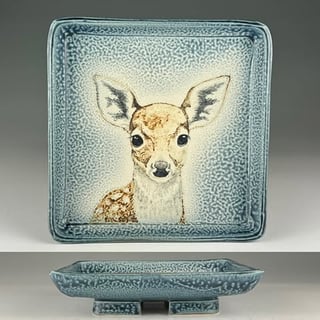
Speaker: Because if it's representational, I'm kind of telling you the story, right? Or I'm telling you some of the story, but if you have more abstract imagery, someone might see something in it that you would never expect. Like, this is a really funny example, but I have a. Plate that I posted on Instagram a while back, and it's got all these flowers on it and I don't usually do representational stuff. So that's a little new.
Speaker: And someone the other day chimed in and said it looked like her pasties. And I was like, I love that. Do you know what those are? They're like nipple covers. Oh, I was confused. I mean, some people would be horrified by that, right? Like that she made that association. I was over the moon. I'm like, I love that you see that in it. It's not what I saw in it. And it would never have been put in my head unless that person told me that.
Speaker: A lot of people come up to me and say weird stuff about my work like that. Like, oh, is this mug supposed to be this? This is what I see in it. I'm like, yes, it is to you. That's the great part about art. You get to make up whatever you want in your head, right? Like, even if it is representational, there's still room for imagination and art. And I love that. Absolutely love it. Let's talk about the business side of pottery. Can you tell me about the moment when you decided to become a full -time potter?
Speaker: I guess when I graduated grad school, I thought I'd just try to make a go of it. I had always had jobs before that. And we moved to the Portland area. I live in Vancouver, Washington. So, you know, I was just like, well, I have this degree. I don't really want to teach full time. A lot of people take that avenue after getting their grad degree. So I came out here, I found a residency, I started making connections in town and
Speaker: just slowly started growing my business and selling things, still very much living off my savings. When this is the time, it was more like, I've built up all this momentum in grad school. If there's a time, this is it. Let me try this and not get a job for a while and see how it goes. What were you feeling when you decided to take this leap towards becoming a full -time potter? Oh, terrified.
Speaker: You know, it's hard. Even when you do have a reputation and people like your work and it sells, there's still doubt. There's still insecurity. There's still months where you don't make good money. You know, especially with ceramics, it's very laborious. There's still sometimes I'm terrified. I'm incredibly grateful these days that it's worked out as well as it has. And I've accomplished as many of my goals as I have, but
Speaker: I think that terror still lives inside all of us a little bit. It fuels us, right? Because if we were too comfortable, if it was too easy, I'd probably get bored and move on. But eventually the terror subsides a little. The more positive things that happen and it gets a little easier, you set up systems that make you more comfortable, all of that. Now, what is something you wish you knew when it came to selling your pottery at the beginning stages?
Speaker: Ooh, that's a good question. At the beginning stages, you know, I, I'm kind of like the opposite of most people. I don't sell things until I feel like they're really worked out or perfect. So I didn't sell my work much when I was in the beginning stages. I think maybe the one thing I would like to have known back then, which I know now is that people aren't just buying an object. They're buying a story. They're buying you.
Speaker: I was really resistant to that idea for a long time. Even when I was first out of grad school and on Instagram and trying to be a business, I had a really hard time with being like, I need to curate a personal brand that people can buy into. I think that's an icky idea, but it's so true. I think I would have liked to know that sooner and not resisted it so much because people want that
Speaker: genuine interaction with the maker, and that helps them along with supporting you. And now I understand all those things, but back then,
Speaker: And because I'm a very shy person by nature, I was just like, can it just be about the art? But it's not, unfortunately. It's just not. How do you build this personal brand or what advice would you give someone trying to build their own personal brand? I think the best advice I could give, especially to anyone else that identifies as a perfectionist or has those tendencies is to not over edit yourself. You might edit everything out and then you don't have anything left to share with anyone.
Speaker: And I think for a long time, that's what was happening. I just felt like things weren't good enough and they couldn't be shared unless they were good enough in my eye. But, you know, the work I'm making now, I couldn't even have imagined making this work five years ago. And that doesn't mean that I shouldn't have been trying to sell my work five years ago. It just means that I'm growing as an artist. So just try not to be your own worst critic and edit
Speaker: yourself out of some really good opportunities because some things that I've put out there that I think are horrible have gotten me the most like a claim or opportunities. And I'm like, people see things differently than you do. So you need to give them a chance to like give you that feedback, you know. Some excellent advice right there. I love it. So let's talk about discovering your voice. What would you say was your biggest obstacle when it came to finding your own voice?
Speaker: quieting the noise of everyone else's truly. There's just so much out there to look at, to be inspired by, to try and copy to, you know, whatever it is. And I see it a lot with like my workshop students too. Maybe people that don't have a formal art background but are really trying to grow their skill or their craft with just these kind of hands -on workshops.
Speaker: They learn new techniques, but maybe don't take the time to reflect and ask themselves if they really are jiving with those techniques, if they bring them joy, if there's something that needs to be in their practice. You know, I see some people, they take a workshop, then they make work like that person, and then they move on and take another one and make work like that person. And I did that for years, I think, maybe not like workshops per se, but more being in school for art or
Speaker: working for artists and I realize why I'm just making like a version of their work just from being around them and being exposed to it. You can't necessarily see that in the moment, but you see it years later when you look at a pot you made, you're like, oh my God, that's just like that person.
Speaker: And I think that it's so great. It's a great exercise to mimic someone with the idea that, yes, I am mimicking someone. I'm trying something that I like that looks good. And you use that as a point of departure. You don't get stuck there, right? You just, you try it. You say, that's a really nice whoever pot. So how can I make that more my own? And then you kind of take steps to do that. It's incredibly hard to find your voice though.
Speaker: And it took me years, I mean, 15 years in clay. Honestly, I think I just found it a few years ago. So just don't give up, you know, eventually it'll happen. It's probably not going to happen as quickly as you want it to, especially with clay because clay is such a technical media and there's so much that you can't control.
Speaker: You mentioned taking or mimicking what other people are doing, but taking that with other people are doing and trying to make your own. How exactly would you do that? So this is an exercise that I actually was given when I was a volunteer tech at San Diego State. Richard Burkett used to be the professor there, and I think he could see it in me. He could see that I was just making other people's work. So he gave me this prompt where he was like,
Speaker: I want you to pick a pot and I want you to try to remake it exactly the way that you see it. And then I want you to make it again and let yourself kind of diverge a bit, you know, and then make it again and diverge even more. And it was this exercise and starting with something you like and then picking it apart into all these elements of like, why do I like it? What do I like about it? What's working with it? What do I need to keep?
Speaker: And then how can I roll that into something that's a little bit more genuine to what I'm trying to communicate instead of the original person's pop that I was copying or mimicking. So he, it was like meant to be an exercise as a point of departure to try to get to my own voice. And I've always been grateful to him for that because it was just a really nice way to
Speaker: Kind of give me permission like, you could copy people's pots, you know, you can as. The learning tool go ahead. You just can't put them out in the world and say they're your own, or you shouldn't at least. So, yeah, I did that for a while until things morphed into. Being an Adrian pot instead of whoever I was looking at.
Speaker: Absolutely love that. Shaping Nation. It's okay to copy and model other people's work, but don't stay there. Continue making small changes until you have found that one thing that resonates with you. Right. And just don't monetize those things either. That's the really important part. When it's not your intellectual property, you probably shouldn't be selling it. Absolutely. What new opportunities started to come your way once you found your own voice?
Speaker: Oh, that's a great question. You know, I used to keep a file on all the opportunities that had come my way after I kind of started working like this. And I think that it was really due to self promotion, right? Because you can make work and
Speaker: There are so many people making really great ceramic work now that aren't getting recognized. And it's just because they're not getting it out there enough. But with like that perfect storm of finding my own voice and then sharing it enough online, I got that residency in Asheville from it. I was invited to do workshops. I was invited to be in books, to write articles for pottery making illustrated.
Speaker: to do lectures. I've been invited to teach places that I didn't apply to just based on my reputation. It's kind of endless. And it really is just a true testament to like, make it and they will come kind of thing. But like, it's just it's that just keep working. And if you keep working and it feels genuine to you, people will take notice. Absolutely love that. What advice would you give to someone that is looking to discover their own unique voice with their pottery?
Speaker: I think that one, I would say don't give up, you'll get there. And two, what I found is really helpful is treating it like it is visual research. So you wouldn't sit down and write a research paper about the Civil War without reading about it first, right? And finding your sources. So why do we think we can make art like that? We can't just come to a blank page or a blank pot
Speaker: instinctively know what it should be. So you need to actually sketch. You need to look at things online. You need to go to museums and you can find inspiration far and wide beyond ceramics. And I would actually encourage you to do that because once I started looking at other things for inspiration, I stopped copying people's work so closely because I wasn't looking at pots anymore. Right.
Speaker: So, yeah, I think I keep like a file, I keep a physical file and then a really active Pinterest page where I'm collecting all these pieces of inspiration and kind of just building up this visual research that gets me closer to what I'm trying to communicate in my work. And I think as artists, we are always asking questions and you should keep asking questions of yourself, of your objects, of what you want to be making.
Speaker: And as long as you have more questions and answers, you're on the right path. Absolutely greasy. Adrian, it's been so great challenge today. And as we're coming to a close here, what is one thing you want to hammer home with my listeners today? Just to believe in yourselves and keep going. You know, I think that you can get there if you want to. And if you need some help with that, taking one of my workshops is a great way because I help students find their own voices all the time.
Speaker: teach like here's how you make my work. I teach let's figure out the work you want to make and I make them do a lot of that visual research and teach them a lot of those skills so that they can go beyond that classroom that workshop experience and have all those tools in their tool bag to start being more of their own artist and that the class that I'm teaching at Pennland
Speaker: in fall. It's a short session. It's just a little under a week. It's called Say It With Surface, and it's all about finding your own voice. Absolutely love it. Adrian, it's been so great chat today. Where can my listeners go and learn more about you? Well, I have my website, which is adrianeliotis .com. So there's a lot of good information there and a lot of eye candy with
Speaker: current and past pots. And then my Instagram at bugaboo underscore eyes. That's where I'm most active and have lots of great videos and stills of what I'm making both in process and finished.
Speaker: Hey thanks for listening to this episode of Shaping Your Pottery with Nick Torres. If you want to master the art of pottery and dive deeper into the techniques of the potters I interview, I created a newsletter that does just that. It dives deep into the techniques of the potters I interview. If you want to learn more, go to shapingyourpottery .com forward slash newsletter or click the link in the description to learn more.