Transcript
Speaker: Welcome to Shaping Your Pottery with Nick Torres where we help you discover your own unique voice so you can stand out from the crowd and have more fun making pottery so you make pottery that is truly amazing. What is up everybody and welcome to Shaping Your Pottery with Nick Torres.
Speaker: In this episode, I got to interview Joan Lurie. Joan has literally had her pottery featured all around the world from Japan to pretty much every other place you can think of. In this episode, you will learn how Joan makes her pottery through, inspired by architect. Joan, welcome to Shaping Your Pottery and share with me what is one thing people might not know about you.
Speaker: Well, before I started ceramics, I was making my own clothing. And that was a big part of what I was interested in designing clothes. And so I was like a toss up between, well, should I, you know, the clay at one point it became I had to choose between the two of them. So maybe that's, you know, that was just a direction that I was could have gone in.
Speaker: but ceramics were more compelling. So can you tell me the story, how your photographic work led you into clay? Okay. Let's see. You know, I graduated with a BFA in 1981, so it's quite some time ago. And I was doing my own work and somehow I
Speaker: Yeah, then I went back to school to get a master's. And I was really interested, I used to go out and photograph at airports, and I was really interested in that kind of built environment and what it was about, and, you know, in a social context. And through that, I started to, it was difficult to photograph at the airport, so I started to work a lot from books,
Speaker: and do these collage images. And I started to look at a lot of books about the built environment old books from like the 60s and 70s. And my fascination with these books was they were of the past, but it was this recent past that we seem to have forgotten in a way.
Speaker: Some of the things I came across, I don't know if you're familiar with Giorgi Kepes, who was an architect, and he was from the Bauhaus. And he went to work, taught at MIT for a long time. And he came up with in the 60s, he was writing about like cellular forms as models for architecture. And that was like, I just, I found all these books of his and
Speaker: that sort of sent me in this whole direction of interest in biological forms and cellular structures and
Speaker: And then from that, I was also looking at, started to find old craft books. And they had the same fascination of being like, maybe they were 20 years old, but they seem to have come out of another culture almost, you know, from like the environment of the 80s and the art world of the 80s, the photography, what was going on was so different that
Speaker: They were just so compelling and fascinating. The imprint of the hand in the work and the connections to the body. It also had references to a lot of feminist art. And so through that, I started looking at ceramics.
Speaker: more and more, I mean, and more like modernist ceramics. And I was really into like Ruth Duckworth and Lucy Rhee and all, you know, that kind of thing. And I just, I don't know, I just fell in love with it. So that was at the point where I really wanted, you know, started to do it myself. But I mean, you know, it was a long road, you know, it's a very slow,
Speaker: medium to learn. It takes a long time, right? And so, I mean, that's sort of like the background. I can't, you know, if you have any questions, you want me to elaborate. No, that was that was wonderful. So you are inspired by natural forms and architecture. How does this influence what you are going to make? Well, OK, the
Speaker: I use it kind of like the inspiration for a lot of the shapes when I was starting out. And some of the work, you know, just looking at very unusual, interesting architectural shapes, like I was into like the Japanese Metabolists. I don't know if you know them, but they had all these amazing ideas about
Speaker: redesigning like Tokyo and creating this city like the out in the bay and that everything, all the buildings could be added to in the same way that you could grow something, right? They were modeled really on an organic model of growth. It was really like, they were pretty wild.
Speaker: So that kind of conceptually, you know, I would have these ideas and these images of these unusual shapes from the buildings and that would be like, I would be like, oh, that, you know, I'm going to work with that. And so that it had this, you know, there were all these ideas there that kind of propelled my own interests in doing the ceramics, you know, gave it something to work towards.
Speaker: conceptually and physically of like kind of trying to construct things early on. You know, putting say different thrown forms together, you know, combining forms. And yeah, I mean, I guess that's where it was at.
Speaker: So you have kind of like two styles I would say. So the first one is more like a traditional vase looking shape and the second one is more of an abstract look. Can you walk me through how you create these sculptures?
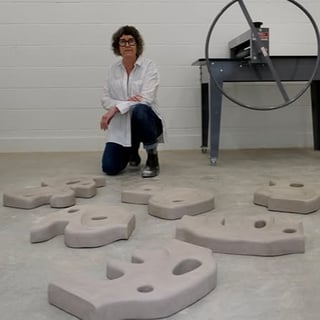
Speaker: OK, well, let's see. The freestanding sculptures, I have one right behind me. Can you see it? It's like this. Yeah. OK, I start out usually with two thrown forms. And then I put them together so it becomes a big flows form. And then I use coils of clay to build up the surface.
Speaker: And then when it gets a certain structural quality, I cut out and then build them up more. So I always have this kind of a surface to work off of. The throne form becomes like my surface that I can build on and holds a piece together. When I'm making,
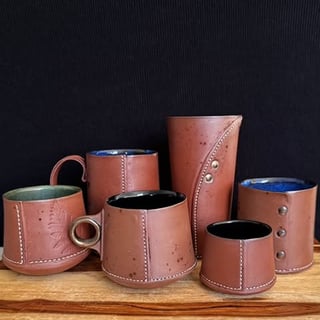
Speaker: the functional pieces, I start out the same way of combining forms and working with coils. But it's like they're stopped at a different point. Then I go in a different direction. But they're both basically come from the same basic way of working with the medium.
Speaker: That is awesome. What are the most common mistakes you see people make when they are trying to make sculptures? Oh, well, I think when putting things together, I mean, sort of like a very rudimentary thing.
Speaker: is, you know, when you're putting things together, you don't like have things dry enough, or you're not patient enough, or you haven't figured out how to, how are you going to construct something in a, like, the steps? It's sort of like, I find that with my work, it's like, I had to figure out certain steps that had to be done, and then you could then take it further, you know, and there's maybe
Speaker: So, I don't know, I just think that's very important. You know, you have to learn a lot of how to work with the material. And I think people are impatient with it, you know, like students. Is that what the question is for about students? How would they? Well, it's just like people in general, just like if they're making sculptures, like the biggest mistakes you see.
Speaker: biggest mistakes? Well, it's hard to say. It's sort of like more like, do you like them? You're not like them. You know, I mean, the mistakes, I guess, could be good if they're interesting. But yeah, I, I, you know, I'm not Yeah, I don't. I mean, since I'm looking at work, mostly ceramic work and galleries and stuff, things get worked out before.
Speaker: You know, but, um, I don't know. You know, that's a, that's a hard question. I think you covered it pretty well. For those that are listening, for those that are listening, it's important to have patience and to follow the steps that are necessary to make your sculptures, to make your pottery. Can you tell me when you feel overwhelmed or unfocused, what do you do to get back on track?
Speaker: Well, you know, working in ceramics, the one great thing is that you can just start making something. You know, you don't feel so good, you don't feel inspired, but you can just sit down and start working. You know, it's like the studio, my studio practice is really
Speaker: You know, I'm sort of always sort of busy. It's like you're always like working on something and one thing leads to another. So I think the important thing is just to start, get started working on something and not worry too much about it. You know, and it's a big pick me up and it will, you know, usually get you out of a funk.
Speaker: love it. So your sculptures have been exhibited all over the world. Can you tell me the story how this came to be? Well, when I first started, you know, with ready to try to show the work, I would apply to a lot of competitions. And so that's like, so a lot of the, like, you know, my work has been, you know, say like in Japan, and
Speaker: different countries but it's mostly through ceramic competitions like it was in Mino for the competition and I was in Croatia and I don't have my list now for my resume but so it's through these the international competitions are great and it's a good way to get your work out there and it's
Speaker: And also, national competitions, it's just good to start somewhere. That's to get it shown, and that's an easy place to start. Because you don't have to go knocking on gallery doors, which will get you probably nowhere.
Speaker: And, you know, so that's the best route, I think, for people. And I just came back from a residency in Nevada, which I enjoy doing. And I wish that, you know, I'm not sure if I'm going to go on or apply to any more residency, but for, you know, people like getting out of school and starting, you know, they're starting their studio work. That's a great thing to do, to meet people and to get
Speaker: you know, your work, get people to know it as to do that. How do you get into these competitions? Well, you just apply. I mean, you can go on, you know, their their list of
Speaker: you know, with the deadlines, Ceramics Monthly has some of them, but the international ones are a little bit harder to find. You have to like do some, you know, research, Google international competitions and just, you know, follow their guidelines and do an application. And so that's a, it's a good thing to get that going because then you'll, you know, have your work
Speaker: It's easier to apply to the next one and the next one and the next one, you know. Really great advice. So what have you gotten better at saying no to that has helped your process? Um, that was also I, I don't know if I, I'm not very good at saying no, but, um, um, I, uh, like I, I've been doing a few commissions and, um,
Speaker: I can't really say no to them because it's always like they're challenging. So, you know, sometimes I think, oh gosh, I should have said no because it is a real pain in the ass and what they want me to do and expect and what if they don't like it, you know, but it just pushes you. So, yeah, it's been very interesting to see what comes out of it because it's in a way it becomes a type of collaboration
Speaker: with, you know, the person conditioning it and their parameters and all that. That is really, really awesome. I love that so much pushing your work to make it make it even better. Can you tell me how has your ceramics evolved from when you first started to now? I mean, it was, you know, not as
Speaker: not as much in my control as it is now. That's basically, yeah, I think it hasn't changed that much in many ways. And the things that I'm interested in and the forms, etc. But it's more getting the kind of control and being able to you know, the big thing is being able to like really push again, the
Speaker: the construction of the pieces. And I mean, it takes a long time to get that, you know, like mastery of it, it's just to know what, I don't know, by the feel of it, how what you can put together and how it's gonna work out, you know, and have it not be a disaster, whatever, you know,
Speaker: Right. So you mentioned control. How do you how do you get this control that you're talking about? Well, I mean, I think it takes time, you know, of I've, you know, I started this. I guess everyone has to sort of figure out how they're going to work. And I mean, you might have different ways of working. But
Speaker: You have to have some methodology that you're following. You know, like I had a friend who worked with slabs. I mean, all her stuff was constructed with slabs. And I would watch. And it was interesting, you know. But I watched her evolution. And you learn, you know, when to put it together, what more you can do with the piece.
Speaker: just technical things that are necessary so that you feel like you're getting where you want to go. It's very limiting at first when you don't have those kinds of skills and you can only get them by doing it. That is really, really great advice. That is awesome.
Speaker: As we're coming to a close here, what advice would you give to people looking to discover their own unique voice with their work? Well, that I think that that's a hard, hard one. But because I remember, you know, when I first got out of college, all the
Speaker: can feel all this pressure and you want to show your work and you want to be have it accepted. And so it's often like, you know, people will see, you know, what's being shown and will like copy it or want to do similar work. And so there's my advice is to try to not be influenced by
Speaker: what's like in now, you know, I mean, I feel like very much in getting involved in ceramics, when I started, it wasn't like other people were if nobody was interested, you know, like that I met, I mean, people, of course, there were people interested, but it was a very small community. And there are very few places to see ceramics, you know, at, you know, a high level. I mean, there was like, Garth Clark in New York, and it was like,
Speaker: that that was basically it, the Museum of Art and Design, which was the craft museum that was in the other place. But so when I started, it was still, you know, anyway, so I, I'll just finish up, I guess what I was just saying that, you know, I had to like find my own personal interests there.
Speaker: And that's what I mean, people have to do if they want to, you know, find their own voice. Really, really great advice here, Joan. Thank you for coming on here today. And where can my audience go and check out your work? Well, I have a website. It's just JoanWorry .com. If you look at it there. Now I have work in Paris now at this place called Boom Room.
Speaker: Thanks for listening to this episode of Shaping Your Pottery. If you have questions about developing your voice or just pottery questions in general send them to me my way. Go to shapingyourpottery .com forward slash contact to send me your questions.