Transcript
Speaker: Real quick before we get started, did you know that the questions that we asked are going to determine what our pottery is going to look like and is going to determine what our voice is going to look like? That's why I created 15 questions that you can use right now to start discovering your own unique voice. Go to shapingyourpottery .com forward slash questions to get this free booklet.
Speaker: If you love pottery and want to take your skills to the next level, you're in the right place. Find your own pottery style right here on Shaping Your Pottery with Nick Torres. Let's get started. What is up, Shaping Nation? This is Nick Torres here. And on this episode of Shaping Your Pottery, I got to interview Anthony Romero. Anthony makes some really incredible pottery that is inspired by space and time.
Speaker: In this episode, you will learn how Anthony makes his space and time pottery and how he incorporates it into his pottery. You'll also learn about the power of just working hard and working a little bit longer just to find your own voice. And also you'll learn about mentorships, getting mentorships so you can pursue your pottery even further. Anthony, welcome to Shaping Your Pottery and share with me what is something people might not know about you.
Speaker: Um, so I've been in ceramics for a while, but before I was in ceramics, when I was really young, actually, I was a, like an entrepreneur type. So, uh, I would actually find about like different ways about making money. So I started, um, I saved up enough money to buy electronic cigarettes. And I actually.
Speaker: ordered them from China right from Shenzhen. So it was like up to like two o 'clock in the morning coordinating bulk orders of electronic cigarettes back in 2012 when I was like still in high school and like trying to figure out how to make money that way. So I think I've been like a go -getter and making things work right from the beginning actually.
Speaker: love it, love it so much. So can you tell me the story how your upbringing directly helped you into pursuing pottery? Yes. So I mean, I've been working construction and labor my entire life working with my hands. So I'm really like familiar with like getting dirty and the raw materials. And I think that kind of shaped my attraction to it originally, you know,
Speaker: getting dirty and getting muddy. But then also the parallel of being that hands -on and working with materials, but then being able to create something beautiful that never crossed my mind when I was working those labor jobs. And then I guess getting into clay was that connection. So when you were going into pursuing art or pottery,
Speaker: What were you feeling when you were going and like pursuing this? So I've been doing it for a long time, but the decision to take it on full time and like take it, um, you know, think about it as a career and take it very seriously. It was a hard decision. I was in college and I actually studied electrical engineering for two years. Um, and then I made the switch to ceramics. Um, and it w it was hard. Um,
Speaker: you know, you're worried about money, you're worried about what are you giving up, you know, feeling a lot of dread and doubt going into that. But then once that kind of like subsides, then it's just it's straight for me, it was just straight focus, like you're doing this. So you have to make it work. And how is that going to be? So it just turned into working as hard as I possibly can.
Speaker: How did you come up to the moment when you were deciding to switch your career from electrical engineering to pottery? Yeah, so I was taking electrical engineering courses, doing very intensive mathematics courses. But for some reason, in looking back on it, it was crazy. I would still travel home to my parents' house where I had a home studio.
Speaker: I'm not sure why I was doing that other than I loved it. I was so invested into it. And then the question really came to mind like truthfully for most people, you only get one shot college. So my mindset was what do you want to do with this time if you only got one shot? If this was like your one chance at a career, what do you want it to be? And I wanted to be in the studio. I wanted to be making things. I wanted that career and not just career, but life path.
Speaker: You know, and I'm very happy I made that decision. It seems like it's my path and not what somebody else has decided. I definitely agree. Shaping Nation, if you're listening right now, it's important to choose your path and not what somebody else is kind of choosing for you so that you can be more happy with what you are making and what you are pursuing. Absolutely. So we will come back to your story in a bit. But for now, can you tell me how being inspired by space and time affects what you are trying to make?
Speaker: Yeah, definitely. So when I was younger, I had like a sort of like an existential crisis. Well, I didn't, you know, grow up with a lot of money so that and I was stuck in the labor force when I was really young. So we turned into these questions like, who am I? What am I? Where are we? Like, what is happening? So I turned to cosmology and astronomy and like trying to understand
Speaker: universe in my place in it, you know, kind of from like a, you know, anthropologic type of view where our ancestors like study the stars to understand life. I guess that's what I started doing, studying cosmology. And then I had an incredible professor that was part of the project to colonize Mars, Peter Dederlein. He was our astronomy professor, or not even professor, this was in junior high.
Speaker: Um, and they ended up taking a class with him in high school and he taught me about quasars. Um, and this is something I've been like super attracted to and we'll talk about it more. Um, but it's been something that I use as reference for, uh, work and things, but just this fascination with the universe and it kind of grounds me and places me in where I am and understanding who I am.
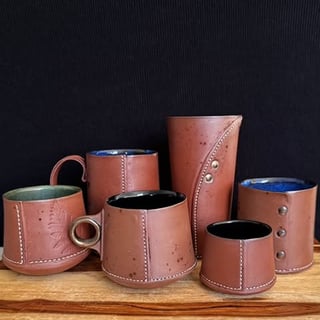
Speaker: I love that. I like that how you're taking inspiration from things outside of pottery and like you're trying to think of ways to put it pretty much into your own life, into your own pottery. Can you tell me the story how you started adding wood handles, zip ties and bungee cords into your work? Yeah, so this was, I mean, thinking back to, you know, blue collar origins, this was a collaborative project.
Speaker: that I started with someone who also was very blue collar. I met him at college at Temple University. And we started combining all of these materials and ideas to create a mug that was, well, originally just started an idea. It's like, how do we engage the everyday person in a creative way? How do we get art into the hands of the everyday person?
Speaker: And then we started with, oh, it should be comfortable. You should feel the material. So it had to be wood. And it's like, how do we attach this to ceramics and make it interesting as well as something that you can relate to? So we're trying to put in all of these parallels of material and then redefining material, thinking like repurposing materials, like along the line of recycling or something, but reuse.
Speaker: It was really an awesome project to engage the viewer in a way that they might not be used to doing. So this is a mug that comes with instructions, sort of like IKEA. So like how many mugs do you order that have like user interface developed into them? I scan a QR code. So yeah, that was a great project that I really enjoyed doing.
Speaker: Shaping Nation, how can you add other materials into your pottery and maybe collaborate with other people so that you can make your pottery look a little bit more unique and be a little bit more relatable? Speaking of that, you mentioned being more relatable. Can you explain that to me a little bit more? Being more relatable. Yeah, so I mean, I think you really need to focus on, right? So we're trying to express something in some way.
Speaker: But it has to be like digestible and understandable for it to, for people to absorb it. So you have to think about like your viewer too. So there has to be some, you know, relatability, like when they see it, are they going to get the feeling that you're trying to put into it? So I think you have to think about viewer and how people will interact with it and understand it as well.
Speaker: I love that because I always say that pottery is about a connection, our hands to the clay and the whatever we made to the customer. And I think making it relatable is about making a connection with everybody. So can you tell me the story? Nope, sorry. Can you walk me through how you make your unique shapes and effects onto your pottery? Yeah, so this is related back to quasars. So we were talking about
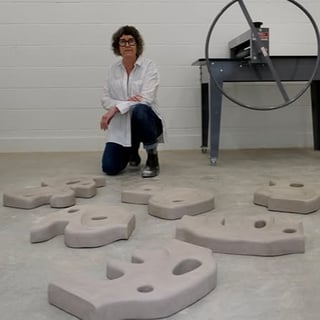
Speaker: the origin around cosmology. So quasars is when two supermassive black holes are forming very close to each other. And in between them, they actually emit heat and light. That was called an accretion disk. So I'm kind of taking this undulating form that's occurring out in the universe, and then I'm applying it to a positive way.
Speaker: So I'm using otherworldly sort of things to create this idea. So they're called, a lot of my vases I refer to like orbital vases. And then I have a kinetic line that actually orbits around that central point. But using these outside references to create the forms has been super helpful. So how much research did you have to do to kind of put
Speaker: thinking about quasars and like the space and put it actually into your pottery. Yeah. So, um, I mean, a lot of it is, is, is like past things that I've studied, but some of the new pieces, I will actually go up and look, um, scientific. Um, like I just did one and it was called a
Speaker: Kepler 11 E in the black hole. So I'm referencing a very specific planet that sometimes viewed as purple. So I can put like a purple sort of color onto it and then incorporate that into the design and the flow of it. So it will vary depending on piece to piece. And then there's also a whole design component too, because if it has to be
Speaker: It has to move. It has to be kinetic. The weight, the density of the material, everything, like the thickness of the clay can support this amount of weight. So a lot of my engineering actually ends up working with ceramics as well, actually. I love that. That's really amazing. So what advice would you give for someone trying to add to their party a little bit more personality? I think it's really important to use your own story as
Speaker: inspiration, it's important to be authentic with your viewer. Like if you're putting something out in the world, it should be, in my opinion, your story or related to you in some way. I think a big thing for me, though, is when you're in the studio, you get so focused on making and craft that thinking about your work when you're not in the studio is very important. So sitting down and like drawing and writing
Speaker: where you can't get stuck in the flow in the same way as making, but you can still think about how is this work related to me and taking a little step back. I love that about Shaping Nation.
Speaker: You don't have to be focused on making all the time. If you sit back a little bit and think about how does this relate, how does this work relate to me and what do I want to make, your voice is going to show up a lot better because you are taking the time to think about these things. So back to your story. Something I found interesting is that you said art school helped you grow as a person. How did art school help you grow as a person? Yeah, I think a big thing was like getting accepted into it.
Speaker: Um, I didn't really have a complete portfolio and then it was all on my ceramics portfolio that really like blew them away. Um, and they really appreciated that, but it gave me a lot of. Freedom to explore myself, my identity, the art school I went to was very conceptual and it was very, it was different. It was kind of like every day was Halloween there in the sense of like people would dress up and
Speaker: do all kinds of different things. It was complete freedom of expression. And it was almost strange if you weren't expressing yourself in these very creative ways. And that just allowed for an environment for really creativity to just flourish. And then it was acceptance, too. Being somewhere where people were weird like me. They were really into art and making. And they would get stuck in the flow. And people would be there till 3 o 'clock in the morning like a crazy person.
Speaker: like I was doing. So it just felt really great to be around other people. Oh, and networking. Oh my God. Networking is kind of everything in the art industry. So that was a huge help in shaping me and my career. I love it. Shaping Nation.
Speaker: How can you go out and go be around other artists, not just potters, other artists in general? Doing this will allow you to come up with new ways and you're gonna network and you're gonna get a lot of new ideas just by being around other artists. So another thing that I found interesting is you once had a conversation with your professor and in this conversation he told you to work harder than you ever have before and something will come out of it. How did these words help you?
Speaker: Yeah, I remember this conversation very vividly. My professor, Roberto Lugo, he was like a newer professor at the time at Temple University at Tyler School of Art. And I just, I was like really thinking about dropping at school. Like, am I able to make this work and not being short and going to him in tears being like, what if my mom gets sick? Like, how am I going to like,
Speaker: help my family if I can't afford to like, keep this going. And I mean, he just said that to me, and it just like little fire under, you know, because looking at his story, and that's just all he's done, you know, like, he, you know, comes from nothing, and he has this huge career now. And it's just, he works, he works so hard. So and that really, it really pushed me and showed me like,
Speaker: like working hard can really get you somewhere, but it was also the thought of like, of course I can do that. I've been working hard my entire life. Let's just keep going. You know, a really important thing for me though, as well, was knowing that a person of color was in that sort of leadership position as well. So having, you know, black and Latino person in a piece of,
Speaker: a tenured professor position leading the department, it just meant so much to me that I believed that I could achieve it too because I was seeing him and he was there. That is really amazing. I love that so much. And I think that everybody should be able to just kind of work a little bit harder. It will come eventually. Things will start coming eventually. Just you got to work a little bit harder for it. So let's talk about discovering your voice. What struggles did you face when you were trying to find your own voice?
Speaker: So with ceramics, it's difficult because you have to overcome the challenge of the materials first. Like you can get very easily stuck in the process of making, you know, where we work with kilns and glazes and form. And there's so much you can get stuck on that can really distract you of why you're there in the first place. And I think that's really a thing for a lot of people. And for me, it was that I was so focused on
Speaker: craft and honing my craft and how do I make the best work and have a really a grasp on the material that sometimes I was forgetting that there was a bigger picture here that if I'm going to make a career out of this, I need to pull things from myself and give it back to the work because the work you're breathing life into the work and in a way the work should
Speaker: breathe life back into you. I love that. That's a great quote. I love that. So when you were able to find your voice, what new opportunities started coming your way? Yeah, I think it goes hand in hand, though, because when you're sort of discovering your voice, you're getting more involved in your career. So and you're more motivated. So for me, it was like,
Speaker: figuring out my sort of style helps me put things into the world and gives me more confidence. So I think naturally things start to come your way once you start posting and sharing more and you feel really strongly about this work. But I had recently, which has been a huge help for me, which could be related to having my voice in my work is been having mentors, having a mentorship
Speaker: has been a huge thing. So George Rodriguez has been an amazing mentor for me. And also helping me continue to shape my voice and grow my work as someone, having someone that's already established in their career and has their thing and has their story. And helping guide me has been a huge thing.
Speaker: But at the same time, I'm still growing my voice as well. I think it's a continuous journey. So yeah, I might ask you to come back and ask me again in two years and see what more opportunities come out of that. I definitely agree. Finding your voice is definitely a continuous journey. I don't think it ever just kind of stops and stays still. I think it's just always growing. So what advice would you give to someone trying to find their own unique voice? Yeah.
Speaker: It's important to remember that clay or whatever art medium you're working in is a tool, but your voice is the art. And truthfully, just do it for longer. I think people jump into it and they do it for a year, two years, three years, and they're like, well, I don't have my style, I don't have my thing yet. I've been working in ceramics for 10 years now.
Speaker: You know, and I'm at the point where I'm like really starting to figure out a portion of my voice, but it's still not 100 % established. So I think a lot of it just, it takes time. Just keep going and it'll come. I definitely agree. Shaping Nation, you may not find your voice right now next week, maybe not even next year, but you're doing a little bit longer and you'll find it eventually. It'll just kind of come naturally to you almost.
Speaker: So as we're coming to a close here, what is something you want to hammer home with my audience today? Yeah, I mean, we've talked about it a lot. I think working hard and dedication is very important. Like going to the studio and working on your work, maybe when you might not necessarily want to. But getting in there and making sure you're putting in the work.
Speaker: If you really want this to become something for yourself, if you want to grow this into a career, it's very important. But also asking why. I think that's something at art school that helped me very much. Whether that's getting a peer or something to help you critique, but having that deep questions of why do you do this? But then why again and why again? And just the consistent, repetitive why.
Speaker: Why, why, why? I think that really helps you understand. And I think a lot of times, for me specifically, it turns into, oh, I don't know. And then you start thinking about that question continuously. Why am I here? Why am I doing? And then the answer does come eventually. And then also, the mentorship is a very wonderful thing. Finding a person that you revere and
Speaker: look up to and it has something established already. And then being in a place where you feel ready to take on that responsibility is a great opportunity to grow your voice in your career. That is some excellent piece of advice. Anthony, it was a really great channel today. Where can our audience go and learn more about you? Yeah, absolutely. So networking, yeah, is one of the most important things. So you can find me on Instagram at Anthony W. Romero, one word.
Speaker: Um, and that's mostly where I post a lot of content. I try and make some cool, interesting videos to engage as much as possible. Um, you can reach out to me on there. I love, you know, talking about your questions. You can definitely ask me, um, or email and my website is attached to there as well.
Speaker: Thanks for listening to this episode of Shaping Your Pottery. If you have questions about developing your voice or just pottery questions in general, send them to me my way. Go to shapingyourpottery .com forward slash contact to send me your questions.