Transcript
Speaker: Hey, real quick before we get started and get into the episode, if you want to figure out how close you are to discovering your own unique voice, I put together a free little quiz for you to see how close you are to finding your own unique voice. If you would like to take this quiz, go to shapingyourpottery .com forward slash quiz, or you can just go to shapingyourpottery .com and it'll be right there.
Speaker: If you love pottery and want to take your skills to the next level, you're in the right place. Find your own pottery style right here on Shaping Your Pottery with Nick Torres. Let's get started.
Speaker: What is up, Shaping Nation? This is Nick Torres here. And on this episode of Shaping Your Pottery, I gotta interview Ryan Reich. Ryan makes some really incredible pop culture pottery. In this episode, you will learn how Ryan makes his pop culture pottery. You'll also learn about why you need to learn the basics so that you can start experimenting better later. You'll also learn about not doing too much to your pottery because more can be bad for your pottery.
Speaker: And finally, you also learn about. I hope you guys enjoy this episode and I'll see you guys in there. Ryan, welcome to Shaping and Pottery and share with me what is something potters should be doing to have success in pottery.
Speaker: Well, I think the number one, I don't know, it's hard to say what the number one thing is. I think it's kind of one of those. Everybody has to find what works best for them, but I definitely think that it's like such a...
Speaker: such a like, I don't say oversaturated, but it's like, it's like so many people have been doing ceramics for so long, like literally like thousands and thousands of years. So there's part of it is like learning your basic, like your basics and being good at basics. But then there's also something to be said about like thinking outside of the box and like trying to figure out a way, if you're trying to be an artist or sell things, I think,
Speaker: There's something to be said about trying to do something different and unique, which is really, really hard. But you know, that's what we do as artists is idea is to
Speaker: do something that no one's ever seen before. And if you're doing ceramics, like best of luck because there's a lot of bowls and mugs out there that have been made for like thousands. I teach high school. So like part of my whole background as a ceramic artist is also being an educator and kind of going over all the like, you know, thousands and thousands of years ago, these nomadic people were wandering around and started making pottery and settled
Speaker: agriculture. So it's been around like forever. So how can you be different, but also know the basics because there's so many rules that you can break. And then, but before the, what I tell my students is before you know, before you break the rules, you have to know all the rules. So, you know, good craftsmanship, solid foundation about how to make stuff and how the materials work and what are the limits of your like glazes and firing, but that's just practice. And
Speaker: like lots of mistakes. And, you know, I'm all about like failure and making mistakes. And like, that's how you get better. And that's how you learn. So I absolutely love that one thing. That's one thing, but that's something sorry, shaping nation. It's important to learn the basics, learn the rules of party, and then learn to break them as well. Once you start getting comfortable with that, I love that so much. So tell me the story, how you got started in ceramics.
Speaker: My experience started when I was in high school. It was actually the summer before my freshman year. So I was in eighth grader going into freshman year, and I was able to take summer school. And my neighbor, my mom was like, you got to go summer school because you can't sit around the house and play in Nintendo. I'm 46, so this is like 1992. And my neighbor's like, oh, I'm taking ceramics. I'm like, oh, that sounds like fun. I think I did it once in kindergarten or first grade.
Speaker: And it was mainly a wheel throwing class. This is at Claremont High School in Southern California, and it was mainly a wheel throwing class and was summer. So it was like, you know, I don't know how many weeks it was, maybe like three weeks for two, three, four hours a day. I can't remember what it was, but I remember everybody was on the wheel. It was all Lockerbie kick wheels.
Speaker: And I really was not very good at it. I sucked at it, but I remember it was a mixed class where there was beginner and advanced and there were a bunch of like seniors or there were juniors going into their senior year that were all like the football players. They're all dudes and they were all like throwing like, you know, thirds of like two thirds of a bag or a bag of clay, like up to their elbow. And I remember like walking in the first day and seeing them doing that. And I'm like,
Speaker: I can do this. Like there's, I saw like they're, they're older than me, but they're doing that. And I'm going to be at the school for four years. So I wasn't good at it, but I liked it. And I just, my counselor let me just kept taking it. So I just kept taking it just about every semester. Some semesters I had it for like two periods. I know I had it for summer school. So I think I had like, I had a lot of it in high school and I just put through a lot of practice and a lot of mistakes. I just got better at it.
Speaker: I went to college as a business major and I pretty much flunked out my freshman year of college at Cal Poly Pomona.
Speaker: because I didn't go to class and they didn't really, they got my money. They're like, you don't want to go to class? I don't go to class. So I didn't go to class and I would drive to school. I'd meet up with friends. We'd go to the arcade or the pool tables or just go F around. And so reality check, I went to junior college and then started taking ceramics again in junior college at Chafee College.
Speaker: in Rancho Cucamonga and then just I was still a business major for the first like year but I was taking the art classes and then one day I decided I was like yeah like I want to take more art classes and less business classes and went to Cal State Fullerton and got my BFA and then got my teaching credential
Speaker: And then I've been teaching high school for the last 18 years in Placentia, California, just like Northern Orange County. I have to say where I'm in the shadows of the Magic Kingdom. So near Disneyland, but not that close to Disneyland, but like, where do you live? I live in Anaheim. I live close to Anaheim near Disneyland, but I never go. So.
Speaker: So yeah, and I've been teaching and making my own artwork and that's pretty much how I got to where I am. So you contribute your growth as an artist to your experience of getting your BFA and MA at Cal State Fullerton. Can you tell me about your experience, about this experience?
Speaker: Yeah, I think part of my growth was really being around people that were better than me, that I felt like I could learn from and had different perspectives and just being in that community environment, especially looking back now as being a high school teacher, whereas I create the environment, I create the culture in the classroom, and I'm basically the teacher, the expert.
Speaker: which is kind of a joke to be like, yeah. Like I know what I'm talking about, but at the same time, I feel like I'm still learning so much. So really like when I was at Cal State Fullerton, I had that, and also at JF college, it was just more of that like growth mindset, like getting assigned assignments, like you have to make this or make something like this, which to be honest, both my teachers I had at Cal State Fullerton and JF were kind of under the,
Speaker: were both older guys, Vincent Suez and Chris Gonzalez. They both went to Claremont graduate school with Paul Solner and they both kind of had that like, I don't know, here's the clay, here's the glazes, go figure it out kind of attitude towards teaching. So it was a lot of like all the students were all kind of like helping each other and teaching each other. Not that the instructors weren't helpful, but they were more of just this like
Speaker: Hey man, like you wanna be here? Here's this stuff. Like here's the studio, like get to work, like make your stuff. So we didn't have a lot of like assignments assignments. So being in that community environment where we're just like bouncing ideas off each other and like learning from the graduate students that were when I was an undergrad, that I think helped me a lot. And then as I got to be a grad student in my later years, I became more of the, you know, people would ask me a lot of questions and I was not to say I was the,
Speaker: towards the top, but I definitely appreciate it when I was more at the bottom, when I was more like learning and bouncing, getting more feedback from each other as opposed to being more of the teacher. So I guess just being a student in general is just good. It was good for me at least.
Speaker: Love that so much shaping nation. Get around other potters that are better than you. Their skill levels are better than you because that's where your growth is going to start happening. I love that so much. Yeah. So let's talk about your pottery in one sentence. Can you tell me what you think?
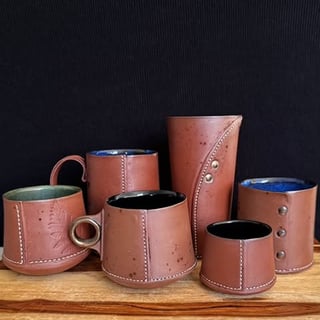
Speaker: What do I make? I make various versions of mugs. At least that's what I've been doing for the last, I don't know, seven or eight, nine years that I've tried to take, I guess eight years that I've tried to take myself a little more serious as an artist and less of just a teacher. I've kind of gone through a bunch of little phases, which kind of
Speaker: So in my graduate show, it was called Game Over and it was all kind of stuff. It wasn't very literally based off of like video games, but it was very much based off of like my youth and growing up in the 80s and kind of having this like visual vocabulary of like
Speaker: Pac -Man and Star Wars and all these you know pop culture things that I grew up on and I kind of came up with like this idea that like I made up the game and the game was like lines and dots so I could only use like lines and dots on my pottery because I would be someone that would be overwhelming with just using too much stuff.
Speaker: So I kind of made up like a game for my graduate show and that idea kind of continued into the game I play in my brain. It's no one game for anybody else, but it's a game I play in my brain where I'm limiting the amount of tools I can use to decorate because my whole thing is like throwing and altering.
Speaker: And I kind of progressed that idea using lines and dots. You can go up to my Instagram back from my 2016, 17, 15 and see like, oh yeah, lines and dots, robots, spaceships, blah, blah, blah. Then I get more simplified lines and dots. And then I'm using just lines with colors. And then I transitioned to the sneaker mug thing, which is its own kind of like, still based off the same thing, but it became its own thing. And then I kind of,
Speaker: I have three kids. We just had another kid a year ago. So I kind of took like a year off of making and just being a teacher. Recently I've got back into it and now I'm just going back with the line idea, but kind of changing the idea. So it's mostly mugs, but, and it's all kind of the same like circular pattern I run around in, in my making cycle, as far as the creative ideas in my brain, but it's mostly mugs.
Speaker: So you mentioned that where you are basically, you limit yourself on what you put on the mugs. Can you explain that to me some more? So I very much got into like the like stamping, like throwing and altering and like using stamps. And that's a lot from my instructor I had at Cal State Fullerton. And I would use like, for example, here, I'll just get like,
Speaker: Like, let's say, right, like, I like just to use, like, a lot of my process is also, like, not using traditional, like, pottery tools that we buy at the store in the pottery kit. Like, I don't, I like something to me about having my own, like, weird set of tools that are mostly, like, handmade. So, for example, like, the end of the needle tool, right? Like, that makes a certain size circle. And then if I have, like, the end of a pencil, that would make a different size circle. Then I have, like, a wooden dowel that was, like, an inch,
Speaker: in diameter, that would make like a different mark. And I was at one point, I was just using all of them, all of them. And it was like, I remember in critiques, it was like, this is kind of like too much, like there's too much going on. So then I kind of made it like, I can only use like this tool, I can only use this dot on this mug. And I have to make an
Speaker: I'm also weird with numbers so I have to make things in multiples of three all the time. So I have to do like three or six or nine and not always but for a while it was like I have to make like three lines and I can use this tool like with five dots and the canvas is like the cylinder and then I have to think about how am I going to incorporate the handle
Speaker: because mugs are something that cups were something that is easy to make and I can make them quick. So it's really like three dimensional sketches, even though the sketches never become anything more than more mugs. It's not like I'm using them to make like bigger things, but that was kind of my process of my brain process as far as the game I played. So.
Speaker: Yeah, I love that so much shaping nation sometimes too much is too much and you have to simplify things down in order to make the pottery look good. So you are inspired by pop pop culture. How does this impact the way you make your pottery? Well, I think the idea is is that I'm a human being in the 21st century. I grew up in the you know, I feel like
Speaker: I feel like I'm in this really awesome generation of people that got to grow up late gen X early millennials. We grew up with an analog childhood, you know, and then as we got to be like teenagers, we started to transition to the digital age.
Speaker: So a lot of my, like, a lot of my, you know, early childhood was like playing with toys and like doing stuff like that. So that kind of, and the toys, what's weird is like the toys that I played with and the things that I was into when I was a child is still somewhat relevant now. Like my kids play with Legos. My kids know what Star Wars is. Pac -Man is not that cool anymore, but for some reason Pac -Man was a huge influence on me and.
Speaker: that kind of like, you know, I see kids wearing Nirvana t -shirts and it's like, dude, you guys wish you were in the nineties. Like you guys just wish you were in the nineties. Like everyone just wishes they were in 1993 or 96 and like living my childhood. So I see that and I guess in some weird way, like,
Speaker: you know, making the sneaker mugs, that's like Jordans, that's, Air Jordan ones, those came out in like 1985 or 86. And that's when I was like a kid. And I remember like having Jordan threes when I, when they first came out and I was like, Oh, I got my first pair of Jordans. And so I guess a lot of it is like the, the nostalgic memories of my childhood pop culture. I guess I've, in some ways I've tried to incorporate that. Another thing I, when I was doing my like,
Speaker: I was doing a series before I got, which kind of the stuff that led me into the sneaker mugs, I was doing just like the kind of line mugs and I was painting different color schemes. And a lot of the color scheme I was using was kind of that, which I kind of got ran down rabbit holes, but it's kind of like that retro wave, outrun aesthetic. It's like that purples and blues and oranges and yellows and this like style that's very like 1980s that you see everywhere now.
Speaker: I don't know, it's just this yearning for my childhood again or something like that. In that sense of pop culture, I guess colors and shapes of my childhood.
Speaker: I love that. So something from your Instagram that I found interesting is you said, I was making a really popular thing that got lots of positive feedback and high demand, but as a self -centered slash self self -loathing artist, I am currently working on something else because I can do whatever I want. Can you explain this to me some more?
Speaker: I don't make my living off making pottery. So what kind of sucks is that my life as a ceramic artist is very limited because I only really, I have three kids. My wife works. I teach high school. I'm off for the summer. I'm dealing with my three kids. Two of them go to camp, but I still have a one year old I have to deal with. So my main time that I get to work is at night.
Speaker: like 9 9 30 till whenever I want to go to bed. And for a lot and honestly, a lot of that's just like, that's me time. That's my like, therapy. And the sneaker mugs was awesome. Because I got to the point I was like, Oh, wow, I feel like I'm successful. And a lot of I have really high demand. But then I also felt this like an order amount of pressure, like I would open up my Instagram messages. And I had all these like,
Speaker: Can I get on the wait list? Can I get on the wait list? And like so many people wanted it. And it's like, the demand was so high. It just caused me like anxiety and like stress. And like, it was like not healthy. It was like, it was causing me like, Ooh, like I don't want to do this. Like, uh, so when I started getting back into it, I kind of told myself, like, don't feel pressure to make the sneaker mugs, just make regular pottery and just do what you want to do. And.
Speaker: to get back in the groove of making. So yeah, it was just kind of like, ultimately I'm doing this for myself. I'm not doing it. I'm lucky that I don't have to, I can make a living in clay and not have to sell pottery. So I can be selfish and just be like, yeah, I just wanna make what I wanna make. And if you don't like it, that's cool because I'll have plenty of Christmas gifts next year. So. I love that so much. Shaping Nation, if you don't,
Speaker: feel like making something, you don't have to make anything in pottery. It's up to you. You determine what you wanna make first. I love that so much. So now, can you give me a - Don't take requests. Don't take requests. Yes, I hate people asking. I hate it when people are like, can you make me a Lakers mug? It's like, go buy a frickin' Lakers mug. I don't know. Sometimes it's rough or it's like, I've had it happen where it's like,
Speaker: My father died, can you make an urn? It's like, of course, like how can I say no? You know, it's like, but then it's like, oh, like I hate it, but I hope they like it, but I hate it. Cause that's not what I make. That's not my thing. So can you explain to me how you make your pottery in a simplified way? I think my favorite stage of clay is that like,
Speaker: right out of the bag, like, you know, like plastic, but when my wheel thrown pieces are like that. So what I like to do is throw it and then I heat gun it, I'll just put it to the side until it kind of dries out to that like, you know, cheese hard, some people call it.
Speaker: And then some version of altering it to some degree. When I did the sneaker mugs, it's kind of making it like that. And then kind of pushing the forms out and then later go over it and clean up lines. The process I'm doing now is I'm putting the lines in when it's thrown. And then once it firms up, I start to move the shapes around a little. So it's really just throwing and altering and using variety of tools that are outside of the box.
Speaker: Like I've been doing the line, the line pots lately. And I was using this tool. It's like for your YouTube people. It's like a, you know, scraping tool for tiling. Before that I used, I have a variety of like combs I was going through and, you know, trying to find the right thickness of lines and depth of lines. I even, you know, tried using one of my like hair clipping tools.
Speaker: And then I went to go, I just went to Home Depot and got myself some trowels with some nice grooves on it. So it's like, my process is kind of throwing an altering, but also using lots of unconventional tools to make marks for the process. Love that so much. So let's talk about discovering your voice. Over the last 30 years, what is the best piece of advice you received that helped you the most?
Speaker: Make a lot of shit, make a lot of stuff, make a lot of work, like just work. I mean, I think one of the experiences I think was kind of a good lesson for me when I was my first semester at Cal State Fullerton.
Speaker: I was at Tafee College and I had a good experience there. My last semester there, I was in like, it was like called student, student invitational and you had like apply for it. And I was only a ceramics person and it was like, we took over the gallery and I made a bunch of lamps. So sconces and floor lamps and table lamps and like hanging lamps. And I thought I was like, oh, I was like pretty, thought I was pretty cool. And I remember I went to,
Speaker: like the first, like the semester, like a couple days, or maybe the
Speaker: A week before school started, I went to go introduce myself to the ceramics teacher. I was like, hi, I'm Ryan. I'm going to be a Cal State or I'm going to be a ceramics major. And he's like, okay. I'm like, oh, here's my work. He's like, I don't care. I'm like, okay. And I ran away with my tail between my legs and I was like, oh, like that sucked. And then it was like the first day of class and I didn't know anybody. And I was just kind of like, okay, like whatever. And I started working and I just started making a bunch of stuff.
Speaker: And at Cal State Fullerton, where I went, they had two rooms. There was the main room, which was the beginner's room, and then there was the grad student room. But the grad students had their grad spaces. And the undergrads, the BFA majors, they had smaller spaces, like a table and maybe room for a wheel, but your own space so you could leave your mess.
Speaker: And I remember I went through the whole first semester and I didn't really know anybody. I didn't really, you know, I was cool with people, but I wasn't really like making a bunch of friends. And I remember at the end of the first semester, Vince was like, here you're, so -and -so is graduating, you're going to have their space. And people that had been there for like two or three semesters before me were like really pissed off. They're like, why the hell does this guy get a space where he's only been here for one semester and we've been here for like,
Speaker: whatever. And Vince was like, he makes a lot of shit. So I'm like, Oh, make a lot of stuff. And by making, and I think when I was an undergrad, I was very lucky. And as a grad student that I call where I went, basically I had a key to the studio and I could be there all day and all night and I could basically live there. So I didn't live there, but you know, I did stay overnight a couple of times to, cause I didn't know what I was doing, firing kilns and stuff, but
Speaker: So I think having that experience of just making a lot of work and a lot of it sucked, but just making a lot of stuff and trying lots of different processes and techniques. And even now as a ceramics teacher, I encourage my students to go onto social media and look at stuff. And I tell them, if you see something that looks cool,
Speaker: You want to try it. Let's try it. And a lot of times I'm like, I don't know what the hell we're doing, but sure. Like I can watch what they're doing and I can. Like I remember a good example was like the bubble, the bubble glazing. I don't know if you've seen that where they mix like under glaze into the bubbles and then you kind of take the pot and you put it on there and cause you're like, Oh, this is cool. And I'm like.
Speaker: Okay, like, let me find some soap and let's try it, you know? And so a lot of that is just kind of making a lot of work. And we see something that looks kind of interesting, you know, experiment. And I'm forced, I'm literally forced to experiment with my students sometimes.
Speaker: And that keeps me engaged in other things besides making my own stuff by being a teacher because it's like every year I got to teach pinch pots and make a bunch of pinch pots. And every year I got to teach slab mugs and make slab mugs. And I got to do all the beginning classes that you've been beginning projects that you do. I do those, you know, all, all year, all school year. So that keeps me kind of.
Speaker: keeps me experimenting and keeps me practicing. But thankfully, it's not on my time. It's on like the on the state of California's dime. So I get to just make dumb animals and stuff. Have fun. So as you mentioned, you are a high school teacher. So if a student came up to you and asked how can I find my own style, what would you tell them? I mean, pretty much the same.
Speaker: stuff that I, well, you know, one of the, one of the, one of the great resource that I use with my students is a book. It's by Austin Kleon and it's called Steel Like an Artist. Are you familiar with that book? I've heard it a couple of times on this podcast. Yeah.
Speaker: Yeah. So it's a, I think it's a really good thing because it really, it just, he lays it out in a very easy to engage, easy to understand way that like nothing in the creative world is new. Like there are no new notes in music. There are no new colors.
Speaker: there's no new ways to make, I mean, people come up with new things all the time. But the idea is, is that like, you kind of pick and choose from all these different influences that you have, and you make that yours, which is, you know, I think of myself, like, I like the whole
Speaker: Star Wars and the Pac -Man aesthetic from my youth and then like colors that I was talking about and just finding all these different influences and then making it my own and then looking at like ancient pottery and looking at like contemporary ceramic artists or like you know the
Speaker: artists of the 20th century that I was really into. I think that's just looking at a lot of art and don't be afraid to be influenced by things that are outside of the art world. And I think that book, that's something that I kind of go over with my students and be like, yeah, this is a good thing. What are you into? And that's an assignment I have him do. Or it was like, you have to
Speaker: find an artist that you like and try to incorporate, or an artist and other things that you're into and then incorporate it into some sculpture or vessel or something. But, you know, trying to be new and it's crazy. I see stuff on Instagram all the time now where it's like, that's, like I saw, I can't, no, I don't, I wish I knew her name.
Speaker: But I see a lot of just really cool, like, like I'm not into anime, nothing wrong with anime. Don't anime community. You don't come after me, but you know, anime is really cool. And to see like people doing like this girl who just does amazing, like illustrations.
Speaker: of the anime with underglaze and I'm like that's like I show my students I'm like look you like anime look there's anime on pottery you can paint your your anime character that you draw on everything on the pottery and then it's like but I'm like well this is cool though like whatever you're into I have kids where I teach who are into like graffiti
Speaker: you know, that kind of art. And I have a big appreciation for like street art and graffiti. So I'll have students I'm like here, like, like make a plate and like tag the plate, you know, make a little slab plate and turn it into like a piece, you know, and I had a student last year that did that did that on a few things. And it was like, cool, like, take your outside influences and bring it into ceramics.
Speaker: Absolutely agree. Shaping Nation, take your outside influences and put it into your pottery because that's literally where your voice is going to start coming alive by putting in your own interest into your pottery. I love that. So as we're coming to a close here, what is one thing you want to hammer home with my audience today? I don't know. I think definitely think outside of the box, but have a good foundation. Like don't just be like, oh, I've been taking, I have like one semester or I don't know.
Speaker: a six week class or whatever and I barely know how to center clay. I don't think you should be thinking outside of the box. I think you should know. I think you should be able to efficiently make basic pottery before you start getting super experimental.
Speaker: it's a lot easier to be experimental when you can make a when you can make a bunch of stuff quick and if it doesn't work out you're not like heartbroken and you know when you're like scrolling on instagram use that little save feature on the right side it's like a little corner and you save the oh that's cool and then you have this like file of when you're bored
Speaker: You can go through all the things you saved and be like, oh yeah, that's a cool idea. And run down rabbit holes and make your own tools. That's another one. Make your own tools. Because then your work will look slightly different. Even if you're trimming tool, like, where is it? Here is the best tool you can do is go get a bobby pin from your hair. If you're a lady, you have a bobby pin, bend it into a nice shape.
Speaker: glue it into the end of a thing, sharpen on a grinder, and you have the best grinder, the best trimming tool. I've used all the different trimming tools, not all of them. I never used the bison one, but I've used all the other ones and I still prefer my, my homemade bobby pin tools the most. So make the bobby pin trimming tool. It's the, it's the, it's the best. I should start selling them, but it's more work and I don't want to do that. I want to make my own stuff.
Speaker: Ryan, it was so great chatting to you today. Where can my arms go and learn more about you? The best place is to hit me on Instagram at Ryan, Ryan, Rike ceramics. I have a TikTok, which is the same, but I don't really, I tried doing, I tried to repost it, but the best place to get me is on Instagram. Yeah. Just put my name in in ceramics and it shows up. So you see my mug.
Speaker: We hope you enjoyed this episode of Shaping Your Pottery with Nick Torres. Do you have questions about pottery that you'd like Nick to answer? Send them to us on Instagram at Nick Torres underscore pottery. We'll see you next time.