Transcript
Speaker: If you love pottery and want to take your skills to the next level, you're in the right place. Find your own pottery style right here on Shaping Your Pottery with Nick Torres. Let's get started.
Speaker: Welcome to Shaping Your Pottery with Nick Torres. Today I am interviewing Steven Showalter. He makes some amazing glazes. His glazes have some absolute incredible effects on them. Steven, welcome to Shaping Your Pottery and tell me how your recent show went.
Speaker: Hi, thanks for having me on your podcast. So the recent show I was in, Madison's Art Fair on the Square, and it actually was my best show that I've ever had over a two -day event. So it went really well. There's been just a, I think a real push or I don't know, just noticing a lot of buyers after the pandemic, after kind of being cooped up inside, people are ready to get out. So it was a great event.
Speaker: Now, when you're preparing for your shows, how do you choose what you're going to prepare to show? That's a good question, because it's always hard, I think, for every Potter to figure out what you're actually going to bring. And I can only fit so much in the truck, so I have to think ahead of time. So anytime I'm preparing for a show, my process may differ certainly from others in that I
Speaker: I start with kind of a two -page list of everything that I currently make. And on that list, I put on there all the sizes of these things and the weight so I can weigh them out and any other little information I might need. Because if I make 50 different things, it can be hard to remember off the top of my head. So I start with that. And then on that list, I put a little quantity thing on there. And then I'll kind of mark it out. What do I think I'm going to need for that particular show?
Speaker: I had a show like Art Fair on the Square where they get about 200 ,000 people. I know it's going to be a big show ahead of time. So I'm already kind of looking at probably bringing about 600 to 700 pieces, which I know is kind of a crazy amount to bring to a show. But even if I just get in a small portion of that 200 ,000 people through the booth, I know I'm going to usually have a pretty good weekend.
Speaker: For instance, last weekend I sold about 400 to 450 pieces. So it seemed like about the right amount to bring. I'm going to always start with mugs, knowing I'm going to need a whole lot of mugs. So it brought probably, gosh, probably close to 200 mugs. I know the small stuff is going to generally go out the door quicker, which varies a lot versus like if I do an online sale, big stuff and small stuff,
Speaker: kind of a little bit more intermixed. At shows you sell less of the big stuff, although the show, like all my large bowls all sold out like right away. So some of that stuff gets tricky to plan for sure. For you personally, what do you think sells the best either online or in person?
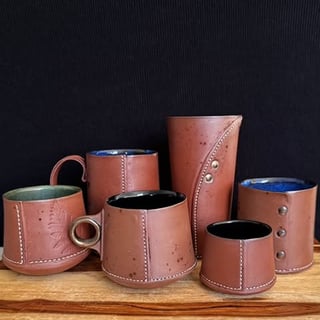
Speaker: I bet it's pretty similar to a lot of potters. We sell a lot of mugs, you know, like you end up making a ton of mugs and I, right now I think I've got five different mug designs, kind of keep on adding on. So my, the one I've made longest, now I just call my classic mug. That's just like a shape that I've done for a while. I've got a tall mug, a short mug.
Speaker: XL mug and then I do these like state mugs for different places so like I brought a couple dozen Wisconsin state mugs since I was in Wisconsin. Those also really well when I was in Minnesota I did some Minnesota ones.
Speaker: Some states are hard to do like Colorado, where it's just like a square isn't isn't really a great state mug shape kind of depends on the state, I guess. But yeah, for me, probably mugs and then whenever I'm making something new, for instance, when I did like a run of
Speaker: uh butter dishes a few years ago like those just sold like crazy or if i did trivets for a while then i sold out of those you know and then people end up having myself will sell them but kind of as i'm releasing a new item uh those can sell be kind of the hot seller for a few months so now you don't have to answer this next question but i'm just genuinely curious how much money did you end up making from your last show
Speaker: That's, that's a good question. That's kind of like, uh, my students asked me that question. I always give them crap when they do, but I know that they're curious. Um, at this, uh, last show it was close to 17 ,000. That is awesome. So now the next thing I thought we'd talk about is your glazes. So you make some really beautiful, awesome glazes. What is your favorite color glaze? Um,
Speaker: I'm probably most partial right now. I've got a powder blue that's just looking extra good and I'm really partial to that. And it's probably for two reasons. One is just, I mean, my favorite color is probably green, but I just love this color blue. But two,
Speaker: It's really hard to achieve that color and part of I think my love for it is the fact that it took me so long to get to the point of it working. Like it's not even just the color it's just it just I know the background story personally of how difficult that is. It just blistered for so many years or
Speaker: just wasn't the color that I wanted. And ever since I recently changed my killing elements and kind of changed my firing schedule, it's just looking really good. So right now that's probably my top favorite color. It's coincidentally or not, I guess it's not the best selling of my colors, although it sells
Speaker: fine. It's not like, like my patina green, I think sells like a crazy amount. But perhaps that's the reason why it's not my favorite is that I end up, I end up glazing a lot in that color. So it becomes, you know, becomes a bit ho -hum for me sometimes if I'm doing a whole load of one color. I look at it like somebody asked me this weekend,
Speaker: do you like pay attention to each pot that comes out of the kiln? And I was like, I do, I try to like give each piece it's due. Like I made, you know, a lot of pieces in a relatively short amount of time, they're just kind of prepping for a big show. And as I'm taking them out, I do look absolutely at every single piece and some I,
Speaker: you know, a piece that's good versus bad varies by the minuscule amount of glaze that I would add. I added a little bit too much and it ran off the pot or I didn't add enough and it didn't have very good drips. There's kind of that, there's this little zone where it can look good. And for me, my challenge is can I get in that zone? And if I do, then I feel really good about a firing.
Speaker: I like that because I'm the same way with when I'm making things, I'm very picky about what I make and if it looks good or not, if I'm gonna keep it. So now the next thing I thought I'd talk about, you obviously were very inspired by wood fired pottery. How has that impacted your pottery today?
Speaker: Yeah, I think a lot of people will probably be surprised to know, I mean, I do put it out there occasionally, but I think you will be surprised to know that I'm inspired by woodfire work because I think my work is now has kind of visually a pretty big divergence from that, mostly with like the colors are pretty bright. But I started doing woodfiring because I met a, I teach at a high school in Minnesota.
Speaker: outside of like the suburbs of the Twin Cities. And I was approached by a guy who wanted to build a wood kiln and do that at the high school. So we ended up building this wood kiln together, fired it for many years with a number of other potters kind of in the area. It's nice to have some help.
Speaker: and fired up with my advanced classes. And as I kept doing this sort of early on in my career, I just loved that each fire and you didn't really know what you were gonna get in those drips of that were just so, I just loved the drips that were coming off of there with the ash kind of coalescing with the glaze. And when I ultimately kind of started doing a switch over to electric firing,
Speaker: I tried to make glazes that could mimic at least that aspect that I really loved in the wood firing. So it really has played a substantial role in my growth and just interest in overall. How long did it take you to kind of find your glazes for the electric kiln?
Speaker: You know, took a really took a really long time. I, at the time wasn't really even. I don't even know if I was even trying to do my own work at the time I so I was teaching and I've been teaching now for, I'll be entering my 22nd year here in the fall so I've been teaching for a while.
Speaker: About 15 years or so ago at the high school, I made this really huge glaze chart, just went through tons and tons of glaze testing there to create glazes for the students.
Speaker: And kind of interestingly enough, I got done with the chart, put it all together, have it up. I still have it up in the classroom just because I really love it even though we use different glazes now. But I learned through so much through that process that I kind of started over and it really inspired me to sort of take that challenge on in my home studio. We use totally different glazes at the school than we do at my studio just because
Speaker: Mine are so finicky and so runny that it's kind of a nightmare, would be a nightmare with like introductory students. But it took me, I mean, I probably tested, gosh.
Speaker: I mean, hundreds and hundreds of glazes to get to this point. And the thing that I think people mistake a lot of times is that the glaze is the most important aspect. And really there's three main keys. You've got your glaze, you've got your application, and you've got your firing. All three of those have to work and coordinate together to really get and achieve the result. So people will ask me, hey, can I get your glaze recipe? And the answer is usually no. But the second response is,
Speaker: Uh...
Speaker: it wouldn't really even matter if I did because I give you the glaze recipe, I'd also have to give you exactly how I apply it and also how I fire it, or you're gonna get such a different result. I just think it only opens me up to having people say, hey, it doesn't look the same. And my answer is like, of course it doesn't, because you're not really doing what I'm doing. You're just doing one small aspect of it. And because they are so finicky versus some other glazes that I have, it just, it really only works in a very like defined way.
Speaker: For those that are gonna be listening to this, you literally have to find what is gonna work for you pretty much. And that's how you're gonna be able to make it work.
Speaker: I think so. I mean, there are a lot of glazes that aren't quite as temperamental as mine. And you could go on to, you know, you could follow different, there's some really wonderful groups on Facebook. There's tons of books out there. I mean, now more than ever. Absolutely. You can go online and I could go on there right now. And partly I know a little bit what I'm looking for, but I could go on there right now and put together a glaze palette today.
Speaker: that would look great. And I only think it would take a significant amount of effort. That wasn't the case 10, 20 years ago, absolutely not. So if you're a, you know, starting out as a potter and you're like, where do I even begin? You know, depending on what firing range you're looking at, find some great books. There's lots of them out there, you know, with cone six or cone 10, depending on what you're maybe firing at or lower temperature perhaps.
Speaker: Find some Facebook groups. There's a lot of active ones. That's really great. And then you just start researching and get some testing in. Fire it under your particular circumstances and how you want to fire them.
Speaker: I agree 100%. So now the next thing I thought I talked about, you get some really cool effects with your glazes, some drips and stuff. Could you walk me through how you're able to get those drips? Yeah, that's a great question. So I think a lot of times people think that the drips are caused
Speaker: by the glaze, and I'll go back to that it's, you know, that it's all three, it's the glaze, it's the application, it's the firing, but that application is such a critical role in this actual glaze drips. So I've got some glazes that will definitely drip more than others, but almost all, I won't say all, but almost all glazes, you could get probably a similar effect to what I'm doing by making sure that you're really applying a lot of glaze
Speaker: in near the top of the plot pot and let that gravity do its work to create the the drips. Now the reason why this doesn't sometimes work for people is
Speaker: If you apply and apply and apply glaze, so you're building it up thick, that can be problematic sometimes with glazing because you end up getting so much water in there that it creates some other glaze issues like crawling is kind of a typical one, or perhaps it could introduce more blisters or pinholes or other kind of other glaze defects. But crawling, I would say, is kind of the main issue with that. So what I do when I mix up my glazes is that
Speaker: I don't mix as much water into the glaze, and I'll add in Darwin 7, which helps disperse the glaze, thin it out a little bit, but it allows it to actually be thicker just on the application. So it will look and mimic that there's more water in there, but there isn't. So Darwin 7 is a really great one.
Speaker: a great additive that I recommend. It's not the same as sodium silicate. People oftentimes were like, could I just use that? You could, I just don't find it nearly as effective. Just a few drops of Darwin 7 really does the job. How did you discover that Darwin 7?
Speaker: Um, it's a deflocculent. And, you know, I just, I'm a glaze and pottery nerd and I just read a ton of books and articles. So just one of those things I came across and I was like, let's give this a try. And I tried it a few times and I was like, holy crap, that works amazingly well. I know that when you are glazing, I know most of the time you spray your glazes. Could you explain to me why you spray?
Speaker: Yeah, that's a great question. So when I started doing my glazing in general, I think like most people, you know, you start with brushing or dipping is pretty common. And don't get me wrong, those you can get outstanding results. And I know lots of powders who do that.
Speaker: The problem for me was that I would make a circular bowl, nice one, and I would do maybe two colors overlapping, and I would get this harsh interior line on there. And I just wanted to have a result that kind of fit more with the work. I didn't want people to know how I was glazing. And I always felt that the dipping method sort of revealed the process.
Speaker: which some people really like they love that you know revealing of the process and they're totally fine with that but I wanted to be able to put glaze exactly where I wanted the glaze to go and at the time I was doing that a couple of my pottery buddies were also spraying glaze and I kind of checked that out for a little bit and all of a sudden I was like oh all right they just sort of
Speaker: opened up that a little bit for me. And then I just kind of started practicing. Unfortunately, I wish I could tell the people listening that it's easy to do or that there isn't a steep learning curve, but you know, you lose a lot of pots at the beginning because it's not like, you know, if you're using a can of spray paint, you can spray it on and if you want it to cover it with red, you know, once it's covered, it's covered, you can see it.
Speaker: but as potters know paint and glaze are so different you don't get that same translation so you have to build it up and you don't get to rely on kind of the beauty of dipping is if let's say you're going to do a three second dip once you have that glaze mixed to the right consistency you know you can kind of
Speaker: fairly quickly go along and dip a number of pieces successfully. So there's some definite great parts about it. You can spray and apply the glaze just where you want. And then the downside is that you never know that thickness. You have to sort of, that's one of those experience things. The more you do, the more you hopefully get, gain success with it. Right. So now I know you, so sometimes you'll add like some textures with like slip. How does that affect the glaze when you do that?
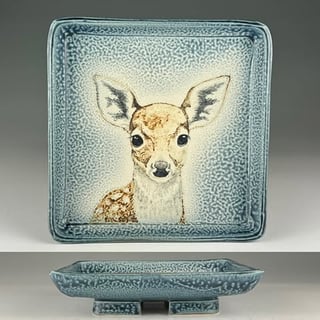
Speaker: Yeah, I can't remember who told me this, but at some point, I remember hearing that, you know, when a piece is finished, it should just look like that was the way it was supposed to be done, where every aspect of it comes together and feels just like a really finished piece. And what I love about slip is that it sort of, you know, it works, I think, really well with my glazes and that it
Speaker: it shows off, it breaks on those lines to show even more details on the piece. And I'm a pretty organized, detail -oriented person, so getting these
Speaker: you know, if I'm using dots or if I'm using slip textures, getting this repeated marks just really fits my personality. So that also shows off those repeated glaze drips. The glaze drips will happen whether or not I put slip texture on there.
Speaker: But if I do put a repeated slip texture on there, the glaze drips will follow that. So it does allow me to create a more defined texture in the piece. Now, if you had to give three pieces of advice that you or three things that you do that you to in order to achieve consistency, what would those be? Consistency in the work. Yeah. So where it's not like being messed up all the time.
Speaker: You have more control over it. Sure. Well, one of the first things is that people will ask me, how do I get, quote unquote, like perfect lines on the work with slip? And I'll tell them that I don't. The reality is that our eyes tend to, you know, if we're making a line and the line comes close to making a circle, our eyes read that visually as a circle.
Speaker: we kind of we fill in as humans this little part we kind of want to I think visually so I would say first of all don't be hard on yourself you know give yourself those leeways for making just human work you know you try the best you can on it like I don't even try to have a like
Speaker: insane amounts of precision on the work. And if you try to pick apart my work, you'll see that there are like little things here. And I'm totally okay with that. And I think it adds a lot of human look to the work, which I think is important. Let me see, what else? Thanks. What was the question? Let me go back to three pieces of advice so that you can control your glaze and like make it how you want it.
Speaker: Oh, right, right, right. So controlling the glaze, I would say, really get a feel for how thick you want your glaze to be. Absolutely number one most important thing. And it's rare in almost any glaze that I'm going to come across, either I have to add in some additives. So if my glaze is running,
Speaker: too thin, which does happen, not in a lot with my glazes, but glazes at the school where if I'm dipping, for instance, I've got like drips that are just kind of uncontrolled on the side, all put in some Epsom salts to just thicken that up just a little bit. And then on the opposite side, if it's too thick,
Speaker: especially if you're using something like a ghursly borage or something like that, those glazes tend to want to need a Darwin 7 in there to thin them out a little bit. So thickness is really a key, getting a feel for that.
Speaker: If you do have runny glazes, kind of number two here would say, I would say, think about putting some little glaze catch at the bottom of your piece, so rather than having the foot just come down to a straight line, maybe have it flare out a little bit at the base and that'll help save a lot of pots and kind of be a cool look on a lot of pieces.
Speaker: And then get a feel for how you're doing your firing. People overfire their pots a lot, and that creates, well, I will say both, they overfire and underfire. Get a sense, you know, use your cones to make sure you're really measuring your kiln, get that thing dialed in.
Speaker: I think now with so many of these kilns being able to just adjust temperatures quick, you know, to program things in quickly, people get used to that and they might just type in Cone 6 and get it fired. But if you're doing Cone 6 with a hold, so Cone 6 is like 2232 degrees.
Speaker: Well, if I do cone six, but then I put a 30 minute hold on it, remember that more or less each minute of that hold will add about a degree to it. So you end up over firing it sometimes by about 60 degrees, which makes a pretty huge difference at that point in temperature, which can create some issues with some of your glazes. So those three here.
Speaker: I think those are awesome pieces of advice like that, like probably will help a lot of people. Now, this is a pretty random question is next one, but if you had to make pottery with anybody in the world, who would that be? For example, I think Clay Thompson from the Golden State Warriors. I think that would be pretty fun just to make pottery with him. Oh, that's funny.
Speaker: Yeah, I didn't think about that. I had seen that quite, I just very quickly skimmed your questions before the show and that was one of them and I thought, oh my gosh, who would it be, who would be fun to make pots with?
Speaker: You know, if we're thinking outside of the pottery world, I think it would be, I would probably want to make pots with Barack Obama. And the reason why is that like, I just love anything he's doing, whether I've seen him like on the basketball, you know, you got me thinking about basketball. But when I've seen him play basketball or anything that he does, he just seems to have a really,
Speaker: just like kind of an authentic interest in things and just, I think, a really fun personality. So I think that he would, I think he would be really okay making a fool of himself, which by the way, he would totally do, because he probably has no experience in it, which is what happens the first time, which is why it's so fun. And I just think we would just have a really good time just kind of talking about, you know, random stuff. And I think he would be okay with making some mistakes and learning it along the way.
Speaker: I think the same thing about Clay Thompson, like that was like almost exactly what I think what I think Clay Thompson. Right. I think it's that personality aspect of people. Sometimes you just pick up on the fact, like the toughest thing about learning pottery, and I tell this to my high school students, I think maybe my toughest job there is that I have to be a cheerleader, you know, with them, because some students or people in general want
Speaker: You know, we're in a world of instant gratification and pottery isn't that not only does it take a while to learn it, but then once you make your first piece, you got to wait for it to dry, then I got to fire it, and then
Speaker: Hopefully you do a good job glazing it, you know, you have to sort of allow yourself to, to not be amazing right away. And, you know, but, but on the other end of it, that's the greatest part of it is that when you do gain some success with it, you know, it feels like a really authentic accomplishment, rather than, you know, just a fake achievement, which I think is also maybe my favorite part of it.
Speaker: But yeah, anyone who's just like willing to just have fun with it, I think is always gonna be a great pottery student who doesn't try to take it too seriously or too hard on themselves. If you can give yourself a break and just sort of just have fun with it, usually you will have fun and that makes it all more fun for the teacher too. I totally agree.
Speaker: So now now that we're kind of like on the topic of student and teaching. So if you had to give advice to your students looking to start pottery as a career, what would that be?
Speaker: Yeah, you know, I've got a number of students I had a couple of students that worked with me last summer. They wanted to do kind of an internship and so we worked together for a few months, which was fun and now they're, they bought wheels and kilns and they're kind of getting started and they'll send me texts, you know, fairly frequently about different questions which is what I'm happy to answer them.
Speaker: Getting started is, I mean, I just remember being so excited to just make that first sale, you know, just kind of, and, you know, I still am, every customer I'm always still really very happy with. Getting started, the biggest key is make good work, you know, make the best work you absolutely can so you feel good about that work going out into the world.
Speaker: Yes, this is how we make a living and it's absolutely critical to my family. So I'm aware of the sales that happened because that's how I paid the bills. But before all that started, I was just really, I didn't try to sell pots before I felt like I was ready to sell pots, before I felt like my work was ready to kind of go out into the world.
Speaker: When I look back at them, I don't think they're, you know, they're not as good as the ones I'm making today, but you'll have that, you know, that's how it all starts. But once you feel like you're ready, you know, seek out whatever venue you can for selling, there's online sales are so different than they ever used to be. You know, when I started selling pots, you sort of had a gatekeeper and those gatekeepers were oftentimes galleries, you know, they were the ones who would sort of pick and choose who they thought were good and who weren't. And
Speaker: or different marketplaces in general or juried shows or things like that. Now it's like, who are the gatekeepers? People are the gatekeepers, fans, people that are on social media, those are the gatekeepers. If they like the work, whether or not it's quote unquote good, doesn't really matter. It's that they're buying that piece and they are the ones who determine whether or not that has value.
Speaker: I agree 100%. I think that's the people that we need to find in order to really sell our pottery. Right. And you don't have to try to appeal to every person. Is it great if your audience is larger? Sure it is. But you start somewhere. You start somewhere and you build from there. So now, as we're wrapping up here, what is one thing that you would like my audience to really take away from this interview?
Speaker: Hmm, one thing to take away from this interview. So I would say if you're looking to get into pottery or you want to better improve your glazes, just remember that nothing can ever just get translated to your one experience. Just be you in your work. Try to be your best representation of yourself rather than trying to imitate anyone else. So that means if you're doing a social media,
Speaker: Have the social media be your personality. Make videos that show off your personality. Share a little bit about your family or what other things you're doing so people get kind of a full sense of you as a person in general.
Speaker: Like when I was at the show this last weekend, I had probably probably 100 people comment to me about how they liked the steps that I built at my cabin, like just totally unrelated to pottery. They're like, hey, just want to tell you. I mean, they always preface it by saying, I'm not a stalker. And I'm like, no, but it's totally fine. I'm putting it out there in the world. It's okay. And they're like, love your steps. And I'm like, it's just kind of fun because you
Speaker: You be yourself in your work, you know, and that comes true to not only social media, but the pieces that you make. Your pieces that you make should look like you, not visually, but be your personality and your stuff. If you do, I think you're going to find a lot more success in the pieces that you make. That is awesome. Steven, where can my audience go and check out your work?
Speaker: So probably the easiest thing is on my Instagram at Steven Showalter Pottery. That's my handle on there. Or I think I changed it to that same thing on Facebook. Or if you look up just my name, Steven Showalter Pottery, you'll find everything you need to know online. So website, all of that. I do an online sale.
Speaker: Usually about every six weeks, I took a little break the summer because I went back to doing in -person stuff after two years. It was kind of, you know, we had the pandemic and we had to switch things up there going online. Thank you so much, Steven. I had a wonderful time today. Yeah, it was great talking with you.
Speaker: We hope you enjoyed this episode of Shaping Your Pottery with Nick Torres. Do you have questions about pottery that you'd like Nick to answer? Send them to us on Instagram at Nick Torres underscore pottery. We'll see you next time.