Transcript
Speaker: If you love pottery and want to take your skills to the next level, you're in the right place. Find your own pottery style right here on Shaping Your Pottery with Nick Torres. Let's get started. Welcome to Shaping Your Pottery with Nick Torres. Today, I am with Emily Bronner with Emily Christine Ceramic. She makes some wonderful pottery specializing botanically made mugs. Emily, welcome to Shaping Your Pottery and share with me one thing that you love to do outside of pottery.
Speaker: Thank you so much for having me. Since I turned pottery into my business, I did have to find some other hobbies outside of that, which I'm sure you had to do as well. So just a couple of my hobbies. I love to read. I've gotten really into collecting indoor plants, and I also love to spend time with my family. My husband and I have two dogs. One of them is a new puppy, so that's been keeping us very busy.
Speaker: that is awesome. So now tell me the story when you decided to quit your job and pursue being an artist. So I guess I'll kind of back it up to when I first started ceramics. So I actually
Speaker: right after I graduated high school, I started photography business. And I went into college to study photography and graphic design, I thought that that's what I was going to do. I loved it. But I got kind of tired of taking all of my art prerequisites, because these classes were six hour week classes, I had so much homework outside of school too. So I was like, Oh, what about ceramics? There's no way they can give us
Speaker: Homework and ceramics. It's kind of seems kind of daunting, but seems kind of fun at the same time. So I took the class enjoyed it. That was my
Speaker: my last semester at my junior college and then when I transferred to my university I just thought I'd take a couple more classes and I quickly decided that that was my path and that's what I wanted to move forward with so for a while I was like my last semester in college was when I started this business so I was juggling this ceramics business I was also working I worked retail
Speaker: It was technically part time, but like about 30 hours a week and I had my photography business going. So that was a lot. So once I graduated in 2020, I kind of decided I did that. It was the right time to make the jump to doing this full time. I was about to get married, so I also
Speaker: I'm very blessed and I didn't have that financial burden that I know a lot of other artists do have. So I was able to quit my part time job.
Speaker: I had just graduated school and then a few months after we got married, we moved out to Texas. So then that was a really natural transition out of my photography business since I was getting so busy with both. I kind of needed to choose and I didn't have that passion for photography that I have for ceramics. So it was really an easy choice and it's such a blessing every day to get to do this full time. When you jumped into this, what was your biggest challenge that you faced?
Speaker: One of my big challenges was a studio space.
Speaker: When I started my business, I was still living at home with my mom. So I was able to kind of get a studio space set up there for the time being in her garage. And then when we moved out to Texas, I was able to get something set up in my in -laws garage while we kind of made the transition of finding a house and getting our house ready and stuff. So that was probably a pretty big challenge. I'm a really big introvert. So having a home studio is really important to me.
Speaker: So getting that set up in our house did take a while, but finally it set up. And then also just finding my style. When I first started out, I was kind of just making a little bit of everything here and there, which there's nothing wrong with. I learned a lot from doing that. But when I was able to finally kind of find my path and hone in on that, that's when my business started really seeing a lot more success because
Speaker: I mean, anyone could get a plain pink mug from another artist, but no one can get the mugs that I make from anyone else. So once I found my style, I was able to kind of move forward from there. So now that we're kind of talking about style, how did you find what you're doing today with making the flowers and all that?
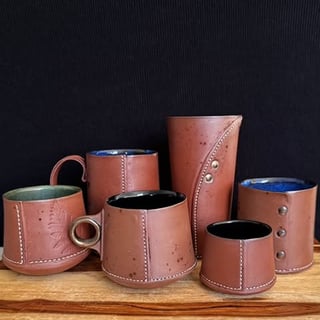
Speaker: So I've had two styles that I've been kind of rotating between. One of them is my bouquet mugs, which has the sculpted flowers on them, and then one of mine is my rustic mugs, which have the carved flowers on them. I don't always do flowers, but that's kind of what inspires me the most, or just anything in nature.
Speaker: So with the bouquet mugs, I'm kind of taking a break from those because they just, they take a long time and I haven't been loving them lately. But when I first started my business, that was one of the very first mug ideas I came up with. I thought, okay, what if I put a flower on a mug that could be really pretty? And then those sold pretty well.
Speaker: And a few months in, I made one for my mom for her birthday with a bunch of flowers all over it. And all of my followers and customers went crazy over that. And I got all my stories and I kind of talked about the amount of time it takes and how much I would need to charge. Everyone seemed really excited. So I moved forward with that style. And then at the same time, I got a diamond core tool, carving tool. And I didn't know what I wanted to do with it yet.
Speaker: I...
Speaker: really like all of their tools. I always thought they're super cool. I was really intimidated to start carving but when fall came around I thought it'd be cool to carve some leaf designs in a mug. So I did that and it kind of just snowballed from there. All of my followers really liked that style where I carved the design in and glazed around the carvings. So I kind of decided that I would make that into a seasonal collection
Speaker: So I went on and did Christmas ones, spring ones, summer ones, and now that has become my main body of work is those mugs. And not all do seasonal ones, but I also have some core designs as well. So could you walk me through how you create your carved ones, your carved mugs?
Speaker: Yes, so I work with porcelain clay and I do cone six. So with those mugs, I throw them on the wheel, trim them, handle them. Once I've done that, I carve in my designs. So whenever I'm doing a new design, I always sketch it out first.
Speaker: because that kind of helps me. I'll kind of draw like the outline of the mug, sketch it on a mug, how it will look, and then I'll also sketch it by itself. And that kind of helps to give me a feel for it so I don't ruin any mugs. I haven't been ruining a lot lately, but in the beginning I ruined a lot. So that kind of gives me a feel for the design and what I want to do, how I like the composition, if I want to change anything. And then once I do that, I can go in and I start carving.
Speaker: And then once I'm done carving, I let them dry, fire them, and then I apply iron oxide to them. So I mix some iron oxide, some red iron oxide powder with water and I do a wash and then I sponge it away so that it gathers in all of the carvings. Then I let that dry and then I glaze them, which
Speaker: I don't know if this is a technical term, but I call it precision glazing. So I go in with a little underglaze bottle that I fill with glaze and I actually glaze inside everything. It's really satisfying. It's kind of like coloring inside the lines, you know, when you're a kid coloring in a coloring book.
Speaker: So that's how I glaze all of them. And then even the white on the outsides, I glaze with that little bottle and then I'll go through and brush the rest on the handle that's top of the mug. But it's a really long process, but I really enjoy it. It gives the mug a really nice texture as well. So why do you use iron oxide to stain it?
Speaker: Honestly, I guess I never really thought about using anything else. After I've kind of shared my process on Instagram, I've had a lot of people ask why I don't use underglaze. To be completely honest, that just never really crossed my mind. And I always kind of worry that black underglaze would stain my porcelain and kind of give it a gray cast. I learned like the process of doing an iron oxide wash in college. So I just kind of
Speaker: decided to try that out once, and I really liked it. I like how it also gives more of a dark brown in some places and black effect in some others. It kind of gives it a little bit more depth, and it doesn't alter the glazes very much that are underneath it, which is surprising because the mug looks pretty red when I glaze it, but the Celadon glazes that I use pop really nicely still. It just kind of gives them a little bit of warmth.
Speaker: So now if you could give me three pieces of advice for someone looking to kind of make pottery almost like you do, what would those pieces of advice would they be? Having really good tools is really important. I don't think you have to have expensive or fancy tools for every step in the process. But if you want to carve, you need really good tools. Shout out Diamond Core tools. I really love their tools. That's what I use for all of my carving because they just
Speaker: give such clean and it really is a big difference. I would say also make sure to sketch out the design first. When I look back at the first couple of mugs that I carved and the last ones I do notice that
Speaker: Sometimes when I do the design at first, it's a little tight. And then as I move through my process, my carvings are a little bit more fluid and I always like that look better. So making sure that that design is kind of sketched out really nicely is really important. And then also just don't be afraid to ruin a few mugs. I've carved through mugs. I've decided I don't like the design I did, but at the end of the day,
Speaker: you can always, when you're in that wet place, you can always start over and it's better to start over than to try to make a mug work that just isn't working. I love that last piece of advice because it holds so true to just pottery and just really anything. If you are messing up, just toss it and just restart.
Speaker: Yeah, it'll take so much more time and at the end of the day, it's not gonna look as good anyways. Like you're gonna tell where you tried to patch things up and fix it. You might as well just start fresh with something that you can make perfect, especially if you're selling it, you wanna make sure that it looks really good for your customers.
Speaker: I agree 100 % of that. So the next thing I thought I'd talk about was something that you had on your website. It's I'm quoting here. So every single piece I create is made with so much love and attention to detail, since I truly believe in the importance of beauty and uniqueness. Could you explain this some more? Yes.
Speaker: So this kind of stems from even my childhood ever since I was young. It was so important to me to be unique and different. I did not like being the same as anyone else. I did not like matching. So having
Speaker: each of my mugs be completely unique I think makes them more special rather than spending all this time to make every single mug look exactly the same. I'll work with the same designs but I never try to make any single mug look exactly the same because I think it actually adds more value to them knowing that this mug right here is completely different than the next one and that's something that my customers also really like just kind of knowing that
Speaker: the mug that they have is not a mug that anyone else can get. Someone else can get one that's a little bit similar, but it may have a different color flower in one spot or just a different shaped petal, things like that. So that's kind of what I meant by that. I think that when things are one of a kind, to me, they're even more beautiful than if I were to make everything exactly the same.
Speaker: I agree 100%. For those listening, it's okay to be different. It's okay to kind of try different things. It's okay to do all those. Yeah, not every single mug has to be exactly the same size. It doesn't have to look like it's part of a set. People are buying your work because it's handmade and they love those little imperfect qualities.
Speaker: I love it so much. So now on the days when you don't really like feel like making any pottery, like you don't feel like doing anything, what do you do kind of get back into the zone of just kind of so you can have that flow of making pottery? So something that I do that is extremely helpful is I actually, I have a whiteboard with a calendar in my studio.
Speaker: So I'll actually write in the days what I have planned to do and that kind of helps me if I'm not feeling like throwing but I know that I have to throw today to be able to meet the deadline that I've set for myself that kind of helps give me that little push to get into the studio but if it's not like
Speaker: Super important for me to be doing a lot of work, sometimes even just cleaning and organizing my studio taking time to plan ahead really helps. It makes me feel like I have a little bit more control over my work, but
Speaker: Sometimes you just need a day off being creative. It's really hard to create when you feel burnt out. So there's nothing wrong with taking off a day here and there. I mean, most of us work longer than eight hour days anyways. So I know I'll make up for it eventually. And sometimes I actually come back to my work with a fresher mind once I've taken that time to kind of decompress and relax.
Speaker: So could you go a little bit further into when you talked about setting deadlines? Yes. So the way that I set my deadlines,
Speaker: With my restocks, there's small batches and my mugs are really intricate. So I try to give myself around a month and a half, sometimes two months to create a collection. I try to overestimate because life always tends to get in the way somehow. So I usually start with the date that I want to have my restock and I work backwards. So I'll look at the calendar, I'll decide, OK, I want to do my restock, maybe not that exact day, but that week.
Speaker: So then I know, okay, I'm gonna need two weeks to glaze. So that means I'm gonna have to have all of my work done by this time. So if that's maybe two weeks out from the day that I'm setting all of those goals, I know, okay, I have these two weeks to have all of my mugs thrown and carved and dry and ready for the bisque fire so that I can start glazing. Glazing is the longest part of my process, hands down. So that's kind of the,
Speaker: It's taken me some time to kind of get a feel for how long glazing takes. I feel like it takes me longer and longer as I do more intricate work, but that's kind of the main block of time that I focus my planning around. That is some great piece of advice. So now, how has a failure or a parent failure led to future success?
Speaker: I feel like in ceramics, there's a lot of opportunities for failure, which can sometimes be discouraging, but it's also really important to fail because when you do fail, you learn, okay, this didn't work that way. Maybe I'll try it this way next time.
Speaker: I wouldn't be where I am at this point with my work if I hadn't failed, if I hadn't made bad mugs in the beginning with handles that weren't comfortable and designs I didn't quite love. It has really helped to shape my work, just kind of moving a couple of steps forward with each batch of mugs I make. If you had to change any like one thing from when you first start a pottery to now, what would that be? Or if there's anything that would be?
Speaker: better handles. My handles were pretty thin back then. And I've learned that because when I when you start pottery, especially throwing on the wheel, it's always like the big thing that the professors and the students emphasize is oh, wow, you can throw so thin on the wheel. So I thought throwing thin and making nice dainty handles was
Speaker: showing off my skill, but I've realized now that it's also important to make sure that mugs are strong. So making strong and comfortable handles is something that's very important to me in my work because I feel like a lot of other ceramic artists don't put as much emphasis on the handle shapes and a handle is what makes it into a mug from a cup. So it is really important and
Speaker: Even looking back at my handles from a year ago, they have improved so much. So I'm excited to see how they'll improve a year from now. I am so glad you said that because that's exactly what I focused on when I was making my blog. Just handles, handles, handles.
Speaker: Yeah, it's really important and people kind of forget it but I don't want to be holding my mug in a weird way with my wrist kind of bent or I don't want to be able to not hold it by the handle because the handle is uncomfortable. You need that if you have a hot drink in it. Gosh, I am so glad you said that. So if you could make pottery with anyone in the world, who would it be? For example, I think making pottery with Tony Robbins would be pretty fun.
Speaker: Oh, okay. So you went non ceramic artists. Okay. So I'd say I'll do a ceramic artist and a non ceramic artist.
Speaker: And the ceramic artist that I love to make pottery with would be Kurt Hammerly because I think his work is awesome. I would love to learn how he makes his molds and how to do slip casting on the level that he does it at because it's just amazing to watch.
Speaker: And then I guess I would probably have to say Taylor Swift because I'm a very big Taylor Swift fan. Although I'm not sure if I would want to meet her because I'm not sure how I would be able to act and conduct myself. But if I knew that I would be able to be level headed and calm, I think it'd be pretty cool to make art with her because her music has also inspired my art a lot. I think that's the best part of it. You don't know. You're going to be able to just kind of mess around a little bit.
Speaker: Yeah, that would be really fun. So if you had to give advice to someone looking to start their own pottery business, what would that be?
Speaker: So back on your handle talk, use your own mugs and use other artists' mugs. That is one of the best ways that you will learn. I know when I first started my business, I didn't want to keep mugs for myself in the beginning because I wanted to sell them and give them as gifts. But keeping my mugs and using them really helped me learn how to make them better. And then also using other artists and kind of learning what I love about theirs and what I can
Speaker: incorporate into mine from theirs has been really helpful. Another really important thing too is to surround yourself with people who are supportive, whether that's family or friends. Being in the art world and being a business owner can be really hard and
Speaker: you need to have people around you that are supportive because there are going to be days where, at least for me, there are days where I don't believe in myself. So when I have people around me, like my husband, my mom, just everyone in my family standing behind me and supporting me, it helps me remember why I'm doing this. And it helps to remind me that I'm not alone in this and I am supported. And then the last thing I would say is to make work that you love.
Speaker: don't make work that you think is going to sell because if you make what you love, it will sell itself. I think, I don't know, it's kind of hard to put into words, but I guess I would say when your followers, I use Instagram a lot. So I'm talking about Instagram in general, but when your followers on Instagram, when your customers see how passionate you are about something and how much you love it, they will want to buy it because they believe in it because they can see that you do.
Speaker: but when you're just making something that you think is going to sell, they will be able to see that you don't have the passion for it and it may not sell and then you're stuck with a bunch of pots that you don't even like. That is some great piece of advice. I love that last one especially. Thank you. What is one piece of advice that you have received that has kind of helped you the most? I can't even say who I got this advice from because
Speaker: When I first started my business, I just started seeing this piece of advice everywhere and it was niche down. And after kind of reading into what that means that has really helped my business because
Speaker: when you kind of choose ceramics in itself is a niche, but I feel like I'm like extremely niche in the ceramics world because my mugs are very, very unique. I haven't seen other artists make work similar to mine. So kind of choosing that niche and
Speaker: I guess like growing in that small little area will definitely help to bring people in because they know that they can't get that work from anyone else. They can't see that work from anyone else. And when I first started out with my
Speaker: bodywork being so broad, it wasn't producing the results I wanted. So when I kind of started honing in on my more intricate mugs, that's when my sales really exploded. I've actually learned that my most expensive mugs that are the most intricate, those are always the ones that sell first. So that's kind of pushed me to go even further into my niche and
Speaker: I guess just kind of expand my designs and make them even more intricate, which is super fun and really awesome to know that there's a market for that. Find your niche and everything will work out pretty much. Yes, exactly. Hopefully. Yeah, hopefully. So as we're wrapping up here, what is the number one thing that you want my audience to take away from this interview today?
Speaker: I would say don't be afraid to try new techniques don't be afraid to fail you're going to lose pots things are going to get ruined, but I feel like every single ruined pot is a really great learning opportunity and.
Speaker: everyone makes bad stuff in the beginning, it's gonna take time. Also don't compare where you are to where other people are at because everyone has such unique journeys and such unique experiences that you kind of just have to step back and focus on what you're doing and do that the best you can.
Speaker: We hope you enjoyed this episode of Shaping Your Pottery with Nick Torres. Do you have questions about pottery that you'd like Nick to answer? Send them to us on Instagram at Nick Torres underscore pottery. We'll see you next time.