Transcript
Speaker: I think that sort of the way that I've approached pottery is more of just an experiment. Everything has been an experiment. And just the logical nature of, you know, my brain likes to understand things on a deeper, deeper level. And I think that getting down to the molecular structure of
Speaker: what is going on in my clay has been a lot of fun.
Speaker: What is up Shaping Nation, this is Nick Torres here, and on this episode of Shaping Your Pottery I gotta interview Sarah Chedlmanich. Sarah makes some really incredible bright colored pottery that is called Nerukumi Pottery. In this episode you will learn how Sarah makes her Nerukumi Pottery, you'll also learn how Sarah treats everything like an experiment and how that has helped her with developing her own voice, and finally you'll also learn about the power of just doing one thing.
Speaker: And there's so much more in this episode. I hope you guys enjoy it. I'll see you guys in. Sarah, welcome shaping your pottery and share with me what is something you love besides making pottery? Something that I love besides making pottery is traveling and experiencing new cultures, new people, new ideas, new experiences. I think that that's something that's really helped me keep my mind open and keeps reminding me that my way is not always the only way.
Speaker: to do things. And so I love doing that. I love that. Shaping Nation, there's always a different way to do something. Sometimes just about maybe getting out there and looking for a different solution. I love that so much. So tell me a story how you got started making pottery. Well, I kind of accidentally fell into pottery. I've been doing art for a really long time, but I was painting and collage work.
Speaker: had a lot of different mediums I was working with and for some reason pottery just never really came into my world until my son was taking a wheel throwing class and he was 10 and we moved to a new city and they didn't offer wheel throwing classes so for his age so we had to drive to Boulder to a place called the art lab which is an amazing place and they offered
Speaker: They offered wheel throwing classes for kids and we drove up there so that he could take that class. But it's about a 35 minute drive from my house. So I didn't have time to turn around and go back and then go back and pick them up. And so my daughter and I would stay and we just did this little fun pottery class and the teacher let me grab clay and just start playing with it while my daughter was doing her class and.
Speaker: Before I knew it, I was just, I couldn't put it back down. So I didn't even mean to pick that up as an art form, but once I did, I really enjoyed it and I kind of couldn't stop experimenting with it. I love it so much. So in college, you were a math major. Can you tell me about the moment when you decided to focus more on art and pottery?
Speaker: I, it was my freshman year and I took a photography class and that kind of did it for me. I just absolutely loved it. And I think I've always really been good at math. I'm really good at logical things. I was a programmer for a really long time. And the backend logic is something that I'm good at, but what I really enjoy doing is, is art. And so.
Speaker: Yeah, that kind of started pulling me further and further away from math. And it's served me well in my life because I've been able to do both analytical things as well as creative things at the same time. And so it's worked out well. So how did your experience being a math major, being good at math help you with your own pottery? So I think that sort of the way that I've approached pottery is more of just an
Speaker: everything has been an experiment. And just the logical nature of, you know, my brain likes to understand things on a deeper, deeper level. And I think that getting down to the molecular structure of what is going on in my clay has been a lot of fun.
Speaker: And it's something that I really enjoy understanding is what's going on with my clay, what's going on with the thermal dynamics of the heat work and the kiln to my clay. And I think on one level that's been really, you know, sort of a driving factor is just sort of figuring this thing out that
Speaker: isn't as straightforward as something is painting where when something goes wrong, I can just paint over it. But when something goes wrong in ceramics, it's just, it's gone wrong and you've got to figure out exactly why. But I think also I've always been intrigued by patterns, patterns in math, patterns in nature, you know, Fibonacci sequences. And I think that plays a lot into the
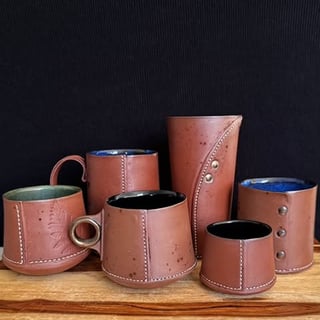
Speaker: patterns of my narikomi. I love that so much. So let's talk about your pottery. In one sentence, can you tell me what you make? I make functional narikomi porcelain pottery. So can you explain to me what narikomi pottery is? Sure. Narikomi, that's a Japanese technique or Japanese word, narikomi. And it's basically just making
Speaker: patterns out of colored clay, and you make them into a huge block, and then you slice off layers of those layers of the clay to reveal the patterns, and you build from those layers. So coloring the porcelain and forming them wet into layers, into patterns, I mean, and then slicing those layers and revealing the pattern.
Speaker: I love that. So tell me a story how you started making this Nerakomi pottery that you make today. I don't really trying to think of when this actually started. I think I was just inspired by someone and I just sort of experimented on my own there. I haven't experienced a whole lot of resources in learning about Nerakomi. I think that there I'm finding more
Speaker: today now that I've done a lot of experimenting and failing on my own, but it was just an experiment. I just kept experimenting and, oh, that went wrong. Okay, why did that go wrong? Okay, well, that worked. Why did that work? And so it was just sort of fun. Just sort of played with it. Yeah. It just kind of came to be, I don't know. So when you are experimenting with your own pottery,
Speaker: What are the questions you were asking yourself that maybe will help you with the experiment? Well, usually when I'm experimenting with my pottery, I know what has failed in the past. So I know what I'm experimenting with, whether it's a new type of clay or I recently just did an experiment with a houndstooth pattern. And a lot of my pieces are, you know, you can
Speaker: push them all together in a way that it doesn't matter whether or not your pattern gets a little slightly warped. But this one I wanted perfect. So you have to experiment with, OK, how much can I push it in on each side without losing the pattern? And you want the air bubbles out, but you don't want it to warp at all. So I would say that with this particular project that I was just experimenting with, how much can I not compress it?
Speaker: before it failed on me. And I got a lot of failure on that one. So I learned a lot. I love that shaping nation. That is shaping nation. The best thing for your pottery is to experiment and to keep failing so you can learn more so you can start making some awesome pottery. Yeah, I love that so much. So you are inspired by bright colors and patterns. Where did you love for colors come from?
Speaker: I've always loved pop art, and I've always been drawn to bright colors and went in my paintings. Before pottery, I would do a lot of really bright, stark colors placed next to each other. I love the colors of Palm Springs. I don't know, I think it just makes me happy. Bright colors make me happy, so I like to surround myself with it.
Speaker: So now can you walk me through how you get all the bright colors and patterns into your own pottery? Sure. So I start by taking a porcelain clay that I use and I'll dry it out completely. I know a lot of people like to put colors into their wet clay. I just, my wrists don't like it and I just don't enjoy doing that. So I'll dry my pottery out completely.
Speaker: And then I will rehydrate it with the colorants with it. So if you just add a little bit of Mason stain to it and let it completely rehydrate. And then I blend it up with an immersion blender or a nice little Amazon basics immersion blender and then put it out on a plaster table and let the water reabsorb or absorb out of my clay again. And then I wedge it up and then I've got that color.
Speaker: And what does the actual process look like when you are, are you like wheel throwing, hand building? What are you doing? I hand build. Yeah, I hand build everything. So I'll hand build the pattern and then slice it off and I hand build all my pieces. So why did you decide to hand build rather than throwing the wheel or do something other than pottery? I don't want it to be too marble.
Speaker: And so when I'm throwing it on the wheel, there's just a tendency for it to smear and mix in with the other colors. And I just wanted something that was super stark, very patterned, and more illustrative in nature.
Speaker: I love that. Shaping Nation, you don't have to be worried about doing one thing. If you want to do hand building, you could do hand building, especially if that's going to give you the design and the techniques that you actually want. I love that. Sure. So let's talk about the business side of pottery. You call yourself a full -time potter, but at the same time, you're also not. Can you tell me more about that? Yeah, I can. So I'm a full -time mom. And so that is my number one job.
Speaker: taking care of my kids and I've got two dogs and my husband works a lot. So it falls all on me, which is fine, but that is my number one responsibility. And it takes a lot of time and some weeks, maybe I won't get to pottery at all. And another weeks I have a lot more time to focus on it. So yeah, I would say I'm full time in the time that I have and I am, but yeah, it is second priority to all my other priorities.
Speaker: You know, it's a great way to spend my little moments of time that I do find in the week. So what, so you are obviously very busy. Your mom, you have a lot of dogs, your children and, and pottery at the same time. What are you doing to help you kind of balance everything together? It's really hard and it's really hard with Narikomi because Narikomi is probably, it requires so much more time and patience than any other
Speaker: stock pottery that I tried before Narikomi. It's so finicky and it's just so prone to, you've really got to baby it. You really have to watch it along the process. And so I've had to come up with a lot of different techniques just to be able to help me pause in the middle of something, which was my, probably one of my hardest struggles in the beginning is that when something comes up, I just have to walk away immediately. And that's just the way that it is. And so.
Speaker: Nerakami doesn't always love that. And I also live in Colorado, which is unbelievably dry and there's no moisture in the air. So within, you know, five minutes, I might have a piece that went from totally fine to completely cracked. So you really have to watch out. So I think that just coming up with some techniques to be able to help me pause and not, you know, mid, mid, whatever I'm doing, pause,
Speaker: and walk away and come back when I need to has been really helpful. And I think another thing that I do is just telling myself like just at least one thing a day, one thing every day, even if that means walking into my studio and cleaning it up so that the next day I'll have time to do some more work. You can just do one thing a day, you know, eventually you're set up where when that time does come, you can really get in there and make some stuff happen, so.
Speaker: I love that so much. Shaping Nation, the easiest thing that you could do is to simply try to do one thing, whatever it is. Maybe it's wedging clay, making something, cleaning the studio. Just try to do one thing because that one thing is going to stack on another and another and another and then you're eventually going to touch it all the time. I love that. Yeah. So you mentioned finding a way to pause what you're doing. Can you give me an example of that?
Speaker: Sure. So I think sent for my own personal pottery, you know, just having an abundance of dry cleaning plastic sheets around all the time. I also have a lot of wet pillowcases or wet cloth. I'm able to wrap around my pieces that can be just a little bit moist or I can have a moist little area with the dry cleaner sheets. And as long as I can cover, cover, cover everything really, really well.
Speaker: And make sure that it's moist inside that covering. Usually I can pause and walk back, but I, in the back of my brain, I know how much time I have. I know that it's like, you know, it's borrowed time. I don't get back in there at a certain point that it's, you know, all the work before then I'll be gone. So yeah. I love that. So.
Speaker: We kind of got a little off track with the business side of it, but we're back on it now. So what would you say has helped you the most with being able to sell your own pottery? I would say it's really just the internet and social media that we have right now has really helped a lot because I don't have the time or the space in my life right now to go to a market for an entire weekend and sell my stuff or really invest in the
Speaker: tables and everything that's required to sell at markets. So I sell online and that's really helped me a lot because I can manage both parts of my life. I can kind of fit it all in there. So. So if you were to like, if you were somebody that is just new to social media, what would you do to start being able to sell online? You know, I would probably
Speaker: If I had it to do all over again, I might consider doing a place like Etsy or something. I know they take a higher commission than a lot of places, but I think it's a pretty low pressure place to sell your work. That doesn't require all the backend of building your own website and, you know, paying the monthly fees for a, you know, for your own storefront and
Speaker: I would just do something on a smaller scale like that just to get started, get yourself out there, get understanding how your shipping is going to work and just your packaging and what you want to do. Start small. So now what advice would you give to someone that is looking to start selling their own pottery? Start selling their own pottery. I would say, I would say don't rush it.
Speaker: You know, like don't, don't be in too big of a hurry to sell your pottery. Give yourself time and space to really understand your work and what you want. And, but, but when you are ready, I don't know, just sign up with Etsy or I guess Instagram has a nice little thing you can do through Facebook and just put a couple pieces out there, give it a shot.
Speaker: I love that so much. So let's talk about discovering your voice. You contributed growth as an artist to being involved in art communities. Can you tell me more about this? I've been involved in a lot of art communities for a long time. I owned an art gallery about 20 years ago. And we were just part of a huge art community. And we all I don't know you just it's so great to be around other artists and
Speaker: learn and just bounce ideas off each other. I just feel like the energy can be just a nice creative electric space when you get a lot of creative minds together. And so that's something that I've always really enjoyed doing is finding art communities and even if it's different styles of art, even if it's different types of creativity, writers and
Speaker: I just, I really enjoy being around other creative people. So that's, it's been just part of my life for a long time. I love that so much. So what can people start doing if they want to get involved in their own art communities? I think that, you know, social media has been a pretty powerful way to find art communities without even having to leave your home. I think, you know, the
Speaker: the what social media has brought to the table is both pretty powerful and it's also, you know, it's a bit much. So I think that if you don't have any obvious art communities that social media is definitely a great place to start.
Speaker: I love that. Definitely agree 100 % shape nation. The easiest way to start connect with people, get on social media, maybe start asking questions, connect with other people that way is much easier that way. I love that so much. So now what advice would you give to someone that is looking to discover their own unique voice with their pottery? I'd say take breaks from as much as I'm saying social media, take breaks from social media. And I think that you can feel like you're supposed to be someplace else
Speaker: than where you're at right now and give yourself a little bit of space without outside influences to just understand exactly what it is that inspires you and what you want versus what you're being told is what is the right thing to be doing or what would be successful or anything like that. It's just good to take a pause and figure out for yourself what makes you tick.
Speaker: I love that advice. Some excellent advice right there. So as we're coming to a close here today, what is one thing you want to hammer home with my audience today? Be patient in your journey. Just be patient. I think that sometimes with the way that social media is, it makes you feel like you need to be someplace that you're not. And it's really nice to take your time with pottery as a journey and understand all that it's
Speaker: little, be there for all the bits and pieces of the journey and really just enjoy the process along the way. Enjoy your, enjoy your journey on the pottery. Definitely agree. That was some excellent parting words of advice. Sarah, it was really great challenge today. Where can my audience go and learn more about you?
Speaker: you can go to my website which is chattawanich .com and that's C -H -A -T -A -W -A -N -I -C -H .com or chattawanich .ceramics on Instagram. Thanks for listening to this episode of Shaping Your Pottery with Nick Torres.
Speaker: If you want to start discovering your own unique voice, you must first start with the right questions. That's why I put together a free 15 question booklet for you to start discovering your own unique pottery voice. All you have to do is go to shapingyourpottery .com forward slash questions to get this free booklet.