Transcript
Speaker: Real quick before we get started, did you know that the questions that we asked are going to determine what our pottery is going to look like and it's going to determine what our voice is going to look like? That's why I created 15 questions that you can use right now to start discovering your own unique voice. Go to shapingyourpottery .com forward slash questions to get this free booklet.
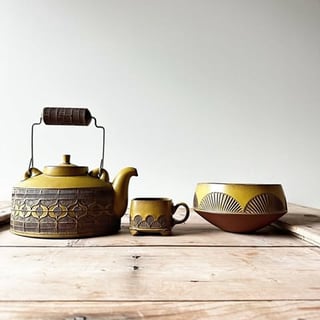
Speaker: If you love pottery and want to take your skills to the next level, you're in the right place. Find your own pottery style right here on Shaping Your Pottery with Nick Torres. Let's get started. What is up, Shaped Nation? This is Nick Torres here. And on this episode of Shaping Your Pottery, I got to interview Mandy Henry. Mandy makes some really incredible, incredibly designed pottery.
Speaker: this episode you will learn how Mandy makes her utilitarian pottery. The power of it just takes one idea to spark the rest ideas to keep them flowing and finally you will learn about how Mandy's time in Japan when she went there twice and how that time in Japan really helped her with her pottery and her work and just as a person in general. Mandy
Speaker: Welcome to Shaping Your Pottery and share with me what is something you believe potters should be doing to have success in pottery.
Speaker: I think potters should always keep in mind that you need to keep people around you, that you admire, especially artists, that's going to help you succeed and have a drive in what you want to do. I also think you need to work really hard because I think your hard work is going to dictate your success.
Speaker: Absolutely. I love, I love being around other artists and other potters. And I feel like that's where most of my growth came from was because I was being around other artists. I love that. Me too. Yeah. So tell me about the moment when you decided to become a full -time potter. I had been working a full -time job.
Speaker: eight to five type situation. And my boss had, he retired in the spring and I thought, you know, I think I'm going to take some time and get back into ceramics and enjoy my summer and take a workshop, a workshop that was a wood fire workshop from Trevor Dunn in
Speaker: at the college that was close to my house in Colorado. And it was a nice program because you had like, I think it was two or three weeks of a wood fire workshop. And after it was over, you got to continue to use the facilities at the college, which was a pretty amazing situation. So after that summer, the professor, the ceramics professor kind of came to me and said,
Speaker: What are you doing? What's your plan now? That semester's getting ready to start. And I said, well.
Speaker: I guess I got to go out and get a real jobby job again, I think was my answer. And she said, you are so prolific. This can be your job. And it was just enough of a boost for me to realize, hey, maybe if she believes in me, maybe I should believe in myself too. So I think that was the moment that kind of turned around for me. And I was like, I want to do this full time.
Speaker: I love that. So can you tell me like, what were some of the difficulties you faced when you were starting to go full time? You know, I second guess myself. I second guess my abilities. You know, and I knew
Speaker: that I was had the fortunate ability to go and work in a fully operational studio every day that had the wheels and the kilns and everything that I needed to make. And I knew that if I was going to do ceramics, that eventually I would have to phase out of that and have my own studio. So, you know, the the difficulties I faced were building a studio. I mean, it just doesn't happen overnight. And then
Speaker: building a body of work that's going to be marketable that people are going to want to buy. Because if you don't have that, you're not going to be able to sustain your studio. Absolutely. So how did you find this body of work that people want to actually buy? It was a process. I'd always made pots. I feel like I've had mud in my life forever.
Speaker: I threw and threw since I was like in middle school. And I look back at that time and I always think that was where my naked pots.
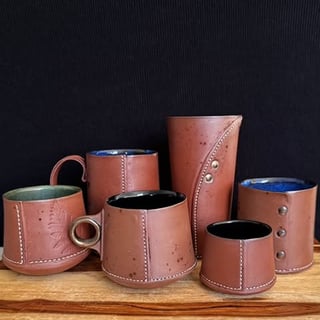
Speaker: because I just want to see pattern on everything. And once I realized that that's what I wanted, and I realized that I could do, I don't like to glaze. I would like to do all my surface design and spend all my time on that and then do a simpler process and glazing. And I think that helped me get to the point where I found a body of work then.
Speaker: that was marketable that I enjoyed making. I mean, you can have marketable plots, but if you don't enjoy making them, what's the point?
Speaker: I absolutely agree. Shaping Nation, if you're listening right now, you don't have to like everything in pottery. If you don't like glazing, then you don't have to go and make some super complicated glazes. Just stick with what you like and that is what is going to help you find your voice and help you market your pottery a lot better. So let's talk about your pottery. In one sentence, can you tell me what you make?
Speaker: I make pots that I want people to use and display. If it's not being in use, that large serving bowl looks nice as a centerpiece on your table. Love it. I think that is a really great mindset to have with pottery. I like that a lot. So tell me the story how you started making your utilitarian pottery.
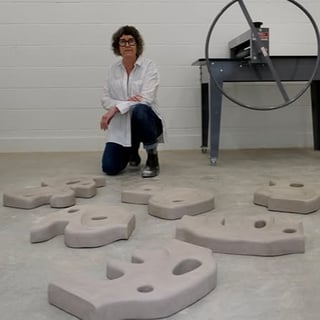
Speaker: When I started making pots, I really had my studio in mind first because you have to think about what kind of space you need to accommodate your needs. Because if you know you're going to have a small studio, then you're obviously not going to be making 500 -pound sculptures.
Speaker: And so I started with the base of my studio and I knew that I was always going to live more than likely in a neighborhood that had an HOA. So I knew HOAs have so many rules and regulations and I wouldn't be able to build and fire a gas kiln or a wood kiln or soda kiln out in my backyard. So I really thought about
Speaker: okay, what do I love about oxidation firing? What do I love about pods that come out of an electric kiln? And the two things that came to mind were the predictability and the colors. And once I got to that point, I was like, okay, I know that firing mid -range is going to be probably where I need to start.
Speaker: And it just kind of grew from there. I love color, I love patterns. So bit by bit, I started incorporating each one of those elements into my work.
Speaker: I think that is really amazing how you use pretty much your own resources of what you're able to do at that time until you are ready to like expand. And I think that is where a lot of people should be like focusing the work as just their own resources and then expand later. So can you give me a simplified explanation of how you make your patterns onto your wheeled drum pottery?
Speaker: simplified explanation. Well I love designing patterns and I start on the computer with that. A lot of the times I'll find a pattern that I really love but I think to myself I can make that better so I always I'll change it up.
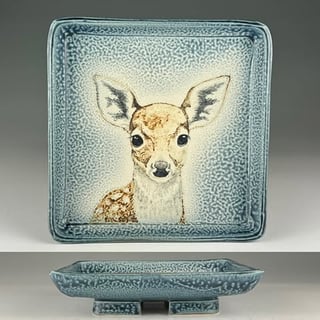
Speaker: I have a machine that will cut my stencils for me, so all my stencils are made in -house. And then once I have my patterns in my stencils, I love throwing at the wheel, so I typically start there, and I try to think about what forms is conducive for putting a flat plastic stencil on. So I will typically wrap the stencil around the wet clay,
Speaker: And then I paint colored clay on top of that. And then the tricky part is now I've created a situation where I can no longer touch the outside of my pot. So what can I do to my pot to not just make everything straight up and down or flat? So I have to be able to shape the pots and throw them from basically the inside out without touching them.
Speaker: But once all the patterns are on, I wait till they're typically bone dry and I go through with a little stylus stick that I got from Diamond Core that I love and go through and clean up all the lines because it's not always perfectly on the surface of the pot. The patterns are, if that... How did you figure out how to put the colored slip around the pottery to make the designs stand out a little bit more?
Speaker: Oh, it was trial and error. I knew that I wanted to somehow get pattern on my pots. I didn't want to be using rice paper. I didn't want to be using like a monoprint technique, although I do dream about that sometimes.
Speaker: But I started out with just, I had a stencil in my box of goodies at the studio and I was like, well, what if I mixed some Mason stain with a little bit of water and like sprayed it on or something? That was obviously a disaster. And it was just basically trial and error. And I think one day I was
Speaker: flipping through YouTube and I saw a video that Forrest Middleton did and he had this way of putting his, I think he does a type of monoprint, I think.
Speaker: but he laid it on the pot and then peeled it off. And then he had this flat desk and then brought it up and it was like just light bulbs going off in my head. Like I wasn't going to copy what he was doing, but yeah, I had like 20 other ideas and it just, I mean, it was just that one little thing that I saw and it just took off. And the next day I went into the studio and did it. It was just like,
Speaker: Light bulb, that's my light bulb moment. I love that. I love that so much. Shaping Nation, all it takes is one little idea to start sparking a ton of other new ideas to make your pottery look even better. All it takes is one, not a thousand, just one idea. I love that so much. So something I found interesting is that you have the ability to visualize in your head what you want your pottery to look like, and you keep making revisions until you get it right.
Speaker: Can you explain this further to me?
Speaker: Oh, it's a weird process, Nick. The only way I can really describe it is it's like I have a plethora of different folders floating around in my head. And in my quiet moments during the day, I'll like grab one of those and decide to start just designing and redesigning. And like, how do I want this pot to function? What do I want it to be? There's folders for new ideas. There's folders for...
Speaker: redesigns, but I will sometimes think about a form for a year or more before it actually comes to fruition. But it just seems to be a better process for me because whatever I can visualize and change over and over is way better than writing it down on paper or trying to sketch it because I can't draw or sketch at all. I feel the exact same way. Yeah.
Speaker: Draw is just so hard for me. I had to like figure out like a new way. And I think I like that way because it like it reminds me of myself. But and a lot of people can't do that. And I think that is really special that you can do that. Yeah, I know what I can see in my head is going to be better than what I can put down on paper. It's just how exactly shaping nation. You don't always have to draw things out. If you have a clear vision in your head, just try to make that vision come to your life from your head. I think that is really special. Like talent that you have.
Speaker: So you grew up on a farm in Wyoming. Tell me how this experience impacted the way you think about making pottery. Um, obviously it's kind of a anymore a different way of growing up. Um, I feel like the objects that we had in our lives were out of necessity. Um, there wasn't an abundance of material things and I, I learned the value of taking care of what you had. Um,
Speaker: I never went without anything, but it was just more of like a way of life, kind of living in a bubble. But I think growing up that way is probably the reason why I make functional pots and not sculptures. And I think that not having anything really fancy in your life, I think that's where my patterns come in.
Speaker: kind of how I look at it. I know I play it in a lot of mud pies. I think it all started there. I love it. That's awesome. I want to talk about your time in Japan, I think, right? You went to Japan? Yeah, twice. So can you tell me about that experience and how that really affected your pottery?
Speaker: was one of those places that I never thought I'd go, but ended up there. And it changed, it impacted my soul. Like just the people and the beauty and how much they value ceramics. And, you know, you go to a restaurant and
Speaker: They bring you your food and there's, everything's mismatched and it's like, here's a wood fire bowl and you're drinking out of a, you know, a, you know me. And you think like, wow, this stuff is really like living on and they're using it. And that is part of their daily life. They're not bringing you these straight white dishes that have food on them. Japan was, it is such a special place to me.
Speaker: my girlfriend was with me on my first trip. And we went to Mashiko, which is the village where Sodi Hamada worked and lived. And we got to the day that we went, it was like the beginning of the rainy season. So it was kind of a slow drizzle. And we took a bus
Speaker: using Google Translate, which was interesting, to the slow village from Tokyo. And it was like we had the whole place to ourselves. And we got to walk through the museum that is the Hamada Museum. We got to walk through his residence and see his kilns and his workspace. And it's just a moment in time that
Speaker: all forever. It just kind of it changes the way you you think about your practices in your own studio. So it was it was a magic moment to say the least. How long did you stay there the first time and also how long did you say that the second time? The first time I was there for almost three weeks. And then the second time I think I was there for almost two weeks. Second time I went with my husband. Yeah.
Speaker: That's a really amazing experience. And how did that help you with like developing your own voice with your pottery? It helped me slow down. You know, I think we get in this mode of, oh, I've got to make, make, make, make for this show. And I've got this and I've got that. And being there and seeing how they just focus on
Speaker: the moment in front of you and how they take their time and how they have pride in everything that they do. It really helped me kind of reevaluate my voice and my practice in my own studio. I definitely agree with that. We have to have pride in our work. And that's how it's going to be get better and better and better if we have pride in it. I love that.
Speaker: So when you were trying to find your own voice, what struggles did you face and how did you get through them? You know, I kind of mentioned before the second guessing, but, you know,
Speaker: Once I did get into my studio, being able to work in solitude is another thing. When you've been in academia and you've worked in a studio setting for so long and you have people to visit with and bounce ideas off of, being able to work by yourself and stay motivated and do your job and do it well, I think that's probably a hurdle for everybody that goes through that transition.
Speaker: So what did you do to kind of get over that hurdle? I made a schedule for myself first. And I treated it just like a regular job. I know I have to be here at a certain time. And this is what I need to get done today and kind of have a schedule.
Speaker: I definitely agree. Schedules are like a lifesaver when it comes to like pottery and pretty much a lot of every other thing too. So what is something you wish you knew when it came to discovering your own voice? Don't rush. Work hard and be persistent and true to what you love. I think your work will come if you just remember those things. It was don't rush, be persistent. And what was the third one?
Speaker: be true to what you love. Like I mentioned earlier, don't be making something that you're not passionate about. So always have passion. I love those. Those are some three really great advice for anyone just to help with their pottery. Now, what advice would you give to someone trying to discover their own unique voice besides the three that you just gave?
Speaker: Learn the rules. Learn the rules of ceramics and learn them really well and then go out and break every one of them.
Speaker: Because I think that, you know, in the process of learning ceramics, I think that we're told like, Oh, you can't do this. And don't do it that way. Do it this way. And I think it's important to learn all of those ways. But then I think it's also equally important to forge your own path and learn how to break all of those rules.
Speaker: Because I know for myself, when I think about some of the things that I was told in high school and it's like, that's not even true. I'm so glad I broke those rules. So I think that that will always help you get to a point to find your own voice.
Speaker: absolutely agree 100 % with that. Shaping Nation, there are certain rules that you must kind of learn with pottery, but you don't have to follow those rules forever. You could break them and find what is working for you. I love the way you said that and explained that. So as we're coming to a close here, what is one thing that you would like to hammer home with my audience today? Follow your passions.
Speaker: in ceramics. If you're going to decide to make pots for a living and that's what you choose to do day in and day out, make sure you love it and make sure that you're proud of what you're doing. I absolutely agree. Mandy, it was really great chatting with you today. Where can my audience go and learn more about you? You can find me on Instagram at Mandy Hanabry Ceramics or you can go to my website at MandyHanabryCeramics .com.
Speaker: Thanks for listening to this episode of Shaping Your Pottery with Nick Torres. If you want to start discovering your own unique voice, you must first start with the right questions. That's why I put together a free 15 question booklet for you to start discovering your own unique pottery voice. All you have to do is go to shapingyourpottery .com forward slash questions to get this free booklet.