Transcript
Speaker: Hey, real quick before we get started, if you would like to find your own theme for your pottery so your voice really stands out and you're not getting bored with making the same thing over and over again, I put together 53 themes for you guys and it's completely free. All you have to do to get it is just go to shapingyourpottery .com forward slash 53 themes. That's shapingyourpottery .com forward slash 53 themes. I'll see you guys in there.
Speaker: If you love pottery and want to take your skills to the next level, you're in the right place. Find your own pottery style right here on Shaping Your Pottery with Nick Torres. Let's get started. Crystal, welcome to Shaping Your Pottery and share with me what is something you believe potters should be doing to make the best pottery that they could possibly make.
Speaker: Thanks for having me Nick. Something that I think potters should be doing to make the best possible pottery that they can is asking themselves why they're doing it. I know what after I left university, my why was very clear when I was in university. And after I left, I found that once I had written down why I was doing it, it really helped me consistently show up in the studio.
Speaker: So what is your why now? That is a great question. My why changes. My why has changed over the years and I'm sure it will, it will change again, but it's, it's my way of connecting with other people in a way that I feel is fulfilling. Absolutely. I think we'll touch on that a little bit later, but for now, can you tell me the story, how you got started in syrinx?
Speaker: how I got started. I had graduated from high school and my parents were very insistent that I go to university and I wasn't sure what it was I wanted to take. So I said, you know, I'm going to apply for Fine Arts. I'm not too sure what else it is I'm interested quite yet. And so after applying into Fine Arts, you need to complete a 3D course.
Speaker: and it was either sculpture or ceramics. So I took ceramics. And I know from listening to other people you've interviewed, it was the same for me. I feel as it's been for other people where I just picked up clay and it just was fascinating. I respond so well to things I can build versus more two -dimensional ways of expressing myself. So it was just, I touched it and I couldn't believe I could build objects.
Speaker: Absolutely love it. What experiences helped you with growing as an artist?
Speaker: So this one was fairly easy for me to think about when I was deciding what really helped. And hands down, it was convenient. I don't know, the Winnipeg ceramics community is very supportive and we're all pals and we all talk to each other. And whenever we end up getting together or talking on social media, it's always, how did that kill mode go? Or what's that glaze?
Speaker: you always want to do justice to the medium. So it's almost like this little mini competition, but not quite competition, where we push each other and we ask questions about each other's work because we want everyone to be successful and make really good pieces.
Speaker: I absolutely agree with that. I have a friend that he would make pottery with me as well. And like, when we were doing it together, that's when like, I feel like growth was really happening because we were doing it together. We were bouncing ideas off each other. I love that a lot. So let's talk about your pottery. In one sentence, can you tell me what you make? I love this question. I make functional sculptures which seek to harmonize opposite ideas.
Speaker: Ah, very interesting. So can you tell me the story, how you started making these functional sculptures? It's been an evolution. When I discovered Clay in university, you learned to throw on the wheel. And of course, I was very interested in that. And I remember there was another student who, her name was Nova, and she was hand building. And I remember seeing some of her work
Speaker: come out of the kiln and I just was fascinated by these objects that were not real thrown and trimmed. I just responded to the shape. And so I started Slab. And from there, it turned into my interest in texture. I feel a lot of people as well who work with clay get very excited about how clay can receive any imprint you put into it.
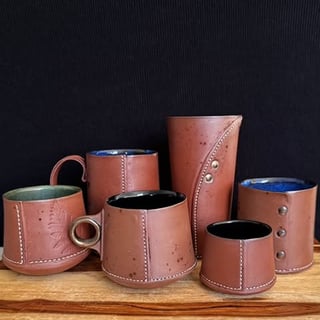
Speaker: Because I was working with soft slabs after I would stamp the clay and build shapes, cylinders, which I would turn into mugs and bowls. I make functional sculptures. I would push and pull the clay and it would further change and distort all of that texture. And I was really interested in watching how the clay moved and responded and changed this imprinted surface as I would touch it.
Speaker: So I went through phases where I would stab different things into the...
Speaker: So that's always been a part of my process that I really love and has gotten me to the pieces I'm making now with the texture on the bottom that I'll distort and the smoother part on the top, which I can push and pull out. Absolutely love it. That's super fascinating. I can't wait to learn about it some more later. You are inspired by lots of things, but one that I want to touch on is you are inspired by your feelings. How does this come back into your work?
Speaker: So I love this question. You're so good at finding questions for people. No one has ever asked a question about my feelings and my work. But after I read this, I was like, yes, all of my feelings are in my work.
Speaker: So how does this affect or come into my work? I like feeling extremes or recognizing when I have feelings what they are and not trying to hurry through them. For instance, you know, if you're sad or you're not feeling so great, just that's okay and you're not your feelings, but it's also a part of life. And on the opposite side, when you're having a really good day or you're doing something and it's a lot of fun,
Speaker: I always think I really need to enjoy this because it'll be over. So it's these two opposites that I think coexist in everyone and bringing that into my work is really the two different surfaces up against each other.
Speaker: You know, and that's one representation of what the surfaces mean, but just that idea that you are not one thing all the time and you can be and feel two different things and just to really enjoy, enjoy whatever those feelings are. Now you mentioned so like the opposite side of where you maybe one day you're feeling bad and one day you're feeling happy. What does that look like with your pottery?
Speaker: So this actually ties into another question about what advice would you give someone trying to add feelings into their pottery? So how I bring that into my work is straight lines make me feel sad. And I, for instance, and I know that. So
Speaker: if there's a part of my work, and I'll use a straight line in it, that's what it's communicating. So if you have shapes or colors that you associate with different feelings, I'll usually jot down some things and that will come out in my work. So exuberance and joy and happiness, it's
Speaker: curvy lines and bright colors and a surface that is layered and it's thick and it's loud. So all of those formal parts of drawing or of art give me these feelings. Sometimes if you're feeling quiet or shy or you know you're tired, those surfaces can be muted or a little bit drier or a little bit more rough. So
Speaker: these things come out in my work in that way. Absolutely love it. Shaping Nation, how can you add your own feelings, whether if you're feeling sad, mad, happy, over ecstatic, whatever it is, how can you add your feelings into your pottery in a way that makes it truly unique for you? I love that so much.
Speaker: Something I found interesting is you like to leave small reminders of yourself through irregularities in your shapes. Can you explain this to me how you do this?
Speaker: So with slab building, there's different ways you can work with slabs and templates. And there's different stages of the clay that you can use to your advantage. So if you want shapes that are more static or straight or
Speaker: I kind of like hold their shape. You'd wait for the slab to be a bit drier so it doesn't move around when you try to stand it up into what you're making. I like to work with slabs when they're wet, wet, wet. So when I stand them up into different shapes, I can take my hand and push and pull out the walls. And this leaves me with perfectly imperfect roundness where you'll look at it and you can tell it's round and I make an effort to keep the shape
Speaker: pleasing 360 in a 360 view so I'll turn it as I'm making it to make sure each side looks nice but it's not perfectly round so you can see spots where I've pinched it or the rim is a little bit taller.
Speaker: or the texture on part of a mug would go up a bit higher, so I didn't push out the top as much, so the rim dips down. And I feel when after they are finished and they come into the kiln, I'll test picking them up or holding them, envisioning when someone else uses them, they'll be able to touch and pick up and hold where I actually touched during the making process. And that's another
Speaker: That's another way to connect with whoever's gonna end up using my work. I absolutely love that. Shaping Nation, you don't always have to make the most perfect pottery. You can leave those little mistakes that you guess you could say. You can leave them in there and that's gonna show your feelings in your pottery. It's gonna show your own personality in that. I love that so much. Now, can you give me a simplified explanation of how you create your functional sculptures?
Speaker: Yes, so I roll out all of my slab by hand. I eyeball it for thickness, which I'm fairly good at at this point. And then I'll measure out whatever size of shape I'm making, whether it's a bowl or a cylinder to be a mug or a cup. I'll cut it out and I'll have a cylinder. And then to add all the texture part, I take a piece of wood and I hit the clay when the clay is pretty thick.
Speaker: And then I'll heat gun it to seal in that surface. And then I'll take that textured slab and throw it out and throw it out. So you start to get these cracks. So it looks like tree bark and soil is what a lot of people see whenever they see my work.
Speaker: And so by hitting the surface with the heat gun, you'll have some really dry areas. And then as you pull out the slab and stretch it out, the underneath softer areas kind of come through. So you get this abstract texture. And I'll cut out part of that and attach it to the bottom of a mug. And I will push out the top using my trusty red rubber rib by Mud Tools. That's hard to say.
Speaker: Absolutely love it. That was a great explanation of that. So let's talk about finding your voice with your pottery. Can you describe to me the moment when you knew you found your voice?
Speaker: Eureka, I don't know if there was an exact moment. Well, no, you know what? This is interesting. Maybe there was. I had been making work in school and using, there was a wood kiln that we were able to use. And so all of my work was made in the wood kiln. And I have a little catch where the texture meets the smooth part and it's a ledge.
Speaker: And so this ledge would catch all of the ash that would come through the wood kiln and make the top lays drip down further. So it would have this luscious top surface. And then the bottom would be the texture part, which I wouldn't put any glaze on. After I left school, I just had an electric kiln, a cone six electric kiln. And I struggled for a really long time, five years or so before
Speaker: I ended up figuring out how to use cone six glazes in a way that would compliment my work. And I remember pulling out a mug, and this was the first time I had layered, I think there was seven or eight glazes, all in a thickness of three to four glazes on top. And I pulled out this mug and thought, okay, we're getting somewhere, fine. I absolutely love it. That is really amazing. I love hearing those stories.
Speaker: What were some of your struggles outside of trying to master that technique that you faced when you're trying to discover your voice? Struggles. And I don't know even now if that was a struggle, but I always felt like I needed more time or I would discover something that I had made from a batch of pots and I would really like this one.
Speaker: And I would also really like a different one for different reasons. And I would want to experiment with these two different ways to see where they would go. So I always felt like I was moving forward and taking the best part of a previous pot and trying to repeat it or dig a little bit further into that detail. But even now looking back, I'm just like, oh, there's so many different paths that I would have liked and maybe still will explore.
Speaker: Sometimes I wish there was 10 of me. Absolutely love it. Definitely. There's definitely a lot of steps and sometimes it's like you got to focus in on a little bit so that you can actually make your voice come to life. Yes. What would you say has helped you the most with discovering your voice?
Speaker: What has helped me the most with discovering my voice? I spend a lot of time alone by choice. I find I do my best thinking when there's no other energy in the room. So I have a really good intuition and sometimes it's hard for me to hear that intuition if I'm around other people or
Speaker: or influenced by other people. So I walk a lot and I'll do some of my best thinking there or even just spending time like in the studio before I start making alone, just thinking about a couple of things. Because I know when I've trust my intuition, when I have trusted my gut reaction in the past, it's led me to something that I am very excited about.
Speaker: Absolutely reshaping nation. Sometimes you just have to trust that little feeling in your gut. You have to trust and go after it with your pottery because that's where more exploration, more how your pottery is going to evolve further with this. I love that. Now, I think one of the hardest things with finding your voice is boredom. What is something you do to kind of hear boredom a little bit?
Speaker: Oh, something to keep things spicy. Well, I have anyone who makes functional work usually makes more of it because then someone who would work on one large sculpture for a really long time. So I tend to have two different phases. There's the, you don't have to think just do phase. And then there's the, okay, you really have to think this is new, this is experimenting, this isn't working.
Speaker: Kind of phase and so usually, you know, if I have something coming up where I need a bunch of work.
Speaker: I'll like trusty like podcasts or some music, something that I can just enjoy and kind of find a flow state and just make. Because when I'm making a batch of mugs, I'm not really thinking of anything new. I just need to physically show up and go through this to get these pieces done. So I think distraction. I don't know if that's a good or a bad thing, but when I'm in that phase, I'm like, okay, I'm gonna listen to a podcast. I'm gonna listen to some music.
Speaker: do I'm not making something or discovering something new versus the exciting part sometimes is like okay today there's no expectation in the studio I've really wanted to make this flower vase form and I thought about it in my head but I don't know if it's going to work out so today it's just like
Speaker: permission to do whatever. And if it doesn't work out and you leave with nothing at the end of the day, then that's okay. So I think spicing it up with those sessions of just allowing yourself to play and try these new ideas really helps. Absolutely agree. Shaping Nation, it's really important to just give yourself time to play and have times where you're strictly working. Play and work are definitely two things that help you find your voice.
Speaker: As we're coming to a close here, what advice would you give to someone trying to discover their own unique voice with their pottery?
Speaker: I think it's good and it fosters a healthy kind of like you're like a healthy sense of discovering something new or trying to push yourself. But I think you need to decide what success means for you.
Speaker: and focus and focus on, on that. And success can mean different things for different people. And I know for me, sometimes when I get carried away and I see all of this stuff happening and all of these amazing opportunities that I just want to say, yes, I go back to like what success looks like for me, which is different for everyone. So if you, if you kind of go back to what does success mean for you, then
Speaker: you'll be able to stay on your path and really make the best work because you're not being distracted by all these opportunities that you might not need to help you grow. Absolutely. Shaping nation, sometimes we have to say no to certain things and just really focus in on what we believe success should be. I love that last piece of advice. Crystal, it was really great sharing with you today. Where can my audience go and learn more about you?
Speaker: Yeah, thanks, Nick. It was great. I was nervous, but I think that went okay. My website, which is crystalnicolic .com, and as a lot of people are, I'm more active on Instagram, so cnicolic underscore earthshaper. I post, well, more on there. Thanks for listening to this episode of Shaping Your Potter.
Speaker: If you are struggling with finding your own theme for your pottery so that, you know, you are known for something, I put together 53 themes that you can use and you can take. All you have to do is go to shapingyourpottery .com or slash 53 themes. That's five, three themes to get these 53 themes.
Speaker: It's really important for you to find a theme for your pottery so that you're not going to get burnt out. You can have multiple styles with your pottery and you can be known for something. So again, go to shapingyourpottery .com forward slash 53 themes. That's five, three themes to get these 53 themes. Thanks guys. I'll see you guys next time.