Transcript
Speaker: If you love pottery and want to take your skills to the next level, you're in the right place. Find your own pottery style right here on Shaping Your Pottery with Nick Torres. Let's get started.
Speaker: What is up, Shaping Nation? This is Nick Torres here. In this episode of Shaping and Pottery, I got to interview Constance Stotzer. Constance makes some really incredible canvas pottery that she paints and adds some little tiny sculptures onto there. In this episode, you will learn how Constance makes her canvas pottery. You will learn about the power of just figuring things out and just problem solving.
Speaker: And then finally, you will also learn about making a real world experience and adding that into your pottery. Constance, welcome to Shaping Your Pottery and share with me what is something you believe potters must be doing in order to have success in pottery. I've been giving this a lot of thought and listening to your other podcast episodes.
Speaker: I feel like there's a running theme with people exploring play and practice and exploration, but I think that a lot of things that I focus on is also problem solving and working through that with trying to find success in your own pottery. So can you explain to me what that problem solving might look like?
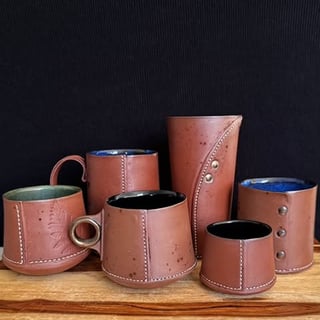
Speaker: the way that I tackle my work is there's something that my brain is chewing on. Um, I was just, uh, explaining to my students today about how the way my cup form came about was because I really liked the one angle and problem solving. How do I get it thin to get that extreme angle, but not have it collapse in on itself? And then,
Speaker: Um, there's the trapped weight in the corner. And so I kept feeling like I was failing at that. And so it was problem solving. Like, how do I get what I want? And so the forms kept changing and the techniques kept changing and evolving. Um, until I felt like, you know, I nailed it. And then there was always a different problem that you just keep beating over the head and experimenting with and exploring.
Speaker: until you've kind of fixed that problem, now you can tackle another problem. And sometimes throughout pieces, you're tackling texture and design and how you want the foot to be and not just the overall form of it as well. I feel like there's lots of problems that you're solving along the way. I love clay just because I feel like there's so much, and art in general is creative problem solving. I definitely agree. I love that answer because
Speaker: Even though it's the first time I've heard it on here, I have always approached my pottery with the same way of trying to problem solve so I can make it either easier for myself or make it look better. And I love that so much. So can you tell me the story about your involvement with the foundation of clay arts in Vegas? Clay Arts Vegas.
Speaker: Yes, I was asked to be a part of a group of potters that were interested in forming a community and a resource here in Vegas at a time where there was only two other studios.
Speaker: There was just a group of us that really wanted to have a community. And so I was part of that in the construction and at the beginning I was involved with the social media, building that up. And then it evolved into me being a studio assistant and a teaching assistant there.
Speaker: Um, Clay Arts Vegas has a store, a studio, a space, and a gallery. And so I got to learn kind of all the different aspects. I came from a retail background, so I got to help with, you know, the stocking and inventorying, as well as, um, while there, I got to hone my skills as a potter. Um, and Clay Arts brings in visiting artists, so I got to, um,
Speaker: learn all the different things from the visiting artists as well and got to experience that. I don't know. What else did you want to mention to that? That was pretty good. That was pretty good. What is something that you learned there is time that really helped you grow as an artist? Like I said, the visiting artists and the techniques and things that they bring in,
Speaker: I, as a teacher, am always interested in how other people teach. Right now, once a month, we have a group of ceramic teachers in my district that have been coming together and every time we've
Speaker: different teachers have been hosting at their school, and we've each been doing a wheel demo. And everybody does it differently. Everybody throws, but everybody does it slightly differently, and everybody explains it slightly differently. So having those visiting artists come in while at Clay Arts, my teacher brain would go, ooh, that's a great way to describe it. But also not only,
Speaker: learning how to teach it, but also learning how to do it. I know I keep referring back to all my teaching stuff. I got to have that practice and play. I never was a thrower. I took, I was a ceramics major in college, but it was sculptural at that time. So I really got to learn how to throw and just more of the functional aspects that you can add to
Speaker: doing pottery with hand building. I love that. That was a really great answer. I love that. You are also learning as well and trying to incorporate into how you teach. I love that a lot. Can you tell me the story how you started creating your ceramic canvases? My background is I came from a 2D background of drawing and painting right before I started taking pottery classes again.
Speaker: I was doing color pencil drawings and watercolors, but I'm creating it in a diorama, in a like a framed picture frame. And I was cutting out the paper and then curling the edges to make it look more three dimensional. So taking that idea of trying to take my 2D work into a slightly 3D aspect. And now I make 3D work.
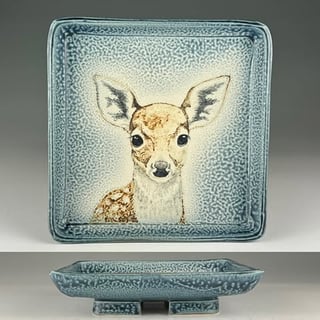
Speaker: and now I'm putting my paintings on it. So I'm trying, that's the problem that I'm trying to solve right now is how do I take my 2D and make it into 3D? And there's so many different avenues I've explored through that where it's, I feel almost like I've been going backwards with my plates because I feel like it's gone back to a flat canvas.
Speaker: Um, and with the cups and mugs and bowls, it's at least three dimensional. Again, like even with a mug, sometimes I feel like it's front back. So I've evolved to having, um, the design wrap around. Um, but now I do more sculptural and, um, like low relief stuff, trying to get pushing that three dimensional, but
Speaker: It gets lost because my stuff is so nitpicky with the painting that you don't even, unless you're holding it, a lot of times you don't even realize that I've spent two days carving into it. So again, that's my problem solving is how much can I get the canvas to be more three dimensional, but I'm creating pieces to put my paintings on. But I also want to bring my paintings to life.
Speaker: Right. So what are you doing right now? It's really roundabout complicated. What are you what are you doing right now to kind of make your canvas on your mugs and your plates look more 3D? Um, I've been doing additive and subtractive. So I'd add like little baby coils to like bring out some of the surface, but then I also carve in more of the lines. Um, I'm trying to give places more for glaze to pool.
Speaker: instead of just sitting and painting with a two -hair brush over everything, I'm trying to find that happy balance of encouraging the three -dimensional and making that stand out. And if I go to two three -dimensional, then it just, it's really hard to paint. Yeah, lots of carving, and I love the carving. But then I paint over it, nobody can tell I even carved it, so I'm like,
Speaker: Well, that was fun. You know what might be good for that is if you painted it first and then carved over it afterwards, that might make it look a little bit. I don't know if it will affect it, but it might look make it look like it's a painting more than carving, I guess. I guess you have to find out. I guess we have to find out.
Speaker: So you are inspired by nature, lines, and movement and pinpoint. But the one that stands out for me the most is that you are taking inspiration from Asian aesthetics. How does this come back into your work?
Speaker: Well, I feel like the Asian aesthetic that I'm really drawn to is very similar to Art Nouveau. There's a line quality that I'm absolutely obsessed with, and I feel like both of those are kind of related. I did travel to Korea and Japan, and my Korea trip was before Japan.
Speaker: It was very eye -opening because I thought that the way that they did their pictures and paintings was just stylistic. But then when I went there and I saw that the mountains actually looked and was shaped like their drawings and paintings, I was like, oh, that's not a style. You know, that's how they look.
Speaker: because so many artists, they could draw a person and it looks so different, but to go to a different place and be like, oh no, their faces actually look like a stick figure or a line drawing rather than, and the mountains actually look like that. So I'm obsessed with how they incorporate the cloud line and the wisps and the curls. Frequently, I start with that line,
Speaker: and that movement, and then I build the design out from that. How can I incorporate this into the picture, into the hair, into the vine, into the whatever, the smoke? Because I love that aesthetic. That is very interesting. To me, the way you're explaining it, it sounds like it's almost like a more realistic type of style, I guess you could say.
Speaker: So can you walk me through how you create your canvases onto your pottery? I used to draw just on the bisque ware because I used to paint on wood and I really liked how you could give it a more like watercolor layering when working on bisque pieces. It was very similar to working on just painting on wood.
Speaker: Um, and, but I felt like I wanted more vibrant colors. So now I, um, I start with, uh, I guess leather heart. And then I trace, I trace the design on. A lot of times if I, uh, I have to trace it out frequently because I feel like I'm going to mess it up too bad. So I draw it all out on tracing paper and then I trace it onto the piece.
Speaker: Lately, I've been feeling like that's way too stagnant. So I've actually been using watercolors on clay because it burns off. And I've been doing rough drafts with the watercolors and then mapping out the basic designs and then going in and I draw the lines in. Then it's more like a coloring page and paint by number then. And then I start laying the underglazes onto the piece.
Speaker: Very interesting. So what advice would you give to someone trying to make canvases onto their pottery? Well, I think canvases, like in itself, it's just the thing that you're painting on. But it's how you look at it, I guess, because I used to paint on paper and I used to paint on wood.
Speaker: And now I paint on ceramics, but the cool thing about that is I make it myself. I don't have to go out and buy an oval to paint on. I don't have to buy, you know, my canvas can be any shape, size, you know, texture or variation that I want. So it's whatever I'm applying my image to. I love it. Love it. That's very, that's very interesting to like learn about.
Speaker: So can you tell me about your time traveling Korea, Japan, and then Europe and how this helped you discovering your own unique voice? I don't know that it helped me necessarily create my unique voice. I think it is eye opening, like I said, to be able to see those things that you've studied forever and to see like the real life compared to just what you're seeing. The images with
Speaker: like I said with the mountains, like seeing what I thought was a stylistic version of what their mountains look like to like, no, that's honestly what I got. Like the way the clouds whisk through the mountains, like it looks like that. There's just like the architecture and the colors and I went to Japan, I went to Nikko and it is the most, it's a UNESCO heritage site. It has the most elaborately decorated wood structure
Speaker: Being able to witness that in person is just fantastic because you're walking upon it like a fairy tale. And the colors influence different pieces, the way that they organize those things together. It's just phenomenal.
Speaker: I love it. Shaping Nation, if you're listening right now, how can you go out into the world and make a real life experience and gain experiences from things that you look at and try to incorporate that into your own pottery? So over the last 13 years since you started making pottery, what is something that has helped you the most with kind of discovering your own unique voice? I guess that again goes to problem solving. And it was actually somebody else that pointed out that I
Speaker: I even had my own shape and they're like, I could tell us dots are right off the bat because of the shape. And I was like, oh, I didn't even know that I had a shape. Um, I was just doing my thing. I didn't realize I was that recognizable. Um, so sometimes you have a voice and you don't even realize you have a voice until somebody is like, I know your piece. Repeat the question. Cause I know I keep sidetracking. It's a long day.
Speaker: Over the last 13 years, since you started making pottery, what was something that has helped you with discovering your own unique voice? I'm going to go back to problem solving. And I do focus a lot on the design aspects. And as an elementary school art teacher forever, I drill in and kill in the elements of art, playing with just the lines and the shapes. And I think getting your influence,
Speaker: What influences you? Your likes and interests, I think is key. And kind of just, I'm always writing lists. What am I interested in? Oceanography, the woods, missing my house, and just incorporating those things as well as lines and movement. And those are the focus points that I'm working on. So how do I put all that together? And it's really just your interests and the things that make you go,
Speaker: I like that. Who you are is your voice, I think. I love that. That's some really great advice. Shaping a shift. You're listening right now. Sometimes you have to work through those problems and you have to keep on working at through those problems until you find your voice and who knows you might already have your voice. Usually some somebody else to kind of point it out for you. So part of finding your voice is gaining confidence in your work. What is something you have done or still do that helps you gain confidence with your work?
Speaker: I don't know that I have confidence in my work. Once in a while, I feel like I've nailed it, but most of the time when people compliment me on my work, I'm like, it's getting there. I'm getting better at it. I can do something better today than I did yesterday, but as that artist that you nitpick your own stuff, I don't know that I necessarily have the confidence that I should. I love it. I love it. Make it till you make it.
Speaker: Exactly. You got to fake it till you make it. That's the only way you're going to be able to make it. Nobody knows unless you tell them. I just blew my own cover. Dang it. Now they all know. So what advice would you give to someone trying to find their own unique voice with their pottery? I say make lists, play, experiment, figure out what that problem is. That's itching you and keep plugging at it until
Speaker: until you feel you nailed it and then go tackle some other challenge. I feel like, especially with clay, we keep coming back because we like the abuse, but there's got to be that problem that we have to fix. You just got to keep plugging at it and start beating it over the head instead of letting it beat you over the head. I definitely agree. I always used to say that you can't let the clay bully you, you got to bully the clay. Right? If it's mud pies for big people, why are you letting it beat you up?
Speaker: Exactly. I love that. That's some great advice. So as we're coming to a close here, what is something you want to hammer home with my audience today? I wrote that down because I knew I was going to forget. Be patient. Get through the ugly growing stage because you're going to make a whole lot of ugly.
Speaker: But it's gonna be beautiful at the end. Even when I start a piece, even working a single piece, you're like, oh, this is so ugly. It's never turning out. But you keep pushing through. And at the end, you're like, oh my God, I made this. Do you see this? Hello, I made this. So you gotta get through that ugly middle school, acne -ridden, ugly stage that everybody gets through.
Speaker: Be patient with yourself, be patient with the clay, and you will nail it. Absolutely, some great piece of advice. So Constance, it was really great chatting with you today. Where can my audience go and learn more about you? Well, if you can spell my name, you can go to ConstanceDotter .com. You can also catch me on the Instaface at ConstanceDotter on Instagram. Where else can you find me? Stocking me.
Speaker: I think that's about it. Main places will lead you other avenues. Have you ever asked yourself the question, how can I find my own style with my pottery? If you have asked this question, you are not alone. That's why I created a free 15 question template to help you discover your own voice with your pottery. All you have to do is go to shapingyourpottery .com forward slash questions to get this free template.