Transcript
Speaker: And I had a home sipotty mug on the side and she said, oh, we had those as children. And I said, yeah, we did as well. And she said, I don't like how it makes me feel. Oh, it makes me feel a bit uncomfortable. And I thought, oh, that's interesting.
Speaker: What is up Shaping Nation this is Nick Torres here and on today's episode I had the great pleasure of interviewing Emily Rowley. Emily makes some really incredible pottery that's like figurative and functional at the same time. In this episode you will learn how Emily started making this figurative functional pottery. You'll also learn about the story of when Emily got her first kiln and how this impacted the trajectory of her career.
Speaker: You also learn about how Emily does workshops and the mindset it takes doing workshops. And there's so much more episode. I hope you guys enjoy it. I'll see you guys in there. If you love pottery and want to take your skills to the next level, you're in the right place. Find your own pottery style right here on Shaping Your Pottery with Nick Torres. Let's get started.
Speaker: Emily, welcome to Shape Your Pottery and share with me what is something you believe potters should be doing to have success in pottery? Well, I mean, I'm not sure that I'm the best person to ask just because I don't really class myself as being, you know, a success in pottery. I always said at university that if I made enough money to be able to live in a house and pay back my student loan, then I would be a success in pottery. But now I've got to that point, I sort of think,
Speaker: know you're always learning and developing so I don't know whether you ever feel like you're actually a success in pottery no matter what you're doing but I think that what what made me feel like I was becoming more successful in pottery was I started selling things that excited people you know like I
Speaker: I made words that made people laugh and giggle. And if I had that response in somebody, then I felt like I'd been successful in that one little cup or whatever it was that I've made. And so I just sort of blew that up into a bigger scale. And I just started thinking, if I make people smile or if I make people laugh in my classes or if I make people want to, I don't know.
Speaker: If I made people want to buy something purely because it made them smile, that was what I thought was a success in pottery. But I think that you get there by just experimenting. I think the success, on the board, a success comes from just experimenting and learning what you're good at.
Speaker: what you don't enjoy doing, just because somebody else enjoys doing it, like throwing, for example. Lots of people think, if you're going to be a potter, you have to be able to throw. You know, the great pottery throwdown, I don't know if you watch that or if you get that, where you live, but the great pottery throwdown is a good example because it's called the throwdown. It's all about throwing. And people think, if I can't throw, then I obviously am no good with working with clay. But that's just not the case.
Speaker: you'll see master throwers, and they'll make you think, oh, I could never do that, so I'm not a success in pottery. But there are endless ways of working with clay. Endless, it's mud, you know? There's hand -building, paper clay, coil -in, pinch parts. You know, you can go on and on and on, but you have to try them all, I think, to find the one that excites you enough to keep going with it. And then that will lead on to people
Speaker: enjoy looking at it and then you can sell it. That's my journey. That's what I felt like has happened to me. Absolutely. I love that. Shaping Nation, there's going to be many different roads that you could take for pottery. You don't have to be a wheel thrower. You don't have to be a handboarder. You just make what you want to make. And once you feel like people are starting to recognize that, that's when your voice truly starts showing up. I love that. So tell me a story how you got started in pottery. Well, I was thinking about this.
Speaker: My mum and dad are hoarders, not to the point of being on a TV show about it, but they like to keep everything. They don't throw anything away. And they found this little model that I'd made for my dad when I was 13. And it was two little people in a roller coaster and it was made out of air drying clay. And I'm looking at it. I could see the similarities between the work when I was 13 and the work that I do today at 43 nearly. So I would have to say that I started probably in primary school
Speaker: So elementary school for you, it's like, if there was a day when I knew that the clay was coming out, because clay was a treat for the kids to play with. And if I knew there was a day when the clay was coming out, I was excited. I was not going to miss that day. And then I found myself, my mum is quite arty as well, and she was always making plasticine models. The gift of choice to me as a kid was to get me Play -Doh. And then as I went on to secondary school, if any choices came up,
Speaker: I always chose Clay, always. Same at college, at art college. You know, the world is your oyster at art college, but I just went towards Clay. Not on its own. I did other things as well, but Clay got me. And so really, it genuinely has always been there. I never took a class and thought, oh, I wonder what pottery is like. I'd like to try pottery. That never happened. It was just always in me. So I don't think
Speaker: I don't think I could ever say that I started in clay. I suppose the time that I actually started in clay was going to university where, you know, I learned some actual skills. You know, I learned slip casting, which I did most of my university life. I did slip casting. So that was probably, I would have been 20 and that started really learning properly.
Speaker: I absolutely loved that. Tell me a story about when you started teaching and decided to get your first kiln after going to university. Oh, it was like the stars aligned. I'd gone home from university. I've got no access to a kiln, no chance of getting access to a kiln. So I joined the night class at my local college where I was teaching special needs, young adult. Well, yeah, young adults, so post 16, 16 to 19, I was teaching them how to do life skills.
Speaker: And at that college, they had a ceramics department and they did a night class in pottery. So I joined that so that purely so that I could keep doing it and use that kiln. And then the lady that worked there, the technician, she mentioned that there was a woman in our town who was, she'd got through her shoulder and she was selling her entire pottery. So she was selling a wheel.
Speaker: a huge kill. All of her props, glazers, bags of clay, molds, extruder, jigger, just everything, powders, jars of powder, a massive big oil drum full of glaze. And she was selling it in one bulk lot for £1 ,500, which is like $1 ,000. You know, it was just, that doesn't happen.
Speaker: So we hired a van and we went and we got it and I put it in my parents' outbuildings and that was it. I just thought, this is what I'm going to do. And then I sort of learnt enough or retain, I'm quite a good learner, I retain knowledge quite well. So I could then just sit at the wheel and remember exactly what I've been told at university and work on those skills. And I developed enough confidence doing that to teach it to my students at college. And we started doing
Speaker: enterprise, we called it enterprise. But basically, it was teaching kids how to make their own money from nothing, you know, so one teacher would use cooking and they would do bake sales, another teacher would do drama, then he'd put on shows and sell tickets, you know, just something to make them realize that they could
Speaker: make money rather than just do a job. And we did ceramics and we became really, really popular and teachers would come up and people around college would come up and say, oh, when are you having your next sale? And we'd make mugs and plates and just lots and lots of lovely things. And then suddenly they were all over the college. And, you know, it was again, just a little step by step development in into something that happened.
Speaker: And I did that for 20 years. I stayed there 20 years and did that, which is far too long. I love that. I absolutely love that. So cool. So what were you feeling when you got your first book? Just like all these opportunities opened themselves to me. It just felt like I couldn't believe that I could just go out and put, you know, I could make something and fire it in my own house. It was just exciting.
Speaker: Probably not exciting to a lot of people, but I was just, it was like, I just got the best toy that I could ever have been given. And not only that, it all came together. So it wasn't like I had, you know, a couple of bags of clay and a kiln and I was dying to get into it. I had this like theme parts, like play area of just everything I needed.
Speaker: Just like a massive starter kit. It's great, I was so excited. And that kiln's still in my parents' shed now. Absolutely love that. Not used. Whoa. Yeah. I love that so much. So let's talk about your pottery. Can you tell me the story, how you started making the pottery that you make today? Well, you've caught me at a sort of transition phase because for years I was known as this person that made
Speaker: people, figurative sculptures, humorous sorts of figurative sculptures that usually were naked and in unusual situations. And people started wanting their families making in unusual situations naked. One family wanted their entire family on a flamingo naked. So I did it. I made a flamingo with their family on it naked. And I did that for years. I did that the whole way through teaching. And then when I
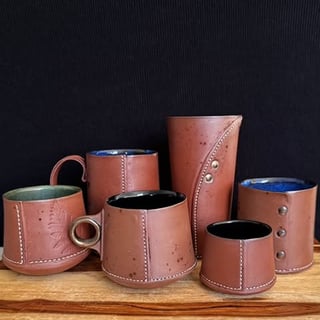
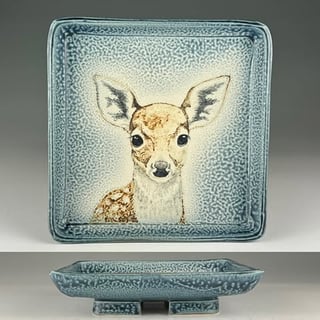
Speaker: left teaching. I don't even know how it happened. But I just thought, I've always loved mugs. I love crockery and I buy crockery. I don't buy figurative ceramics. And I always thought it was strange that I made figurative ceramics when I don't have any ornaments around my house. So I thought, well, I'll just make some mugs and I'll see how it goes. And I did enjoy making them, but other people loved them.
Speaker: So then when you're doing it as a full -time job and people like what you're making and they're asking for it, you go with that to a certain extent. I let everything else go into the back burner while I did what people asked for. And every now and again, I'll sort of delve back into making figurative ceramics again. I don't know why my particular style came about. I don't know why. Well, I don't know why.
Speaker: When I was at university and college, I enjoyed life drawing. So I really enjoyed just drawing naked forms. I wasn't interested in drawing the clothes or even the faces particularly, but I just liked the blobs and the, you know, the curves and everything else. And I really, really enjoyed it. I found it relaxing. So it seemed natural to just do that when I was making clay, to make natural forms. And then they turned into comedy characters. And again, it just kind of evolved.
Speaker: That's the way it worked. And I sat next to a lady, I don't know if you know her, she's called Sarah Saunders. She also does ceramics. You can look her up on Instagram. But we sat next to each other at work. We both did the same job. She also left to do Pottery full time. But we worked together. So at one point we were working together, going to galleries and shows and things. So we were sort of making what each other, we collaborated and we bounced off each other.
Speaker: So when she wasn't there anymore, because I was sitting in my room on my own, I moved more towards crockery because that's personally what I enjoy to buy. I think that's how I've managed to get to this point. I don't know if that answers the question you asked me. I love that. I love hearing that. So you are inspired by patterns and nostalgic items from your childhood. Can you tell me more about that? Yeah. So my dissertation at university was about the importance of nostalgia in design.
Speaker: And it's just something that is the only, the only non wavering part of my work is that I will make things that have an echo of things that made me feel cozy as a child. So things like I had a tablecloth or my mum had a tablecloth that was a particular pattern, a retro kind of, well, it's retro now, but it wasn't at the time, this pattern that because I'm a visual learner and things stick in my head,
Speaker: I can see it clear as day now and the thought of it makes me feel like I'm at home. It makes me feel comforted. So I wanted to sort of put that feeling into my mugs, but I did it sort of expecting that everybody had those feelings about the same kind of patterns, but they don't. Because I had a lady round one day, she was in a course, she'd come to do a mug making class with me.
Speaker: And I had a home sipotty mug on the side. And she said, oh, we had those as children. And I said, yeah, we did as well. And she said, I don't like how it makes me feel. Oh, it makes me feel a bit uncomfortable. And I thought, oh, that's interesting. It didn't make her feel cozy, but it made her feel something. And I thought that was really interesting. So yeah, that's what I'm trying to, you know, there was another thing that was a really boring set of tumblers.
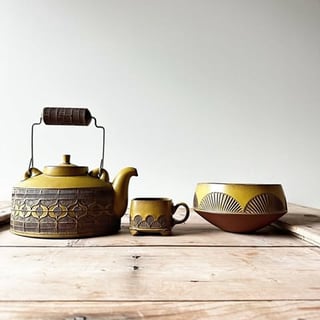
Speaker: They were made by Tupperware and they were just straight plastic tumblers. And the colour scheme was mustard, brown and rusty, red and cream. So one was cream, one was mustard. There was no pattern on it and they were boring, but I remember them and they make me feel comforted because they're just, they were in my childhood. I had cold drinks on summer days out of them and you know, things like that. So I'll use those colours because they make me feel comforted.
Speaker: Does that make sense? That's how it comes through. I love that. I love that. Shapingation. Everybody's going to have a different meaning for whatever you make. Maybe if you make something that is sad, somebody might make it as happy. Whatever you make, it doesn't matter. As long as you are enjoying what you're making. I love that.
Speaker: So let's talk about the business side of pottery. Can you tell me about the moment when you started to leave teaching after 18 years and become a full -time potter? Just the best day of my life. It happened. It came along because there was lockdown. Well, to start with, I had a baby and I had a baby three months I'd had him when lockdown started. And so the act of becoming
Speaker: A new mum was really intense, really, really intense because of lockdown. You know, no visitors, no parents to come and help you. And at the same time, my partner was still teaching at college, but he was teaching from home. So we were sort of all together in the house. And I felt like that was really, really good for us as a family. So then when we did go back to work after lockdown, I started thinking about how lovely it was in lockdown when we were at home.
Speaker: And I was having panic attacks at work because I didn't want to be there. I found it really hard to be a mum and a full -time out of the house working person. Lots of people are really good at it. I am not one of those people. I found it really hard to separate the two. I found it really hard to be at work and I found it really hard to concentrate on my son because I was thinking about what I should be doing at work. So I was having panic attacks in the morning.
Speaker: And my mum was there and she said, I think you should just leave and do pottery. And I said, I can't, I can't, we've got a mortgage, we've got this baby, I can't just leave. And she had worked with me at college and retired maybe 10 years ago now. And she'd saved some money for her retirement and she offered to loan me some to get the business started. So it felt like a sort of
Speaker: now or never. I was going to stay in that college until I died if my mum hadn't made me that offer. So I took her up on it and three months later, after I'd worked my notice, I left teaching and I worked at home and I was panicking. I was just thinking, everything's a job. If you do it every day, it's a job. I'll become stressed. I'll have orders. I won't enjoy it. I'll just be a factory, a one woman factory and I'll hate it and I'll start
Speaker: I'll start resenting the one thing in my life that I love, that I relaxed while I was doing. And it hasn't happened. I've just, if anything, I've fallen in love with it more. I've learned more. And now, I can't say it too loudly because my partner will hear me, but I look forward to the working week, probably more than the weekend now. You know, it's changed my entire life. It's just made me feel
Speaker: at home in this world, you know, it's just, I wish I'd done it sooner. So yeah, it's a great feeling when I left teaching. And I did like teaching, you know, I still do it, but I needed to leave because the other thing was I've actually written down in my notes.
Speaker: It got to the point with the college that they didn't want clay, they didn't want art. England had this big government push on academic subjects and art was written out of school subjects and it went into colleges as well. If you weren't an art college, then you weren't to deliver art. So we were told art wasn't important, colouring in was babyish, portraits were babyish.
Speaker: Clay was playing with Clay, was babyish. And I started to believe it. And they were saying, there's no point to it. What's the point in it? I was thinking, have these kids died going from meek little mild kids who don't think that they can do anything to these kids who are basically running a business within college? It's confidence building.
Speaker: You know, it's important. So I just knew that when I was, I was being told every day that the thing that I loved the most was childish. I just, I knew that I had to leave. I had to pass those skills on to some people who wanted them. Cause there's lots and lots of people. I didn't know it at the time. There were lots and lots of people who are desperate for the skills that I can pass on to them. You know, they want to know what I know and they pay to come and find out. So the college,
Speaker: You know, they were missing out by stopping me doing arts with the kids, I think. So you mentioned that you actually fell in love with Clay more once you've done it full time. Can you tell me more about that? I think when you're working with it all day every day, you get to know it better, don't you? Like if you're not working with it all day every day, you imagine what you'd like to be able to do and you plan it and then you get a snippet of time where you can put it into practice and see if it works. And with Clay,
Speaker: 90 % of the time things don't work how you want them to. There's disaster after disaster after disaster. But then you'll go away and you've gone away on a negative. Whereas when you're with it all day every day, you can work through all that to the other side of like, oh yeah, you know, if I'd have just let it dry for 10 minutes before trying to do that or if I'd have just, you know,
Speaker: If I knew about damp boxes, damp boxes have been a complete life changer and you didn't, I didn't have time to investigate things like that before because I was teaching, I was planning and I was going to work for nine, 10 hours a day. So it's not more, it's not that I fall in love with, well it is that I fall in love with clay more, but it's more like I've built a more stable relationship with clay. You know, it's become a little bit less
Speaker: frustrating for me because you want to be able to do everything and you want to be able to do it to the best of your ability and I think you have to be doing it a lot to get to that point. I absolutely love that and I definitely agree.
Speaker: So, outside of selling your pottery, you also do workshops. Can you tell me more about these workshops? So, I started doing them because I didn't want to give up teaching completely. And there was lots of people online asking me if I did workshops. I was thinking, you know, what could I do? What could I do a workshop on? And
Speaker: I thought the naked people, this is the thing that I make the most of, it's what people enjoy. So I just tried, I just put this advert out there and people came. People came, you know, at stadium hotels, people came from across the country to come to my, you know, my little pottery in my house. So it just sort of spurred me on and I started teaching, I do a regular class on a Monday night. So the same seven people come on a Monday night and we work on
Speaker: personal projects and it's really lovely to see how they've progressed over the two years that we've been doing it. And yeah, I just, I think because when you become, when you're a teacher, especially for as long as I was, it's all consuming and you start to think that you can't do anything else. You don't realise that because you've worked in those situations that you've got this massive arsenal of skills, you know, dealing with people and talking, ways of communicating with people, especially with teenagers.
Speaker: that I was working with, you know, troubled teenagers. And, you know, parts of society that most people are scared of, you don't realize what confidence that's given you. You don't realize the skills you've got. And you feel like you couldn't leave college because you couldn't do anything else. That's what I was feeling like. So when I started teaching workshops, all those skills came out. I realized I could speak to people and explain things well. And, you know, people enjoyed
Speaker: And I started teaching and it just went, people want to come back, people keep coming back. So again, it's one of those things I keep saying that just, I just tried it and it escalated. But you know, there's a lot of people that want to learn pottery and I never realized that. I thought that it was sort of a old lady thing, but there's so many people that want to learn it. And it's not old lady thing anymore, you know, especially in America.
Speaker: all the potters in America seem to be in their 20s. You know, they're all exciting young kids doing it. Whereas in England, it's a bit more dour. I'm one of those kids in the 20s. Exactly, yeah. A lot of people I follow, you know, like Sarah Anderson and, you know, Vanilo Presti, people like that, they're just so exciting to me because they're young and they're doing it, they're doing it young, which to me seemed impossible. I've started late, but I'm glad I've started.
Speaker: I absolutely love that. I absolutely agree. So now what advice would you give and how should people approach getting people into workshops if they want to start doing workshops? I think the conversation I've had over and over again with people, especially, you know, you'll always get those people that come who have signed up for it. You've never met them in your life before.
Speaker: They know they enjoy doing workshops, so they come to a workshop. And then there are people that are my friends and family who will say, oh, I'd love to have a go, but I could never do that. And that's when, you know, I remember teaching 16 year olds who say, I can't draw. What do you mean you can't draw? Like, you can't draw, you can physically draw. And yeah, but it's no good. It's like, to whose mind is it no good? You know, you've never,
Speaker: Nobody's ever seen this drawing that's in your brain. How do you know if it's no good? So people will come into the workshops just to support me and then going home with, you know, a piece of work that they're really, really proud of that, that they never ever thought that they could make. And they say things like, can I, can I drink out of this? Yeah, you can drink out of it. You can put it in the microwave. You can put it in the dishwasher. It's like, no, no, no. I won't do that until break. It won't break. It's got less chance of breaking.
Speaker: than something you've bought from the supermarket. You've made it by hand. You've took hours over it. It's a thing you've done. And then that gives them the confidence and they want to come back. If I could say that to everybody in the country who thinks they can't do it, then I'd want them to have a word with one of these people that's come to my workshop and gone home proud of themselves. It happens every single time.
Speaker: It's great. That's my favorite feeling. When they pick it up, when it's been fired and it's been glazed and they pick it up and they're like, I made this. Yeah, I just glazed it. That's all I did. Yeah, it's a good feeling. Absolutely love that. So let's talk about discovering your voice. Can you tell me about the moment when you knew you were heading in the right direction with your pottery?
Speaker: Well, I wrote down here, but I didn't even know I had a voice until you asked me how I discovered my voice. I think people always think that their own work is a bit of a mishmash work in progress. And I don't know whether anybody really thinks, you know, my work is completely unique because nobody's really is. But I think I knew that I was going down the right route when not only did other people
Speaker: wanted by my art but I wanted to have it as well. So for years I'd made these ornaments that other people wanted and loved but I never had in my house because I didn't, it's not that I didn't like what I was making but I didn't have ornaments so I didn't see the appeal of them. And then when I was making the mugs and the plates and I realised that I wanted them on my shelves and I wanted to drink from them myself, that's when I realised that I must be on the right track because
Speaker: other people liked it and I liked it and it made me feel that comfort feeling that I wanted to get. So it's hard to say when you... The moment I realised that I had a sort of style was I went to a pottery show not too long ago in November and somebody said that they were worried that their work didn't read as one body of work, that you couldn't tell that one potter had made it.
Speaker: And I said, oh, I feel like that about my work all the time. I'm always being turned down for shows because my Instagram just looks like a mishmash. My kid's been thrown together and it's just a million different potters. And I saw him was looking at me like, are you crazy? It's obvious that your work's all made by one person. And it had never occurred to me. And it had never occurred to him that his looked like one person to me. And then we had this conversation around all the potters like, yeah, I don't think that my work looks like
Speaker: cohesive body of work. So I'm not sure that anybody really thinks that they found their voice. And if they do, then they're lucky, I think. And they're going to really exploit it and take it to the maximum that they can, because it must be lovely to think, oh yeah, I know my style, must be a nice feeling. Whereas I'm a working progress all the time.
Speaker: Constant. I don't know. Are you the same? I loved it Yeah, absolutely. Absolutely shaping nation You may feel that your work is a work in progress and that is completely okay The more you feel that way the more your party will probably get better. I love that now What would you say helped you the most with being able to develop your own voice? again, it's the the time the time that
Speaker: I was allowed by being full -time in the workshop to just play and experiment and buy different kinds of glazes and different kinds of underglazes and different brands of underglazes even, different tools, like I'm addicted to tools. If I see something or if I see something being used, I want it. I want to try it and see if it's useful to me. So I think having the time to try all these things
Speaker: has just helped my work come on so much quicker than it would have done and so much more, I've become more, what's the word? Efficient. So what used to take me a week now takes me maybe two days. That's how I've found having time to play has affected me. Well, what's the word? I'm forgetting my words.
Speaker: benefited me. So that's what having more time has done for me. And that's really helped me develop everything. I absolutely loved that. Now, what advice would you give to someone looking to discover their own unique voice with their pottery? Again, I mean, let me see what I wrote here, but I'm pretty sure that it's just all about trying and doing as many classes as you can. They don't have to be in -person classes. They could be
Speaker: one -to -one classes with somebody who's a pottery friend of yours. So, you know, maybe someone's a thrower when you're not and they've got a wheel and you could just pop along while they're working one day and just observe passive learning like that, watching YouTube clips. You know, I read somewhere that watching or practicing things in your brain, you know, practicing a speech while you sleep is as effective as practicing it out loud in front of an audience.
Speaker: I think if you are watching videos, maybe doing Domestika tutorials, asking questions, getting involved in comments on other potters, Instagrams or Facebook or whatever platform they're on, ask the question because potters always want to help other potters. If you're curious, ask the question. If you're curious, buy the tool, try it. Don't be intimidated by
Speaker: throwing or hand building, just try it. Try everything. That would be my advice. I think that's, that's the only thing you can do with ceramics. It's, it's a physical thing. It's clay. It's, you know, it's a blob of mud. You can read about it, but you've got to try everything, I think. I absolutely agree. Some excellent advice right there. Emily, it's been a great chance today. As we come into a close here, what is one thing you want to hammer home with my audience today?
Speaker: The one thing that I want to hammer home that I always did with all my learners is just try, like I've just said, try things. Don't think that what you're going to make won't be good enough because there's nobody on the planet that can see inside your head and see what you thought that was going to look like before it appeared on this day. Someone else will come along, see what you've made, and they will have an opinion on it. Some people's opinion will be,
Speaker: confidence building wonder at what you've made. And they're the times that you live for. And I just think don't be held back by being disappointed in what you've made. Just do it. Learn from it. Keep going. Just keep moving. That's what I would say.
Speaker: some excellent last piece of advice. Emily has been great chatters today. Where can my audience go and learn more about you? Well, I have my Instagram, which is just Emily Rowley. That's where I seem to put most of my work. I have a website, which is EmilyRowley .co .uk. But it's not been updated in a while. But if you do want to see my old work with people on settees and naked people, that website is full of those. And also if you go back, if you crawl back through Instagram beyond
Speaker: the little section in the middle where I am photographing nothing but a baby beyond that there's also that old work that seems to have been lost in the ether somewhere but yeah any of the socials really I'm not on twitter or x you can find me there but I don't update it but yeah definitely instagram for new work thanks for listening to this episode of shaping your pottery
Speaker: If you are struggling with finding your own theme for your pottery so that you know you are known for something, I put together 53 themes that you can use and you can take. All you have to do is go to shapingyourpottery .com
Speaker: slash 53 themes, that's five three themes to get these 53 themes. It's really important for you to find a theme for your pottery so that you're not gonna get burnt out. You can have multiple styles with your pottery and you can be known for something. So again, go to shapingyourpottery .com forward slash 53 themes, that's five three themes to get these 53 themes. Thanks guys, I'll see you guys next time.