Transcript
Speaker: I felt like I needed to narrow down the options. So I feel like when you're making in ceramics, every single stage, there's a slew of decisions to be made. And for me, the color, stripping it down to black and white was similar to how I draw. Hey, real quick before we get started, if you would like to find your own theme for your pottery, so your voice really stands out and you're not getting bored with making the same thing over and over again,
Speaker: I put together 53 themes for you guys and it's completely free. All you have to do to get it is just go to shapingyourpottery .com forward slash 53 themes. That's shapingyourpottery .com forward slash 53 themes. If you love pottery and want to take your skills to the next level, you're in the right place. Find your own pottery style right here on Shaping Your Pottery with Nick Torres. Let's get started.
Speaker: What is up, Shaping Nation? This is Nick Torres here. And on this episode of Shaping Your Pottery, I got to interview Savannah LeBeau. Savannah makes some really incredible functional and sculptural pottery. In this episode, you will learn how Savannah thinks about creating her designs for her pottery and her sculptural design. You also learn about why you need to value your time in order to set parameters for yourself.
Speaker: Finally, you'll also learn about how to start doing collaborative projects and so much more in this episode. I hope you guys enjoy it and I'll see you guys in there. Savannah, welcome to Shaping Your Pottery and share with me what is something you love besides making pottery.
Speaker: I think that being involved in my community, so doing volunteer work, can I do that in a couple of different ways? I'm a gallery committee chair for a local arts organization, which means we select work that's shown in the gallery as well as helping install and de -install and being there at events.
Speaker: And then in addition, I also help with the Creative District Council here in Carvin Hill. So Colorado has certified creative districts which essentially provide state funding for certain art things within towns and our town is one of those districts so we do a lot of different art related things. Being a council member, it's a range from restaurant owners to architects like myself and we get together and kind of determine what our goals are as a district.
Speaker: and how we want to serve our community. I love that. So tell me a story how you got started in ceramics.
Speaker: Well, it's kind of a roundabout way. I've always done art, and I decided I wanted to study studio art at Louisiana State University. I'm originally from Baton Rouge, so it was staying in my home, my home city. And I went in as a painting and drawing major. And through my first year, I realized that you could do a dual concentration, and so I quickly added sculpture to the mix.
Speaker: And with sculpture, I was required to take ceramics classes. So then ultimately at the end, I did a dual concentration with painting and drawing and ceramics and minored in sculpture. So now tell me about the moment when you decided to pursue a residency program.
Speaker: Well, I think I was really encouraged by the professors at LSU, as well as the graduate students in the ceramics department. They were kind of the big push. I had done a couple of summer programs my last two years of school at Aramont, Penland, and Anderson Ranch Art Center. And all of those have residencies in some capacity. And so I got to talk with those residents and learn about their experiences. So I applied to a slew of different residencies and ended up in Carbondale, Colorado.
Speaker: So can you tell me about what you were feeling when you were moving to Carbadeo, Colorado? Excitement. I've always come to Colorado. Growing up, my aunt has lived here in the Rocky Mountains and I used to visit a lot and I loved it. My family always joked that I was more of a mountain gal than a Cajun swamp gal where I'm from. So I kind of always expected to end up in Colorado. So a lot of excitement. I love that.
Speaker: How did attending this residency help with your growth as an artist? Well, I think in college, I bounced around from a lot of mediums and different projects with painting and sculpture and ceramics. And so when I decided to do a ceramic residency, I committed to myself to only focus on clay. And so that was a new one for me. And so this specific residency, I kind of left painting behind and I was just in clay all the time.
Speaker: So that really helped me hone my skills and kind of find my voice, what I wanted to make. So you were focusing more on clay. What were you focusing on with your clay?
Speaker: Mostly installation and sculptural work. I think my sculpture background was still, you know, there in my head. And that's how I typically work in clay. I was making some pots on the side just to have things for sale. That was an easier price point. But yeah, I was mostly focused on this sculptural installation work that deals with multiples and making like tiny small part, but having thousands of them and then what that looked like.
Speaker: And of course, my painting background still found its way into the mix. So my exit show at this residency was all about taking these small parts and pieces and having thousands. And it kind of made up this larger mural, really the power of multiples. I love that. So we're going to talk more about your pottery a little bit later. But for now, what is one thing you learned from your time at your residency that you still use today?
Speaker: I think that's the value of time. And so that's, it's kind of a multi -layered answer. So one, how my time is valuable to me and how I want to spend it. So being able to speak up for my own needs and, you know, coming to a compromise with whoever you're working with. I find that that also comes into play with collaborative work as well.
Speaker: but essentially just setting up good expectations so that all parties are on the same page and feel good about the situation. Can you give me an example of what you mean by valuing your time? Go a little bit further on that.
Speaker: Okay, so me personally, myself, I'm a young person. I like to be helpful. If I see a need, I want to fill it. And so personally, I started to notice some overextension of myself with just wanting to be either involved in the community or helping students or in the gallery and really needing to dial it back and spend that time in my studio.
Speaker: I love that shaping nation. The most important thing is to value your own time. If you don't want to do something, don't do it. Value your time so you can pursue things that you actually want to do. I love that so much. So let's talk about your pottery. In one sentence, can you tell me what you make?
Speaker: Oh, it's so hard. Okay, so I'm an artist and designer focusing on making ceramic objects, both sculptural and functional, and explore themes of the power of multiples, multitude of lines, and layers. So tell me a story how you started making this pottery that you make today.
Speaker: Well, if we backtrack to when I was in my residency, that was mostly installation and sculptural work. But when I was making pots, I had all of these different colors. I was using terraces, and I had like 30 different jars of different colors, and there's all of these options. And I got to a point where I was like, I need to set some parameters to work within. I often find that I set some parameters.
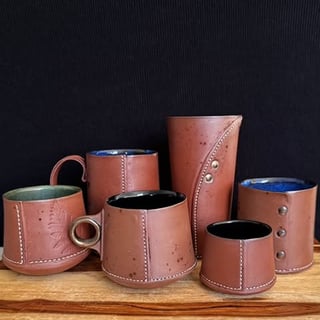
Speaker: I get more creative with my problem solving. So I eliminated all the color and stripped it down to like black and white and the clay body. And so that was kind of where this body of work started. And then I attached back into my painting and drawing. Every time that I draw, it's hatching and cross hatching. So a lot of like parallel lines or perpendicular lines and crossing over and layers and just trying to implement that back into the ceramic work.
Speaker: So what made you get rid of all the colors and not setting a parameter for something else?
Speaker: I felt like I needed to narrow down the options. So I feel like when you're making in ceramics, every single stage, there's a slew of decisions to be made. And for me, the color, stripping it down to black and white was similar to how I draw. I typically draw just with like a micron and the white paper. So it was a more direct translation for drawing to the clay.
Speaker: I love that. Shaping Nation, if you're feeling a little bit overwhelmed with what you are making, try setting a little bit of parameter for yourself and maybe eliminate some things to make it a little bit more simple and make it easier for yourself to make things that you actually want to make. And to that extent, having parameters, I find that and that allows me to kind of push back against those parameters. And then I get to a place that I never would have gotten to without those initial parameters.
Speaker: So that's why in my own studio practice, I tend to like set a problem for myself and then I have to creatively solve that problem. I love that. I feel like that forces you to grow while being limited in what you're actually doing. I love that so much. So you are inspired by uncommon nuances and unlikely intersection. How does this impact the way you make your pottery?
Speaker: Well, let me speak a little to what those mean to me. Essentially comes down to the art of noticing, whether that be like sun coming through the window and how it casts on the floor and over other shapes or when shadows overlap one another and become a denser area or like looking through a fog window or how that distorts what you're seeing on the other side.
Speaker: All of those things I feel really tuned into noticing throughout my every day. And so that has started to inspire some of the choices I make on the circuses of my ceramic work. Can you explain to me how you create your designs and patterns for your sculptures and functional files?
Speaker: Sure. So the sculptural work, like I make basketry where I'll coil and fill a really tall piece and then cut out voids. There's actually, there's one behind me right there. And I think that lends itself to that art of noticing when you see like the railing of the stairs and the cast shadow, and then there's some other shadow on top of it.
Speaker: So you're looking through all of these parallel lines. And so I do that with the baskets, because you're actually looking through the front of the basket to the inside of the basket. And then you have the cast shadows. So that's one specific example. And then on the more functional pottery, it just comes down to the line work. So I'll terrace it to the outside of the piece. And then I have to carve through the terrace edge. And that's a prompt.
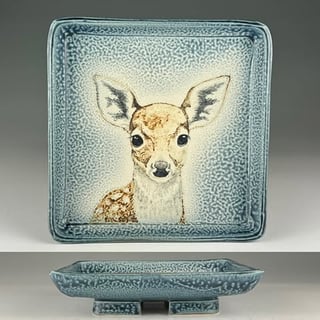
Speaker: It's essentially like the underpainting or drawing. And then when it comes out of the bisque, I have something to respond to when I'm glazing. So that could be line over line or deciding which areas to color block out. Yeah. And a lot of tone on tone, which is how I see the shadows in the world. So how did you figure out the terracage technique that you're using?
Speaker: Well, I learned about terracage. My studio mate in college was using a lot of terracage and she was using it with, with Mason Stadiums and it was her way to add color. And I totally tapped into it for a little bit, but I came back to it in my residency because I was finding, I was making my pots.
Speaker: I, they would dry out really fast here in Colorado. So going from like Louisiana, a hundred percent humidity to here where it's very low, everything was drying out really fast. I couldn't quite keep up to apply like colored slip or something. So terracage was ideal for me because you apply it and it don't dry. So I could kind of like make it and forget it and then come back to it and decide, okay, what color terracage? How do I want to apply it? And.
Speaker: So before we get into talking about discovering your voice, something I like that you do is that you make both sculpture and functional work. Can you tell me why you make both? Well, why do I have to choose?
Speaker: That's the simple answer. But I truly, what happens in college when I decided I was going to do both painting and ceramics, I was trying to marry the two, do the work as one. So in my painting work, I would start with a pattern that would be the underpainting or show up in the painting somewhere. And then in the ceramic work, I was carving that pattern onto pots. And at some point I had this epiphany that I don't really like making pots. This was college days.
Speaker: that I didn't like making pots. And so why not I make physical pattern that I was trying to draw. So that sent me into the more power multiples and doing the art than pieces component that become a larger thing. And so doing both of those at the same time was really valuable to me and rewarding. And then when I decided to just focus on clay, I wanted to dabble in both. And so I'm doing.
Speaker: I love that. Shaping Nation, you don't have to choose either sculpture or functional pots. You can combine the bowls. You can do bowls. It doesn't matter. Just make whatever makes you happy. I love that. Yeah. I think that they inform one another. So like, I don't necessarily make both at exactly the same time. There's making cycles to everything, even when you're solely making pots or solely making installation work.
Speaker: You know, sometimes I take two weeks and I'm focused on like a big installation that has multiple tiles or something. And then the next couple of weeks I'm decorating some pots and they totally speak to one another. There's like a similar language and they totally end up in each of the final pieces. I love that so much. So now you have mentioned the power of multiples a couple of times since we've been talking. Can you explain that to me a little further?
Speaker: Well, I think a part of it comes from, you know, in ceramics, we're limited by kiln size, kiln space, and it's often really hard to make something very large without some other things coming up like cracking or being whatever else. And so one of those solutions is to make the larger thing in these smaller parts and pieces.
Speaker: But beyond that, to speak to my drawing background, like stippling with dots or doing hatching or cross hatching, that's all like small, small mark making that's built up over time. And I like to bring that into the physical world, into the 3D world.
Speaker: invoke this feeling in a space. All of a sudden, you know, if you see a piece from very far away and you walk up onto it and then all of a sudden, oh, those are all like individual parts and pieces. It kind of gives the viewer this like aha moment. Oh, I can see how that that came to be. I love that so much. So let's talk about discovering your voice. What would you say was your biggest obstacle when it came to finding your own style?
Speaker: Wanting to do all of the different things all of the time, I definitely felt like I didn't want to be married to this one specific style, which is hard because when you look at some of the great artists, they're known for this one specific thing or a couple of specific things.
Speaker: as an artist, you think, oh, I should do that. I need to find that thing and be committed to that thing. Yeah, that kind of gave me a lot of anxiety or fear of like, what if I pick the wrong thing and I'm stuck with it? And ultimately you're not. So, yes.
Speaker: I love that. Shaping Nation, you don't have to be stuck doing the same things over and over again. You can always change it if you want to. You don't have to be stuck doing the same thing over again. Pick multiple things if you want. Do however many things you want. Just do things that you enjoy. I love that so much. So what do you say? What would you say helped you overcome this obstacle?
Speaker: I think realizing that I didn't have to choose like exactly what you just said, you know, I think also taking things in bite sizes. So like, if I decide I want to go on a tangent and explore collage for a couple of weeks, like, okay, that's that, that little body of work. And, and I give it that time that it needs and I can always circle back to what I was doing before. That is okay. And what I learned in the collage work will totally inform what I'm doing in ceramic work or vice versa.
Speaker: I love that. So you contribute your growth to the ability to allow time and space to fail. Can you tell me more about this? Yeah, I think it's inserting play in the studio. I found like when I was in a residency program, that was my sole focus. You know, I didn't, I had like a part -time job just to survive, but I was able to dedicate a huge chunk of time to
Speaker: Cranking out the work I wanted to make that I had set as an intention, but also giving some space to like play and experiment and try things out. And in turn, there's going to be failure. And then you learn from that failure in your early first pottery classes. It's, you know, they make you like repeat a shape on the wheel so many times because like that first pot is never going to be your best pot.
Speaker: So anytime I approach a new project and I'm like, okay, I want to make a series of pictures, typically the first handful are like not that great. And I end up reclaiming and it's like, yeah. So these days I try to, every time I come to the studio, I try to give myself a little bit of time to play and.
Speaker: Sometimes that's sketching in a sketchbook. Sometimes that's working with the different material. Sometimes that's just trying something that's not in my normal intern form that I make out of clay. Or collaborative projects. I find a lot of play and creativity comes from collaborative projects. So can you tell me more about collaborative projects? Because I always think about them, but how do those actually work?
Speaker: Well, my most recent collaborative project is with a ballet dancer here locally. And it was actually prompted by a local gallery. They took 10 visual artists, so painters, ceramicists, sculptors, things like that, and paired them with a performative -based artist, whether a musician, a playwright, dancer. So I got paired with this dancer.
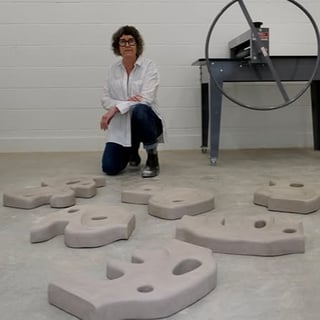
Speaker: and I kind of knew immediately what I wanted to do. I wanted to record her her movement in clay. So I cleared out my studio space, I rolled all my tables and shelves out and had 500 pounds of clay on the floor and she came in and danced for a couple of hours. So that's actually the piece you're seeing above my head. So all of that clay then got chopped up into smaller tiles and they have French cleat on the back so they hang on the wall really nicely and
Speaker: I just did some surface treatment with terrace stage and watered down under glaze to highlight the topography of her recorded movement. So with that, that is a jumping off point for me for other installations or sculpture or even just tactile surface that I could incorporate into other things. And I wouldn't have thought of any of those things without a prompt for that project. I love that. So what can people do to help collaborate with other artists?
Speaker: Well, I think if you have other artists friends that you often like bounce ideas off of, or you consult with, you could approach them and say like, Hey, would you want to work on a side project together? And you don't even necessarily have to have an idea in mind that could be a part of collaborative process of selecting that.
Speaker: Other ways to do collaborative projects is like you start on a form and you pass it along to someone else and they do something and pass it back. And you're just you're not necessarily speaking to one another face to face, but you're more responding to what each other is doing to peace. And that can be really interesting. And that also makes you like let go of final product because you have to relinquish some control when it comes to that. I love that. I definitely love that. I think that will help a lot of people.
Speaker: So what are you doing to evolve your voice even further? Well, I think it comes back to the art of noticing. I recently got a book that's actually called The Art of Noticing. I came across this author and I forget his name at the moment. I think it's Rob something. But if you look up the book, The Art of Noticing, and it has all kinds of prompts in it.
Speaker: and they're rated at different levels of difficulty. So some are like really easy and you can complete fairly quickly and some are more thought provoking and hard and take more time. But simply put, it could be like if you are on your commute and you take the same route every day, you're seeing a lot of the same things.
Speaker: So when you have a little extra time, be intentional and take a different route because you may end up somewhere that you never would have before. That's like one example or another. He did this project where he walked around New York city and was looking for security cameras, like something that's typically hidden and it's not something we're supposed to notice.
Speaker: And then all of a sudden, once you start to notice that thing, you start to see them everywhere. Kind of like when you get a new car and you see your car, then you start to see that car everywhere else when you're driving. So I find that I'm honing in some of those skills of noticing when it comes to shadows or overlapping lines or things like that.
Speaker: And I'm like choosing to look out for those so that I'm developing this language that I can bring back to my house or installation. I love that. Shaping Nation, go out and explore new things so you can notice different things and try to apply that to your pottery. I love that so much. So as we are coming to a close here, what is one thing you want to hammer home with my audience today?
Speaker: Think it's make what you want to live with. This is a quote that I saw posted in Giselle Hicks' studio when she was at Anderson Ranch as the studio coordinator. And it's something that has stuck with me. I wrote this. It's been on my wall. It's something I think about often. And essentially it just comes down to don't try to anticipate what your buyer or customer wants.
Speaker: eventually that will suck all the joy out of the making process and what you're making. You should make what brings you joy and what you would ultimately want to surround yourself with in your everyday life. And then once you really find that voice and you continue to do that, the people who like your work are the people you're making your work for.
Speaker: I definitely, that is such a great quote. Make what you want to live with. I love that so much. Savannah, it was really great chatting with you today. Where can my arms go and learn more about you? My website, savannahlabow .com. I'm also on Instagram at savannahlabow. Yeah. It was really