Transcript
Speaker: Hey, real quick before we get started, if you would like to find your own theme for your pottery so your voice really stands out and you're not getting bored with making the same thing over and over again, I put together 53 themes for you guys and it's completely free. All you have to do to get it is just go to shapingyourpottery .com forward slash 53 themes. That's shapingyourpottery .com forward slash 53 themes.
Speaker: I have a lot of customers that return to me and I'm lucky enough to have that. I didn't want them to feel like they were buying the same thing over and over again.
Speaker: Natalie makes some really incredible face pottery that has some really cool facial features. In this episode, you will learn how Natalie makes her face pottery. You also learn about the impact her sister -in -law had on her business and her pottery. You also learn about if you're not in the mood, try starting a new project to help you get in the mood to make pottery.
Speaker: Finally, you'll also learn about using seasons as themes for your pottery. I know so much more in this episode and I hope you guys enjoy it. I'll see you guys in there. If you love pottery and want to take your skills to the next level, you're in the right place. Find your own pottery style right here on Shaping Your Pottery with Nick Torres. Let's get started.
Speaker: Natalie, welcome to Shaping Your Pottery. Then share with me what is something you love besides making pottery. I recently got into snowboarding, actually, and I'm a big fan of that. I love that. So tell me a story how you got started in ceramics.
Speaker: So my husband took me to ceramics as a surprise date. And basically the second that I started doing anything on the will, which I didn't know at all what I was doing, I was just playing around, but I just started laughing because it was so much fun. And he created a monster. I love that. So can you tell me the story how pouty pottery got started?
Speaker: Yes. So before pouty pottery, it was my own thing called refined ceramics. And I did that for a little over a year until my sister -in -law who runs her own business called Rainbug. A lot of people started telling us that we should combine our styles. And so we did just cause we had so many requests and because we thought it would be fun. And that's, that's how eventually it became pouty potteries cause we acted on that. So.
Speaker: What obstacles did you face when you first started pouty pottery? Once it transitioned from refined ceramics, which was my thing, to pouty pottery, which was both of us, I think the biggest thing, and I'm sure she would agree with this, the biggest thing for us was that it was two creative brains coming together. So we would disagree on, like we'd agree on the core theme of the design.
Speaker: But there'd be little things that we disagree on where sometimes we're like, let's just let our followers decide because we like couldn't pick on our own. It's hard to get too creative brains to pick on one thing. So that that was definitely the biggest hardship. So you and your sister -in -law originally started a pouty party, like you said. Can you tell me the impact your sister -in -law had on you pursuing this further?
Speaker: Yes so I was already pursuing ceramics without her but specifically in pursuing this style even though she's not part of it anymore the impact is one I still use the faces which is definitely something that she brought to the business but
Speaker: also just the general of we I ended up pulling a lot of inspiration from the same place as she did so she's impacted me a lot you know the way that she kind of was the first one to introduce me to like all the cool things around us in nature and once I started paying attention to that it really started influencing you know the current style that I was working with so she she definitely still has a footprint in the business for sure so let's hold on phone's bugging out okay so
Speaker: What advice would you give to someone trying to go full -time with their own pottery? I would say to just be smart about it. It's always going to be a risk for sure. Something that I did with my own is I worked a full -time job and then was doing ceramics on the side.
Speaker: And so I would say keep that job like it's kind of a safety net, you know, until you feel like it's stable enough as you build the following because it's going to take a lot of patience. It's a really long buildup for sure. It's nothing that happens immediately. But if you think you can do it and if you're passionate enough, then go for it and also be okay with making sure that you're okay with doing it as a job rather than just a hobby.
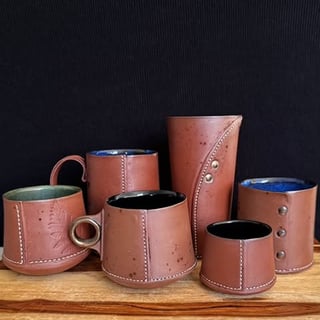
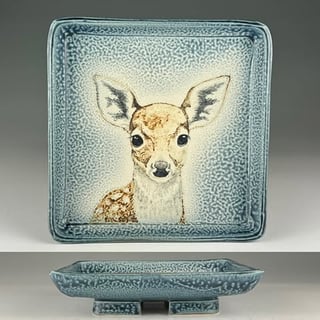
Speaker: I love that shape nation. You have to have patience if you are, if you want to go full time, you don't jump into it, but right away, but have patience and then commit to yourself when you do do it. I love that so much. So let's talk about your pottery in one sentence. Can you tell me what you make? Yes. So I mostly, I make functional mugs that are inspired by nature and incredibly detailed. So
Speaker: So tell me a story how you started making this part of that you make today. So the style has transitioned a bit. I mean, I still carry the core of, you know, having all the different types of like faces or personalities as I call them. But it's changed a lot in the sense that I've branched out in what types of faces. I also think it has become more detailed since Ray exited the business. It's always been really detailed, but I have learned every time I try to make something simple, I'm like, I'm going to keep this so simple halfway through.
Speaker: I also think, man, what would look great? 30 mushrooms on this. And so I think I've kind of just accepted my style is not simple. So it has become a lot more complex than it used to be. What did your faces used to look like before it started becoming more complex?
Speaker: faces were fairly similar although they were mostly like frowns. This year I started adding in smiles and that's different because the frowns are like hand built onto the mug whereas the smiles are kind of engraved and carved into it but there's all kinds of like I don't know little pouts so it's still I've still got the old frowns but I am trying to add in those other emotions as well. So what made you start adding in these other emotions?
Speaker: I have a lot of customers that return to me and I'm lucky enough to have that. I didn't want them to feel like they were buying the same thing over and over again. And so I wanted to give them more variety and also just because I get really tired of making the same thing over and over again. So that's why. How would you say that helped you just in your business in general? Like creating the different faces? Yes.
Speaker: It has helped branch out the audience because I've had people who come to my page and absolutely love the frowns, which is what it originally was. And then I've had other people be like, Oh, I loved it. And then I saw the frown and it totally ruined it for me. And some people are like, Oh, he's so sad. And other people love that it's sad. And so having the other faces, like the smile, people who don't necessarily like the frown have that option of being like, Oh, well, it's a happy mug. I don't have to own something that looks so sad. You know what I mean?
Speaker: I love that. Shaping Nation, you don't have to be stuck making the same things over and over again. If you want to start changing some things up, you can start doing that. And there's always an audience out there for you. I love that so much. So as you mentioned earlier, you are inspired by nature. How does this impact the way you make your pottery? It gets me in that creative style of thinking. I cannot create if I'm not in the mood to do so. It really shows in my work. And so
Speaker: For me, if I'm not feeling creative, I can go for a walk or for a hike and I can see anything. I mean, I can see a mushroom or a tree or even wood that just looks pretty to me. And I immediately start thinking, how would I put that on clay? Like how would that look and how would it look when I added color to it? So honestly, almost anything around me can kind of spark that idea of how would I put this onto a mug. So.
Speaker: So you mentioned that if you're not in the right mood to make the pottery, then it's just harder for you to make outside of going on a hike or like sometimes when you can't go on a hike and walk, what do you do to get into the mood to help you get into the studio?
Speaker: Yeah, a lot of it, some of it just comes down to discipline, like knowing like, if I'm dragging my feet on it at one point, but then knowing once I get into it, I'll feel excited about it, or other times it's starting a new idea. So if there's, if I'm supposed to work on one thing, but I'm more excited about a new idea that I have, I'll allow myself to step out of that schedule and work on the new idea, because then I start getting really excited about how it's coming along, and then I'm excited enough I can go back to the old work and continue from there.
Speaker: I love that so much. Shapingation, if you have something that you've been working on, but a new idea sparks in your head, go chase that new idea, see where it takes you, and then it'll allow you to be more excited to come back for the other stuff. I love that so much. So as you mentioned earlier, you add a variety of faces to your mugs. Can you tell me why you decided to use faces as your core theme?
Speaker: Yeah, so that was definitely, that is Ray's, that's my sister -in -law. She brought that to the business because she saw this pot at a store near us. We were shopping and this, it was a planter, I think. And it had this super grumpy face, this big old nose and everything. And she liked it so much that she started doing her own thing on polymer clay and making these cute little mushroom figurines, which she's rain bug for anyone who doesn't know.
Speaker: And since we were combining styles, that was the biggest part of her style that she brought in. And even though she decided to continue just doing her own thing and leave the ceramic business with me, we built up so many followers that were specifically following for that style. And I just didn't feel right to the followers to change that again. So that's why I've kept it as the core theme, to just keep it fair for the followers and then just kind of put my own twist on it.
Speaker: So what is something you're doing to evolve the, even further? I know you mentioned you're adding different facial features, but what else are you doing? For pottery specifically, I'm trying to, not trying, this year I've been doing more themes. So like I've been doing more before I was making just whatever I thought would be cute, something that I liked. But this year I've been doing kind of like collections where I did like a warm seasons collection. So it was all summer items. Like I made a mug that had,
Speaker: Like a camping scene on the background of it and then I made a mug that looks like a s'mores Whereas now I'm gonna probably go into like a spooky seasons collection That's strictly like Halloween themed so I've been doing a lot more themed stuff so that people can kind of I don't know sort of shot by collection throughout the year if that makes sense and
Speaker: I love that shape nation. If you're ever having trouble with picking a theme for your pottery, have the theme be the season that you're currently in. So if it's winter, try doing a winter theme. If it's summer, do a summer theme and just stick with that and do that throughout the year. And you're going to be able to have a lot of refreshing ideas as well. I love that so much. So could you explain to me how you create your faces and your designs onto your pottery?
Speaker: Yeah, so all of my mugs are well thrown and then after I will throw it, like I said, it's really it's a lot of hand building work where
Speaker: which is funny because I'm not a hand builder like at all but all you know I roll the eyes and the ball you have to put on the eyebrows onto it and and meanwhile one of the biggest things in creating the piece is that since I do I'm hand building all the detail on the outside like moss mushrooms whatever it may be trees sometimes that can make the mug super heavy so I need to throw it really light so that's that's in the mugs it's it's so many small steps it's like
Speaker: throw it light, trim it as light as you can, handle onto it, and then I do glazes, fire it, add more under glazes, glaze it again. It's a whole process. So can you go into a little bit more detail on how you actually apply the faces?
Speaker: Yeah, that's pretty standard. It's just like slipping and scoring all of that. So rolling up the eyes, you roll it into just a couple little balls. You try to make sure that they're even, that they match each other. Slip it and score it onto the piece. And then I get another slab of clay. Not a huge slab, just not like one that needs a roller, just one you can do with your hands.
Speaker: You roll that out, flatten it, and then you just cover part of the eye to get whatever kind of eyebrow facial expression. Because a lot of the expression is in those kind of eyebrows that also kind of work on eyelids on my pieces. And then the mouth, it depends on which type of mouth I'm doing. Some of them I can draw on, like I said, or carve. Others, it's just about another grabbing a small piece of clay. And then I just use my fingers to kind of form that pout. Same thing, slip and score and attach.
Speaker: and then all the other details it's that same thing it's just shaping it with my hands like the mushrooms adding stems with slipping and scoring it's a lot of slipping and scoring. What would you say is the hardest part about this entire process? The hardest part
Speaker: I honestly think the hardest part is throwing. I think that's the part that takes the most skill because that's what took me the longest to learn. As far as hand building goes, I feel like with what I do anyways, there's a lot of room for error. So if I mess up, I don't have to put it on the piece. So there is more flexibility there. Whereas on the wheel, it's like you throw it and you mess up and there's not that much wiggle room there. So I definitely, I think throwing is the hardest part to get down and the rest of it I think just comes with experience.
Speaker: I definitely agree. Wheel Throw could definitely be a challenge in itself. It's definitely the hardest thing to probably learn in pottery. So let's talk about discovering your voice. Can you tell me about the moment when you knew you were heading in the right direction with your pottery?
Speaker: I don't know if there was an exact moment. The whole reason why I started the business was just because I was so into ceramics that I just wanted to keep creating, but I did not have more room for ceramics in my house. And so I was like, well, I need to do something with this.
Speaker: and I only have so many friends that I can give these pieces away to so I'll just start selling it and see what happens and then I just started to slowly build a consistent following and it was kind of like once I saw that people were actually buying my items even though it was small at the start and seeing how excited they were when they received it that's when I like once people started sharing my excitement about the items that's when I was like okay like I think I have something here that could make a lot of people happy and also solves my issue of
Speaker: needing to keep creating without filling up my entire house of ceramics. I love that. So you contribute your growth as an artist to self teaching. Can you tell me more about this? Yes. So as I mentioned earlier, my husband is the one who took me into ceramics as a surprise date, but he did not really know how to teach me. And the problem is I outgrew him really fast because as you know, pottery is an endless world.
Speaker: of learning there are so many different ways to do the same one thing and there's so many different like strategies that you can do and artistic styles and so I since he couldn't help me and I just couldn't afford classes at the time and I wasn't sure what I was doing with it anyways it was a lot of
Speaker: I got my own will really quick because I there's not a good studio around us really. And so I got my own will so I could practice at home. I started just doing YouTube like john the potter or earth nations dynamics. Thank goodness they've made those wonderful videos. And it was a lot of honestly it took me way too long to figure it out. I would not recommend self teaching. But it was a lot of me just kind of following along with their videos and feeling what does feel right what doesn't
Speaker: Because once you get going, it feels pretty obvious, you know, when it's working and when it's not. So it was a lot of experimenting for me. And I did that for the first three years of ceramics, actually. I love that shape nation. If you can't afford to, you know, maybe go take a workshop and go learn pottery, the best thing you do is just start experimenting, start coming up with things that you can create the pottery that you want to make. I love that.
Speaker: So what advice would you give to someone trying to discover their own unique voice with their pottery? I would say branch out, use all the media platforms. Facebook groups are amazing and there are so, so many for ceramics. Reach out to fellow potters because in the ceramic community, my experience is that people are really friendly. Most people are incredibly willing to help because I think we all remember how hard it is that we've all been there.
Speaker: and like and use its consistent content to get your voice out there. I think everything runs by the internet these days, unfortunately. And so got to post consistently in all the platforms, TikTok, Facebook, Instagram, all that stuff that none of us like doing, but that's very important to get your voice out there. So what advice would you give to someone trying to that wants to reach out to more potters? What would you have them say?
Speaker: people reach out to me and they'll say something as simple as hey I'm just barely starting or sometimes they're sweet enough to say hey you inspired me I got my own will what would you recommend and and I personally will just send them like YouTube links of stuff that I watched but I would just reach out and say hey I really admire your stuff I'm starting ceramics myself or is there any tips you'd recommend for someone who's a beginner who doesn't can't really afford classes and I can't imagine anyone wouldn't respond to that well like I said potters are pretty awesome
Speaker: Yeah, definitely. Shapingation. The most important thing after you have that message is just to hit send. It's scary, but you have to hit that send button. I promise you, it'll be worth it in the end. So as we recover to a close here today, what is one thing you want to hammer home with my audience today?
Speaker: I think the biggest thing is to stay creative and not just like even on any art platform, right? But thinking outside the box is so important. Because if you think about it, we wouldn't have even half of the things that we have today if people weren't thinking outside of the box or staying creative in inventing things even outside of art. And so that's the most important thing. You never know who you're going to inspire, what it could potentially lead to, or even if it just brings someone joy. So stay creative. That's super, super important.
Speaker: So I know I said that was the last question, but what do you do to stay creative? I look up new techniques on ceramics a lot. And if I feel like I've maxed out, so like when I was self -teaching myself and I did that for the first three years, eventually I got to the point where I was like, okay, I don't think I can teach myself anything more. I've kind of maxed out. So then I started looking into advanced classes around me to see how I could just keep pushing that skills. Cause people are also paying you for your skillset. And so I think it's important that you kind of keep
Speaker: increasing in that. And, and once I mean, once you do that, it's like a whole new chapter because you're around other potters. You've seen what they're doing. You're like, Oh, that's so cool. I bet I could do this. And so that's a lot of what I do is just new techniques. There's so much to discover in the ceramics world. It's never ending. Absolutely. Love it. Shape Nation. Stay creative, keep learning and keep growing. I love that so much. Natalie, it was so great chat today. Where can my audience go and learn more about you?
Speaker: on Instagram is where I'm the most active. So just at poutypottery .com.