Transcript
Speaker: Hey, real quick before we get started, if you would like to find your own theme for your pottery so your voice really stands out and you're not getting bored with making the same thing over and over again,
Speaker: I put together 53 themes for you guys and it's completely free. All you have to do to get it is just go to shapingyourpottery .com forward slash 53 themes. That's shapingyourpottery .com forward slash five three themes. And so having had the amazing opportunity to join both of these mentorship opportunities has been incredibly
Speaker: beneficial for the growth, my personal growth and the growth of my work. What is up Shaping Nation? This is Nick Torres here and on this episode of Shaping Your Pottery, I got to envy Yael Braha. In this episode, you will learn how Yael makes her super cool designs and patterns onto her pottery. You'll also learn how about how
Speaker: Yael's past life of being a graphic designer and filmmaker have helped her with her own pottery. You also learn about how being inspired by growth is the most important thing and can really help your pottery. There's so much more in this episode. I hope you guys enjoy it and I'll see you guys in there. If you love pottery and want to take your skills to the next level, you're in the right place. Find your own pottery style right here on Shaping Your Pottery with Nick Torres. Let's get started.
Speaker: Yael, welcome to Shaping your Pottery and share with me what is something people might not know about people. Hi, thank you so much for having me. One thing that people might not know is that I was part of the national team of Flatwater Kayak. Oh, interesting. So tell me the story how you got started in ceramics. All right, let's try to see if I can make it short. I started ceramics very later on in my
Speaker: as an artist. I was born in Italy. I studied graphic design. Then eventually I moved to the United States. I got interested in filmmaking. I went back to school for MFA in cinema. And then I started exploring all sorts of different art forms from metal sculpture, metal fabrication, interactivity, and started working on interactive installations, combining filmmaking, graphic design, and sculpture.
Speaker: Eventually I moved to Canada and that was I think that was somewhat the trigger because I grew up in Italy is a very Mediterranean warm environment and I really had to adjust to the six months of winter in Canada with very very low temperatures. So I was really interested in
Speaker: Keeping my curiosity. I'm a very curious person and very passionate. And so I really love to constantly constantly learn new skills through my lifetime. So I enrolled into a community class for ceramics. I've never done ceramics
Speaker: maybe when I was very, very little in elementary school, I probably touched clay for the first time, but since then I haven't touched it. And so I enrolled in this community class that didn't even have a wheel available. It was a very small classroom, only hand building, and that was it. I got hooked, and from then on I started
Speaker: wanting to learn more and I kept traveling back and forth to the United States to attend workshops and eventually my curiosity became a full -time passion. So tell me the story about why you decided to move, make the move from Italy to San Francisco to get your MFA.
Speaker: Actually, I moved because I was working already as a graphic designer when I was in Rome. And then again, another struck of the curiosity. I never been to the west coast of the United States and I went to attend the graphic design conference.
Speaker: And I fell in love with the environment and the access to the arts and the gallery environment. And I basically was offered a full -time position. So I moved for work at first. And then after that, I pursued a Master of Fine Arts in cinema, just as my interest group grew. So that was not the original plan. It was to go to the United States, stay one year and then go back to Italy. But I never went back.
Speaker: So how did attending here help you with your own pottery growth? Sorry, what was the question again? How did attending here? How did getting your MFA? Yes, how did it help you with your pottery growth?
Speaker: I think both my studies in graphic design and filmmaking are influencing my current work in ceramics because my work is heavily graphics. My work is heavily graphic design based. So I design my own patterns and with that I use all the background that I learn in my graphic design studies and doing my professional work.
Speaker: And filmmaking also, it does have an influence in the work that I do because in filmmaking, you do a lot of editing. So I was part of a filmmaking cohort that actually we had to learn how to splice a film strip together to make editing. So we took shots, we took a whole film strip and we split it where we wanted to attach one shot after another. And in filmmaking,
Speaker: when you create a splice or an edit is to add a minute change perspective and to move the story forward. In my pottery work, I do a lot of splice. I do a lot of cutting, I do a lot of editing, and I do a lot of framing. How I frame the pattern is really important to me. So while thinking about my pottery making, I consistently
Speaker: draw from my experience in filmmaking, let's say I hold a camera and this is how I want to frame the shot. And in this case, this is my template and this is how I want to frame my pattern to
Speaker: make it a three -dimensional form. And in terms of the cutting and the splices, all my work has a lot of overlap, has a lot of seams. And I always work a lot in trying to create some dynamic contrast between positive and negative foreground, background. So that's pretty much, I hope that answers your question.
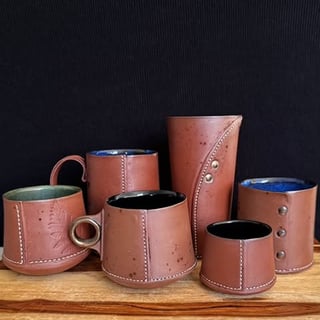
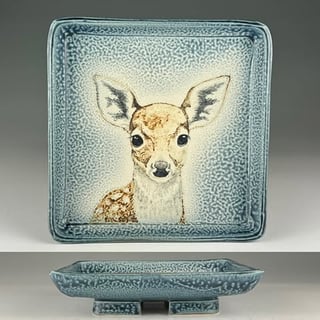
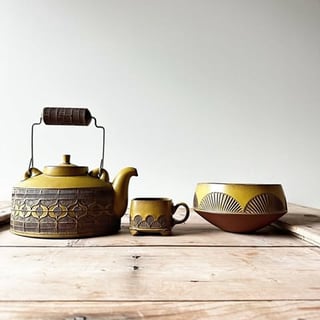
Speaker: So let's talk about your pottery. In one sentence, can you tell me what you make? OK, I make functional ceramics with bold and stylized surface patterns. And all these patterns that feature tessellation, optical and geometrical illusions. So tell me a story how you started making this pottery that you make today.
Speaker: So, well, I was part of the inaugural a cohort mentorship that was originally founded by someone living. And as part of this cohort, I intensively for about nine months.
Speaker: while I was attending an artist in residency. I was very lucky that I would be mentored all the way through my residency, or at least part of this residency. And I was very, you know, I still feel that I'm very green, I'm very new, but at that point I was very, very, very new. I was dedicating my time to do wood firing. I really didn't know how to read any of the results.
Speaker: I really was looking for some guidance and some instruction that it was somewhat informal because, you know, it was during the pandemic. So I didn't have access to any other forms of education and instruction. So I experimented a lot during this month of the mentorship. I was
Speaker: you know, guided and feedback was provided was amazing. A lot of discussion were had and the interesting part of it is that while you're in, while I was in the thick of it, I didn't take the time to sit down and look at the work objectively. I just felt the rush of like constantly making, making, making, constantly trying, constantly getting results. And it was only after I finished the mentorship
Speaker: that I had a little bit more time and clarity in terms of intention. I looked at the work and then I hand picked the work that it resonated with me a little bit more than others and I picked the work that
Speaker: I thought it had potential for really developing my own, what people call voice. So it's really developing my own style. So I focused on that. I took that extrapolated out of the myriad of experiments that I did. And then I really pushed and focused my time and development on that. And that was, I think there's two events where the origins and the spark of where I am today.
Speaker: I love that. That was a really great story. I love that. So in 2021, you received the Multicultural Fellowship Award from NSEQA. Tell me about this moment. Yeah, that was a very, very meaningful moment because, you know, as you can imagine, you know, there's, let me, let me just restart.
Speaker: That was a very meaningful moment to me because it was a validation and boost of confidence that I needed to continue to pursue the work that I'm doing right now. Until then, I've been mainly self -taught
Speaker: I haven't had the opportunity to pursue another degree this time in ceramics. So, you know, the imposter syndrome level is pretty high when being around all these amazing talented artists and amazing events around the country. And so the fact that I was recognized by ANSIKA, the National Council of Education,
Speaker: and ceramic arts, it was fantastic. So it did happen being the pandemic. Of course, I wasn't able to attend the official event at that time. I was also moving, but regardless, now I'm part of this really amazing niche of people who have been awarded this fellowship and we meet every year and we're in touch somehow and it's been great.
Speaker: So you are inspired by a lot of different things like art, music, meaningful conversations. But the one that interests me the most is you are inspired by growth. Can you tell me how this impacts the way you make your pottery?
Speaker: I think growth, learning and curiosity, they're very tied to each other, as well as failure or trial and error. On the other hand, I am very, very motivated by continuing to learn and continuing to, I'm a curious person and I love everything. Today, for example, it's a perfect example.
Speaker: I was just wandering around. Right now, I'm an artist in residence at Starworks in North Carolina, and I was just wandering around and talking to people. I walk into a studio and, well, I just discovered that in five minutes, there's a puppetry workshop that is starting. So I asked if I could crash the workshop and I was invited. So I just came back from that workshop and it's been amazing. And I think all this,
Speaker: this opportunity for growth they're not necessarily related to specifically to ceramics you know of course I love going to a ceramics workshop and I love going to conference I love going drawing specifically attached it's specifically in ways related to the ceramic work but to me growth is
Speaker: you know, an opportunity to grow everywhere. It could be a movie theatre, it could be attending a cultural event, it could be reading a book, it could be attending a puppetry workshop. So I think as long as I'm going to continue to do it, I'm just going to continue to be worthwhile.
Speaker: I love that. Shaping Nation, the more you grow, the better your potter will be. And also the more you grow, the better a person you'll be. And you'll just be living better and a more fulfilling life. I love that so much. So can you explain to me how you create your designs for your potter?
Speaker: So I design my patterns. I don't start them in clay. I first design the patterns and then I transfer them in clay. So I design my patterns either by hand
Speaker: or using my computer, I design some patterns that I'm interested in. And in particular case, I'm really, really interested in optical illusion. I really admire some of the work that was done and what the wave of up art that was in Vogue in the 1960s. It's very black and white contrast, very abstract. And especially because I've been doing lots of work for
Speaker: you know, for clients while I was having a full -time job and it's always really needed to be.
Speaker: you know, justified to a certain degree. I really love the freedom that I have right now to really exploring just purely aesthetic and purely design, going to the basics, really not working that much with color and just thinking about the simplest form and the aesthetic of a simple line and a curve and how that can manifest in a three -dimensional shape.
Speaker: So to go back to the story of how I created my patterns, I designed them first, whether by hand or a computer, I make sure that they are tiling or looping. I transfer them onto a slab with a thick layer of slip. And then similar to the process that I mentioned before, I have some templates
Speaker: that I'm working with in terms of the form, either tar paper or just regular paper. And then I use them to frame the pattern on the slab and cut the form, assemble the form, and then finish up putting in the final touches on the form. That in a nutshell is the overarching process that I'm using. So it's very much hand built.
Speaker: I rarely do some wheel throwing. Sometimes I do the foot of the cup as wheel thrown and then I assemble it hand build top of the cup and the bottom wheel thrown. But mainly I've been doing lots and lots of hand building. So what do you use to make the transfers from your designs to your pottery?
Speaker: I tried a number of different ways. I cut some patterns by hand, but as soon as I started creating some more intricate patterns, I started in what has been around for a very long time. It used to be called a vinyl cutter. Now everybody's calling it a craft cutter. So I'm using a vinyl slash craft cutter to cut some stencils. And the stencil material, it really depends. There's a lot of people who have a preference for
Speaker: a variety of different materials. Some people use Tyvek, some people use actual stencil material. I, again, it's almost coincidentally, I was in Canada, I didn't really have access to many materials to play with at that particular point when I was trying to develop this technique. So I had access to this material that is called Duralar. It's almost like this, I think, it's thick, it's opaque, it's a little bit
Speaker: yeah cloudy looking it's not clear but it's thick enough so that I can actually use it apply it on a slab and then wash it off and reuse it multiple multiple times and that I think I like in terms of the process I really am trying to minimize as much as I can the ways to create it so once I create this pattern I
Speaker: use it forever is I mean, unless I accidentally destroyed or rip it, then I need to cut another one. But once I have a pattern that I'm happy with, then I use it and definitely. So let's talk about discovering your voice. You contribute your growth as an artist to your mentorship. Can you tell me more about this? And when you ask this, is that you mean like when I've been mentored, right? Because I haven't mentored anybody.
Speaker: Yeah. So is that what you mean? Yeah. So as I touched upon a little bit briefly beforehand, I've had this opportunity to, to have been first part of the, the first cohort of, of clay cohorts. Sorry, let me rephrase it. This was very sloppy. So as I mentioned, as I, okay.
Speaker: water. I had the amazing opportunity to be mentored a couple of times formally and I'm continually being mentored but also I really really love occasional sporadic opportunity for conversation. So the first opportunity it was with
Speaker: Clay Cohort was the inaugural group founded by Simon Levin and that lasted for a few months. And then after that, I had the amazing opportunity as well to have
Speaker: to start being mentored by Team C and that is also an amazing dynamic relationship that really allows me to have the who is available, informal question, doubts and validation and all sorts of like really having
Speaker: A figure that I can relate to, it makes me not only feel a little bit less alone but also very much supported and very much encouraged and that is, I think, such a key for growth, talking back about growth.
Speaker: This might be particularly important to me because, you know, having not gone through a ceramics degree and maybe if I had gone through a ceramics degree, probably I would have found mentors along the way. But me being self taught and just being jumping from, you know, workshop to residency opportunities, I really.
Speaker: was missing this lovely type of dynamic that it gets created in an academic environment. So having had the amazing opportunity to join both of these mentorship opportunities has been incredibly beneficial for the growth, my personal growth and the growth of my work.
Speaker: I love that so much. Shaping Nation, the easiest way for you to grow is to take workshops, learn from other people because they have done it before and your growth is going to be exponential if you can learn from other people. I love that so much. What would you say was your biggest obstacle when it came to discovering your own voice? I think the biggest obstacle, and it's actually, it's a current obstacle in my mind, I think is
Speaker: finding my audience and finding a market and finding a space where I can be and I can show my work and I can be part of amazing opportunities and shows and think that I haven't overcome this obstacle yet. I'm still, and I'm sure it's going to be for a long time, I'm still
Speaker: looking at word and forward and not only how can I become, how can I improve my work, how can I improve my craftsmanship, how can that be, this piece that has potential can be even better, but also how can I sustain myself and how can I make this passion and
Speaker: profession, how can I make this definitive switch? You have to think that I've been working in graphic design, I've been working in filmmaking full time to sustain myself. I don't have
Speaker: I am it. I don't have anybody that I can rely to financially to support me because I fall. So it's me. So I've been working since very young.
Speaker: in a variety of different capacity and developed my profession as a graphic designer, filmmaker, multimedia artist. And this is the first time later on in my life that I have actually I am not having a full -time job. And, you know, it's a gamble. It's a really big gamble that I'm taking on myself. So this is what I've jokingly I've been saying. I'm taking a gamble on what I can do and
Speaker: how long and I'm gonna be able to do this for and who knows maybe you know in a few months I'm gonna be able to maybe in a few months I might have to
Speaker: seek some sort of employment to be able to financially stay myself. But at the current moment, I've been very, very grateful and lucky to have been offered a number of opportunities in residencies that may have been supporting me along the way. So in a way, until half of next year,
Speaker: I know that I will have a roof over my head, I have a bed to sleep, and I have a studio to work. So I'm continuing to gamble on myself. And until the bed is over, then we'll see what happens. But I am going along with the flow at the moment. I love that. Shaping Nation, sometimes you have to take a gamble on yourself and go full speed at what you want to do. I love that so much. So as we are coming to a close today, what is one thing you want to hammer home with my audience today?
Speaker: If there's one take away from what I've learned from myself or is that they're always going to be, this lesson actually comes from filmmaking. There are some moments in filmmaking in which a character, it goes through what is called the point of non -return and
Speaker: That point is where the stakes are so high and the obstacle maybe are so pronounced that after that moment, it's almost like you're climbing, and then it feels like you can't almost take it anymore, but that is the transformative moment.
Speaker: after that transformative moment things are going to be different, nevertheless are going to be different and transformative and hopefully they're going to be for the better in one way or another. So in a way if there's one thing that I can pass on as an inspiration is
Speaker: to really want to follow your passion, follow your gut feeling. I know people call it gut feeling and it's like, what, what is it? How do you understand? How do you come attuned to it? But you know, and what I've been doing is really kind of trying to put the fears aside and following that instinct. And this is what I really want to do. And, and trying to go over that.
Speaker: hurdle and after that point of non -return, there is going to be a transformative moment that is going to be enriching, fulfilling, and gratifying. And I hope that I can pass on this kind of inspiration to other people who might be starting right now. I love that. Some excellent parting words of advice. Yeah. It was so great chat today. Where can my arms go and learn more about you?
Speaker: Oh, you could follow me on Instagram. My handle is yellbraha .ceramics, or you can take a look at my website, which is ceramics .yellbraha.