Transcript
Speaker: What is up everybody and welcome to Shaping Your Pottery. On this episode of Shaping Your Pottery I got to interview Martha Grover. Martha makes some really incredible pottery using porcelain. She has been featured in ceramics monthly and she has been all around the world teaching pottery. In this episode you will learn about how to alter your pottery, teaching workshops, and discovering your voice.
Speaker: If you love pottery and want to take your skills to the next level, you're in the right place. Find your own pottery style right here on Shaping Your Pottery with Nick Torres. Let's get started. Martha, welcome to Shaping Your Pottery and share with me one thing people might not know about you. Well, thanks for having me, Nick. It's great to be on this podcast with you today. Oh, gosh, let's see, one thing people might not know about me. I studied architecture for my undergrad degree.
Speaker: which is often kind of a surprise. But luckily, by the time I got done, I enjoyed my pursuit of architecture, but knew that it wasn't going to be what I was going to pursue as my career. So I had started to find clay and continued to pursue that after my undergrad was done. That is awesome. For those that are listening, we're going to have a great show today. You're going to learn about altering your clay. You're going to learn about doing workshops.
Speaker: and also working with porcelain and also of course finding your voice. So now can you share with me about your time at the Red Lodge Clay Center? I can. So my residency at the Red Lodge Clay Center came at a really great time in my
Speaker: professional development. It was a couple years out of grad school. I had done a couple of shorter term residencies. I'd been at the R .T. Bray Foundation for a short end of the summer residency and then at Northern Clay Center and then done a full summer long at the Bray. So I'd done two residencies at the Bray, one at Northern Clay and then
Speaker: this full year long at Red Lodge and all right after graduate school. And I found that my time at Red Lodge, they have this really great program where you've got tons and tons of time in the studio, but you're also committed to teaching at least two classes a session and working in the gallery two days a week.
Speaker: And that I think really set up this great balance for me thinking about making my living as a potter, of spending some of my time teaching, some of my time selling work, and then some of my time, of course, making the work as well.
Speaker: So I really love that kind of balance that they set up for you in daily life and working in the gallery I actually found to be one of the most useful set of experiences. I learned about taking really great photos of my work and publishing those on the web. Red Lodge is in a tiny town in Montana and so almost all of the pots that are sold there are shipped in from the artist and then shipped out to the customers as well. So there was an awful lot of packing and shipping.
Speaker: And now as an artist living in a remote area of Maine, there's again a lot of packing and shipping. So there definitely was a lot of valuable lessons to be learned, not only in how they wanted the work to leave the gallery, but also how other artists got it to the gallery.
Speaker: You know, unpacking someone else's pots, you see the really great ways of doing things and then the other things that you think, hmm, that's amazing that that actually made it here in one piece. So I feel like that was a great lesson. I also, teaching wise, Red Lodge again is a very small town. It's about 2 ,000 people.
Speaker: very similarly sized to the town in Maine that I'm in now, and they have a very vibrant relationship with their community. And I have set up a teaching studio here in Bethel, Maine as well. And so kind of thinking about getting to know your community and also being a place for your community to come together, learn about ceramics, have a good art outlet was very, very inspiring and something that I've
Speaker: sought to have in my studio practice now. That was amazing. We're going to talk about teaching you, you taking workshops later, but for now, how did being a resident help you develop your unique voice with your pottery? So I think for me and all of the residencies that I've done, whether it was at Northern Clay, the Bray or Red Lodge, that time to just be in your studio and really
Speaker: explore an idea in your work and not have quite as many commitments of your time as I do now, kind of supporting myself in my own studio practice. Now, there's definitely that sense of have to make the pots to sell the pots to meet all of the monthly bills. And you know, there's this progression that happens that you find yourself not taking the time to maybe
Speaker: explore an idea that might not take you anywhere because again you have to you've got the certain quota that you have to meet for yourself financially and so residencies across the board were a really great time to just delve into finding my voice and if there was something that was sparking my interest to be able to let myself go down that particular path and you know try something totally new and really just explore ideas without feeling like you had to make product that you had to have an end result
Speaker: from that exploration. So now you make some very, very unique ways that you alter your pottery. So can you explain to me how you go about making your pottery? Sure. So I everything I make for the most part starts out on the wheel. And I always joke with people in workshops that watching me throw is like watching the most boring throwing on earth because I do throw fairly simple forms. And then after they come off the wheel, do all kinds of really interesting things with them.
Speaker: Now, the people watching me throw tell me that's not the case, and it's always exciting watching anybody throw, but I definitely, you know, there are some people that as soon as they get done on the wheel, it's this amazing object. And I think for me, that amazingness happens afterwards. And so I really, I think of working on the wheel as just kind of this form generator. It gives me these kind of basic parts and pieces that then I can manipulate and
Speaker: change into these really kind of fantastical, very floral forms. And I really love that relationship between being able to take something that's very simple and turn it into something very complex. So they all start on the wheel. And then once they get to a stage where they're still very soft and malleable, but they formed a skin so that I'm not making lots of fingerprints and kind of making the clay feel overworked
Speaker: then I will change the shape so that it maybe doesn't even look like it started on the wheel, but it has nothing to do with being round anymore by pushing my fingers through, pushing different tools into the clay and really kind of trying to make the work feel like it's very organic and maybe something that a plant grew. That is then followed by adding on lots of parts and pieces that are either handles that have been pulled or lots of slab pieces integrated into the work.
Speaker: Now, you use porcelain, and porcelain is a different beast entirely. How does one get good at using porcelain? Well, I think, you know, I like to think that porcelain isn't as difficult as it gets a wrap for. It definitely, I think, has this reputation for being sort of the princess of clay, that if you don't treat it just right, that it cracks, then it really can be a real stinker.
Speaker: to you, but I actually find that having a clay that has all the same particles in it, same size particles in it, really gives you an ability to attach different parts that have been made in different techniques, whether it's slab and thrown and pulled and all these different things together and have them
Speaker: kind of coalesce into one being and not feel too disparate. And that if you know the right way to work with it, the possibilities are endless. I love that it is very flexible and malleable. I love that it gives me this bright white background for all of my colorful glazes. It also has this amazing translucency where if you have it in just the right light, you can actually start to see that light coming through the surface of the pot and
Speaker: you know, giving the interior of your cup this amazing warm glow that I find absolutely fascinating or have the edge of a piece almost look like it's glowing. And I have yet to find another clay body that does those same things that porcelain does. I also really love the history that it brings with it. You know, it's kind of fascinating learning about how it was traded from the east to the west and how
Speaker: the Westerners couldn't find a recipe for porcelain for a really, really long time when it was first imported from China. And that whole history I find totally fascinating. I didn't know that the history went that deep with porcelain. That was very interesting. It does. Yeah, yeah. We'll have to talk about that again sometime because that is interesting.
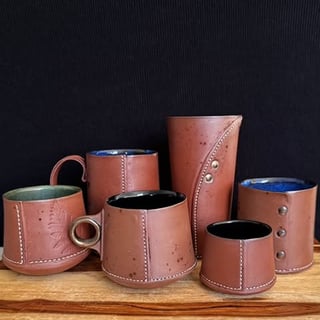
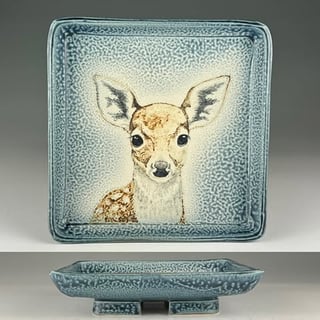
Speaker: So you mentioned your glazes, and I do like your glazes. How do you get this speckled effect that you get with your glazes? So I'm doing a lot of layering with my glazes, starting out with the greenware, the brown and pink dots that you see on the pieces. Those are applied on -go that I put on with a slip trailer.
Speaker: And then the glazes themselves I've got a transparent clear that I add lots and lots of different mason stains to to get kind of all the bright vibrant colors and then an opaque white that I layer on top of that. And I do a combination of dipping and spraying and each piece usually has
Speaker: three to six layers on it depending on kind of the color combos that I'm doing and as I said some of that happens through dipping in very specific ways and a lot of it happens in the spray booth. And the chemistry between the two glazes that I use when I put the transparent clear on first and then the opaque white over on top of it
Speaker: they do what's called a phase separation so that the white glaze, I think the clear glaze starts to melt first. And so the white glaze actually cracks a little bit. And then when it melts, it revulates into itself, which is what kind of makes that snowy texture on the outside surface. And I love that kind of magic of the chemistry between those two glazes. And if you flip them and put them the other way, they don't do that. They've got this beautiful creamy effect, but none of that beautiful speckling and riveting that happens.
Speaker: when you do them in just the right combination. That is amazing. So can you tell me what advice would you give to someone looking to alter their pottery a little bit? I think that you shouldn't be afraid of it. I think often you know we spend all this time learning how to throw and making the absolute perfect object and you know you've finally gotten something that the rim is even and the walls are the same thickness that is really hard to think about oh I'm gonna go in and I'm gonna
Speaker: somehow mess that up in some way and that it's good to sort of, when you first alter and maybe have never done it before, give yourself a piece and say, okay, I'm just gonna push the bejeepers out of this and see what happens when I push in, when I push in a little bit harder. What happens when I push out from the inside and how all of those different things can come together and not worry about that first piece, but just let yourself play. And then from there, say, oh, well, that worked really well. That maybe didn't work so well.
Speaker: you know, kind of find those things that you find those moments that you're like, ooh, this is really interesting and then try to push that. But kind of put that fear on the shelf and just go in and see what your hands will do, see what different tools will do.
Speaker: Keep exploring because it's such a huge set of things that you can do to a pod as soon as you allow yourself to take it out of the round off of the wheel. For those that are listening, it's important to explore and it's important to experiment. That's where you're going to find your voice. So exactly. Can you tell me the story how you started teaching workshops at your studio?
Speaker: So I have been teaching workshops for a really, really long time, mostly at other people's studios. And I love that experience. I really love going to a completely new place. And across the board, every workshop that I've taught, the hosts are always really welcoming and they're excited to show you
Speaker: their town and, you know, you get to go to their favorite restaurants while you're there and meet really interesting people and see interesting sites. But you're always in someone else's space. And so, you know, I send a list of I need these tools and I need this for these students and
Speaker: you know, kind of all of the parameters that you want to be met during the workshop and places are really good at doing that, but it's different when you're setting all of that up and you can really kind of craft that experience for the people kind of from soup to nuts, as they would say, in dining in a restaurant. So the workshops at my studio, I've really kind of thought about the things that I've enjoyed most at workshops myself and
Speaker: kind of the community experience that I want to build through them. So the workshops I do out in my studio are a week long. And so it goes from Sunday to Saturday. It's a full week. We do a glaze firing during the workshop. So we make pots and actually get them all the way through the entire process, which is wonderful to be able to get finished work.
Speaker: from start to finish. And then I also feed all the participants lunch every day, which sounds like kind of a simple thing. But I do it for a couple reasons. So the first one is we're about four miles out of town. And so if we took a lunch break every day where everyone went in, you know, to even pick up sandwiches or something, it would take a good hour to two hour chunk out of the middle of the day, which is a lot of time to lose when you've got such a short time period and you're trying to get
Speaker: work all the way finished through a glaze comb. But then also I had this wonderful experience. I taught a workshop in Sweden and the Swedes do this thing that they call FICA every day. And FICA is a coffee break.
Speaker: which, you know, it sounds like, oh, everybody takes a coffee break, whatever. Well, when I taught this workshop, they had the schedule set up, we started teaching at nine. And then at 1030, there was a FICA break. And then at noon, there was lunch. And then at two in the afternoon, there was another FICA break.
Speaker: And then at five, the teaching was done. And I was teaching the workshop with Ayumi Horie. And the two of us looked at the schedule and we thought, oh my God, you want us to take two coffee breaks that are half an hour long in the middle of a kind of short day already? How is this going to be productive? Like we want to cancel the FICA break. And the director was like, no, no, no, you have to.
Speaker: respect fika it's a very important part of our tradition and just you know try it the first day and see how it goes and what i found was that pausing where everyone left the studio you know for 10 minutes half an hour
Speaker: The conversations that happened around the table were amazing and weren't the same conversations that were happening when folks had clay in their hands. So what I found in my own workshops that lunch break that we have is this really great time for everyone to gather around a large table together and talk about what they've been doing in the studio, talk about their families, talk about their home life. And the conversations that happen around that dining table are just incredible and I think really
Speaker: enrich the experience of the workshop so much.
Speaker: It also, I think, most potters I know also really enjoy to cook and serve. You know, if you're making vessels intended for food, you can't help but want to see really great food in those vessels. And I, like so many potters, am a great collector of other people's work. And so this summer workshop event is a really great time for me to be able to actually see all of those pots in action.
Speaker: you know, to get to fill them up with these really delicious food items. And I actually, I spend the whole year kind of thinking about the menu and whenever I go out anywhere or try some new food at someone else's house, I think, oh, could that get added to the workshop menu? And so, so I love that I get to really craft the entire experience from, you know, the tools and the space that people are in to
Speaker: kind of what they're eating in the middle of the day and the work that they're going to get out of the kiln at the end. So it's really kind of this hopefully cohesive whole for the end of the week for all the participants. That was a really, really amazing story. So could you tell me, how does one get started teaching workshops?
Speaker: So for me, I was just really lucky right at the beginning of, so I finished graduate school in 07 and then
Speaker: I was on the cover of Ceramics Monthly in 09. So very shortly after I finished graduate school, I got on the cover and I was an emerging artist at Inseka that exact same year. So I had these two really big events kind of very early on in my career and people just started asking. So that little bit of publicity kind of sent me out into the world and then
Speaker: I have, again, through the different experiences that I've had, I've really tried to pay attention to my teaching as well as other people's teaching so that when I do go to a place to teach a workshop that hopefully the participants think that it's, you know, a great workshop and that they're satisfied with what they get from it. So while I was at the Bray,
Speaker: just after I finished my residency, they asked me to stay on as their education coordinator. And part of that job was organizing community classes, but then also taking care of the workshops all summer long. So not only did I get to do all the paperwork for them, but I also got to sit in on all these really, really amazing workshops. And so I was paying attention to what the person was making, how they were making it, but then I was also thinking about how they were teaching and really kind of trying to make sure
Speaker: That I took good notes of like, oh, people responded really well to this approach. Maybe they didn't respond so well to that approach so that when I go into the classroom, hopefully again, I'm, I'm being a good presenter, a good host, a good teacher.
Speaker: for all of these different workshop experiences. So folks started asking, but then I think I also, hopefully, I've been told that I'm a decent workshop presenter. So, you know, one often begets another, begets another. Someone will come to a workshop and they'll say, oh, that was really great. I want you to come back to my studio. Or they'll tell someone, oh, we really enjoyed Martha Grover. You should have her come.
Speaker: They kind of keep snowballing if you do a great job, then people keep asking, which has been great. That is awesome. So when you are teaching your workshops, what do you think is the most common mistakes you see? And how do you prevent them? Oh my gosh. I think, you know, we talked about fearfulness a little bit. So sometimes people will come in being really, really nervous.
Speaker: or they will feel very precious about the work, you know, they'll think, oh gosh, this is, I'm here for this, this one amazing thing and I can't make my hands do the same thing that Martha's hands do. Or, and I really try in my teaching to impart to people that you're, you're learning a technique that you're going to take and
Speaker: morph into your own technique rather than trying to exactly copy my work. So I try to approach altering in such a way that isn't we're learning how to make Martha Grover's pots exactly, but that we're learning how to push and pull a material in lots of different ways so that when then when you go back into your own studio
Speaker: you can start to find your own way with that rather than just copying exactly the thing that I'm doing. So I think there's that fearfulness and that kind of
Speaker: feeling that people aren't good at something they've never done before, which totally makes sense. If you've never played the violin, you're probably not going to be a good violin player the first time out. But the more you do it, the more practice you get, the more you let yourself open up, the better you'll get at it.
Speaker: So I think that's probably one thing. And it's again, it's just human nature. And I think it's been interesting over the years doing different teaching experiences from teaching high schoolers to teaching folks that are in their 90s. Often once we get past being in school, we forget how to learn and we forget how to be bad at something.
Speaker: You know, as, as you get older and older, you have practice driving. So, you know, you've been driving a car forever. You know how to do it. You've been talking forever. You've been speaking English forever. You've been, whatever it is, you know, we just kind of, we get into our routines. And so it's often hard to go back to learning something again. Whereas when I work with kids, they're learning everything. And so they're often less reluctant to dive into something that they've never done before.
Speaker: Um, so I think it's, it's often really important to remind people, this is new. You're not going to be good at it right out of the gate. And that's okay. It takes practice. It takes falling a few times before you learn how to ride the bike really well. So that was amazing for those that are listening here, you're going to suck at things. The first thing, the first time you try it, but yet if you come in with the attention of wanting to learn, you're going to come a long ways. When you discovered your voice with your pottery,
Speaker: What changed? What changed overall? You know, it was kind of an interesting moment for me. I think when I, so I finished my undergrad at Bennington College and then I went and did a special student here at Syracuse University. And I think it was about October during that school year.
Speaker: I did a series of five gravy boats and it was kind of, I was just starting to alter, taking things out of round off of the wheel, not copying things that I'd seen before. And I remember there was this moment I opened up the gas kiln and these five gravy boats were in there and I looked at them and I said, oh, wait a second. This feels different. Like there's something about these pots and they were
Speaker: They were altered, they were different than anything else that I had made before. And that's kind of sent me, and they were porcelain. So, you know, there's a whole bunch of things that are what my work is now all coming together in that one thing. And it just, like, I remember that feeling of excitement and wanting to go into the studio to make more. And I think often finding our own voice is just recognizing
Speaker: those things that we're excited about and then exploiting them as much as we can, you know, going in and saying, oh, I really love whatever it is, and then doing it more and more and more and kind of finding all of the different ways that you can do that thing. And what happens if you do this? What happens if you do that? And, you know, just really letting yourself full on dive into whatever that thing is.
Speaker: Um, and I, I think I was really lucky that in that moment, I kind of like, I remember the feeling in the studio of opening up the gas kiln and just, just being like, wow, what, what is that? I want to do more of that. Um, so I feel really lucky that I, I embraced that moment and that then it's, it sent me off onto a whole career of making thrown and altered porcelain pots. Who knew those five gravy boats. What advice would you give to someone looking to discover their own unique voice with their pottery?
Speaker: I think, again, I think it's recognizing those things in yourself that feel like they're you, more than that feel like you're doing something really well. Because I think you can be good at making something, but maybe it's not your own voice sometimes.
Speaker: So I think being able to recognize like what feels like it's actually you rather than it's just something that you're good at. And then also in that when it feels like it's you, it's you're going to be excited. You're going to be looking forward to making the next pot. Whereas sometimes if you're just really good at something, it's like, oh, gosh, I have to go and do
Speaker: whatever it is again, like I've got to make 30 more of those teapots that everybody really loves, you know, that everybody says is really good versus I just want to go and make more of those teapots. So, you know, and that's not a very concrete thing, but it's more of the internal feeling about your own work.
Speaker: And often it can be difficult, especially in the world of social media that we're in now, where you put your work out there and this pot gets 8 million views and this one only gets 500, but the 8 million view pot, maybe you're not so excited about making, but the 500 one you are, sometimes it's really hard with that super quick response that we get from the world to actually recognize what makes your heart sing.
Speaker: And I think finding your own voice is really about that conversation with yourself more than that conversation with the rest of the world. I love that advice so much. That was really great. As we are coming to a close here, what is one thing from this interview you want to hammer home with my audience?
Speaker: I think with clay, give yourself time and take the time to look at your work and be with your work and see what it is about the work that speaks to you that you want to keep having a conversation about. Again, it's often really, really hard to take that time, especially if you're making pots to buy your groceries. There's this constant
Speaker: make the pots, photo the pots, sell the pots, make the pots, photo the pots, sell the pots. And sometimes it can be hard to pause and actually spend some time with the work itself. And I think those are the moments that they keep pushing you forward and start making something that is unique and of your own voice more than just getting the things out there that sell and sell and sell and sell. Martha, you absolutely crushed it today. Where can my audience go and connect with you?
Speaker: So my website is very simply my name, MarthaGrover .com. My Instagram is MarthaHGrover. Don't forget the H in the middle. There's an author who's also blonde, similar age, who lives in Oregon, who is just Martha Grover on Instagram, but she'll let you know if you tag the wrong person. And let's see, on Facebook, I am also MarthaHGrover.
Speaker: Thanks for listening to this episode of Shaping Your Pottery. If you would like to learn how to discover your voice, I put together a free six step guide that will help you discover your voice and so that you can make your pottery stand out. Go to shapingyourpottery .com forward slash voice to get this free guide.