Transcript
Speaker: It takes time. You got to build the following and it helps to have a way that makes it so you don't have to worry as much about selling your work. Because if you're just worried about selling your work, you're first off going to undercut yourself.
Speaker: What is up, Shape Nation? This is Nick Torres here. And on this episode of Shape Your Pottery, I got to interview Caleb Zuhary. Caleb makes some really incredible, really bright colored and awesome patterns on his pottery. In this episode, you will learn how Caleb makes these awesome bright pattern color. You also learn about why you just need to keep going in order to start seeing success with your pottery. You'll learn about also having rules to follow to start making some pieces that look really, really good.
Speaker: And finally, you also learn about how teaching can actually lead you to more success with your pottery. And there's so much more in this episode, and I hope you guys enjoy it. I'll see you guys in there. If you love pottery and want to take your skills to the next level, you're in the right place. Find your own pottery style right here on Shaping Your Pottery with Nick Torres. Let's get started.
Speaker: Caleb, welcome to Shaping Your Pottery. And share with me, what is something potters should be doing to have success in pottery? Keep going. It takes a long time to get good. And I mean, to perfect your craft, it takes even longer. I've been doing this for over 20 years, and I'm still learning stuff every day. Absolutely. Definitely agree with that 100%.
Speaker: So tell me a story how you got started in ceramics. I started in high school. My school had a really good ceramics program and so I learned how to throw there. I learned about hand building. We did all low firework and I met a lady who had a studio and I did classes with her and really dove deep into it and really stuck with it.
Speaker: So do you contribute your success as an artist to your time at grad school? Can you tell me more about this? Grad school, it was great for me. I was expected to be in the studio for at least 40 hours a week, and I was there for probably at least 80 hours a week.
Speaker: I would do large kiln firings at least once a month with about a hundred pieces in each firing. And I mean, that was, that was it. It was just keep working, keep making, you're going to make bad stuff before you make good stuff. Absolutely. Shapingation, the more reps you put in, the better you are, your pottery is going to be. So keep making and keep making and keep making. I love that.
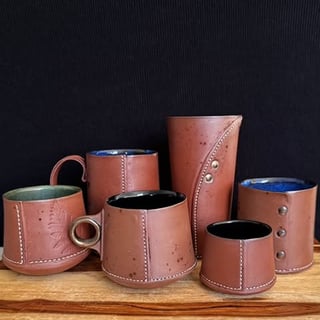
Speaker: So what is something you learned from your time at grad school that you still use today? It's probably the work ethic. My professor was really about being in the studio, making work, being there all the time, and that's what I did. So let's talk about your pottery. In one sentence, can you tell me what you make? I make highly decorative functional pottery. So tell me the story of how you started making this pottery.
Speaker: I probably started in grad school. Before grad school, I was working with a lot of soda firing, atmospheric firing. I started to get into a little bit of patterning, but it was mainly just about watching what the kiln can do. And when I got into grad school and I started walking away from the soda firing, mainly because I knew that once I got out of grad school, I wasn't going to have a soda kiln. And I wanted to be able to continue this as my profession.
Speaker: And so I started working with a gas kiln, started layering colors, started seeing how I could make gas -fired purples by taking a blue glaze and putting it on top of a red glaze, and then seeing those two colors blend together during the firing to make a purple. And at that point it was, it started off with a bunch of, I would
Speaker: cover the piece in dots of color. And when they were fired, they'd look kind of like dragon scales. And I really liked that. And from there, the very small patterns that I was making started to get bigger. And that's when I started to include a wax resist and started creating patterns of my own rather than just allowing the kiln to do its thing. So how long did it take you to actually figure this whole process out?
Speaker: a long time. I mean, I'm still learning. Each firing, I learn a little bit more, and it's all about looking at the smallest bit of the piece, something that you really like, and you explore what happened there. Some of it's just kill magic, but that kill magic is learning why that happened.
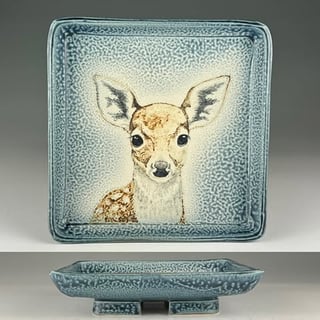
Speaker: And those those patterns just started evolving. They started getting a lot more intricate. And eventually they started turning into things like butterflies, which I'm doing a lot of right now. So we're going to talk more about your technique in a little bit. But for now, you are inspired by getting back into nature. Can you tell me how this impacts the way you make your pottery?
Speaker: So I live on the edge of the forest. I go into the woods a lot. I do a lot of gardening and working in the yard and stuff like that. And I see nature all around me and it's something that brings me joy. And so it's, I like to take those ideas
Speaker: and explore them and yeah. So can you give me a simplified explanation on how you create your awesome designs and patterns?
Speaker: It's really about the experiment. Technically, it's a bunch of layering of glazes. It's seeing how glazes react with each other. A lot of it is trial and error. The patterns that I'm making now, I've been making them for probably around five years now.
Speaker: And they've evolved over those five years. My brushstrokes have gotten more fluid. And the patterns themselves, it's like there are times, not as much now, but when I was starting, where I would get to a point and I wouldn't really know how to continue the pattern to make it cohesive around the piece. And just by doing and seeing and living with my work, I can
Speaker: I've been able to make it more of a cohesive pattern around the piece. So you mentioned experimenting. Would you mind expanding on that for me?
Speaker: Yeah, I create a lot of rules, especially with my patterns. When I do something, in order to make it look like it's a cohesive pattern around the piece, I mean, there are rules that you have to follow. Like, for instance, with the butterflies, if I make it too busy, it won't really look like it anymore. And in order to figure that out, it's taken many years of work. And yeah.
Speaker: What are some other rules that you put into place to help make your patterns come to life? I'm not not not really sure so like
Speaker: Some of the rules that I look at are like the way that I layer them. It's like if I layer them in a specific way, it's not going to work. And it took me a lot of trial and error to figure out which ways work better than others. For instance, if I cover the entire piece in black and then I do the pattern and then I put glaze directly on top of the black underglaze, the glaze will run and it'll get a little bit muddy. But if I.
Speaker: water etch it to take away all of the excess underglaze that's not waxed, then the glaze will adhere better, the pattern will stay crisper, and overall it looks a lot better, but it took me probably a couple years to figure that out. So let's talk about the business side of pottery. Can you tell me about the moment when you decided to go full time with your pottery?
Speaker: Right when I got done with grad school, I was, my wife, she moved me back to Ohio from Texas. And when I finished grad school, I was like, I need to work in clay. I don't care what I'm doing, but I need to be in clay primarily. And so I was looking at places. I found this community studio and I looked to try to get a job there. And first thing the lady would ask me was, you want to buy the business?
Speaker: I was like, well, let's see how it goes for a bit. So I worked there for about six months before taking over the business. And that gave me a revenue stream that I was able to use to build my own personal pottery business. And so I was running the shop. I had one employee at the time. So I was at the shop five days a week. And in the downtime, I'd be working, making my work at the shop.
Speaker: And then we'd have people come in and I'd teach classes and stuff like that. And then I had a personal studio at my house that I would do all of my glazing and firing there. So I was doing all greenware at the shop and glazeware at my house, driving this square to my house every couple of weeks. And I was also doing a lot of street fairs. And so I would make my work and then I'd go off and do a street fair.
Speaker: and everything kind of fed each other. It's like I would have a slow day at the shop but I'd have a busy day at the fair or I'd have a slow day at the fair and a busy day at the shop and between the two I was able to make it happen. Outside of attending grad school you also contribute success to owning your business and teaching beginners pottery. Can you tell me more about this? Yeah so I mean
Speaker: It's the same thing, like you just got to keep doing. And so by teaching people, I was able to see how beginners fail. And using their failures, I was able to make my own throwing skills better. I was able to fix their pieces, which by doing that, I was able to see how they were messing up and I could put that into my own work. And it made my throwing skills a lot better.
Speaker: So what are the steps someone should take if they also want to be able to start selling their own pottery and for what it's worth as well? It takes time. You got to build the following and it helps to have a way that makes it so you don't have to worry as much about selling your work.
Speaker: Because if you're just worried about selling your work, you're first off going to undercut yourself. And second, you're not going to be able to live with your stuff and kind of learn from it. And so by being able to make a living off of my second business, I don't have to worry about whether or not I'm going to be able to sell this mug in the end and so that I can take more risks.
Speaker: Love that shaping nation. You don't you don't have to if you could find another stream of income You don't have to be so focused on trying to sell your pottery and just kind of let it happen naturally. I love that
Speaker: So let's talk about discovering your voice. Can you tell me about the moment when you knew you were heading the right direction with your partner? It's probably when I was in grad school. I really, I mean, so even before that, I've always worked with food. I went to culinary school for a bit. I worked in a lot of restaurants and so I learned the business side of food too and seeing what works, seeing
Speaker: like working in a kitchen using low fire crocs to put under the broiler just to see like, okay, this piece of pottery is, it's a low fire pot that can withstand the heat. And I can, I'd learned to be able to take risks that way. And so I was able to feel more confident making things like bakeware with stoneware, knowing that a lot of it's just that,
Speaker: It's the way that you make the piece, not the actual contents of the clay all the time. And so in grad school, my thesis was the relationship of pottery and food. And so I started making a lot of pieces that were for specific dishes or to compliment the food that was going on the piece. And I like to use my work in my kitchen.
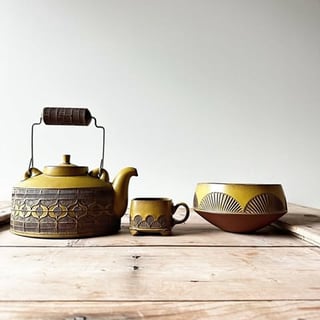
Speaker: And I mean, I work with flameware and so I'll put teapots on the stove. I work with bakeware and I'll make meals and stuff like that in my work. And I mean, my entire kitchen is like, I mean, I have a 40 piece dinnerware set that I made for our house that we use every day. And so I live with my work. So you mentioned that
Speaker: Part of finding your voice is the way you make the piece and not how it really turns out. Can you explain that to me further? It's about having even walls. It's about having a thick enough bottom that can withstand the heat.
Speaker: like especially like when you're baking and stuff. If you have a very thin lip, there's a good chance it'll chip, there's a good chance it'll crack, something like that. But if you have a well -thrown, even it will last a lot longer in everyday use. I definitely agree, definitely agree. Shapingation, the way you make your pottery and how good it is, that really determines what your voice is. I love that so much.
Speaker: So what would you say was your biggest obstacle when it came to finding your own voice? I think that focusing more on the function and less on the surface was a good start.
Speaker: Focusing on making a variety of items, not just making mugs and plates and bowls, but making coffee pots, teapots, serving trays, shot flights, anything that's going to be a little bit more creative, take a little bit more thought, stuff like that.
Speaker: What does finding your voice mean to you? I think that it means to be able to create a cohesive body of work that all speaks to each other. And with my work, a lot of it does. I mean, I just had a show at Charlie Cummings Gallery go up yesterday. And most of them were butterfly pieces, but there were a lot of different patterns. But I think that they still all go together because of
Speaker: form and function and color and a lot of these elements. So what advice would you give to someone trying to discover their own unique voice with their pottery? Keep at it. Keep working, try new things and kind of see what works. And I mean, my work has
Speaker: It's evolved over the years and I used to have critiques with one of my mentors during grad school and he would comment about how
Speaker: I had a very slow evolution of surface treatment and of form. And that's kind of what I do. I look at everything that I make, and then I think, OK, if I make this line just a little bit longer, or if I make these spots a little bit further than they were the last time, what would that say? And it's all about just really exploring your work
Speaker: Seeing what you like. Absolutely love that. So as we recover to a close here, what is one thing you want to hammer home with my audience today? Keep working. Love it. So Caleb, it was really great challenge today. Where can my audience go and learn more about you? I go to Instagram at Caleb Zuhari. I do all of my, my most current work is on there.
Speaker: I do a lot of videos showing my process and stuff like that on there and then it has links to where you can buy my work if you want to do that too. Thanks for listening to this episode of Shaping Your Pottery. If you are struggling with finding your own theme for your pottery so that you know you are known for something, I put together 53
Speaker: themes that you can use and you can take all you have to do is go to shapingyourpottery .com or slash 53 themes that's five three themes to get these 53 themes it's really important for you to find a theme for your pottery so that you're not going to get
Speaker: burnt out, you can have multiple styles with your pottery and you can be known for something. So again, go to shapingyourpottery .com forward slash 53 themes, that's five, three themes to get these 53 themes. Thanks guys, I'll see you guys next time.