Transcript
Speaker: I have this new rule of thumb with every piece, like every color pattern or every piece has to be something a little bit new or different. So I'm not repeating the same thing entirely.
Speaker: What is up Shaping Nation this is Nick Torres here and on this episode of Shaping Your Pottery I got to interview Ashley Gaunt. Ashley makes some really incredible pattern and different color design pottery. In this episode you'll learn how Ashley makes her unique pottery. You'll also learn about how embracing change is really the best thing you can do for your pottery.
Speaker: You'll also learn about asking yourself questions to dive deeper onto what is happening into your pottery. Finally, you'll also learn about the power of making new pieces for your works to prevent boredom. And there's so much more in this episode. I hope you guys enjoy it. So I'll see you guys in there.
Speaker: If you love pottery and want to take your skills to the next level, you're in the right place. Find your own pottery style right here on Shaping Your Pottery with Nick Torres. Let's get started. Ashley, welcome to Shape Your Pottery and share with me what is something you love besides making pottery. My boyfriend Clyde, he's a pit bull, brindle, and he's the puppy love of my life. I love that. So tell me the story how you got started with ceramics.
Speaker: I had exposure at a young age throughout school. I didn't always have the privilege to take classes or practice art, but it was something that I always wanted to do. I just remember that I had this inkling of wanting to know how
Speaker: things were made whenever the few occasions that I had the opportunity to go to a museum and see like ancient Egypt work, for example. And so when I had the opportunity to take an art class, I was really into it. And the further along I got in grade school, I just started taking more and more classes. And then in college, I finally had the opportunity to learn how to throw and I've been doing it ever since for the last 17 years.
Speaker: I love it. So very recently you did something called The Labyrinth of Consciousness. Can you tell me the story about this? So LOC was my first solo exhibition hosted in February, March of 2023. It consisted of over 600 translucent porcelain lanterns. I built a labyrinth of them in a 14 by 26 foot room and they were suspended
Speaker: in a way where you could walk through them. I had shards on the floor. I had about 14 clocks that I also made out of stoneware throughout the show. And all of the lanterns were illuminated with LED tea lights. So that was the only source of lighting in the show. And it was, there were a lot of metaphors between time
Speaker: given with the clocks, as well as just our life journey, existentialistic metaphors between mortality and how we move through our lives, our challenges, embracing our competent reflection as we look back throughout the exhibit. And, because there was an entrance and an exit to the show. So I really wanted to emphasize the importance of
Speaker: embracing the existence and the experience and how we maneuver through that because it had a lot to do with the purpose of the exhibition, how we
Speaker: maneuver through our lives even just like one situation or experience that we're going through how we show up and hold ourselves through it if we choose to face challenges and if so how we move through it and what we allow to
Speaker: accept and learn and grow, so on and so forth. How we, whether or not we choose to conquer and the things that fall away which was the metaphor behind the shards which were actually broken lanterns from when I was
Speaker: stringing them together because they were strung together in columns. So it was a huge influence of growth and how our environment and circumstances and situations throughout our lives and our journey influence us and how they shape us into who we are as time goes on. How we learn boundaries and accept ourselves and build self -respect, so on and so forth. So that pretty much sums it up.
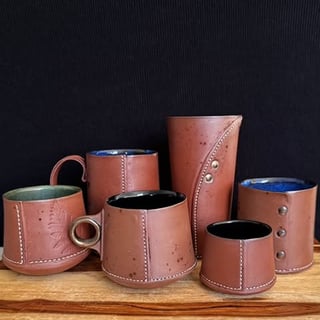
Speaker: I love hearing about that. So let's talk about your pottery. In one sentence, can you tell me what you make? I make reminders that we are art in and of ourselves in all of our glory and in all of our flaws. So that is basically the metaphor behind my choice to use illusory patterns or simplifying it checkerboard patterns. It's a visual reminder that
Speaker: of that same metaphor of not everything is what it seems on the surface or at face value. So I explore different objects, whether they're conventional or unconventional, functional or not. I really like to expand and dig deeper when it comes to functionality and not just stick with pottery. So I love that. So tell me a story, how you started making the pottery that you make today.
Speaker: When I was retrieving my BFA, I had already gained a consistent body of work as far as form and object, but I wasn't fully satisfied yet. So I started playing around with surface decoration, whether it was like following the contour or just playing around with different patterns that I liked. And that's when the checkerboard pattern started to play in. And I knew at the time that
Speaker: after graduation I wasn't going to have that same kind of facilities after graduating so I was already mentally preparing for the direction afterwards and what I was going to do with my work and incorporating a lot more color going to a lower temperature so I knew that part of my work was going to change and so about a year after graduation was when I made the first collection of
Speaker: basically what you see my work has developed into now with the amount of color with and refining those forms and implementing new forms and objects. I love that. So you are inspired by life, color, geometry, and form. Can you tell me how this impacts the way you make your pottery?
Speaker: Yeah, so I have a very technical oriented brain. I like to, I actually have learned that ceramics has really helped me balance my left and right brains. So, and that's where all of these elements come into play. I love geometry just in it and everything that it is. But when it comes to ceramics, the fact that it implements
Speaker: geometry and physics, especially of form and all the technical aspects of clay as a medium and glaze as a medium, all the things. Those really inspire me and keep me motivated to dig deeper and just want to keep investigating and ask the why questions, the how questions when it comes to my work and just clay in general.
Speaker: Color, I'll take photos when I'm out and about not even thinking of my work or projects or whatever and I'll just see a pattern that I want to play with. Whether it's a line pattern or color pattern, I'll take photos, I'll save photos online.
Speaker: And a lot of times I'll imagine a form with a certain clay body or a certain color palette that I want to try and play out or play with. And I experiment with color a lot, whether it's layering color or mixing colors. And I have
Speaker: what I like to call a pottery foot fetish, which plays in with my geometry and physics of clay. Everybody always gets a kick out of that whenever I mention it. I love it.
Speaker: I have this thing with really tall, skinny feet on a piece, whether it's a sculpture or pot, regardless of how tall it is, but in relationship to the height and scale of that tall, narrow, skinny foot, in conjunction with either how wide it gets or how tall it gets. So there's just something that makes my heart and my eyeballs and my creative brain just like, yeah, I love that.
Speaker: But so, and that ties in with my work, you know, my conical forms, they'll come out really wide and they'll have just like a little foot. And, or even like a really tall skinny piece and then it comes down to a point that's really narrow and then it has like a tall skinny foot. So that's always something that I feed in my creative pursuits. And yeah, I think I mentioned everything else in my notes with that.
Speaker: So it's funny that you mentioned the foot because every single time I see someone's pottery or just anywhere, I always look at the foot first. That's always the first thing to look at. I love that. So earlier you mentioned that you would ask yourself the questions why and how relating to your work. Can you explain that to me further? Say that one more time. I'm sorry. So earlier you mentioned that when it comes to creating the work, you will ask yourself,
Speaker: Questions like why or like how does this relate back to my work? Can you explain that to me further? So with, for example, when I'm experimenting or even going back in my early days, when for example, why did it warp or break or crack or whatever the case is then, but not now, or vice versa, things like that.
Speaker: Why did this color or this glaze come out like this right now versus the last time I used it? So things like that that really intrigued my motivation to investigate the chemical and physics and the firing processes and all the variables like scientific related with ceramics. That's where that's coming from.
Speaker: And I love the fact that ceramics always has that sense of unpredictability, mystery. It just, I love the fact that I'm always investigating something further. No matter how much predictability there can be, there's always some form of surprise right around the corner. No matter how much you study it, it's always going to surprise you.
Speaker: I love that. Shaping Nation, the best thing you can do for your pottery is just start asking questions about your pottery. Why do things happen? Why does this happen? Because that's how you're going to grow and that's how you're going to find out more things. Yeah. And then another aspect of or another answer to that question is me internally.
Speaker: I find myself asking myself these whys and hows in a different relationship as an artist. I'm just like looking at my career, I take a step back, I pause and I'm like, what am I doing? Why am I doing it? How am I really doing it? Like not just right now or recently, but how do I want to move forward? And is this like, is this working or how can I do it better? Kind of like a hindsight, so to speak.
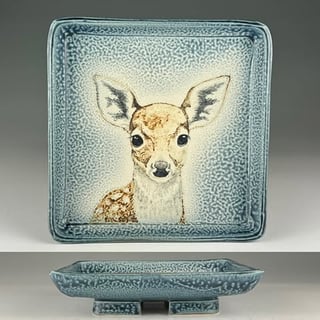
Speaker: Yeah, I love that. So can you explain to me how you create your unique patterns and designs onto your pottery? I use Mishima and I usually do it on you know, a traditional like leather hard state, but I don't use slip I use an oxide stain mostly sometimes I'll play around with in weighing and under glaze or glaze and
Speaker: then I'll wait until it gets bone dry and I clean all the lines up and then I bisque or sorry then I inlay and then I bisque and then I fill in the pattern a lot of times I'll center so that especially if I'm using an oxide or a stain so that it doesn't move when I glaze and I play around a lot with layering glaze or underglazes or a combination of
Speaker: The two and Reese in the last five years. I've done a lot of layering and down firing So and in the last several years at least three years I've been I've had this what's the word I'm looking for I have this new rule of thumb with every piece like every
Speaker: color pattern or every piece has to be something a little bit new or different. So I'm not repeating the same thing entirely. And I've also started to play around with blusters and sometimes I'll implement decals. I basically, I keep adding to a piece until I'm happy with it and it's done. I love that. So let's talk about discovering your voice. Can you tell me about the moment when you knew you were heading in the right direction with your pottery?
Speaker: I've had several of those moments. The first one was when I got accepted to ASU to finish my BFA in 2010. And then shortly thereafter, when things started to fall into place with taking that shift, I also got accepted to Sam Chung's workshop at Penland. So not only was I going to be moving to ASU and taking, he was going to be becoming one of my new mentors alongside Kurt Weiser and Susan Beiner at the time.
Speaker: But I also got accepted to Sam's workshop that summer before starting classes at ASU. I've had several other occurrences throughout my career, such as I was personally invited to work at the Archie Bray Foundation following my graduation at ASU. And it was funny, I didn't know what I was really getting myself into. I just happened to be
Speaker: in the right place at the right time, visiting with friends at Encica in Seattle. And I met Emily Free -Wilson of Free Ceramics, and at the time she was the gallery director at the Archie Bray Foundation. And she invited me to help repack the permanent collection that summer, and I was just like, sure.
Speaker: Just very nonchalantly, didn't really know what I was getting into and I showed up. It was a two week run and I actually was late for my flight and thought I ruined the whole occasion.
Speaker: But I got there and we hauled ass and we got it done. We moved the whole permanent collection in less than two weeks and repacked it all and was personally invited to be the gallery assistant the following year. And so it was just mind blowing that I was in that situation and had that reality kick in when I was there because all of a sudden I'm holding
Speaker: artwork that I had only seen like on a computer or in you know ceramics monthly or in a book and I have it in my hands and I can't tell you how many times I had to stop and just like take in the moment and just couldn't believe what I was what was happening and
Speaker: Yeah, it's, I've had a few other occasions, like getting my residency at Taos Clay back in 2017. And I had a moment where it was like all of a sudden, I think at that point I was in 11 years of my career and I had taken on being the program director alongside my residency and was helping to rebuild the program across the board and
Speaker: had a moment a month in where I just saw everything and my 11 years up to that point just come full circle and like everything started to make sense. Yeah. I love that. I absolutely love that. Shapedation. There's going to be a moment when your pottery is all just going to start coming together. You have to be patient for when that happens. I love that so much.
Speaker: So over the last 17 years, since you started making pottery, what is something that has helped you the most with developing your own style? Trying everything. I did that for at least the first six, seven years. And trying everything that I could throughout that time, especially throughout undergrad. Learning from as many people as I could, professionals, my mentors, and
Speaker: other professionals in the industry that I met along the way, learning from my peers, learning from my mistakes, because that's always very important. Learning how to get out of my own way and testing my limits, which just falls in line with how I learn. I learn through observation. I learn from
Speaker: Like I said, learning from my mistakes and that comes back to what I mentioned earlier of asking the why's, asking the how's. And testing my limits, facing challenges, giving myself challenges in a way where I'm in competition with myself. So trying to become better than I was five minutes ago or yesterday or a month ago or last year.
Speaker: So you contribute your growth as an artist to always having small and big goals as you kind of just hinted on. Can you explain to me this further? Yes.
Speaker: ties in with my last answer. Smaller goals range from projects to opportunities to skills or techniques. For example, over the summer, I just gave myself a new small goal of and challenge on the wheel. I've been throwing for 17 years, but I'm like, I need a new, a new motivator, a new little goal with this. And my goal was.
Speaker: trimming in one or sorry throwing in one part but as tall as I could and I started with seven pounds and but no trimming and I I don't know about anybody else but I because I love to test my limits
Speaker: I love to throw as thin as I possibly can. I don't know why. That's just the stubbornness in me, I guess. I don't know. I like to test the limits of the clay, too, I guess. Not just my limits, but so I was alternating the piece multiple times, so I wasn't just throwing it in one straight shot.
Speaker: that was the next kind of challenge and big goals are either bigger projects or long -term goals such as hopefully building my own studio at some point and small goals are for me anyway they're more specific they can sometimes coincide with one another for example like i have an idea for this installation or this project and
Speaker: I also want to apply to five exhibitions this year. So maybe that project will eventually fall in line with one of those other goals such as applying for a show. If I feel confident that that piece will fall in line with one of those exhibitions that I want to apply to. And I keep my goals open for opportunity or inspiration. So.
Speaker: I love that. So what advice would you give to someone trying to discover their own unique voice with their pottery? Try everything that sparks your interest. Never stop experimenting. Never turn your practice or your work into too much of a job. Keep the sense of play and fun in it, no matter how serious you get with it.
Speaker: work with different artists, especially artists that do not create the same kind of work or have a similar approach to you or how you have with your work. Because you never know what's going to turn on the light bulb of inspiration in your mind, what's gonna influence you, what kind of skills you're gonna gain out of it. So things like that are invaluable. I always encourage people to work with different artists
Speaker: that capacity and organization so on and so forth. Take opportunities despite your fears and insecurities honestly if you're my philosophy is if you have that trepidation it's usually because you're ready you're ready to face that challenge so go with it take it on follow
Speaker: what you feel driven to do or pursue or try, whatever that is. Even if it doesn't make sense right now, you never know when it's gonna fall in line later down the road. It may be later. So that's my advice. I love that so much. That's an excellent advice right there. So as we're coming to a close here, what is one thing you want to hammer home with my audience today? Know the difference between giving up
Speaker: Walking away and press pause. Learn boundaries and self -respect along the way and honor where you're at. Know your limits and test them and trust your reset mode. Trust that you will hit the ground running when you have that inspired idea or hear of an opportunity that falls in line with
Speaker: your goal or your project, whatever the case is, whatever it is your heart is yearning for, what you're looking for. Your work will never support you if you are not willing to support yourself through it. And especially if you're not willing to support your work. Absolutely. So that's what I have. And I'm sticking to it. That was some great party words of advice. Ashley, it was so great chat today. Where can my arms go and learn more about you?
Speaker: So I'm on the gram. My name is mud by Ash and that's mud with two D's same with Facebook. They're all the same. As far as the platforms, my handle is the same. So my name is mud by Ash, whether it's Instagram, Facebook, Etsy, my website, my name is mud .weebly .com. Yeah.
Speaker: Hey thanks for listening to this episode of Shaping Your Pottery with Nick Torres. If you want to discover how close you are to actually discovering your own unique voice with your pottery, I put together a free
Speaker: 4 question quiz, it's very short, it takes 30 seconds for you to take. If you want to know how close you are to finding your own unique voice, go to shapingyourpodtery .com forward slash quiz or you can simply go to shapingyourpodtery .com and it will be right there at the top. I hope you guys enjoyed this episode and I'll see you guys next time.