Transcript
Speaker: Hey, real quick before we get started and get into the episode, if you want to figure out how close you are to discovering your own unique voice, I put together a free little quiz for you to see how close you are to finding your own unique voice. If you would like to take this quiz, go to shapingyourpottery .com forward slash quiz, or you can just go to shapingyourpottery .com and it'll be right there.
Speaker: What is up Shaping Nation? This is Nick Torres here and on this episode of Shaping Your Pottery I got to interview Yoshi Fushi. Yoshi makes some really incredible carved design pottery and in this episode you will learn how he thinks about creating his carved designs. You also learn about his time during his residencies in Baltimore, Taiwan, and even Dubai.
Speaker: You also the final thing you'll learn about is the simple act of just showing up to the studio and why that is so important to helping you being able to find your voice. Hope you guys enjoy this episode and I'll see you guys in there. If you love pottery and want to take your skills to the next level, you're in the right place. Find your own pottery style right here on Shaping Your Pottery with Nick Torres. Let's get started.
Speaker: Yoshi, welcome to Shape of Your Pottery and share with me what is something people might not know about you. OK, I think people think I'm outgoing, but I'm super shy. I smile and I talk to people because it's a job or it's in my classroom, but I tend to be rather quiet. So people might not know about me. I love that. So tell me a story how you got started in ceramics.
Speaker: Yeah, so when I was in undergrad, I was studying Spanish and anthropology as my first two degrees, but the GP way was going kind of bad. So I decided to take non -credit ceramic class, night class for fun. And I really got into it and I ended up adding another degree in fine art. So that's how I got myself started with the claim. So tell me about the moment when you decided to study in the United States.
Speaker: So when I was in high school, I studied every day. I thought everything was just fine, but I think it's a common teenager thing that you start getting kind of sad, and I start hating myself, my family, my friends, and all schools, and I just had to get away. Then I decided to pick up a little suitcase and decide to move to U .S., and after I landed, I just never really left.
Speaker: So that's how my trip started in four years in college and that being no full month in language school and that being four years in college and four years became longer and longer and longer and I'm still here after 20, 25 years. So a little bit longer than that. What would you say was your
Speaker: I guess your biggest obstacle when you moved to the U .S.? Oh, language for sure. And the first place that I landed was in Mississippi. And that's my second home, maybe more home than my home in Japan. And I'm actually going back home in a couple of weeks. But the location was interesting for 18 years old Yoshi, I guess. Culture shock. Yeah.
Speaker: So after getting your MFA, you decided to attend some residencies, one in Baltimore and the other in Taiwan. Can you tell me about these experiences? Sure. So I chose to go to graduate school because of my visa status. I have to have students status to stay in this country.
Speaker: Then I went to school in Carbone, Illinois, Southern Illinois University at Carbone. And that's the 3 years program because I did not know what exactly I wanted to make during that time. So I intentionally chose 3 years program. And as I.
Speaker: was graduating, but a lot of people are doing job search or just trying to find a place to be, then I just ended up sending one little application to Baltimore Playworks when I was working on my thesis show. One application got me in, so I guess it just meant to be, to be in Baltimore. And it's a long -term residency.
Speaker: And again, one year led to a longer term. And I left a little bit in 2016, but I'm still living here in Baltimore. And the residence in Taiwan, we have connection with art school in Taiwan. And we do the exchange artists. So we send some artists there. And we used to bring one or possibly two artists a year.
Speaker: In 2010, 2011, I decided to have eight weeks residency in Taiwan. So yeah, that's my residency experience. Also, I went to Dubai a little bit. That was a teaching residency. But whenever the opportunity comes, I try to go to different places to see what's up. So from these residencies, what is something you learned that you still use today?
Speaker: So like in, in terms of what though, like what I use in terms of like how it affects your pottery pottery. Okay. So the experience in Taiwan, especially was interesting because, well, I guess I am from Japan and we share a lot of similar culture, but when I was there, a lot of great conversation started around drinking, not necessarily alcoholics drink, but the, the literal tea.
Speaker: And those folks are using the pieces made by themselves and with other people. So all the conversation around those handmade objects made me realize that I'm making a work to make those connections. So again, wherever I go to the residency, I meet new people. And yeah, that's something that I
Speaker: Wait, I guess the answer was not really correct, isn't it? The word use. But I use that experience to ensure that I continue to make work. I don't know if that's the right answer to it or not. No, I love that a lot. Can you tell me how attending residencies helped you with growing as an artist?
Speaker: Sure. So, again, if I go to different places, I appreciate what I have here in Baltimore. You know, my set space, I know where everything are, or I know the kiln, or I know all the settings. But when I go to different residencies, you're kind of forced to
Speaker: make the work you before like settle in within the short period of time or set a lot of time. So you will learn how to manage your time, manage your space to be creative and make some scheduled pieces in those opportunity. I love, I love that. I love that shaping nation.
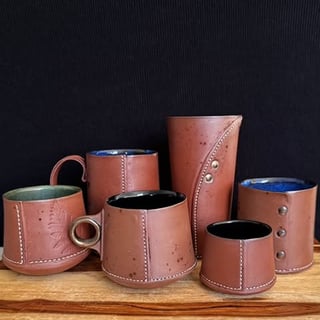
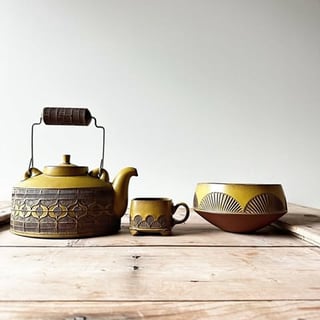
Speaker: If you can learn to manage your time a little bit better, then you're probably gonna be able to focus on the right things to be able to make better pottery. I love that so much. So let's talk about your pottery. In one sentence, can you tell me what you make? Okay, so I work functional pieces through a woman, and now I use stoneware on the curved surface, and I fire it to cone five.
Speaker: hard, high, hard, confined. Not quite since. So can you tell me the story of how you started making the party that you make today? Sure. So again, like I just fell in love with the functionality of the object. So from the time that I just start, you know, taking part of it for fun, I was always drawn into the functional stuff. And I spent significant amount of time using post money here.
Speaker: I thought that technical challenge of working with that material and just just pure clean clay, white clay, I really enjoyed it. And also my carbon, the technique of carbon was just to show off the skill. So everything just kind of matched together.
Speaker: And again, I spent my graduate school. And after I started my residency in Baltimore, I was only doing porcelain, celadon, carbon, all that. But as I was working with different teaching job or some other responsibility, I did not get to spend too much time in my studio. And filling up the kiln, gas kiln, the large gas kiln with my own works was a little bit too much.
Speaker: and I only could fight like maybe twice a year and that's not really enough and I was losing a lot too because of porcelain and I handle so much with
Speaker: during the carving process. So I was losing a lot through warping or cracking and all that. So I decided to switch my clay to a different clay body. And I think I mentioned a little while ago about the trip to Dubai.
Speaker: But that residency, I have to purchase everything that they own from here in the US. So I have to purchase clay, glazes, tune, all the equipment from here and ship out to Dubai.
Speaker: And, of course, they did not have just young and they did not want to work with porcelain at that time. So I have to figure out how I can make my own work too. And that's why I discovered often where in like.
Speaker: the stone mirror and it just went from the white clay to the dirty black clay and that kind of opened up my eyes like oh my god I don't have to do the porcelain anymore all I have to do is just make small batch and put in a small electric kiln and
Speaker: people pop up and that's done, right? I mean, I didn't have to babysit the gas kiln for 20, 24 hours. So I might, my work, I don't have much of the loss anymore. And I just start seeing my work in different way. Long answer. I'm sorry. I love that. That was a really great story. So you are inspired by
Speaker: Viewers of your work as active users, can you explain this to me some more?
Speaker: when my work is being used, right? So when I go to my friend's house, and if I know they have my work, I'll look through the kitchen and try to see where that piece is. And if I see it in the sink, I'll be like, yes, this person just used it this morning or a week ago, whenever they did the dishes, right? And when I was making porcelain work,
Speaker: because of the delicacy of it. I think people tend to put it in the cabinet and never they never really use. So that's another reason why I wanted to make a different clay body, but I just want to make the work to be used really like the cup would moist your body through, you know, with a fluid or whatever. Like I just want to see my working action. I love that shaping nation.
Speaker: If you could see your work in action, then you can get an idea if you're going in the right direction because that's where your voice is probably gonna show up a lot if you could actually see it in action. I love that a lot.
Speaker: So can you give me a simplified explanation on how you create your carved surface designs? Sure. So everything is thrown, almost everything is wheel thrown. And also I have to throw those objects in certain size so when it gets leather hard it's on the right measurement.
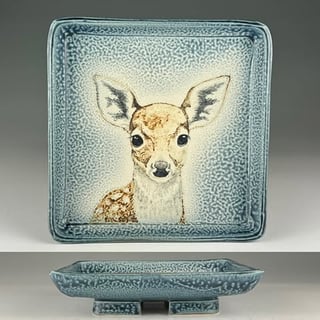
Speaker: And I use just simple penciling ruler and just draw all those lines and patterns and just start carving using small sculpting tools. Yeah. Sometimes I have different motifs, not just the geometric patterns, but I look at like advertisement or like tattoo design, some random motifs and try to incorporate onto the surface.
Speaker: I that was a really great explanation. So how do you think about the way you create your designs? For example, some some of your pieces like the whole pot is covered in.
Speaker: of full design, while some is just only a portion of the pot. Can you explain that to me a little bit more? Sure. So I guess it's my personality. I think I overdo and to get so excited about the surface design. So as you said, I tend to cover the entire surface with the pattern, but I have to long to back out a little bit, back off a little bit.
Speaker: And I think the good example, I've been looking at it and I still, I have been looking at it and I still do, is the oribe ware from Japan. The green glaze in one side and the beautiful, like the iron wash drawing on one side or whatever. Like I have to learn how to be positive and negative, like active and
Speaker: kind of for me quiet like i have to have two parts instead of like in your face or pattern i do enjoy it of course i mean when i feel my cup like i can feel the surface and i really enjoy it but visually it is okay to have this busy area and also have some quietness inside so i'm learning to
Speaker: not to put the pattern or the motif in or the surface. I love that so much. Can we talk about it? I think some questions are right on the target. How do you know? That's the stuff that I've been thinking about. To me, it's a great question too. Thank you for asking that. Yeah, you're welcome. I do tons of research beforehand. I thought it was so interesting
Speaker: like how some pots work, only recovered it fully in design and others weren't. I just thought that was really interesting. I really wanted to ask you that. So that was like a question. I love that so much.
Speaker: Let's talk about discovering your voice. Can you tell me about the moment when you knew you were heading in the right direction with your body? So my mentor was the one who told me about this direction. And during the conversation, he told me to look for Yoshi -ness.
Speaker: In the beginning of my career, of course, I didn't know what I was making, but he encouraged me to look for something that people can identify out of all the hundred cups. And if people could say, this cup must be made by Yoshi, that's your personal style.
Speaker: And that was a good, good mentorship from him. I always thought about it, and now I'm teaching undergraduate students and even graduate students. I always tell them the same thing. Like, when I see your work, I want to recognize that's your part. So that's the journey as a maker, isn't it?
Speaker: you want to make something to represent you, the part should be you. So sometimes you want to meet the artist that you like.
Speaker: And the part ended up being kind of like, okay, but sometimes like the magnificent piece, you just never know what this artist is. Does it make sense? I don't know. Yeah, I love that. But I met some artists too, like, oh God, I really like this work. Then when I met this artist in person, it's like, oh no, I can definitely tell like this is made by you.
Speaker: It's like, that's what I want to become. I want to make my work and say, yep, it's Yoshi's work. That's the ultimate accomplishment, I think. I love that so much. Shaping Nation, try to make pottery that can be distinguished by other people. It's like maybe showing off your own personality or interest, whatever that is, just make it interesting to you and make for yourself first. I love that so much.
Speaker: So what would you say was your biggest obstacle when it came to discovering your own voice? Not having enough time in the studio, I guess. It's a consistent journey. I don't think I've had my voice quite yet.
Speaker: I think I'm on the right direction, but because of other obligations, right, we have to pay the bills. So I cannot spend the whole time in my studio quite yet, but I don't think I have made enough work. So that's the problem or struggle looking for the voice. I don't, I don't think I make enough work. So what advice would you give to people trying to manage their time a little bit better?
Speaker: Oh God, I'm not that good person to say that though. Cause like I have full -time job at Baltimore Play Books as an exhibition in the shop director. And I, last year I was teaching eight classes at six different schools and I was making my own work. So somehow I did it, but I don't think I can
Speaker: give any advice for time management because I struggle so much I'm total like a procrastinator I'll just wait until the last minute to do everything so but if you if you want if you have to make the work in the studio you all even though you might only sleep for a couple hours I mean it's just if you have the deadline you have to meet
Speaker: God, as long as you don't get sick, I guess you just have to stay in the state. Oh, then another good thing though, another mental mind. I had a problem or I had a struggle with the time management, like you said. I just could not spend time at all in my studio. And she said like, Yoshi, you don't have to make anything, but just go to the studio and sit for like five minute, 10 minute.
Speaker: You don't have to, but you have to make into the habit of just being in your studio. I'm like, okay, I'll just do that. And since then, like, maybe it took me how many days, maybe three days, five days, maybe a week. I did not get to make, but.
Speaker: by being in the studio looking at my tools or looking at the shelf, empty shelf, half empty shelf, and it starts thinking like, I want to make it. Like, this is the reason why my studio is here. I'm still connected to Baltimore Playworks. Like, I want to make this work so that like, oh, I'm busy. I cannot make work became like, no, I really want to make the work. So it was good. It was good for me to forcefully be in the studio, even though I didn't make it.
Speaker: I love that so much. Shaping Nation, the hardest part about actually making things is getting into the studio. So if you build that habit of just getting into the studio, you're more likely gonna be able to make something. I love that so much. So what is a quick win someone can do to help them discover their own unique voice with their pottery? So to my student, I always tell them to like,
Speaker: going to like an Instagram page or whatever the random source is. But now it's so convenient because that little computer is our cell phone, right? So just swipe your finger, you can just connect to all the sources without any issues. Back in when, the old people like us, we, or like the beginning of the internet, we still need to make photocopy.
Speaker: of artwork from ceramic monthly or other magazines. So I still say that to my students too, but just keep the portfolio of the work that they like and also the stuff that they don't really care for.
Speaker: And maybe a week, maybe a month, a year, whatever, after this stack of actual printed out paper, you just put it on the table and look through the similarity or differences or some sort of connection. Then you start finding like, why do I like these things?
Speaker: So that's how maybe the voice start coming to life. Like that could be the clay object or could be other just maybe the woodwork, glasswork. It's something to do with art or it could be nature or it could be like a cityscape or whatever like not just
Speaker: clay object, not just art object, but they can also look for some inspiration from other sources. So, looking for the voices may be forcefully put into paper, not again the screen, screenshots and everything in the computer or the cell phone is gray, but there's something about printed paper and you can see it on the surface might have a different impact.
Speaker: I love that. So as we're coming to a close here, what is one thing you want to hammer home with my audience today? If you, see, I have a way of saying in this, but after this 20 minute of the conversation, it's kind of, okay, I never expect it to become a powder, but
Speaker: I made a promise to myself as I start this career. If the opportunities there are only to continue to make work, I think I'm on the right path. So I was about to lose my studio one time, but some other people be like, oh, I heard you're looking for a studio. Would you like to come?
Speaker: Like, sure, I didn't expect that, but somebody that I didn't even know made me the offer. When I was applying for graduate school, I sent an application, but that program told me, we want you, Yoshi. Please come and study with us. It's like, okay, great. Even Baltimore Playworks the same way. I sent just one application, and they said, Yoshi, we want you here.
Speaker: Great. Thank you. So it's about like the opportunity and make yourself available. If I could do it, I think anybody can do it. So just being honest about.
Speaker: What you want to do is just make yourself available for those opportunities. There's some unexpected opportunities out there. Just like the trip to Dubai, two and a half years, I had one little phone call, one little email from this Asian looking for a clay teacher. I'm like, sure, I'll do it.
Speaker: And originally it was three months. In three months became six months. In six months became two and a half years of wonderful, wonderful experience. So right time, right movement and right attitude, right people too, especially. So I'm so grateful that I met all the people that made this happen. So keep yourself available. That's what I can say.
Speaker: Absolutely great. Last parting words. Yoshio, so great chatting today. Where can my artists go and learn more about you? Yes, you can find me at Yoshifuji .com, which I have not really updated. But you can find me on the Instagram, Yoshifuji ceramics, and I'm at Baltimore Clay Works. So you can always come and find me.