Transcript
Speaker: Hey, real quick before we get started and get into the episode, if you want to figure out how close you are to discovering your own unique voice, I put together a free little quiz for you to see how close you are to finding your own unique voice. If you would like to take this quiz, go to shapingyourpottery .com forward slash quiz, or you can just go to shapingyourpottery .com and it'll be right there. I'll see you guys in there.
Speaker: If you love pottery and want to take your skills to the next level, you're in the right place. Find your own pottery style right here on Shaping Your Pottery with Nick Torres. Let's get started. What is up, Shaping Nation? This is Nick Torres here, and on this episode of Shaping Your Pottery, I got to interview Ellen Robinson. Ellen makes some really incredible functional pieces that she depicts psychic landscape of informs in abstract
Speaker: from nature and from other things in her life. In this episode, you will learn how to make Ellen's functional sculptural pieces. You'll also learn about going out into galleries and going out to museums to take inspiration from other potters and other artists in general. Finally, you'll learn about just the power of just doing things to figure things out, right, to do things
Speaker: that is in your mind and putting that into action so you can actively figure it out.
Speaker: Ellen, welcome to Shaping Your Pottery and share with me what is something you believe potters should be doing to make the best possible pottery they can. Thank you for having me on. Yeah, I mean, I think for me to make the best work is really to just do something that's deeply felt. I think, you know, a lot of the reason that we get involved in making art in the first place is something that kind of
Speaker: touches on the deepest part of who we are and it really is a place like to access that place is really a place of like profound like personal freedom like and where you're really just the most yourself so I think just trying to get into that mental state when you're making things and thinking about things is I think the best any of us could do.
Speaker: Absolutely agree. I absolutely agree 100 % with that. I feel like if we have more connection to it, then we're going to make something that is truly amazing that we think is also amazing as well. I love that answer.
Speaker: So tell me the story how you got started with ceramics. Yeah, it's sort of funny. I love this question too, because it's sort of like, I think a lot of us working in ceramics, it's like our origin story, like with ceramics. So I'm always so interested to hear how other people have gone well too. But for me, it's funny because, you know, when I was in high school, I had an amazing art teacher, Sy Shames, who was
Speaker: Actually, I kind of found out after high school, he was like, this noted ceramicist. And I found this out because he appeared in a book I had. I was like, oh, my God, that's my high school art teacher. And then in college, I had a wonderful professor, Nancy Bowen, who.
Speaker: She's an artist who works in ceramics and I was like, actually her studio assistant in summer. And I had taken like various like wheel throwing classes, but I never got into ceramics, despite all of those opportunities until 1 day.
Speaker: When I was in graduate school, I just sort of randomly decided to audit a hand -building class in ceramics, just to sort of add, you know, a different way of making to expressing what I wanted to express in sculpture. And I really fell in love with the material and it just, it grabbed me and I've been making ceramic work ever since.
Speaker: I love that. So you contribute your growth as an artist to graduate school. Can you tell me how graduate school helped you with growing as an artist?
Speaker: Yeah, I think that for me, having two years of time just blocked out where the only goal is to really develop your work and that intense focus and also, you know, working with professors and students and getting constant feedback on the work you're making. So having a really ask loop, you know, while you're making things can really accelerate
Speaker: I mean, I'll also say like, I totally think that it is getting an MFA is not necessary, you know, for everybody, you know, it's.
Speaker: disgustingly expensive and all those things. So it's, and I think you can, you can, you can get that feeling to, you know, working in community studios, getting feedback that way, or, you know, engaging in, you know, group of artists that you need residencies. But I think, you know, for me, I really wanted to get an MFA. So I went ahead and did, and I think it was important, you know, and also just
Speaker: The friends that you know in school the friends you make your peer group is really so important So for me for me, it was important, but I don't think it's like the only route that also I just want to clarify Definitely agree. There's definitely there's multiple Roots that you can take in order to get the results you want. I love that answer So let's talk about your pottery in one sentence. Can you tell me what you make? Yes, I
Speaker: Make a depiction of interior psychic landscape through the medium of ceramics. That's not too dense a statement. Can you tell me. Can you tell me the story how you started making this type of sculptures? Yeah, so, as I mentioned, it was, it was really during during graduate school that I found the medium of ceramics and I I've been.
Speaker: you know, working in that mode ever since. And I have my own studio, so I don't work in a communal studio. But I guess, yeah, so it's just been a development from there. And I feel like for me, the biggest change has been over the years has been how I address the surfaces. In graduate school, when I first started working, I was painting them, spray painting them. It was a very like painterly approach and using kind of mixed media.
Speaker: on top of the ceramics and then kind of getting more into glaze and pairing it back to more monochromatic finishes and using the glaze to, yeah, express it. So to me, that's been a big change, just the use of color and how the surface is finished.
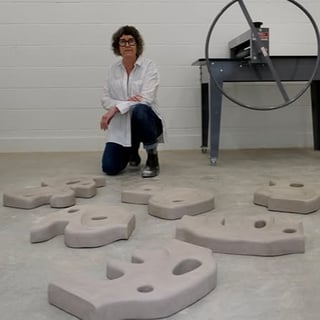
Speaker: So you mentioned expressing the way you make your surfaces. Would you mind explaining that just a little bit more? So the way I make the sculpture is I kind of do it with slabs and build forms, usually like coils and pieced together, the form of the sculpture. And then once that
Speaker: is set up. I go in and I carve off the block. I make different elements. So all of the elements on top of the sculptures are applied to the surface, sort of like an accumulation form. What do you do to come up with all the different surfaces, techniques onto your sculptures?
Speaker: That's a good question. You know, some things I've sort of stumbled upon. I do love to go to, you know, ceramic supply stores and look at all their different tools. And it's funny because like I have, you know, a lot of tools
Speaker: That I'm like, I don't know how to use this or like, I know how to use it in theory, but I'm like, I don't know how to use it on my own work. And then 1 day I'm just like, let me just try messing around with this and then. I kind of figure something out to do and like how that looks good and I can use that sort of as an element. I definitely have different.
Speaker: elements that I use like there's sort of sort of almost like a drapery a fabric thing so I roll them out very thin this like a very thin and sort of make that into sort of a folding drapery sort of thing or I love the wiggly wires I love those things those give such beautiful like carved fluting I don't know if you use those but they're
Speaker: those are those are kind of paper me it's such a funny silly silly name for a tool to the wiggly wire but that i i do love that and yeah i mean i i think i'm not yeah i kind of find things through like doing them and and and just try trying different things out
Speaker: I love that so much by just shipping nation. If you're listening right now, the easiest way to figure things out is just to try things out, try different, a bunch of different things out and see what you like and keep the things that you like. I love that answer right there. Now you are inspired by looking at art. How does this come back into your own world?
Speaker: So I love going to the Metropolitan Museum and looking at things there, like the Palosse ceramics and the Robert Ellison collection of ceramics. And if you go to the Met, I don't even know what section it is, but if you go up the stairs and come back toward the Great Hall, there are these vitreans up there and they're always like the best contemporary ceramics up there. They just always have amazing stuff.
Speaker: So I love looking, looking, you know, just going around, looking, going to galleries. I also worked for art galleries for many years. And one thing that was very interesting to me about that is, you know, different artists like Louise Bourgeois, Linda Ben. When you work for a gallery that represents an artist, you get to know their, like all of their work, like not just the best of things that you see in the museum, but things that are, you know, lesser known or
Speaker: Maybe not as successful a work and to me seeing that like breath of work is very inspiring because it's like not everything is is a museum quality a plus work like and and just like the attempts and.
Speaker: trying things I find very inspiring. And I think also, you know, I think for me, like the way that the way that I'm really inspired by things like directly in my own work, it can be a little oblique, like, there could be something like like Louise Bourgeois, the way she
Speaker: her bronze works were painted white like and you really see it's like like the white paint and kind of the bronze is coming through and that sort of finish I think is sort of somewhat similar to the way I'm working I'm doing just like a white sort of transparent glaze over red terracotta so like the material is coming through and it gives it like a very kind of painterly but also monochromatic surface that I really like.
Speaker: And there are other things too, like I work for Chimeon Reed and they did a show of Louise Bourgeois's suspended work. And I just try and try again to make a suspended work and they never work, but so that's like a long term.
Speaker: thing I wanted. So sometimes they're like cooking in there for years before I can get something to come out. So sometimes, but I think, you know, it's just like you get an idea of something or you see an element that you like, like suspended sculpture, suspended from the ceiling. And it's like, oh my God, that's so such a powerful, great idea. And then how, but then like making it your own. That's the challenge, right? So yeah.
Speaker: So what do you do to make the work that you're seeing and turn it into your own work? I think, you know, I'm someone like, I don't really draw, I don't do that sort of model. I have to figure it out by making, by actually working through the material. So for me, I find that translation of trying to take
Speaker: an idea in my brain and get it to come out through my hands. To me, that makes it, you know, kind of turns it into my own thing. And then also, you know, I wouldn't try to recreate something. I wouldn't try to recreate something, but I take an element and then go off.
Speaker: in a different direction with it or like you know kind of create my own idea out of that that sort of glimpse or glimmer sort of like that you're seeing it out of the side of your eye or like oh that could be that could be something for me like I think it's if something speaks to you if it hits a chord then you know it's something that you can try to work with
Speaker: Definitely agree. So there's two things I wanna point out for Shaping Nation here. So number one is go out and go explore galleries, go explore other people's art so that you can get inspiration from them. And then number two is when you get inspiration from them, go out and try to put your own little spin on things and actively do it. If it's sticking in your mind, it's gonna stay in your mind. But if you start doing it, that's when it starts coming to life. I love those two tips right there.
Speaker: What advice would you give to someone trying to add some flair to their own pottery? I don't think I would say just, I think just to be where you are with it. I think that in all the different stages of making and ability, you can make something great. So, you know, if you're, you know, like, I love, I love like,
Speaker: lumpy ceramics and all the different parts of where you are in your journey. And then also, just to really listen to your inner voice about what is speaking to you, what's resonating, what has a deeper impact. Definitely agree with that. You have to know what is speaking to you. You have to be truthful to yourself and so that you can make your voice come to life.
Speaker: So let's talk about finding your voice. What would you say was your biggest struggle when it came to finding your own voice? I think for me, the biggest struggle has been like the technical part, actually, like figuring out how to make something. I think because I was making sculpture for a long time before I started working in ceramics, I feel like I knew what it
Speaker: was that I wanted to express, but, and I still feel this way, like getting my, the skill of what I want to make up to the level where it can meet my idea. So I think technical challenges for me and like just learning like technique and that sort of thing has been my biggest struggle. I definitely agree with that. Like technique is probably one of the most crucial things that keeps us from finding your voice. Cause if we don't have the right technique, it's hard to make it actually come to life.
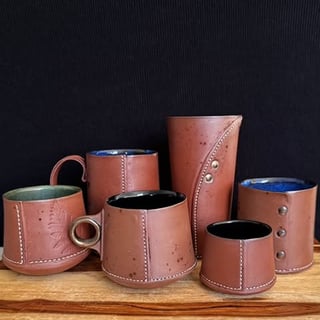
Speaker: because I felt that myself when I was learning how to make wheel thrown pottery felt that a lot. Can you tell me how has your pottery evolved into what you make today? Well, most recently I've been working on functional ceramics. I've been doing vessels, candlesticks, and the way that I've been looking at it is making these forms, these vessel forms.
Speaker: and then almost like making a sculpture on top of it and like pulling elements from my more purely sculptural work and sort of isolating that element and having that on a functional form. So that's one way, yeah, that it's been evolving for me recently.
Speaker: Now over the last 19 years, what would you say had the biggest impact on you finding your voice? I think just carving out the time.
Speaker: every day or if not every day, as many days a week as you can manage to work. So I think nothing can replace working through things and putting the time and effort in. I was very inspired by like Toni Morrison who she would wake up at 5 a .m. and work on her novels before going to work.
Speaker: She wrote Song of Solomon while she had a full -time job. So I think it's possible just to get up, even if it's only an hour a day, carving that time out is really crucial to developing your work, putting that time out.
Speaker: Absolutely agree, absolutely agree. Shaping Nation, we must be intentional about when we are trying to make pottery because we have to make, we have to at least put in the reps and put in the practice so that we can make our voice come to life. I love that you said that. Now, if you were a beginner in making pottery, what are the steps you would take to find your own voice?
Speaker: So, I think just to really to look at as much as you can and, you know, to. To, you know, and where I know every, you know, I live in New York, so. There's a lot of opportunities to see things, but I mean, I think there are so many amazing.
Speaker: Regional museums and in different places to go. So, I think even auction houses, you know, to, to, to look at just to really look and see, see what's out there, look at different work. Basically, YouTube is a tremendous resource. I watch YouTube videos all the time.
Speaker: I love it. So I think that's so helpful now too, which is a great resource. And I think, you know, to not be afraid to make mistakes and fail, you know, and if you're still drawn to making it through like those challenges, you're really in the right place.
Speaker: Definitely agree. So as we're coming to a close here, what is one thing you want to hammer home with my audience today? I think just to go out and look at everything you can, whether it's a museum or a gallery, maybe it's just getting out into nature because nothing can replace the act of being in a place and really looking at things and experiencing them and getting inspiration from those things.
Speaker: Definitely agree. 100%. Ellen, it was really great chat with you today. Where can my audience go and learn more about you? Yeah. My website is ellenrobinsim .net. And my Instagram is, it's a little hard to, it's Ellen underscore L underscore Robinson. It will be in the description as well for those listening.
Speaker: We hope you enjoyed this episode of Shaping Your Pottery with Nick Torres. Do you have questions about pottery that you'd like Nick to answer? Send them to us on Instagram at Nick Torres underscore pottery. We'll see you next time.