Transcript
Speaker: If you love pottery and want to take your skills to the next level, you're in the right place. Find your own pottery style right here on Shaping Your Pottery with Nick Torres. Let's get started. Welcome to Shaping Your Pottery with Nick Torres. Today I have Amanda Siska. While Amanda doesn't make her pottery, the designs she makes using a technique called sandblasting is truly incredible. Amanda, welcome to Shaping Your Pottery.
Speaker: And tell me, what is something that most people mostly don't like but don't know about you? I think most people don't realize that I used to want to be a tattoo artist. Ever since I was a teenager, I wanted to be a tattoo artist and I actually started tattooing when I was a teenager. And I've sort of been looking for different ways to put my artwork
Speaker: onto things, people, the world, my whole life. How did that kind of affect the way that you design your sandblasting today? My first batch of designs that I created were all based on traditional tattoo designs.
Speaker: So a lot of my art was inspired by tattoos, and I originally thought of glass etching as tattooing your home goods. Before I was sandblasting, I was actually hand engraving items using a Dremel tool. I upgraded to a dental drill, but I was actually drawing the designs directly onto glassware and ceramics.
Speaker: which was a lot like tattooing, only there's no blood and there's no sanitizing and there's no possible regret. Could you tell me the story, how you came up with the name Bread and Badger? I knew that I wanted to start my own business forever. I actually ended up quitting my job. I was just working retail selling shoes for a number of years in my teens and 20s.
Speaker: And I wanted something that was going to be my bread and butter, the business that would pay all my bills. So I wanted, I was kind of going on the bread and butter theme, but badgers are really tenacious and fearless. And I knew that if I was going to start a business, especially not really knowing what I wanted to do, I realized I had to be fearless and not back down. So I was sort of channeling the energy of the badger.
Speaker: and Brad and Badger, I like alliteration, so it worked. That's incredible, using the Badger as kind of like your theme and the brand too. So could you tell me the story, how you learned about sandblasting? I was doing the hand engraving and my dad is an artist too, and he was like, you should do sandblasting, it's so cool. And I was like, no, no, no, that's
Speaker: It's not very artistic, it's just a lot of production and I had been avoiding it for a really long time. And then in 2008, I think, I was starting to get a lot of wholesale orders. And I mean, I was just drawing my designs one at a time onto things and it was taking forever and I couldn't get anyone to help me. So I made a mustache pint glass back when the mustache trend was really, really popular.
Speaker: And I couldn't keep up with the orders. And Urban Outfitters contacted me and wanted to wholesale 1 ,000 or so glasses for me. And I knew I couldn't make them. So I was like, OK, now is the time to figure out how to do sandblasting. So I ended up licensing a few designs to Urban Outfitters. They had them produced on their own. And I used that money to buy sandblasting equipment. I just went all in, bought everything I needed.
Speaker: And I've been sandblasting ever since then. So as far as learning about it, I had to take to the internet because there weren't really books on it. And way back then, the only way to find information about things like sandblasting was message boards. There weren't like Facebook groups, there weren't
Speaker: blogs, it was just like a single message board on all of the internet that I could find where a couple of people talked about sandblasting techniques. So I would just diligent really read through all the posts, talk to people on there. It was mostly like middle -aged people who were doing trophies or making engraved monuments and things. And it was like,
Speaker: It was not super artistic. There were a few people doing really amazing art, but not a lot. So I kind of had to blaze my own trail as far as sandblasting on ceramics, because I didn't see anyone else doing that at the time. So can you explain to me how sandblasting works? Sure. The basic element is that you have to have some kind of abrasive. And it's not really sand. What I use is silicon carbide. It's an abrasive grit. It's really, really fine material.
Speaker: And it's being forced through a hose using compressed air and you're just kind of spraying it onto the surface of your item and you can sandblast all kinds of things. A lot of people are familiar with sandblasting paint off of metal like in car body shops and things. But what I do is I use a stencil. I put it on my mugs and glassware.
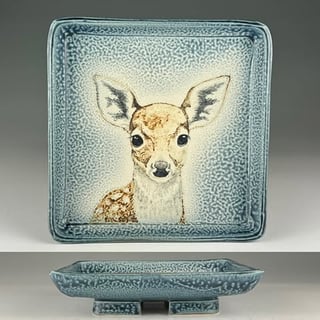
Speaker: completely mask around it and then I spray the grit onto the item until it carves as deeply as I want it to. So for ceramics, I'm carving all the way through the glaze layer so that the pottery is being shown through. What was the biggest challenge you think he's faced besides having to go through all those forums? What was the biggest challenge that you faced?
Speaker: trying to find a way to make it feel artistic to me because sandblasting itself is not particularly hard. It's expensive because the materials, the basic materials aren't very expensive, but the resist material I'm using for my stencils is expensive. So you don't really want to waste it. You don't want to use too much of it. So just trying to learn the techniques, make it work, having people help me and trusting the process to them is difficult for me.
Speaker: But really my biggest challenge I think is just finding a way to make repetitive production work feel artistic still since I think of myself foremost as an artist and not as a manufacturer. So it's been a lot of years where I've been experimenting with the style and the technique and just trying to find new ways to make it feel expressive for me. So how have you like really made it expressive for yourself?
Speaker: I started challenging myself to take up more space on an item.
Speaker: At first, because I had been engraving by hand, all my designs were really basic, really simple, and rather small because I had to draw each one. So I didn't want a lot of areas that were filled in because filling takes a lot of time. But with sandblasting, it doesn't take any more time to engrave. Well, I mean, it takes some time to engrave a filled in area as opposed to just thin lines. But it is more bold, and then there's a lot more contrast. So I've started to really focus on
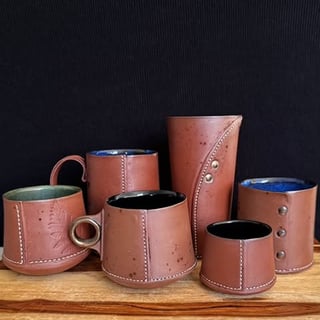
Speaker: more bold filled in areas and having items that wrap around ceramics. When I first started sandblasting on mugs, I was using kind of a curved shaped mug, which is really challenging to put a stencil onto. So I am now working directly with local potters. I'm having mugs made for me and I'm working with people who already make mugs that are wheel thrown or slab formed that are straight sided. So it's a lot easier
Speaker: to put a stencil onto them so I can actually create stencils that are the full width around of the whole mug and take up the whole space. And then I just get to spend a lot more time designing something that kind of tells a story around the mug instead of just like, here's an octopus or here's a robot. It's like, here's something that kind of flows around the outside and has a lot more movement to it.
Speaker: Could you explain to me how you make your designs for your stencils? Yeah, there are a lot of different ways you can start. And I used to start with lino cuts or pen and ink drawings. And these days I'm mostly working digitally because the design essentially has to end up digitally rendered because I printed out on transparency film to use as a film positive for
Speaker: exposing the resist material. So these days I use like a Wacom tablet and I draw my designs on my computer and put them out onto the transparency. Um, but I mean, I still sketch freehand with pencils and I'm trying to, I'm trying to go simpler. I feel like sometimes it's easier to just take like a Sharpie and just draw something out really bold and big and then just digitize that and simplify it from there.
Speaker: What is the software you use to really create your designs? These days I'm using free software. I'm using GIMP and I'm using Inkscape. So most of my drawings are created in Inkscape now, which is just a kind of open source software. It's a lot like Adobe Illustrator and it's really fantastic. I have not turned back ever since I switched over to Inkscape. So now can you tell me
Speaker: How has a failure or a parent failure led to future success? I've had a lot of failures.
Speaker: The first failure was realizing that I couldn't hand and grave things forever. That felt like a huge failure. It crushed my heart to actually switch over to sandblasting because I felt like I was losing a lot of the soul of what I was doing. But that allowed me to expand my business, to actually take on bigger wholesale orders and to have an employee.
Speaker: Um, in 2018, uh, I realized that I was not enjoying doing production work. I wasn't doing anything artistic most of the time. I was just, uh, facilitating wholesale orders and I was managing my employee. Um, I had a warehouse space and it was awesome, but I realized I couldn't afford it anymore. So that also felt like a humongous failure when I realized that, um, my, my art was getting pushed to the side so that I could do corporate logos most of the time.
Speaker: And so I had to get rid of my studio space. I had to let my employee go, which was absolutely heartbreaking. I downsized, so it was just me, and I was working from home again, and it felt awful. But that allowed me to completely reimagine what my business is. I realized that I want to be an artist first and foremost.
Speaker: I was able to actually bring all the art back into it and realize that I didn't want to do wholesale. I didn't want to do corporate logos. I want to do like pet portraits for fun and I want to do whatever seems most inspiring to me at the time. So I spent, I don't know, over a whole year really deciding what I wanted to do with my business.
Speaker: and trying to decide if it was even sustainable at all anymore. But since I started working with local ceramicists and really focusing on the art side of things and small batch production instead of large batch production, my business has been booming. It's doing better than it has in years and years and years. And even throughout the pandemic, it's been growing really strongly, which was a huge shock for me. How did you make the final decision to like, I'm going to make what I want to make and not what other people want to make?
Speaker: That was super hard, especially because I'd been paying the bills for our whole family. I have a son. I'm married. And this business had been paying for all of us to live up until I realized how much I hated it and realized that I wasn't putting any effort into it. And it was like, well, if I
Speaker: If I put all of my effort into this, I think I can make it work. And I'm only going to put effort into it if I'm doing what I want to do and creating art that I want to do. So if if I give it one more try, it was like I have one more year, I'll give it one more year and I'm going to just focus on my own art. And I'm going to say no to a lot of projects that don't involve my original art. And if I can make it work, then I'm good. And if I can't make it work,
Speaker: then I'll have to move on and it worked, so. I love that so much because you literally figured it out. You went into the deep end and you just figured it out. Yeah, that's a badger energy. Yep, it's a badger energy. So what changes about your designs over the years have you changed over the past 16 years? Well, as I said before, everything was mostly inspired by tattoo art, which I'm not really inspired by anymore. Plus tattoo art has changed a lot in the 16 years that I've been doing this.
Speaker: These days, I'm inspired by animals. I'm reading a lot of urban fantasy books, so I'm really into fantasy designs, which you probably won't see any of those right away. I always have about 100 designs I'm working on at any given moment.
Speaker: Um, but nature, especially during the pandemic, it was like, I, I miss nature. I miss people and all I see are my cats. So a lot of designs are just cats right now because, um, that was my whole life. Um, and, and a strong desire to be surrounded by plant life. How do you come up with like new designs so that like, cause you said you make a hundred designs at once, but how do you, how do you manage that?
Speaker: Well luckily when it's all digital and I have a lot of sketchbooks scattered around my house everywhere so wherever I'm sitting I can just pick one up and draw something. But I have just files and files and files all over my computer where I've sketched things out and it usually comes down to when I'm like right now I'm like I'm going to release a collection for winter which I've been working on for a month and
Speaker: because I'm doing production work I can copyright my designs and I do copyright my designs but in order to file a copyright you have to have or you have you have a maximum of 10 designs you can copyright it once so I'm like well to get my money's worth I need to copyright 10 whole designs so I figure out which 10 designs I've been working on are most likely to kind of mesh together or most likely to work well as a collection and
Speaker: It's honestly not as well thought out as I wish it were. It's kind of just like, okay, which 10 are we closest to being finished with? Which one am I willing to spend time on today that I don't hate as much as the others right now? But it's constantly being updated, that list, and I'm being inspired by things I see constantly online. I mean, I spend a lot of time on Instagram looking at other artists' work and
Speaker: It's hard not to be inspired. I actually have to shut it off because I get too inspired and then I don't make anything. I'm just like, oh my gosh, everything's amazing. I totally agree. Instagram can be overwhelming sometimes. In the last six months, what have you changed your mind about? This is tough. I came up with an answer for this and I don't remember what I came up with, honestly.
Speaker: I might have to come back to that one. I'll see if I remember to ask that one again. Okay. So what is one thing that you do to kind of help you just really with your day to day?
Speaker: I started doing yoga a couple years ago and I honestly feel like that has helped my focus on every aspect of my life. I try to do it first thing in the morning because I feel a lot of pressure to jump right into my day which I love. I wake up like
Speaker: absolutely ready to go back into my work. I love my work. But I feel like taking some time to center myself to get a little movement and it seems to make everything go better. The whole rest of the day reminds me to breathe. And I get a lot less stressed out when I take a moment to myself for yoga first thing. Yep, I agree with that statement because I do the same thing. I work, I wake up and I work out and I'll meditate for a little bit. And that just helps me throughout the day.
Speaker: It really, really does. So could you tell me what has been the best piece of advice that you have received that has helped you? That's another tough one. I get lots of advice. I think it's mostly just to only create what you're truly happy creating. That's something that really changed my business where it was
Speaker: It was like I was doing all this work for other people and doing specifically other people's logos or their artwork. And it was like,
Speaker: I have artwork too and I want to express myself and just being able to say, I'm going to focus on what I'm really passionate about and actually say no to other things. So that was some business advice I got a long time ago, which was to always be true to your own passions before other people's because otherwise you're not going to want to put as much effort into it. And some people love doing other people's art or recreating things. But for me, it's, it's,
Speaker: just not as fulfilling unless I get to do something different on a regular basis. And if I get to create my own thing and put it out there. I love that so much because you got to work, you got to make what you want to make. Yeah. Otherwise, like I did, I just, I wasn't putting any effort into it anymore. And it was like, Oh, do I have to keep doing this? Can you tell me, what would you do now to get kind of started on your business to rather than like 16 years ago?
Speaker: Well, I would be on social media first thing. 16 years ago, social media didn't exist. So I would probably plan out my posts a lot better, which I don't do at all. Yeah, I think having a presence on social media and showing your process a lot more seems to be really awesome. People resonate with being able to see how you make things and what you're doing on a daily basis.
Speaker: If I was starting it now, I think I would be more cohesive with the designs I create, and I would have a lot more boundaries set up. I still don't have very hard and fast boundaries for people that have been working with me in the past. It's hard to say, no, I won't recreate something for you. But I think if I was starting now, I might have a better, solid foundation on what I really wanted to create, when I wanted to create it, and when I knew I would say no to other people when they asked about things.
Speaker: Anyone who makes things knows that people will always be asking you to make something special for them and it takes a huge amount of time and effort to make custom things. Yep, I definitely agree. It's hard to make custom things sometimes. Yeah. So how can people get started with sandblasting and making their own designs?
Speaker: You can get sandblasting equipment that isn't as expensive as what I have. And when I first started out, I got all my equipment from a company called Etch Master, who is still around. They're in New Mexico. And they actually run seminars and in -person workshops and things. They sell books and DVDs and things. So if you wanted to get started from nothing, I highly recommend going with Etch Master just because their equipment is like a few steps above, well,
Speaker: It's better than Harbor Freight. You can get stuff from Harbor Freight. If you're really cheap, go for it. But I recommend getting something a little nicer. If you if you're going to be sampleizing, you have to have some form of stencil, but you can make stencils out of masking tape. You can make stencils out of vinyl, which you can just hand cut yourself or you can get a Cricut machine or some other kind of plotter.
Speaker: where you can create digital designs or even buy digital designs, print them out in vinyl, affix them and sandblast that way. So once you have a sandblasting cabinet, a pressure pot and a really big air compressor, I have a 60 gallon air compressor. So you have to have a certain number of things to make it happen. But once you have those, you can make stencils out of all kinds of stuff. If you want to do the,
Speaker: highly detailed stencils that I use. It's a photo emulsion resist and you can even get them pre -made for you from a company called Razeist. They will make the stencils and mail them to you so you don't have to have an exposure unit and make them all yourself. So it's possible to get all the equipment you need is just kind of a lot of stuff and it's kind of pricey. That is wonderful. I love all the detail you get into that.
Speaker: So as we're coming up on our last question here, what is one thing that you want to hammer home with my audience today? I think people should be more playful. I think when you're creating, it's really easy to get stuck in this mindset of wondering what other people are going to like and
Speaker: Honestly, the designs that I've created that I think have done the best with other people are the weirder ones where I was like, I really like this. I don't know if anyone else is going to like it. It's a cat with a mushroom on its head, but that, you know, it resonated with people because I thought it was funny. So being playful, trying new things, trying not to get too set in your
Speaker: ways of creating, you know, even just taking a watercolor class or doing something totally different to get your mind out of the box that it tends to get stuck into, I think is the most helpful thing for any creator. That was wonderful advice. Amanda, thank you for hopping on today. Where can my audience go and check out your work? I am at breadandbadger .com.
Speaker: We hope you enjoyed this episode of Shaping Your Pottery with Nick Torres. Do you have questions about pottery that you'd like Nick to answer? Send them to us on Instagram at Nick Torres underscore pottery. We'll see you next time.