Transcript
Speaker: Basically, it was a whole decade of struggling through getting to make pieces that started resonated with me. That's Chika Joshi, a potter who loves wood fired potter. I thought I'll come back and carve them. I go there and I see all the wood fired work in Taiwan and I'm completely rebooted. In this episode, you will learn how Chika learned how to push the boundaries of her clay.
Speaker: What if I do this or this? And the only way I could get the answer was trying it. So with the result, I learned to push boundaries. You also learned how Shekhar turned her hobby of pottery into a four -time business. I had never had the intention of making this. It was never intended as a business. I had wanted to stay home with my kids, be there and do this as a hobby.
Speaker: And there's so much more in this episode. I hope you guys enjoy it. See you guys. Welcome to Shape Your Pottery. And share with me, what is something you believe pottery should be doing to have success in pottery? Well, I guess if you, first of all, if you love what you do, that's a big part of the equation. You know, if you really enjoy it, it will work out. I mean, I don't think I started off thinking about making when I was making pots.
Speaker: whether I was going to be successful, I was just hopelessly in love with clay. I was just like, when I started doing clay, I was just in love and it just took off from there. So if you love it, it is no way, you know, it'll happen. It'll work out. Absolutely. Shaping Nation. The more you love pottery, the better and more success you'll have in it. I love that. So tell me the story how you got started making pottery.
Speaker: Oh, that's an interesting one. So I grew up in India, and I was working in a software company. I'd just graduated, got a job in a software company, and I'd never done art up until then. And I never was interested in art. But every time I was going to this company, I would cross the street of potters. And in India, you have these street potters who are just sitting and making stuff on the road. All the wares are all literally on the road.
Speaker: So every time I would see someone throwing on the wheel, it was really enticing. So one day, literally on a whim, I just stopped my car and I said, I really need to try this. And again,
Speaker: It was back in the late 90s, and in India, this is not done. I was from a well -to -do family, and I'm all well -dressed, and here I'm with... It was not studio portraits. It's really simple, earthenware stuff that they're making on the street. So it's not common for people to interact, but I was so desperate to try it. I was like, please, can I try this?
Speaker: This man looks at me strangely, he's like, what's wrong with her? And I said, I'll give you money, please. And so he said, he had a nine -year -old boy and he's like, okay, let's indulge her. And so this, they had a little wheel, you know, like a wheel on the ground. So I didn't even know how to squat. So somehow I squatted and this kid, this nine -year -old centered clay for me and I was just playing and making a mess, getting super muddy.
Speaker: and a crowd gathered around us and typically i'm very conscious about you know people watching me you know that day i was enthralled i was so enthralled by this feeling of clay sipping through my fingers i was i knew i was hooked so so that was my first taste of clay as i used to say and i looked for classes and all that was not available so
Speaker: I luckily got married to my best friend and we came to the U .S. and that's where my journey began. I love that so much. That was such a great story. So can you tell me about the story when you got the opportunity to learn more about pottery at Callen -Wold Fine Arts Center?
Speaker: Yeah, so we, as I said, I got married and I came to the US and my husband was like, you work in the, this is late nineties. You know, anyone who knew the sea of computers could get a job back then. And he's like, we get your job. I'm like, no, no, no, no. I want to learn how to make pots. And so I looked through yellow pages. There was no Google back then found this place called Cal World in Atlanta. And I just went there and it's a beautiful art center in a very old home and has a great ceramics program.
Speaker: And this was back in 98. I started my first class in the winter of 98. And I found the most amazing community, not just the teachers, but the community of people around me. They were people who were, I was 22, they were in their 40s and 50s, but they completely embraced me.
Speaker: I fell in love not only with clay but also America because they were the people who I was just fresh off the board. I had no idea about America. They not only taught me about clay but taught me about America, the culture, how to speak, how to be. And I spent five happy years learning to make pots.
Speaker: and it had a great access to Open Studio. I would just literally go and plant myself there in the morning at nine and get out when they kicked me out at five or something. Every day from nine to five, I was there making friends, making pots, and having a great time. I love that. How does this experience help you with developing your own pottery? Initially, how we start, we try everything.
Speaker: When I had this community of people who were always there coming and working, when I was getting stuck, they were there to help me. I had an amazing teacher, his name was Glen there, who was phenomenal. He was an inspiration. Even now, sometimes when I'm making pots, I can hear him in my head, especially when I'm going against what he's told me.
Speaker: And I'm hearing him like sugar. You shouldn't be doing that or whatever, you know. So I think those five years have been very formative in my experience. And it also got me actually. So the studio had access to reduction firing. And that's where I got my first experience and addiction of the reduction fired look.
Speaker: And that's, I think I owe everything to those five years of growth that I had in Atlanta, you know, like that was my foundation. It gave me a very solid foundation. When I moved to Texas in 2003, I was able to bring that with me. I love that. Shaping Nation, the more you get around other potters and just be around that community, the better your skills are going to grow and the faster you're going to find your voice. I love that. So we're going to talk more about your pottery in just a little bit, but for now,
Speaker: It's like the stuff you learn as a child stays with you. It's almost like that. Everything when I'm throwing, it's his technique. When I'm making it, my work is very different from him, completely different from him. He's more of a hand builder with very precise lines. I'm a loose hand builder, but the ideology behind the piece, I think it's literally him talking me through my work.
Speaker: What is something you learned during this time that you still use today?
Speaker: Tell me more about the ideology of his work. I mean, just, okay. It's funny. He was the man who frustrated me the most. I was the slowest learner in my class. So when we started centering, everyone learned, moved on. And six months later, I'm still, what is centering? I just couldn't feel it. And every time I would look at him with these eyes, like, can you help me? And he'd be like, smirk and walk off. And he'd be like, it'll come.
Speaker: And I think that thing, he was extremely frustrating. He never ever touched my clay or helped me, but I think that was the biggest thing he did for me, that when I got into situations where I was frustrated, I was able to get out of it because he just, he's put me in that situation where I learned to just go through it, you know, just touch through it, somehow make it through. And it was always like that wherever I was frustrated, he would just,
Speaker: He would just smile and laugh or walk away and let me struggle. And I think it really helped me. I love that shaping nation. Sometimes you need to struggle. You need to figure it out for yourself because it's not going to be always somebody to help you out. So you have to figure out yourself. So you continue growing as a potter. I love that. So now let's talk about your pottery. Can you tell me the story how you started making the wood fired theme pottery that you make today?
Speaker: Okay, so that's very interesting. So as I said, I moved from, this is a little long story, so bear with me. Well, when I moved from Cowanwall, like Atlanta to Austin, I was left with a home studio setting where I could just have a Com6 electric kiln. And as I had no access to reduction firing,
Speaker: I thought how bad can it be, right? I'll mix a few glazes, make my pots, dip it in, it'll be fine. And I had my recipes mix my glazes and they came out really flat and boring. Now this is something I had not prepared for because I was used to the warm colors of the reduction firing and suddenly these
Speaker: who will lose, which were not moving at all, were just depressing. So I took a little time off and tried to figure out things. So basically, it was a whole decade of struggling through getting to make pieces that started, resonated with me. So at a point, I remember, I don't know if you've seen my original earlier work, but I used to carve a lot. It was very Indian inspired. It was really heavily carved.
Speaker: Intricately carved. So how I transitioned to wood firing was I started noticing that I think the first decade of 2000s, like 2000 to 2010, all my work, even though it got warmer with the change of clay body and glazes,
Speaker: It was very carved and I enjoyed the process, but I noticed that I was only collecting and buying pieces which were foot fired and really warm looking and I was making these intricately carved pieces. So in 2015, we chanced to go to Taiwan for a week.
Speaker: and I remember I had made some pots and I thought I'll come back and carve them. I go there and I see all the wood fired work in Taiwan and I'm completely rebooted. Literally like I cannot I look at my pieces and I'm like I cannot do this again I can't carve again and that led me into I said I need to make this stuff that I love in my kiln and that led to another journey so 2015
Speaker: Up until now, I've been just working with trying to create a vocabulary of how I can create that work that I so love in my electric kiln. So that's how I got into trying to, I mean, it's not a wood fired look, but trying to get a more rustic look in my electric kiln. What were you feeling when you rediscovered your love for a wood fired look?
Speaker: I mean, the love was always there and I didn't realize it. I noticed that if I look at all my collection, it's from different artists, it's all wood fired. So the love was always there. It was just, I wanted to make it myself and I was
Speaker: It was very frustrating to begin with because it's very hard to create that look, but there were certain, and I saw some artists on the way, met people who inspired me. Mitch Eiburg is one person whose work really inspired me and gave me pointers as to what I could do to try to do this in my electrical. And that initial frustration led to a lot of experimentation, intense experimentation, and then
Speaker: after a lot of failures, a few successes. And that was like, started giving me a hope for the future. Like, you know, and a little more successes. And then since then, I've been really excited. Like now I don't feel that I miss not having an opportunity to wood fire because I feel I'm able to get a lot of stuff out, which excites me in electric. I absolutely love that. That was such a great story. So you are inspired by the color and texture of nature. Can you tell me more about this?
Speaker: So again, if you if you look at pieces which I would find are just some of them look as if they're literally dug from the ground, you know, some of them look as if they were just, you know, it's just a rock line there. So honestly, my favorite piece to eat out of would be a rock hollowed out. And if I could eat out of it, that would be so that is what inspires me. I want to make
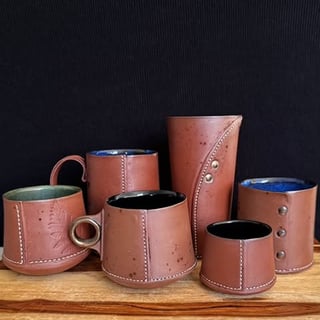
Speaker: pieces that look like rocks which look like you know algae is on it i don't know it's it's stuff like this really inspires me that that's what i'm trying to translate into my the surface of my work not on site i'm a functional potter i want everything to be dishwasher safe and you could eat out of it and all that but the surface is what i play with and then i try to
Speaker: try to get the look that I see in nature. So I collect a lot of rocks, I collect a lot of, I take a lot of pictures of things I see, if I see lichen on the tree. So that's, that's inspiring me. And I'm like, how can I create this surface in my pod? So yeah. So what does that process look like of taking a rock you see outside and then apply it to your pottery?
Speaker: So the rock is just going to be my inspiration. Then I would try and see. So for example, the last series I did was I was trying to get these pieces, my cups to look like as if there was this, you know, you have these rocks, your waterfall, which is they're wet and they have algae on it. So I was trying to get that look.
Speaker: So it's a multi -firing process. So I would build a surface with slip, then I would add a reactive glaze that would blister and bubble. I would grind those bubbles down, add some clear glaze, and over a period of few firings, get to that look. So you know, it's not like I take the rock, in that rock, if I crush it and put it on my piece, it becomes the same color because the color changes in firings.
Speaker: So I am using the texture, but I'm introducing color even through glazes to make it look the way I want. So not really just translating the whole rock into the piece, but using elements of it for inspiration to create that in my piece. How many times are you firing until you get the final result?
Speaker: I mean, typically, ideally, one fire, like, you know, bisque and then glaze firing is what I want to do. But sometimes it is, it ends up being three, four times. And I'm adding another, one more layer, one more layer, you know? So sometimes it gets to, especially the cups where I'm really experimental about my cups, it gets to be three, four times. How did you figure out that you needed to fire maybe one or two more times to get the look you wanted?
Speaker: So sometimes, you know, how pieces come out, they're really bland. I'm like, it's no color. I need to add or maybe sometimes they come out with this blister that I then grind down. I'm like, how can I heal this blister? Then I would add that little glaze to it, maybe add.
Speaker: When I'm working, when you already have a fired piece, it's hard to put glaze on. So I'll just use a hair dryer or a heat gun to heat that spot so that it's able to take glaze again. And then the glaze kind of sits there. Then I put it in the firing again. And if it's better, if I'm not satisfied, then I build a little more there.
Speaker: I love that. Shaping Nation, sometimes you have to keep pushing just a little bit more to find that look you want. It's not going to happen right away sometimes. Sometimes you have to take one or two more times. I love that. So something from your website that I found interesting is he said, as I'm mature as a potter, I find myself being drawn to Japanese aesthetic of wabi -sabi. Can you tell me more about this?
Speaker: So yes, when I started my journey, I was like, I'm going to make perfectly symmetrical, amazingly smooth, clean pots. And I remember having this conversation with my teacher. He's like, yeah, wait till you get there and you'll start altering it. I'm like, no, no, no, not me. I am going to be doing this. And it sure happened.
Speaker: that as I mature, I see, I'm able to see that beauty in infection, like I'm looking for the flaws, I'm looking for the, no, I'm not exactly, I'm not saying flaws, but those, like when I make a slab and there are these wrinkles in the slab.
Speaker: I love that. I'm not trying to smooth that anymore. I am keeping that in my building process. So using all the natural stuff that happens to clay when I just slam my clay, the way it lays itself down, I am using that to make my rock, my crater bowls, you know, trying to make natural stuff and trying to be organic when I handle my clay itself.
Speaker: I love that. So let's talk about the business side of pottery. Can you tell me about the moment when you decided to go full time with your pottery? Again, I had never had the intention of making this. It was never intended as a business. I had wanted to stay home with my kids, be there and do this as a hobby. It just went out of control. Honestly, it was never an intended thing, but it
Speaker: I just had so much fun doing it that the number of hours I put in just increased and then my kids were younger of course I couldn't put in that much time as they grew older and they were in school my time became more full time I started doing more shows and last year our younger one went to college and I think since then I've even more like I've opened myself up to
Speaker: Really traveling and doing workshops and things like that. So I would say I had never intended it. It just morphed into a career organically without intention What were you feeling when you were finally when you were able to become a full -time potter?
Speaker: I think, you know, I just feel so blessed that I get to do this all day and call it work. I mean, what else can I ask for? So I think I feel very blessed that I'm able to do this full time. What would you say helped you the most with being able to sell your pottery? I think, okay, so my work, my work is more
Speaker: I don't know, it's more niche. As in I noticed that my work is more appreciated by people who understand ceramics as opposed to the common population. So I started doing art shows, but very quickly realized that this is not my market. And for me, it became more of
Speaker: doing more ceramic only shows. That's where I did much better because the people who really come out to really appreciate my work is our other other ceramic people. People who have at least some understanding of or have experienced ceramics, they really get it and so I have kind of tailored my work towards doing shows which are
Speaker: primarily geared towards ceramics and not really trying to cater to the wider audience but just to a more niche audience and that has been helpful. I love that advice. Shaping Nation, know your market so you could make for that market that way you'll be able to sell it your pottery easier. I love that. Now, what advice would you give to someone looking to start selling their own pottery?
Speaker: I think I'm the worst person for that, but you know, initially the advice I was given by another potter was that the first few years would be hard. Like it's not necessary, like not everyone takes off, but sometimes you just have to slowly
Speaker: It takes time for people to understand your work. Maybe they'll come for the first time and they'll just get familiar with it. They'll see it. They might take a few years. So it might take a few years to really get yourself selling your work well. And he told me like five years at least before he could really himself see, you know, profits happening from his work. So, and I think I would agree with that. Like five years of consistently going to that
Speaker: same show and suddenly, you know, people who had been coming and seeing my work now, they're like, yes, now this work is really familiar and I can see that you are here. Also, they want to see that you're not just a shooting star, right? You have not. Oh, one day they are here. There's a consistent body of work that's growing. That's the person has a vision. And so that really helps slowly build you up and be able to sell your work to your market.
Speaker: I love that. ShapeNation, take time. It's gonna take time to be able to sell your pottery, but also continue developing your own voice, because that's how you're gonna be able to keep selling your pottery. I love that. So let's talk about discovering your voice. Can you tell me about the moment when you knew you were heading in the right direction with your pottery? So, you know, every, again, because my work transitioned so much from where I started,
Speaker: When I started again, I was doing all these craft surfaces and at that time I felt I had a voice because it's very distinct and I felt very comfortable doing what I was doing. But until I felt like, okay, I'm bored or I need to move on.
Speaker: But personally, because I've always enjoyed what I did at any time, given time, I never felt that I didn't have a voice because I was just letting myself. It was like clay was a medium for me to express myself. So yeah, right now I know people know my work as someone who does surface variation in electric young and that's great. But I don't know, 10 years later, I would probably be doing
Speaker: something else like maybe painting on my work and I don't know where it'll take me but I feel as long as I'm really having fun and that the energy or joy I'm putting in while making my work, the audience, the people are able to see it. And I noticed that when I lost interest in carving and I was still making carved work, I could see the fields going down because
Speaker: Because my interest wasn't there, the energy was not there in the piece and the people could feel it. So I think, again, if you love it, it'll come out in your own way. Absolutely agree. So you contribute growth as an artist to being isolated in your home studio and relying heavily on experimentation. Can you tell me more about this?
Speaker: So the isolation was not really, it was self -imposed in a sense. I wouldn't have chosen to do it, but because, as I said, I was raising kids and, you know, I was in this situation. So I was forced to be on my own. And when I didn't have anyone to ask questions of or to be inspired of, I was in a two car garage with no light, no external sunlight. I was like in there for hours, but
Speaker: I think that really helped me because anytime I had a question, I didn't have anyone to answer. So I was, I'm no one to say that, oh, that won't work. So.
Speaker: I would be like, what if I do this or this? And the only way I could get the answer was trying it. So with the result, I learned to push boundaries as opposed to if I would have asked someone and if someone would have told me that, oh, you know what, that might be that might not work. I would have been I would have taken that and probably not really pushed myself to try this. And of course, I made a
Speaker: bunch of trash in the process and I mean it could have probably helped my journey be faster if I had some advice but it also gave me it made me free to really try because I knew nothing I had no idea going in what to expect so I tried everything and in those hundred things I tried maybe 90 failed but the 10 were great enough to take me to the next stage of my journey so I really feel that
Speaker: Not knowing much and being isolated helped me in that I love that and I definitely agree I felt the same thing when I had to Experiment so much with learning I throw on the wheel and I once I found it I was able to push it my pottery to the next level. I definitely agree about that So something a lot of putters struggle with is finding time to experiment. We're also trying to sell their own pottery How are you able to do this today? so here I would say I
Speaker: Honestly, I have the privilege. I feel I'm blessed and lucky that I don't have to pay my bills with ceramics. I have a partner who takes care.
Speaker: I think, I remember there was a time when I was making a series of mugs called the Happy Mugs and that was one of the only times I made something which was completely accessible and anyone could understand. It was just tick figure mugs with a person playing a guitar or whatever. It was like everyone loved it. And I had fun making it and they felt so like hotcakes, right?
Speaker: But I remember in about a year, I was done now. And I was like, and when people approached me that would you, you know, can you make this or can you make that? I'm like, no, I'm done. Now, because I had the freedom, because I was not having to pay my bills, this was not I could get rid of that and move on and say, I'm not doing this. If that would have been my bread and butter, I guess I would have to
Speaker: It would have been harder. So I I'm not able to Give an advice in that matter because my situation is I can clearly see the privilege I have to say that Oh, I don't want to make this anymore and I'll move on and if even if this doesn't sell it doesn't matter You know what I mean? Mm -hmm. So So now what advice would you give to someone look and discover their own unique voice with their pottery? I guess Keep playing
Speaker: And then keep playing and pursue what you feel in that part you really enjoy. And just go into a rabbit hole and enjoy that. Like if you say, if I love making brush marks on my pieces, go for it. Just explore it till you till you find where your joy. So follow your joy. It'll take you to your voice. Absolutely agree. Shape Nation, follow your joy. And that's where your voice will be.
Speaker: Shikha, it has been very great chat today. And as we're coming to a close here, what is one thing you want to hammer home with my audience today? Keep having fun. That's all. Just keep having fun. Excellent. Last part in words of advice. Shikha, where can my artist go and learn more about you? My Instagram is the handle is at potterybyshikha. P -O -T -T -E -R -Y -B -Y -S -H -I -K -H -A. And that's a great place to connect with me.
Speaker: Hey, thanks for listening to this episode of Shaping Your Pottery with Nick Torres. If you want to discover how close you are to actually discovering your own unique voice with your pottery, I put together a free four question quiz. It's very short. Take 30 seconds for you to take. If you want to know how close you are to finding your own unique voice, go to shapingyourpottery .com forward slash quiz, or you could simply go to shapingyourpottery .com and it'll be right there at the top. I hope you guys enjoyed this episode and I'll see you guys next time.