Transcript
Speaker: Hey, real quick before we get started, if you would like to find your own theme for your pottery so your voice really stands out and you're not getting bored with making the same thing over and over again, I put together 53 themes for you guys and it's completely free. All you have to do to get it is just go to shapingyourpottery .com forward slash 53 themes. That's shapingyourpottery .com forward slash 53 themes. I'll see you guys in there.
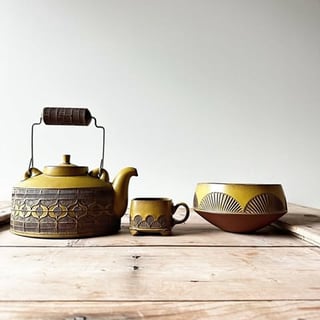
Speaker: What is up, Shaping Nation? This is Nick Torres here, and on this episode of Shaping Your Pottery, I gotta interview Beth Hardin. Beth makes some really incredible textured and colored design pottery. In this episode, you will learn how Beth makes her textured and colored design pottery. You'll also learn about the importance of experimenting with your pottery so that you can find your voice
Speaker: And finally, you also learn about why it is better to just make what you want rather than just sticking to one thing so that you're not getting bored with your pottery. If you love pottery and want to take your skills to the next level, you're in the right place. Find your own pottery style right here on Shaping Your Pottery with Nick Torres. Let's get started.
Speaker: Beth, welcome to Shaping Your Pottery and share with me what is something you believe potters should be doing to have success in pottery. Thanks so much for having me, Nick. I feel like people need to continue to experiment. You always have to continue to experiment and examine new areas of ceramics because there's so many possibilities, like the possibilities are completely endless with ceramics, I found anyways.
Speaker: absolutely great shaping nation. It's important to always be experimenting because that's how you're going to continue growing as a potter, continue having success and even find your voice. I love that so much. Now, Beth, can you tell me the story how you got started with ceramics? So I don't know how I would really classify myself. I guess somewhat self -taught. I originally took a pottery class in 1999 when I first moved up to Yellowknife as a way to get to know people. My mom signed me up like, get out of the house, go do something, try something. So I started there. I didn't make
Speaker: more than an ashtray. It wasn't a great experience. I wasn't a natural at it. So I took a break after that. It was about an eight week class. So after that, I moved on and then didn't revisit it again until 2010 when I found myself, I was in school and whatnot. And I went to school for venture tourism, so not in the arts at all. But when I found myself back in Yellowknife, I signed up for another course at the local guild here and decided to try hand building. I
Speaker: I also wasn't very good in that, but it really interests me the amount of texture that you could add to pieces. I really hadn't seen much more than local pottery. I hadn't paid attention to it at that point in my life. So just seeing in the hand building class that I took, like how much texture you could add to pieces and how different you could make a piece just with like a little slice here and a snip. So that was really neat. And then after that, I took
Speaker: I was hooked again, so I took a level 2 wheel building building course that same year. And that's where I really got hooked. I ended up buying a wheel. I had it in my spare room at my house and would take my because at the Guild, you can only have certain hours. You have open studio hours and I found that really.
Speaker: Conflicted with my creativity, I couldn't be set to create from 6 till 10 p .m. I needed to be able to do it whenever I wanted. So my husband let me dedicate a room in our house to it and I would create there and then I would haul everything down to the Guild and fire it. And then, yeah, we eventually moved into a place that had a studio space that I could then buy kilns and now I have two kilns and
Speaker: Yeah, I quit my full -time job in 2019 and went full -time. So this, I'm going, this is my third year of being a full -time artist and I have zero regret. I love it. And I love all the people that I've got to meet online on Instagram. And I'm really looking forward to meeting everyone in a few short days at Encica, the clay conference that's happening in Cincinnati. So that will be a lot of fun. But yeah, that's from now to here.
Speaker: absolutely wonderful story. Now you mentioned that you are a full -time potter and that was gonna lead me into my next question. Can you describe me the moment when you decided to go full -time with your pottery?
Speaker: I don't know that it was really a moment. It was kind of a steady progression. I got very addicted to ceramics and was purchasing all the materials and kind of slowly setting myself up for it. At which point my husband and I kind of came up with a five -year plan between being in adventure tourism and I was a river guide and ended up injured and took a government job. So those 12 years, I was an information management specialist.
Speaker: Just needed to get out of that and be more creative. Ceramics was consuming all my free time and I have a little family as well. So I think I steered away from your question a little bit. I think it's perfectly fine. So how did, you know, getting back into ceramics and going full time, how did that allow you to express you more expressive self, I guess?
Speaker: I think you end up with so many ideas that you wanna create. And especially with Instagram and being able to scroll and see other people's work. They foster ideas and just a constant need to create. I just didn't have enough time to create all of the things that I wanted to create. And I still don't for that matter. Yeah, it was just a constant desire to want to keep growing designs and adding more.
Speaker: I'd like to add more and more and see how I can take them to the next level with each batch. Absolutely love it. Shaping Nation, as we said in the beginning, it's important to experiment, but it's also to continue and try to take things to the next level so you can grow as a potter and find your voice that way. What would you say was your biggest struggle when you went full time?
Speaker: being organized. Like I said a bit ago there, I was between being an adventure tourism guide and a full -time artist. I was an information management specialist for 12 years. And so when I left that position, I left like all my organization tips and tricks behind. So I'm a very unorganized artist. So I think my biggest struggle was maintaining my own books and being my own administrative assistant and being my own marketing rep, et cetera.
Speaker: The struggle is back of all trades, I guess, because you're not just an artist these days. You're everything for your business. Definitely great. So what would you say you have done to help you get more organized with everything?
Speaker: I don't know that I'm, I don't know that I have more organized quite yet. I've definitely got people harping on me a little bit more. My sister is my bookkeeper, so she's nagging me to get my stuff into QuickBooks, as is my husband. I would say time management, making sure that you're making a little bit of time before the end of bookkeeping season to get your stuff in order. Excellent advice. Which I don't do.
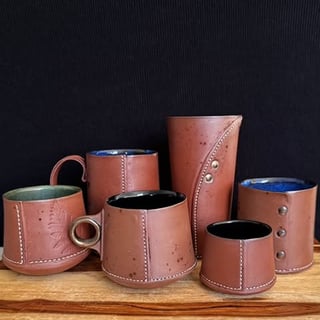
Speaker: Now, let's talk about your pottery. In one sentence, can you tell me what you make? In a run -on sentence, I make whatever I feel like, and it usually orients around being functional, tactile pieces of art that can be used in anyone's kitchen. Very nice, very nice. Now, can you tell me the story how you started making the pottery that you make today?
Speaker: You know, I still kind of make whatever I like, but a lot of my, when I'm trying to look at my pottery and kind of find a theme, the theme is I like texture and color. So what kind of got me there was learning how to wrap my head around, experimenting with designs, but not pinholing to one idea. I feel like people can get trapped.
Speaker: as a starting artist because I don't have any formal training in ceramics to help with creating that vision. I didn't have that vision to start so it was just a willingness to continue transforming each piece and then trying to make them kind of blend together so they're starting to look like they're from the same artist now and not that I have four different people working in my studio it's just me creating all the random pieces that come out.
Speaker: Yeah. So something I found interesting and you definitely just mentioned right now that each piece is different from the last. Can you explain to me how you're able to do this? Well, I think it's exactly with not being set and determined to create just one stream of work and being open to transforming each design. I've allowed myself to elaborate on each piece every time I make a new batch of pieces.
Speaker: My ravens, for example, this batch of ravens, well, I thought they were one of my more simple pieces because they didn't have too much extra. This round, I decided to add trees to them. And well, now I've just added 30 more minutes to that piece. I love how they came out though. So I'll probably continue to put that extra time into the pieces. But yeah, I'm a glutton for punishment when it comes to adding more work to each piece. What would you say is your process when you're coming up with new designs?
Speaker: Did you did you hear my last question or no? Yeah, what is my process with coming up with new designs? Well, so to start to start, I ended up investing in.
Speaker: I'm not great at drawing. So I ended up investing in an iPad that would allow me to draw on the iPad. So that made translating my images in my head a little bit faster than trying to do it from paper. And from there, I can replicate them at any size that I would like them. So my ravens, for example, have been a set image for a couple of years now.
Speaker: And I can stretch them out. I can print them large. So part of my process is I draw my image, I print it out, and then I use that as a template on my piece. And I'll trace it out with sort of a pencil or a stylus so that it is reflected on my piece when I peel away the paper. And then I use that as my carving outline. And from there, I add a little bit more work to my process. And I inlay all the black before firing. And then I do all my color work again before firing the piece the first time. And then any touch -ups will come after the first firing. But usually I can
Speaker: Get away with two to three firings, Max. Yeah. So you just gave me a pretty simplified version of how you create your pottery. Is there any advice you would give to someone looking to really expand their pottery more?
Speaker: Take as many classes as you can. I mean, I'm, I'm up in the Northwest territory, so we don't have very much available to us locally. We get occasional workshops, but with having a small family, they haven't really worked with my timing because, you know, they're at bedtime or when my husband, my husband's a pilot. So when he's away.
Speaker: COVID was kind of a blessing and a curse for everyone, a blessing for artists in that it forced a lot of creators that would originally have workshops in person to get their content online, which was amazing for me. I mean, I soaked all of it up. Every time I see a course coming on, I flag it as like, oh, I'll take that. And those are kind of my little splurges to myself and help me improve and see, sometimes it's just great. Like I don't plan on recreating the work necessarily, but sometimes it's just great as an artist who's developing their style.
Speaker: to just see how it's made. Like, sometimes it's very hard to wrap your head around how someone gets that texture on a piece or what tools they might use, for example. I think the hugest, back to one of your earlier questions of how my work kind of expanded to where it was. I originally started with Scraffito and then Instagram took off and I found Diamond Core Tools and those, I mean, the rest is history. I wear by those products. I love them. I use them in my work all the time. I'm not, I'm not, I don't get a pro deal or anything like that.
Speaker: They're not sponsoring me. I wish they would. It would be awesome if they did, but they're not sponsoring me, but that's my go -to tool. And that's what really changed my work to what it is today, I guess. But yeah, take all the courses. Take all the courses. How would you say taking courses helped you really grow as an artist?
Speaker: Well, I think because I try everything, I mean, I took Kurt Hammer. I do wheel primarily. I am on the wheel all the time. Occasionally I'll incorporate some of my hand building tactics or techniques that I've learned over the time. And so I still like to take the hand building classes because it keeps it fresh. And, you know, if I do decide to incorporate that back into my work, it's fresh. But I mean, I took Kurt Hammerley's course just on a whim. I saw it come up and he was doing
Speaker: slip cast mold making to start and then he did slip casting itself and it was like okay sure let's let's try this out and so one of my girlfriends and I we set aside time after Christmas when it's like slow season and we we'd start doing what I learned from the course and we made ourselves some molds and we did some slip casting I mean I might not
Speaker: continue doing it full time. And it's really cool to learn that set of skills. And now I've got a set of molds that if I ever want to make eight bowls at a time, I can now. And it's kind of, it's just, it's neat to constantly explore all aspects of ceramics. You can easily get stuck in one. And if you have the ability to and the nature to like explore and see what else is out there, it's mind boggling what you can do with ceramics.
Speaker: Absolutely. Shaping Nation, the fastest and most probably efficient way to really find your voice and build your skills is to take courses and workshops from other people. This will allow you to build your skills a lot quicker because you are getting knowledge from other people that already know how to do it. Absolutely love that advice. I think to add to that, sorry to interrupt. I think to add to that, I would also say like,
Speaker: buying your idols work, like if there's someone that you follow and you really like their stuff, buy their work so you can see it, you can hold it, use your own work as well. Because I think using your own work helps you, I mean, if you use your mug and your handle's not comfortable, then you know that you need to start tweaking your design. I think my biggest compliment was when my husband said I had finally like nailed my handle down because that makes or breaks a mug really, but yeah.
Speaker: I absolutely agree. That is some wonderful advice. And I definitely agree about the handle part. Yeah. 100%. Let's talk about discovering your voice. How has your pottery evolved into what you make today? Well, I think, sorry, we kind of went over it a little bit earlier when I could, like, I started with sgraffito. I was really intrigued with carving into clay at first and I hadn't
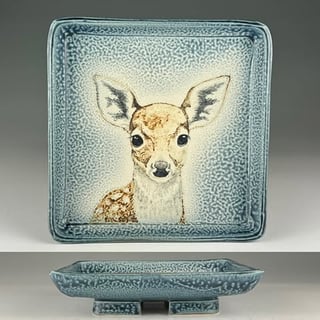
Speaker: I hadn't yet heard of diamond core tools. I don't even know if they were around when I started doing this graffito. They potentially were, but I wasn't on Instagram at that time, so I wasn't aware of them. But I started with graffito and I really liked etching geometric designs into work. And once I found out about those tools, I was able to really expand my design a little bit more.
Speaker: and get a little bit more depth to my pieces by adding all kinds of texture. And so they went from, if you scroll back way, way back in my feed, they went from just being like little geometric designs to now geometric animals or more like a stained glass effect. I try to look at them kind of like color, my own color by number set when I create them.
Speaker: I love it. So can you describe to me the moment when you knew you kind of found your own thing with your pottery? Oh, that's a tough one. You know, I don't know that I've still found my own thing with my pottery. It's constantly evolving. And I mean, there's no real original ideas. So while I haven't seen my work reflected in other people's work necessarily, it doesn't mean that it's not out there.
Speaker: I think I'm just being open to constantly evolving is how I think I've found my current voice in my work. Absolutely love it. Shaping Nation, it's really important to continue evolving your work because even if you don't like necessarily have your own style or own voice yet, if you keep on evolving your work, then you're eventually gonna find your own little thing that you like to make. I love that piece of advice.
Speaker: What is something you are experimenting with right now to evolve your voice even further? Oh, well, I think Encica would kind of come into play with that. I, for the first time, it's been three years in the making, but for the first time I'm heading to, I'm not, I'm going to botch what they're at the National Clay Conference. I'm going to botch what they're actual.
Speaker: title is, but I'm going to Nsika for the first time. It's been three years in the making and it's like three canceled trips in the making. So I'm really excited. I have reached out to a lot of artists over the years and have different tips and tricks. You know, don't be afraid to reach out to artists and ask questions. A lot of them are willing to help and in that I've grown some friendships. So as a way I'm
Speaker: To continue to grow, I'm going to this conference. I'm going to meet all these people. My mind is going to be filled with ideas, I'm sure, and full of inspiration and meeting all the creators of the tools and everything else. I'm super excited. So I think that's really going to help me expand. So I'm really excited to come back from that and see where my work goes after
Speaker: that chaos because it's going to be chaos. Absolutely agree with that statement. Shaping Nation, how can you just be around other potters, other artists, because this is a really, really, really great way to really push your voice even further and help you find your own voice. It allows you to collaborate with other people. Two minds are better than one. I absolutely love that statement. What advice would you give to someone trying to discover their own unique voice with their pottery?
Speaker: I think again, just don't stop exploring techniques. Find out how it's made if you're interested. If you see something or a piece, whether it's a sculpture or a mug or a funky handle, find out how it's made and maybe that will help inspire you.
Speaker: you to create your own version of what you like and you'll eventually tweak it over time. Year to year, batch to batch, things are going to continuously evolve for each artist on their own. So I think it's just the willingness to experiment and don't feel like you have to find one set path. Explore it all.
Speaker: Definitely great, especially exploring all that thing, because that prevents boredom as well. Yeah, well, and I think that's where I pick up, where I don't want to get bored in it. Always trying to find something new, so I totally cut you off there.
Speaker: No, it's perfectly fine. That is excellent advice. So as we're coming to a close here, what is one thing you want to hammer home with my audience? Jeez, I feel like a broken record here. I think everyone should go out and they should find an artist that they admire that has online workshops and they should support their own growth and that artist's growth by supporting their business and purchase a class for yourself while you're working in the studio or while you're working in your house. Pop on a class.
Speaker: of a creator that you admire and hopefully you can take some notes from their course and learn something and use that to reflect it into your own work. Beth, it was really great chatting with you today. Where can my audience go and learn more about that? I'm on Instagram, it's Beth Hardin Ceramics and my website is BethHardinCeramics .com and those are the two places. You can also find me on Facebook, but I'm more active on Instagram for sure.
Speaker: Thanks for listening to this episode of Shaping Your Pottery. If you are struggling with finding your own theme for your pottery so that, you know, you are known for something, I put together 53 themes that you can use and you can take. All you have to do is go to shapingyourpottery .com or slash 53 themes. That's five three themes to get these 53 themes.
Speaker: It's really important for you to find a theme for your pottery so that you're not going to get burnt out. You can have multiple styles with your pottery and you can be known for something. So again, go to shapingyourpottery .com forward slash 53 themes. That's five three themes to get these 53 themes. Thanks, guys. I'll see you guys next time.