Transcript
Speaker: If you love pottery and want to take your skills to the next level, you're in the right place. Find your own pottery style right here on Shaping Your Pottery with Nick Torres. Let's get started.
Speaker: What is up, Shaping Nation? Welcome to Shaping Your Pottery with Nick Torres. In this episode of Shaping Your Pottery, I got to interview Gabz Conway. Gabz makes some really incredible anthropomorphic pottery and sculptures. For those of you who don't know what anthropomorphic pottery is, it's basically taking almost like a human -like form and just making it into your own way of pottery.
Speaker: In this episode, you will learn how Gabs makes her anthropomorphic pottery, power of unlearning in order to start learning first, and then also the power of getting uncomfortable and working on things that you aren't necessarily good at, but can translate into finding your voice later. Gabs, welcome to Shaping Your Pottery and share with me what is something you love besides working with clay.
Speaker: That's a tough question because it seems like it's the only thing that I do anything with my time. I also really like to sew. But like I said, so much of my time is spent either in the studio or I also teach ceramics. So it's a lot of, you know, firing my work, firing other people's work. But yeah, I like to sew and I like to go outside.
Speaker: That is very interesting. So you are a resident at the Wildfire Ceramic Studio. Can you tell me the story how this came to be?
Speaker: Yeah, so I've only been out of undergrad for, geez, I guess almost two years now. But so I grew up in Missoula, Montana. That's where Wildfire is located. And I had gone away for school and my family still lives here. So really the only reason I was coming back to Missoula is because I wanted to be closer with my family. And I knew that the Clay Studio was here. So I initially applied to the Clay Studio
Speaker: I got rejected, as many artists are. It's hard trying to compete for those residency spots.
Speaker: Yeah, but then I was just looking around for other places, just, you know, available studio space or, you know, just even a warehouse, honestly. Yeah, and then I came across Wildfire Ceramics Studio and I had never heard of it before. And I guess at that point they were only a year in. So I applied and I got in and I've been there for a year and a half now and it's been great. So I really enjoyed my time there.
Speaker: That is awesome. So can you tell me what is something that you have learned there that has helped you progress your pottery further? Honestly, I would say it's almost the opposite. I'd say that since graduating, I've had to do a lot of unlearning. There's just so much when you're in art school and learning about
Speaker: It's like finding your own voice, so much of trying to be something. It's so much of trying to find what the standards are.
Speaker: and fit into some kind of hole. So actually, I feel like once I started making outside of school, it was a lot of unlearning where I finally feel a lot more confident in who I am and what I make. So I think that through wildfire, it's given me the opportunity to explore me rather than trying to fit into a hole.
Speaker: Can you describe some of that unlearning that you have done? Yeah, so I'd say, I mean, this is gonna lead them to some things later, but I'd say that in school, I was really, how do I explain? I was really interested in following in some other people's footsteps, I'd say. And I was just really,
Speaker: coming down to trying to make connections. And I was trying to get the A and get approval from people and things like that. And how can I get into grad school? How can I get into shows? How can I do this? How can I do that? So it was more me pushing to get approval from other people.
Speaker: So I think that the unlearning has come where I'm not making work for other people. I'm making work for myself. I'm making work that I love, that I connect with, and I hope that others connect with it too. I think that's the biggest thing. And I'm not trying to be a potter. I'm not trying to be a sculptor. I'm just trying to make work that I connect with, like I said.
Speaker: I absolutely love that. Shaping Nation, if you are listening, it's important to sometimes unlearn things that you have learned maybe in school or just outside of stuff and just start focusing on what you actually like to make so that you can really find something that is truly unique to yourself. So can you tell me the story, how you started making your, I know I'm gonna mess this up, your anthropomorphic forms.
Speaker: Yeah, no, you said that perfectly. So really, it started, I was trained as a potter, as a completely functional potter. And I've been doing ceramics since I was a kid. My dad is also, he went to school for ceramics. So this has been kind of like my whole life. But when I went to school and I was doing pottery, I just never,
Speaker: felt connected. I never felt like it was what I wanted and I kept just, you know, I would draw just weird forms on pots and I was feeling more connected to that. And then I had a program review with one of my professors and he just looked at me and he told me that
Speaker: is like, your work is far too conservative for who you are as a person. And that just hit it for me. I was like, wow, you are right. You are so right. So I just kind of did a 180. I was like, why am I trying to fit into this whole?
Speaker: So then I started thinking about how I connect with pottery, how I connect with ceramics. And then it turned into this relationship that I have come to understand with myself, that I see my physicality and my mentality as two different beings. And they're both kind of fighting for being utmost. Being in the present, they both are trying to be in the front.
Speaker: So anyway, I was making some really weird stuff when I was in school. It was a lot of very grotesque, more, I would argue that it's more grotesque than what I'm making right now. But it was a lot of like disjointed body parts and a lot of organ -y things. Yeah, and so that was the beginning of where I am now. So they've just kind of evolved into
Speaker: what they are now, which I still strongly relate to that mentality, that thought process, but I think I'm just exploring these things right now. Can you explain that thought process a little bit to me? Of how I built where I am or? Yes. Okay. So I really the forms
Speaker: The forms haven't changed super dramatically. I'm still really thinking about organs and I'm still thinking about body parts and I'm still thinking about existence and what that means. But instead of relating it to this disjointed relationship, here he is, instead of relating it to this disjointed relationship that I formed with myself, I have thought more about
Speaker: existence and what that feels like and how we are how we are in this world um so i'm really thinking about i pushed it to thinking about mundane reality you know just like sibling rivalry being scared taking a nap um going for a walk eating food you know being curious just those little things that
Speaker: We bypass. So yeah, I'd say that I'm still really thinking about, you know, back to existing, but in a little bit more biological, deep form about relationships. So now you mentioned this sibling rivalry and a lot of other stuff. How does this come back into your work?
Speaker: Yeah, so I try to explore that a lot. I'm really interested in creating. Each piece is completely individual. It's its own entity. So obviously you can see that there's kind of different species if you're looking at my body of work, but they each are their own person and they each have their own personality. So
Speaker: I guess when you're asking me that question, I'm really thinking about how, you know, in one of my most recent pieces where there's one on the bottom and there's one on the top, it's a double -decker piece. So that piece is called Help Eat, and it's actually related to a video game that my dad made when he was in college.
Speaker: Um, and it's a really silly video game. Um, it's called help eat. And, um, all you do is you feed Cheerios to my uncle. Um, that's the entire video game. Um, but so I was really thinking about that relationship. And then I was thinking about, um,
Speaker: my dad and his brother as siblings and how they've always had this very playful rivalry and like, you know, they're just, they're brothers, you know, and how they just tease each other all the time, but they are always so uplifting with one another. So that piece is kind of about
Speaker: that connection that I've had. So really in that piece, it's called help eat. And it's just one of the brothers helping another to find some food to be able to reach it. So I guess that's how I would connect. I love that for those that are listening. It's important to kind of bring in like outside aspects, whether it's your relationship with your siblings or like with your dog or whatever, try to bring that into your pottery and it's going to show like a lot more of a connection to it. Now,
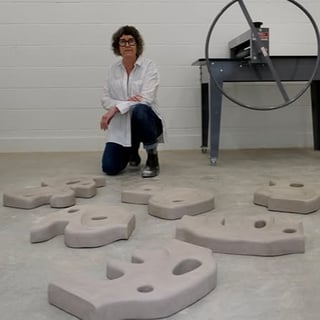
Speaker: Can you walk me through how you create your anthropomorphic sculptures? Yeah, it depends on the piece. When I'm making larger work, so they're all coil built. So for ones that have legs, I first build the legs. I do build the legs solid and I end up hollowing them out later.
Speaker: And then the bodies are 100 % coil built. And I was actually teaching a class the other day. The way that I coil build, it's gonna be hard for listeners to understand this, but I think it's interesting. The way that I coil build, I actually put the coil on the inside of the wall, and then I push down with my index fingers and I pull up with my thumb.
Speaker: So it actually alleviates any kind of crack. And so there's less cracking that way. In my experience, I think it's been really successful. As far as the like worm deeds, those I build solid and then I hollow them out. And then all the fingers are slip casted of my own fingers. So I have a bunch of needles that I've made of my own fingers
Speaker: And then the teeth, this is actually really funny. So I have like 15 teeth molds.
Speaker: Um, and they're all from family members. Um, except for I do have, uh, one of my professor's teeth. Um, but I know. Yeah, I know. Um, but I, my favorite teeth molds are actually my little sisters, um, from when she was like seven and it's her bottom teeth. So every piece that you see, um, has those teeth on it.
Speaker: So that is very interesting. I can understand your family having the teeth of your family, but why do you have the tooth of your professor? He was like, he had some molds because I made a mold for myself when I was first getting into this. I made a mold of my own teeth. And then he was like, hey, I have this. Do you want this? And I was like, sure. So now I have his.
Speaker: That's awesome. So before we go any further, something that reminds me of your work, I don't know if you've seen the show Doom Patrol, but basically there's these like little butt monsters and they have like teeth and they pretty much just turn people into other butt monsters. And that just kind of reminds what your work just reminds me of. Just a little side note and little digression. I'll have to look at it, though. They're they're really, really interesting creatures. Yeah.
Speaker: So can you tell me how has a failure or a parent failure led you to future success? Um, so really when I've had failures, like I, I posted a real not that long ago and I've had a lot of people be like, Oh, why did you destroy that piece? Um, and really it's not like, not everything's a winner. Not everything's going to be exactly what I want it to be.
Speaker: And I know that some people would be like, oh, I would have taken it Which obviously I really appreciate but I want to be proud of everything that I do that every that goes out into the world You know, obviously not everything I make is gonna be amazing, you know, it's not gonna be the best thing every time So if I I want to be proud of things that I go out into the world but
Speaker: In that video, that particular piece, I have never built anything that's been like a freestanding form. That's like that tall. So it's a biped creature. And I really struggled building the legs. It was very challenging. Like I said, I've never done anything like that before. And in my head,
Speaker: I wanted the feet and the legs to be a lot skinnier and I didn't know how to achieve that when I was building it. I just really kind of went for it. So I learned a lot about better techniques to use when I'm building something like that. And just, I also built it in like a week and then fired it the next week and that is not enough time. So there was just a lot of things that I know how to improve for next time when I tried to build something.
Speaker: that extreme. I love it. Shaping Nation, if you're listening, it's important to just kind of if you're not satisfied with your work, don't be afraid to go and just recycle it, throw it away, whatever. Just because that's where your progress is really going to start showing up when you are able to accept the fact that this isn't what I like. And I can do better. Yeah, absolutely. Absolutely. I totally agree. Because anytime that I haven't been proud of something, I know other people are like, why would you throw something that that away? But
Speaker: I want to be proud. I want to be proud of what I've done. And that's the most important thing. I love that so much. So what would you say is your biggest pet peeve when it comes to making ceramics? I feel like I can speak for the entire ceramics community when I say this. Glazing. That's something I hate more than glazing. Oh my goodness. Or even worse, mixing glazes. Are you kidding me?
Speaker: That's no fun at all. Yeah, and I so I spray my glazes. And wildfire unfortunately doesn't have a spray booth. So I have to do it outside. And that's not very fun in the winter. Yeah, I get that a lot like a lot of people say they just hate glazing and I I get it takes forever to glaze I totally get it.
Speaker: In my head, I'm always like, oh, it's going to take what? Three hours? Never. It never takes three hours. It takes like two days. Yep. It takes so long. So before we go on to talking about your voice, you mentioned that your dad was a ceramic artist or he went to school for ceramics. What impact did your dad have on you pursuing ceramics further? Well, it's funny because so growing up. So he studied ceramics in Mankato, Minnesota.
Speaker: And my parents had me when they were really young and I actually went to college classes with him when I was a kid. So I was pretty immersed in clay and firing and all that stuff from practically birth. And then when we moved to Montana when I was about four,
Speaker: My dad then was, he rented space at the clay studio here in Missoula. And so I just remember going with him and like making little snails and making little things and whatever. And I've always been really interested in the arts. It's been like, yeah, a huge part of my life. And my mom does watercolor paintings and she's an author. So my family's very creative and they're always been very encouraging of following whatever your heart says, you know.
Speaker: And honestly, when I was in high school and you're trying to gear up for going to school and what you're going to do with your life and whatever, I was trying to be really practical. And I was like, well, how can I be satisfied with life? And I was like, I'll be an art teacher. I can be satisfied. I can make art, but I can also be practical and have a steady income.
Speaker: And when I went to school and I started taking ceramics classes, I was like, man, this feels right. This feels like what I want to do with my life. And don't get me wrong, I love education. I mean, I do it to this day. I teach all the time. But ceramics really had that calling for me. And I remember talking on the phone. I called my parents and I was like, I think I want to switch my degree. This feels right for me.
Speaker: And my dad was like, absolutely, don't do it. I believe in you. So I think that, and I think, you know, obviously he was, as all parents would be a little nervous, a little cautious of not being a practical position, but he was very supportive. And he was like, if that feels right, then I think a little part of him was excited.
Speaker: I love that so much. I feel like I relate that to that on a little bit of a personal level because my mom, she was always making things. She was always drawing things. And she would also show me paintings of what my grandpa would make. And that really just helped me pursue ceramics further when I got into it. That's awesome. So now let's start talking about how you discover your voice. How long would you say it took you to actually discover your unique voice?
Speaker: a long time. I like I was saying that when I was in college trying to fit in those holes of being a potter and doing ceramics as the potter would, you know. And I think that I'm still finding my voice. I think that it's still
Speaker: evolving. I think my work is evolving as I'm evolving. I don't think anything's going to stay the same. I think I'm just going to keep building off of these thoughts and these feelings and these strong emotions that we experience every day. But I think that I just I will always look back at what my professor said and
Speaker: how he just said that your work is too conservative. And I've told him before, but I just think that that one moment was so impactful for me. It was just like a real kick in my butt to let me be myself. Yeah. And that was my junior year of college. So it wasn't even that long ago.
Speaker: I for those that are listening, you may not find your voice like tomorrow or the next day, but it will come if you just keep on kind of trying new ideas and trying to evolve your work. That's what's important is just to evolve your work and to make something that you like to make. So can you tell me what are some opportunities that started coming your way once you found your voice? I don't know how many. It's hard to say how many opportunities have arisen.
Speaker: I think that it was mostly based in confidence in myself. I think that feeling confident in my work and what I'm creating has helped me be in shows. So have the confidence to be like, this is what I'm making and I want people to see it.
Speaker: So, I mean, really, a lot of my successes, I guess you could say, are very new. Like I said, I've only been out of school for nearly two years. I graduated in May of 2021. So it's not been long at all. In that time, I've done nothing but try to feel confident in what I'm making.
Speaker: and what I'm trying to say to people and hope that they can understand and connect with what I'm saying. I've been in so many shows since outside of school. I just remember being in school and really trying to struggle to be in shows. And I feel like maybe I just wasn't confident in what I was doing and felt like I was trying to do something outside of, I was trying to be something that I wasn't, if that makes sense.
Speaker: Yeah, I think it's in confidence in yourself and wanting to tell people to show people what you have to say. I think that is really amazing. I love that so much because you do need that confidence to be able to show your work and once you have it, it becomes a lot better. What advice would you give to someone trying to find their own unique voice? I would say, and this is going to relate back to when I was in college, at one point,
Speaker: We had this project where we had to make a teapot, and I hated it. I sucked at making teapots so much. I was like, this is the worst thing. I'm never making a teapot ever again. And then I was like, you know what? I'm gonna make teapots until I like it. Newsflash, I never liked making teapots. And I still don't like making teapots. But what I found out through pushing myself to do that
Speaker: is that I don't like functional wear. So the final teapot that I made that I actually loved how it looked was completely dysfunctional. It was a horrible teapot. It was bad at pouring, but I loved how it looked. So I'd say when it comes to finding your voice, pressure yourself. I mean, don't push yourself to where you feel miserable, but find something
Speaker: that you're like, I think that I can do better and go and try to do better. If you feel that urge, go out and try to reach for it. I definitely agree. Shaping Nation, if you are listening to this, it's important to get out of your comfort zone, but also work on the skills that aren't necessarily up to your par yet. You have to work on those skills right now so that you can start discovering your voice later. Absolutely. So as we're coming to a close here,
Speaker: Do you have any parting words of wisdom? I think my biggest thing is I know we're talking about trying to find yourself, but I'm still finding myself. We're all still on this journey together. I don't think that I'm ever going to truly know every part of me, but I think being true to yourself and taking care of yourself is the best that you can do.
Speaker: some excellent parting words of advice. Gabs, it was really great chatting with you today. Where can my audience go and check out your work? You can check out Gabs work on her Instagram at Gabs Conway Makes Dirt. You can also check out her website at www .gabsconway .com.
Speaker: Thanks for listening to this episode of Shaping Your Pottery with Nick Torres. If you want to start discovering your own unique voice, you must first start with the right questions. That's why I put together a free 15 question booklet for you to start discovering your own unique pottery voice. All you have to do is go to shapingyourpottery .com forward slash questions to get this free booklet.