Transcript
Speaker: If you love pottery and want to take your skills to the next level, you're in the right place. Find your own pottery style right here on Shaping Your Pottery with Nick Torres. Let's get started. Welcome to Shaping Your Pottery with Nick Torres. Today I have Wesley T. Brown. He makes some amazing pottery. It is truly unique using a combination of hand built and wheel thrown techniques.
Speaker: Wesley, welcome to Shaping Your Pottery, and share with me one thing you love besides pottery. Besides pottery, one of the things that I love to do, and I feel like I never get time to do it, is a few years ago, oh geez, at least, oh my gosh, at least over five years ago, I got introduced to blacksmithing, and in particular, bladesmithing, and I find that to be really, really fun.
Speaker: I've made a few and it's just a totally different material. It still involves heat, still involves a very, very lengthy, very precise process, but I really like bladesmithing. I don't get enough time to do it these days, but I always think that if I had everything done and an extra year of my life,
Speaker: I'd take that up a little bit more seriously. That's super cool. That is awesome. So could you tell me the story, how you started making the party that you make today?
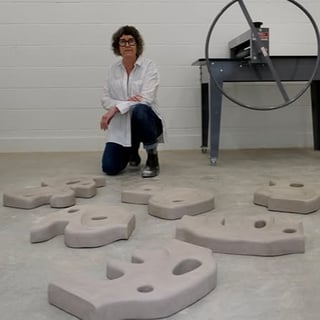
Speaker: Um, yes. So actually I got a, I got a chance to walk down memory lane just yesterday. I went to, uh, I made the drive from PA where I'm located currently to a Baltimore clay works. Um, I started, I would say that that was really where I started making this work. I was coming out of grad school. I was making at Indiana university. I was making these very large, um, monumental sized, uh, abstract sculptures.
Speaker: And when I got to Clayworks, I continued to make the sculptures, but the big thing was, where do these live? Where do they go? Who's buying these? Or at least taking them home? And the answer was almost no one. And so,
Speaker: I started there with the idea of like, okay, I need to find a way to make these sculptures smaller. And I had a background doing functional wares, so I decided, hey, what if I tried to have the meat? What would that look like? And so I think the first one I did was I made essentially what was it, I thought, well, what's a simple, functional, recognizably functional form?
Speaker: And that was a bowl. I was like, well, that's pretty simple. And I said, well, what's a recognizable form for what I'm doing? Because all of my large sculptures are hand -built with a lot of texture. I was like, well, what if I just made a form and then I dropped a bowl into it?
Speaker: And so I made a little trough. I cut a U shape out of the top. I made a bowl and I literally just plopped it right in there. And I think that it just took off from there figuring out, okay, how do I integrate wheel thrown forms into what was all hand built? And so that would be when I really started making the work that I am today.
Speaker: What would you say has been your biggest challenge when you were first learning this? There were several. I would say the biggest one and it was it was a very, very it probably.
Speaker: Took me over a year from when I started making the work to actually get to a point where I'd say I was making work that was truly functional, that people could use for everyday things, was clay choice.
Speaker: I was using a cone 10 reduction fire clay body. And as I moved from studio to studio, um, I realized that I wasn't always going to have access to gas firings. And so I needed to make a change to electric and that was difficult. I had to let go of a lot of conceptions in my mind. And so,
Speaker: getting the right clay body and then figuring out how to make things be safe to use, clean surfaces so that I can repeat it and so that people can wash and feel comfortable using them. I think it was probably the biggest hurdle to get over and that was a material change. When you switched from gas to electric, what was the kind of change that you really saw?
Speaker: The quality of the clay, I relied very intensely on having a clay body that I was mixing by hand and was adding tremendous amounts of grog too. And so the clay had this really great tooth to it. The particle size was really large and then making the switch to commercial clays that are really smooth
Speaker: and very easy to throw with. That was a big change to figure out, okay, well, what does my touch feel like with a new clay that is so much softer, that is so much more pliable? And so at first I added a lot of Grogs to my boxed clay, but slowly I moved away from that and I've,
Speaker: because I feel very fortunate because yesterday I was able to go to Baltimore Clayworks and actually pick up some of that original work. I'm now, I'm holding one in my hand and going, wow, my old stuff is like three quarters of an inch thick for a box.
Speaker: And I'm looking at the stuff that I'm turning in now that's like teapots and it's like, oh yeah, you can pick this up. It wants to be picked up. So just a very big, a very big change that I didn't realize was quite as significant or I got the chance just yesterday to see that. That is pretty crazy. Cause I didn't think that either the clay would really matter that much. Oh yeah. Especially because one of the things with my process is I'm,
Speaker: I'm very much interested in the material nature of clay. So I'm stretching, I'm impressing upon it. I'm rolling in textures. I'm building textures on textures. I'm slapping my clay. When I roll out a slab to make anything, I'm taking that slab, I'm slapping my hands into it.
Speaker: I'm punching it with my knuckles. Then I'm rolling that with a rolling pin to get some of that layer in. And then I'm doing it again. And then I'm taking other parts and pressing them into the clay. So there's a tremendous amount of layering. And so different clays are going to record that very differently. And so how do you keep it going when you're going to work with something new? It's just it's exciting. It's a little scary starting off with something new. But I think now I've got it
Speaker: pretty nailed down. So I don't really know what to really call what you make. So if you had to give a name for your pottery, what would that be? With what I'm working with right now, the biggest forums that have me excited, if you've been following my Instagram for the last few sheesh, I guess I could say weeks, maybe even years. I don't know if you could put together that line. I've been really, really interested in the teapot form.
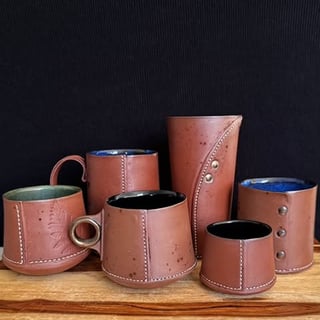
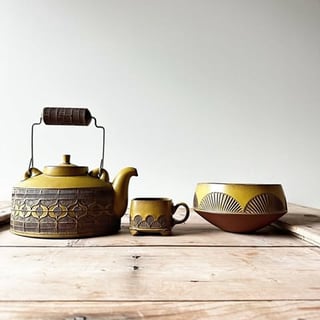
Speaker: I find it to be incredibly exciting because of the complexity of the form, because it has a handle, it has a lid, it has a spout, and cups. I make a lot of those. In fact, I've been making more of them this week and last week than I intended to.
Speaker: I just got carried away. And so I'd say that I'd like my stuff if I were to give them a name that I would simply like to call them functional wares, would probably be the easiest delineation if I were to put them into a camp. Could you give me a simplified version of how you, from start to finish, how you make your pottery? Oh, yes.
Speaker: Now this is, I know that we're going to be listening to this by hand, so I'm going to paint you a beautiful flowery picture, which is the very thing that I was taught not to do in critiques. Because we're gonna talk about what's here, not about what you think you're making. So let me paint you a picture. I start off all my pieces by throwing some of the elements on the wheel,
Speaker: I try to keep them fairly simplistic, pretty geometric, flat planes, not going for a lot of curves. So I'll take those pieces that are thrown on the wheel, I'll set them to the side, and then I'll roll out a series of slabs. Usually the more slabs, the better.
Speaker: and I'll texture those slaps. Like I said, I'll be taking my hand prints and slapping on the clay and then rolling that with a rolling pin to get that impression in and then doing it again. I either have a wooden dowel rod or a metal dowel rod and I'll impress that into the clay and roll that. So I'll build up a series of textures on the surface and I'll let those sit.
Speaker: Sometimes I'll cover them with plastic depending on the humidity. Sometimes I'll leave them out overnight. And then the next day I'll come when they're leather hard. So all of that dynamism, all of that expression is captured. And then I'll start to cut the slabs and attach them to make the bases or to make essentially a three -dimensional standing body.
Speaker: And then I'll try to find a way to make the two together, to bring together both the wheel thrown element and the heavily textured slabs. And it's this meeting where I'm integrating the two together, but like with quilting two pieces of fabric, they get woven together, but they still have a very distinct line.
Speaker: And so that's, so I think I was thinking about this the other day, it's really, it's integration with still there being a very strong lines of segregation between the forms. And so that's really where the play comes in, of how do I bring those two together? And so it's this fun, like,
Speaker: keying together of pieces to make a functional jar or a teapot or a mug or a, you know, me. That was very, very interesting to hear. So now in the last year or so, what have you changed your mind about in general about pottery? Oh, I would say, uh, I had, uh, when I, when I,
Speaker: thought about this question, I honestly really drew a blank. I was like, the last year. Oh, man, I feel like the older that I get, the more time flies by. So looking back on a year, I'm just, oh, it's such a short period of time in rent row spec.
Speaker: We're getting ready to start the new school year on Monday. And I'm just like, yeah, summer's over already. Good night. So when I was thinking, okay, what have I changed my mind on in the last year? I'd say, I wouldn't say it's anything art -related. I'm a man of faith, Christian faith. And in the last year, I've done a lot of searching to try and understand biblical text better.
Speaker: And particularly, I'm very interested in the question of who is the historic Jesus? And so I've been listening to lectures by people like John P. Meyer and J .D. Crossman and T. Wright and Paul Meyer. Hearing different New Testament scholars talk about the New Testament. And I think I used to have this view, having grown up always holding a Bible of like, this is biblical texts and it all makes sense.
Speaker: all the time and listening to these scholars talk about it. It's made me go from the question of having this idea that my understanding of text was this really closed handed, like this is what it is to opening my hand and being, okay, maybe there's a little bit more nuance. Maybe there's some things that we don't know and that in those things that we don't know, that's okay.
Speaker: So I think my faith has become more nuanced as I've learned more from people who, of course, know more than I do. That is very fascinating. We'll have to maybe talk about that some more at a later time. So when you are creating pottery, what do you want your pottery to portray? I think about this every now and then.
Speaker: The answer that I came up with, because my knee -jerk reaction I think was to just simply say it is what it is, and it's kind of like talking. You have a voice, you project, you have your vocabulary, and I guess
Speaker: When I think about art, all art is a form of visual communication, which means that there is an implied message. And to think, okay, well, what is the message that I want to have come across in my pieces? And I think the thing that I came out is I want my pieces to have a sobriety, a certain level of seriousness to them.
Speaker: But I also want them at this point in my career to also have a hint of familiarity. I want them to be recognizable, particularly as pots. In the past I've done abstract sculptures and
Speaker: the idea of, well, where do you place it? What is it? I was okay to play it. And now I very much want my pieces to be recognized as pots, first and foremost. So I want them to be sober, the color choice, heavy textures, things like that. I want them to be seen.
Speaker: And they're not necessarily pieces of whimsy to have something of a soberness to them. That is very, very interesting. So could you tell me the story, how you started teaching your pottery style? I would say, I thought about this one. I tell you, these are some really hard questions. Sorry. Or maybe not necessarily hard, but they're questions that require a certain level of
Speaker: thinking. I don't know if I'd say I've been how I started teaching my style, per se. And that the majority of the teaching that I'm doing is teaching ceramics one, I think I taught a ceramics two class. So those are my college courses. So those are 15 weeks, just, you know, a good amount of time to be to be working with students on on forming work.
Speaker: And it's only been recently that I've started teaching workshops. I did one at the Trual Arts Center last month, which was very fun. And when I'm teaching in my class at the collegiate level, I'm mostly just teaching skills, teaching the fundamentals, the basics. But when I'm teaching a workshop, it's more so talking about
Speaker: exploring the possibilities that can happen, especially when you start to get away from the wheel. I find that a lot of people who take my workshops usually are pretty wheel based for the most part, and so
Speaker: to start talking about getting off of the wheel or taking an element from the wheel that's thrown and then integrating hand building into it can be challenging because so much of working on the wheel, especially if you're like myself and you started on the wheel, the wheel is this kind of
Speaker: self encompassing tool. It's how you can make a cup, trim a cup and then you might put a handle on the cup to turn it into a mug but it's very much it almost starts and ends the construction of the form on the wheel.
Speaker: And so to slowly start talking about, hey, what if you added things to it that weren't circular? What have you started thinking about things not in the round? What if you started thinking about adding 90 degree angles? And so it's really trying to open students when we're talking about, particularly a wheel meets hand is usually what my workshops are titled.
Speaker: Usually it's, okay, how do we build off of a circular form to bring something that's new and exciting? That is really, I never really thought about it that way. Cause I'm also a wheel thrower and I kind of liked how they get broadens out. What advice would you give to like people you were teaching so that they can get the best results they could possibly get?
Speaker: For this, if I wanted a student to get the most out of, and usually I'm thinking within academia, the most out of their collegiate career as the starting point for a life of an artist, the biggest thing would be do it. Whatever the it is, just do it. I think I was listening to
Speaker: I was listening to Tales of a Red Clay Rambler months ago, and there was an individual on there, and he was speaking of having worked with Paul Soldner, and Soldner told him to do it. Because he was thinking, he's like, well, I'm going to try this, but what if it does this? And what if it does this? And what if? And what if? And he said, enough with the what ifs.
Speaker: do it because I don't know what you don't know. I would say that the acknowledgement that like as a teacher I know a lot and a lot of what I know is I've read but probably the majority of what I know is based on what I've tried and failed at. And so there are lessons that you will learn along the way
Speaker: of any creative endeavor that you're only going to learn when you try something new. And usually if you try it in a really novel way. An example of this would be in undergrad, I was making a bunch of very, very large jars. Thank you to Daniel Johnston who
Speaker: was a visiting artist and he ended up taking, he saw that I was trying and he was like, wow, you're really, you're not good at this. And I was just like, yeah, okay. And so he taught me for an afternoon how to make large jars in the style that he had learned, having lived in Thailand for over, I wanna say over a year, learning how to make large jars. And there's a particular style, it's not like the ungi jars
Speaker: Korea. And so he taught me and so I was making these large jars and I had made maybe five or so of them and they were over three feet tall. And so I made one that was particularly beautiful. I loved it. It had this really it had a small foot and this graceful belly. And so it was tall and it was narrow and had a beautiful lid and I put it into the wood kiln.
Speaker: We fired it there at Bowling Green and John Balestreri had returned from research leave, I want to say that year. And when we went to unload the kiln, there was all of this excitement in the air and I went to get the piece. Eventually we unloaded up until that point and I saw that it had cracks on it. It had severe catastrophic cracks on it. It had one crack that went through the apex of the curve
Speaker: perfect horizontal crack around the entire piece. Then below that point to the shelf, it had vertical cracks, perfectly straight vertical cracks, which was completely unexpected. It was up on wads, but it had been in a place with particularly large amount of ash. It had these beautiful red and green glazed trails on it.
Speaker: And so we took it out and we investigated it. And I was like, I don't understand how you get vertical cracks like this. Usually clay comes apart in the way that it was put together. So I understand the horizontal, but I don't understand the vertical. And John went, oh, well, did you glaze the inside? And I was like, well,
Speaker: No, I mean, it's not a functional piece. It's over four feet tall. Like why would I glaze the inside? He was like, oh, well, you know, glaze is going to exert a certain amount of surface tension. And if you have that tension only on one side, like in a wood kiln where there's all of this ash that's turning into a glaze, it'll just rip the piece apart. So you have to glaze both sides. I was not made aware of this.
Speaker: But you wouldn't have known that if you didn't try it. Exactly. So I ended up losing a piece. And it was a beautiful piece. And I still think about it some days. Clearly, it was memorable enough. But he didn't know that I didn't know that. I didn't know it. And so I did something. And that was the result. And now I know.
Speaker: And you'll discover that over and over and over again, there's going to be, there's, especially when you're starting out, there's so many rules to clay, so many rules. And there are ways that you can bend the rules, ways that you can break the rules, ways that you can shimmy around them. But at the end of the day, you have to figure out what works for you.
Speaker: And the only way to figure that out is to do it. So my advice for anybody who's either starting working in ceramics or who is thinking about trying something new is you can do your troubleshooting to try and alleviate any mistakes that could come your way potentially. But in the end, you just need to do it to figure it out.
Speaker: I love that so much. That is like super, super, super good advice. So as we're coming to a close here, would you mind telling me what advice would you give people looking to find their own unique style?
Speaker: I think my professor in grad school, Timothy Mather said it best. I'm not sure if he's the originator of this quote. He has been around for a very long time. He said, the worst way to figure out your style is to go looking for one. Just do what you do. See your work and make that which excites you.
Speaker: If it excites you, then it's speaking to something within you. And if it's speaking to something within you, it's authentic. Don't do what other people are doing because you think it's cool. Do it because you like it, because you think it's worth doing. And then take the time to figure out why you think it's exciting. I would say that's the start.
Speaker: For anyone who's thinking about starting a new style or thinking about changing or what is my voice in this world? Start with what makes you excited because that's coming from a place of true authenticity. Don't start with what other people are doing. Start with what you like and then get good at it.
Speaker: and figure out, what is it about this that makes me excited? And you can start to tell why. It's the same when you're thinking, you know, you form the voice that you have, you have the vocabulary that you have, the words you use, those choices that you make.
Speaker: Why do I speak the way that I do? Oh, well, I was raised around people who spoke like this and well, what else? Well, I take in these influences and I like the way that this is and I'm trying to present myself as a person who is insert blank. But all of that is an outpouring of who you are as a person.
Speaker: unless you are always wearing a mask. And therefore lying to others or yourself. So start with what makes you excited. It's hard to be excited for things you don't care about. That is wonderful piece of advice. So that was my last question. Wesley, where can my audience go and find your work and just go check your workout? There's a few different places.
Speaker: You can always check me on probably the most formal of settings will be my website at WesleyTBrown .com. If you want to see things that are more up to date, Instagram would be the place to go. And that's Wes Brown Creates.
Speaker: And if you want some funky videos, I've been trying to get better at it. I've made a TikTok account because I'm trying to be like all the cool kids. This is one area where I'm trying to follow because I think it's a new frontier as far as video goes. And so my TikTok is the same as my Instagram, but we just dropped the last name. So it's Wes Creates.
Speaker: I don't post there as much. Instagram would definitely be the place to be most updated with what I'm working on or where I'm going. And I do announcements for upcoming shows and sales and things like that.
Speaker: So Instagram at West Brown Create. We hope you enjoyed this episode of Shaping Your Pottery with Nick Torres. Do you have questions about pottery that you'd like Nick to answer? Send them to us on Instagram at Nick Torres underscore pottery. We'll see you next time.