Transcript
Speaker: If you love pottery and want to take your skills to the next level, you're in the right place. Find your own pottery style right here on Shaping Your Pottery with Nick Torres. Let's get started.
Speaker: What is up, shaping nation? This is Nick Torres here, and on this episode of Shaping Your Pottery, I gotta interview Mike Serv. Mike makes some really incredible hand -built pottery that he uses laser cutters to create textures and design. In this episode, you will learn how Mike creates his hand -built pottery
Speaker: You'll also learn about why you should be letting small moments into your pottery and see where that takes you. Finally, you'll also learn about building confidence into your pottery by simply just keep on making. I hope you guys enjoy this episode and I'll see you guys in there. Mike, welcome to Shaping Your Pottery and share with me what is something people might not know about you. Thank you. I love Star Wars and Star Trek.
Speaker: easily totally not pottery related but you know it's a huge debate between the two and I love them both so I've never really seen Star Trek before but what is your favorite episode movie from Star Wars oh episode is really hard there's a oh there's a lot to choose from it's gotta be the original one of the original three though I'm gonna go with number
Speaker: The Empire Strikes Back. So I personally like Attack of the Clones. That one's my favorite. But I do like most of them. Yeah, never take them for their flaws and just accept it. Yeah, very true. So tell me a story how you got started in ceramics. Well, I mean, I feel like I have a couple, but I think the biggest one that really changed my trajectory just like as a person happened in high school.
Speaker: I had a really wonderful ceramics teacher, really privileged high school experience that we even had to play. This, you know, this teacher answered all my questions. I had a glaze mixing project and I really hooked on glazes and one day decided to ask our play delivery person if they knew anything about glazes and I guess they, you know, kind of
Speaker: sent my interest chain to their boss who then emailed me out of the blue and asked me if I wanted to do an internship studio which is now called Belgium Star Studios and that just kind of exploded things for me you know I started helping teach in their summer classes and I had a pretty good working relationship with the residents there and a lot of time with
Speaker: studio members and all of that together really kind of pushed my knowledge base and my interest a lot. So how would you say this experience helped you with pursuing pottery further? It helped me build my knowledge base, right? Like I didn't really know very much technically on how to make pottery or material wise.
Speaker: You know, and while I was in this internship, I got to work with all the studio members and the residents and the studio manager, and they taught me a lot. You know, they taught me various sewing techniques, various hand -building techniques. You know, at the time, I didn't like hand -building. You know, and a lot of glaze chemistry, I was really, really wonderfully allowed to continue testing glazes while I was there. They just let me use the material.
Speaker: And so time in the glaze lab, love that. So tell, so you decided to attend some residencies just like through your pottery journey. Can you tell me the story why you decided to attend some residencies? Yeah, just real quick. So I think really the biggest reason that I wanted to do residencies, at least the ones I stayed with.
Speaker: At the time I hadn't lived anywhere other than Kansas City and, you know, it's a great place. Obviously I'm back here again, but, you know, there's only so much here and I wanted to experience something different and something new and, you know, see what life and ceramics and just everything is like in different areas. So my first residency was in New York, ways away from Kansas City.
Speaker: And then that same kind of thought process of I really want something different applied to grad school, which isn't quite a residency, but, you know, again, I wanted to go somewhere different and experience something new and kind of broaden my horizons. So how would you say attending residencies and attending grad school pushed your pottery further? I mean, probably the main way is the dedicated time. It would really just,
Speaker: going and and pick up as much studio access as I could you know and just work and work and work and yeah so dedicated time time to work when working in residencies me one time with other other people in the field you know whether that be educators or other makers or you know administrators just anyone in the field that was
Speaker: doing something that helped push ceramics forward and all of that that's not working you could say really helped to expand my understanding and helped me to grow skills even just seeing studio members who like are making stuff for fun you know they're they're doing just something for pure enjoyment pure
Speaker: like personal meditation. And I think that even bleeds into my studio is now I'm doing the same thing. I'm doing it just for personal meditation. I love that. Shaping Nation, it's important to surround yourself with other artists, other potters, because that's where most of your growth is going to start happening by connecting and learning from all these other people. I love that so much. So let's talk about your pottery. In one sentence, can you tell me what you make?
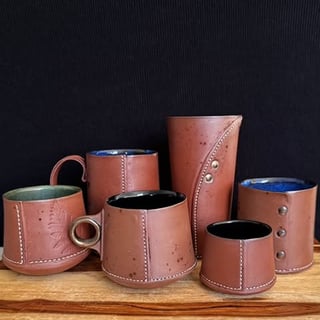
Speaker: for sure. My mate slab built utilizes tar paper templates, which are laser. So can you tell me the story how you started making this party that you make today? I was in grad school, LSU. Mike Pelkey came and gave a workshop and he was showing all of his various techniques. You know, he throws me coils and there's all sorts of things and how his school box he took
Speaker: paper templates and I'd seen tar paper used as like a stencil that shapes the style a bunch of times but not with tar paper but he showed how to make a cube and folding it up as one piece you know it's like it starts as like a T shaped template and it folds up and it blew my mind. I was like astonished and that immediately
Speaker: Got me interested and I left the workshop and went to my studio and then ignored the next couple of days of him giving demonstrations and sat in my studio and made templates. Cause I was so enamored by this process and none of them worked. They're all, I think I was trying to jump a little bit too far before really learning to walk on. Just got so interested in that process.
Speaker: So you are inspired by small moments. How does this impact the way you make pottery? Well, I mean, I think the main thing is I try to let those small moments happen in my pottery as well. You know, I'm really interested in leaving, you know, marks of making, you know, kind of the process. Just bits of happenstance, you know, like my fingernail leaving a neck in the surface or
Speaker: needle tool digging in just a little bit too far when I take away the template wrinkles in the inside of the surface in the slab and just kind of leaving those things so that the clay has a little bit of a voice too and then it kind of it's the layers all drawn the curtains of slip and plays and the firings I think it
Speaker: It's a similar kind of language to those small moments where if you just kind of look at the little bits, like those small artifacts, at least for me, it gives me a similar feeling. Well, more recently, I've been taking a lot of pictures of those small moments. So like, it's a rock and things. And they're turning into backgrounds for instruments. I love that. A little bit of dual use because so much of my studio practice now is
Speaker: is working on Instagram. So before I get into that, so shaping nation, it's important to let these small moments into your pottery. Maybe you are, you mess up a little bit on your pottery. What if you left that in your pottery instead of trying to fix it and leave these small moments into your pottery and see where that takes it? I love that. So you mentioned Instagram is a big part of your practice. Can you explain that to me a little bit more?
Speaker: They never really thought that I was going to be an Instagram person. You know, I'm not really huge on social media. Personally, I don't do Facebook or any of that really. But as I've been working in my studio, you know, I learned sharing help to develop my network as a maker and kind of my market base as a, as a salesman.
Speaker: which feels a little gross to say, but that is, I guess, technically what I am. So it was, it was just how has, how have you been using Instagram with you to help you with your practice? So, you know, with that kind of increased push in Instagram, I've also, you know, that has allowed me to develop a,
Speaker: a business model and then to make money, which is not really my goal, but my goal is to be able to make the work that I want to make and not have to worry about selling. And I have a business that brings in money. I don't really have to worry about selling things. So by pushing on Instagram,
Speaker: you know, showing my process and sharing what I can and helping people where I can. It allows me to then, you know, do what I want to do. It's really just a goal. Definitely 100%. What would you say is your best advice for people trying to start getting better at Instagram or social media in general? Just start doing it, I suppose. For me, the most developmental thing was
Speaker: finding other Instagram tent makers and seeing how they do what they do and seeing why I like them. You know, if there's a certain thing that they repeatedly do in their posts or how they option something, what they do with their best friends or how they flip their videos or the reason they choose. I'll start to take note of what those things are
Speaker: and try to apply similar things to my own Instagram practice to try and build that. And then really, it's just kind of been a slow build, you know, step by step of learning how to do these things, you know, like learning how to edit the videos so that they feel not boring, which I don't always see, you know, learn to use the right audio to fit the video, that kind of thing.
Speaker: A lot of it also seems to be the growth of technology. A lot of my videos have improved simply because they can do more with just post, see if you like it, and adjust for next time.
Speaker: Absolutely love that. Shaping Nation, much like how you look at other people's pottery and take what you like and try to put in your own pottery, you could do the same thing with Instagram or any other social media. Look at other people's accounts, see what they're doing well, and try to almost model that into your own pottery. I love that so much. So now, can you give me a simplified explanation on how you create your pottery? Absolutely.
Speaker: My pottery starts on the computer, so I make a digital form of whatever I want. I then flatten that out, apply whatever pattern I am sitting by, laser cut that into tar paper, apply the tar paper to a clay slab, and then model that slab into the original three -dimensional form with the tar paper attached.
Speaker: And then finally I'll peel that away and I'm like, my pot. So where do you get this paper from? Just a hardware store. It's a roofing material. It's a pretty common roofing material here in America. I've learned since doing this that it's not common everywhere. Other countries don't really have paper. Some of them have other similar things, roofing felt, which not quite the same. So before we try it out, maybe.
Speaker: just do some research or just do a method for them. But yeah, just like a hardware store, like Home Depot, Lowe's, Strasser. I mean, I don't know every hardware store's content, but it's pretty common. Absolutely love that. So let's talk about discovering your voice. Can you tell me about the moment when you knew you were heading in the right direction with your pottery? Yeah.
Speaker: Hey, so while I was at LSU, after Mike Elke was there and before my thesis, I was playing around with favorite templates. Wouldn't you guess it? I finally had a template that was working out. You know, I, it was really the first one that was working and I called it a bloom cup because it kind of like folded in like a little simplify. And I made a couple of those, blazed them with this recipe.
Speaker: that I formulated with my partner. I went out of the kiln and there was this gorgeous chrome tin, pink, and peach, and just like everything seemed to work on it. And that was the moment when I pulled it out of the kiln. I probably gasped because I was so pleased with these cups. Probably the most pleased I'd been with any of my work thus far and my intuition. I feel like there's a lot to say,
Speaker: I suppose that's why that was the moment. I absolutely, I absolutely love hearing that the gasping moment. I love that. So can you tell me how did your pottery evolve into what it is today? Well, I mean, this is kind of like step by step, like anything, but I think the biggest impact, the biggest thing that pushed that evolution was investing in kind of CNC technology. So, you know, not necessarily a router.
Speaker: but any kind of CNC. So like a vinyl cutter, that's a CNC, you know, just a small specialized one. And so that is the first thing that I bought was a vinyl cutter, thick knife and used it to cut paper. So I start making more perfect kind of templates, more even, you know, matching lines, that kind of thing.
Speaker: not really opened up my mind on what was possible with this. You know, now that I'm not concerned about making sure every panel is lined up manually, I can start doing other things to it. And then, you know, I realized the final was a little limited and I invested in a laser. Which seems pretty large, but at this point has well passed so far.
Speaker: Once I had that laser cutter and I could start doing whatever teeny tiny little shape, I, it was like freaking doing. And so I started to find, you know, textures and patterns and work those into the templates. I guess the rest is history. What is the, the name of your laser cutter? Oh, I think I'd have a, a sculpt fun.
Speaker: I got it on Amazon for what that's worth. It's a hobby laser. It's five watt. And I would not be concerned with the brand if someone's looking into getting their own laser, because all of these hobby lasers on Amazon and other suppliers are going to be very similar. It's basically just aluminum extrusion, some 2020 or 4020.
Speaker: a laser diode. And so you have to construct it yourself. It's super cheap. There's no ventilation. So do it outside, weave it in. But you know, they're all basically the same things. It's the same basic components. Just put it in brand new. Absolutely love that. So what would you say was your biggest obstacle when it came to finding your own voice? Probably myself. Honestly, I kind of
Speaker: part of time finding confidence in my own work, you know, throughout my artistic career, you know, feeling like, yeah, this isn't, this isn't good enough for one reason or another. And, you know, even for a while, I, I wasn't signing my work because I didn't feel like it was really worth the signature. It just seemed like, well, this is a pot, so it doesn't, doesn't need it. So yeah, just myself, you know, I kept,
Speaker: letting that internal voice that says, it's not good enough, win over all of the other voices that we're saying. That's great. Not that I'm trying to toot my own horn about something great, but super cliche, no one wears critic, but goodness, I definitely was. So what did you do to help you get a little bit more confidence with your pottery? Nothing really affected me. I just kept working.
Speaker: So I felt that confidence. I wish I could give a better answer or some advice, but I don't really have any good advice for that. I absolutely love that. Shaping Nation, the simplest way to build confidence with your work is to simply just keep working, keep perfecting your craft. That is the simplest thing that you can do to start building confidence with your pottery. I love that so much. So as we are coming to a close here, what is one thing you want to hammer home with my audience today? Just jump in, I suppose.
Speaker: you know, holding myself back, that was me not jumping in. But me buying a laser, that was me jumping in. And every time in my life that I've decided just go for it, just jump in, it's paid off. You know, and so I think just taking that leap of faith, whatever you want to call it, making that first step, starting the journey.
Speaker: Absolutely agree. Mike, it was so great chatting with you today. Where can my audience go and learn more about you? I've got an Instagram, mikeservepottery. I've got a couple of websites. Goodness, I couldn't get the Shopify off the top of my head, but my portfolio website is mikeserve .com and they're linked together as well as through the Instagram. So if you find one, you'll find any of the others.
Speaker: And then you can also shoot me an email at micservepots at gmail .com.