Transcript
Speaker: The cup is something that you look at, so it has to be visually pleasing, but it's also something that you pick up and hold. So you can feel stuff, and the texture, you know, lends itself to that tactile experience, as well as the glazes that you use, because glazes feel different, too. Glazes aren't just their color, their transparency or opacity. What is up, shaping nation? This is Nick Torres here, and I had the great pleasure today to interview Annie Kreichman.
Speaker: And he makes some really incredible texture design pottery that is absolutely incredible how she makes textures.
Speaker: Annie has had her work in articles published in Pottery Making Illustrated over 20 times. In this episode, you'll learn how publishing articles for Pottery Making Illustrated has helped with her own pottery. You'll learn about why you need to be making pottery to the best of your ability. You'll also learn how Annie takes everyday objects that she finds around
Speaker: And she uses texture to make the pottery that she makes. And there's so much more in this episode. I hope you guys enjoy it because I know I did. I know you guys will learn a lot. I'll see you guys in there. If you love pottery and want to take your skills to the next level, you're in the right place. Find your own pottery style right here on Shaping Your Pottery with Nick Torres. Let's get started. Annie, what could shape your pottery and share with me what is something you believe potters should be doing to have success in pottery?
Speaker: They should be making the best work that they can. That's where it all starts. From making really good work, from making original work, and trying to move your own work along as well as contribute to contemporary ceramics by doing something new. I think that's the best thing people can do for their ceramic career. Absolutely agree. Shape Nation, the most important thing, always to make the best work you possibly can. I love that so much. Absolutely. Tell them the story how you got started making pottery.
Speaker: Let's see, I took my first ceramics class in 1991 because I was going to sign up for a class in 1990 and I went in to talk to the teacher and I didn't have the prerequisites of the art classes that I needed to take ceramics and I just went in to see if I could take a ceramics class. And the teacher said, no problem, just come at the beginning of the semester. The class never fails and I'll sign your paper and it'll let you in without the prerequisites. Well, the movie Ghost came out.
Speaker: And then when I went to get into the class, the line was out the door and I didn't think to go, wait a minute, I talked to you last semester. I just saw the big line and walked away. But then I was able to take my first term as class in 1991. That's how I get started. I love that. I love that. So tell me, what made you keep pursuing this pottery journey?
Speaker: Well, because I can make questionable decisions and stick with them. So I went on to get a bachelor's degree and a master's degree in ceramic, taking that first class. Yeah, so it's my longest relationship. So you have had over 20 articles published in pottery making illustrated. Can you tell me more about this?
Speaker: Yes, back when magazines were a thing, and when I grew up, magazines were a thing. You saw other people's work by looking through Ceramics Monthly and Pottery Making Illustrated and Studio Potter, because it was before the internet. So, I'm SoliGenX.
Speaker: So yeah, at one point I met Bill Jones who was the editor of Pottery Making Illustrated at Inseka and I was really still figuring out what I wanted to do and what I wanted to pursue. I was making both sculpture and functional pottery and then I decided on the specific functional pottery aspect and I just met Bill Jones at Inseka and started talking to him about stuff and he asked me if I'd like to write an article.
Speaker: Before that, I had had a cup with a hand built handle in somebody else's article. And then anyway, once I did the first thing, I just kept pitching ideas and they kept saying yes. And then after I kind of ran out of stuff to write about my own work at the time, I started asking if I could write about other people. So I wrote an article when Richard Notkin, I was living in Denver. When he came to town, I went to his workshop and then I
Speaker: I stayed at the workshop, I wrote about that and I wrote about his technique and interviewed him after the workshop. I wrote about David Bowie, Bowie, I think he pronounces it, not David Bowie.
Speaker: croissant, Bowie croissant, that's his name. And then Paul Donnelly, when I went on a trip to Kansas City, they were both studio artists. So, you know, I tell them, hey, I'm going somewhere and they would say, oh, right, see if you can get an interview with that person. So I did a lot of that too. I went and spent three days with Lana Wilson in her studio and wrote an article about her.
Speaker: and what she was working on at the time. So yeah, you just pitch articles and if they want, I mean, they need content. They really don't have staff writers. So if you have an idea or if you have a technique that you want to share, I believe the website tells you how to apply. And I, as I recall, although I haven't done one for a few years, I did one a few years ago, but you kind of write a little paragraph about what the technique is and maybe submit a bullet point to the steps that you're going to illustrate. So.
Speaker: How did how did getting your own articles published and? Publishing other potters techniques. How does this help with your own potter in your own business? Well, it helped me because back when magazines were a thing when you published in the magazines You'd get invited to teach workshops all over the country and in Canada talk to workshops in Canada So back in the odds, I think I started writing like 2007 2008
Speaker: magazines were still a thing. And I would just get invited to different art centers all across the country and up in Canada to go teach workshops. So that's how it helped me. Oh, and then just interviewing other people anytime you talk to anybody about ceramics, you know, it helps you with your own journey, because you're just like talking about ideas and figuring things out. So that's pretty obvious that going into other people's studios and writing about them, you know, helps.
Speaker: I love that so much. Shaper Nation, the more you can get around other artists, maybe interview them, ask them questions, the better your pottery is going to look and the better your pottery is going to be. I love that. So let's talk about your pottery. Can you tell me the story how you started making the pottery that you make today? I wanted to make things with texture all the way around. And so the right way to do that is to hand build. You can texture your own pottery, but you can't get crisp.
Speaker: you know, juxtapositions from one pattern to the next by, by throwing. And then I figured out a way to get a foot ring on the thing. And that was the last article I wrote for Pottery Making Illustrated just a few years ago called Footring Poopies. What was the question again? Just tell me a story of how you started making the pottery they make today.
Speaker: Oh, I just wanted, I just liked working with pattern. I have a too much is never enough philosophy in my work as well as in my life. I love pattern. Pattern energizes me. And whenever I roll out a slab and then put texture on it, I just, it just like makes the pleasure neurons in my brain fire. I just want to make something out of it. So I just figured out how to make the things that I wanted to see in the world. You know, that's what you do.
Speaker: Follow what you like and that's how you kind of develop your own voice Absolutely great. So you mentioned that you have Never too much mentality. Can you tell me about too much is never enough? Well, I just like lots of pattern. I like like lots of texture I like lots of color choices one of the things that I do in my work is play with different different color combinations because
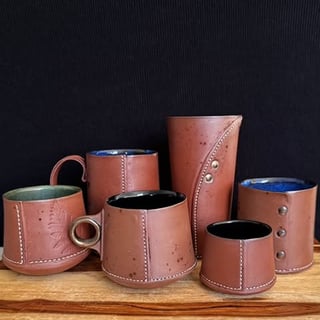
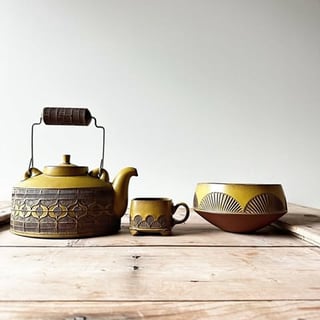
Speaker: different color combinations can evoke a mood or a feeling like this to me has a very nostalgic feeling with an art deco green and this is a glaze that I made when I lived in a neighborhood that had lots of wrought iron details on the houses that had been painted white and the the rust kind of comes through the right the white paint you know and the kitchen in that house underneath the white paint there was this you know art deco green that was popular in the 50s you know as well as being from the
Speaker: the earlier times. And then I just, you know, find a nice butter yellow to go with it. And this color combination just has like a dustbowl era feel to it. You know, so I just like to play with the moods. This, I don't know what this is. This is like retro carny. But the other thing is, is that the different color combinations have different associations to different people too. But they definitely evoke a mood. And what else do I have that's not bad? This is a popular color combination. But turquoise and purple and mermaid.
Speaker: And then these are also my own glazes. So I heard a teacher say once that you need to be 100 % responsible for your surfaces. None of the other people in the class took it to heart but me. And they don't even remember saying that. But I thought, OK, I need to have my own glazes. So I've been working for 30 years doing glaze development.
Speaker: And yeah, none of the other people that had that teacher took that to heart. They're still using those same 10 reduction glazes that everybody else is using. So I don't know. Stuff sinks in with me, I guess. I love that. I love that so much. So you are inspired by functionality and engaging multiple senses. Can you tell me more about this and how this impacts the way you make your own pottery?
Speaker: Yes. So a potter's most successful form is the cup form, right? Because people buy them, people use them, people collect them, people have cup collections. And we know that there are like cup sales, you know, where every, they get all these artists to, you know, submit their own, their fabulous work. Cups are often a place where you can
Speaker: work on ideas and stuff too because it's a small containable format. So the cup is something that you look at so it has to be visually pleasing but it's also something that you pick up and hold so you can feel stuff and the texture you know lends itself to that tactile experience as well as the glazes that you use because glazes feel different too. Glazes aren't just
Speaker: color, their transparency or opacity, they feel a certain way. And y 'all, we make things that people put in their mouths. That is a very intimate act. Your lips are very sensitive. Your lips are even more sensitive than your fingertips. And so, you know, you can feel the texture on your lips. This pattern, this up and down pattern, I love the way that feels on my lip. It just feels like just, ooh, it just
Speaker: It gives me like the good kind of shivers, you know? And then, yeah, you just mess around with how the glazes feel. I always put a glossy glaze on the inside of functional pottery because it's hygienic. But on the outside of pottery, you can mess around a little bit, you know, and play with the matte glazes that I use and semi -mats and, yeah.
Speaker: I never know by the time I'm done talking if I answered your question or if I've just gone on a tangent, so feel free to wrangle me back in because I don't remember what the question was. I'm a space cadet, which is why I'm earth to Annie. I love that. You answered that perfectly.
Speaker: And I definitely agree with the lip on a cup and a mug because that is the most important part. That and the handle, I love that so much. Right. And also, the lip has to be a certain shape too. If you make a lip that's too fat, for some people that have smaller lips themselves, they won't be able to get their lips around it and it'll dribble. So, yeah. There's not a lot of hard and fast rules in ceramics, but if you're making a cup, it needs to not hurt anybody or draw blood or dribble.
Speaker: Absolutely agree. 100 % I love that. So you call yourself a master hand builder. Can you tell me more about this?
Speaker: Well, I do call myself a master hand builder when I'm writing artist statements, but I don't walk around in the world calling myself a master hand builder. And I don't call myself that on Instagram. But I do think I am a master hand builder because I've pioneered ways of layering pattern that nobody showed me how to do. I figured out how to do it on my own.
Speaker: And I know that I've influenced contemporary ceramics because I see people working the way that I'm working. I figured out how to get a nice, tidy foot ring on the bottom of hand belt pots by making the foot ring cookies, and I wrote an article about that. And I just feel like I take my studio practices very seriously. I know that I have some serious chops in hand building and shaping slabs.
Speaker: So talking about your work in person is different than writing artist statements, which I write artist statements all the time to apply to shows, the shows that I do and apply for grants and things like that. But I look around at other handbuilders and I really don't see other people pioneering new things in the field. Anyway, that's why I called myself a master handbuilder in the artist statement that you asked for.
Speaker: I love that. So you mentioned that you are constantly making new artist statements. What makes a good artist statement and should people be making them themselves?
Speaker: So for me, I did go through undergraduate school and graduate school, and we did have to talk about our work. And I do think that figuring out what it is you're doing and writing about it helps you move your own work along, right? First, you have to sit here and figure out what you like and what you don't like so that you can start to make work that you like.
Speaker: But then once you, you know, you need to push your work along. For me, putting things into words helps me do that. Helps to keep me on track, helps me to see where it is I can go next and stuff like that. But I also enjoy it. It was never hard for me to do the art speak. It's just a word game to me.
Speaker: I definitely agree, I love that. Shaping Nation, if you are struggling to kind of put thoughts of your pottery together, try writing it out, try writing an artist statement, because that's gonna move your work along and your pottery will actually start growing from that, because now you know what you don't like and what you do like. I love that so much. So now, earlier you mentioned, you've mentioned this a couple of times, that the foot ring, that you pioneered a foot ring to actually make it look like it's wheel thrown foot ring. Can you explain to me how you do that?
Speaker: So I didn't do it to make it look wheel thrown. It does look wheel thrown because I'm making round pots because often a round pot is a good answer. Also, I try to keep my pots, the shapes very basic because I'm doing such wild things with pattern and color. So if I was making crazy shaped pots too,
Speaker: that might be a little bit over the top although maybe that's something I need to explore in January. So basically the thing that I use to make this with is something that I throw on the wheel and if people want to know they can google Footring Pookie P -U -K -I and it will come up on the Pottery Making Illustrated website and they'll be able to look at it and read it. It'll show you how to make them and also how to use them.
Speaker: And I got the idea originally from a Japanese inkstone that I saw when I was an intern at Trinity Ceramic Supply a long time ago in the 90s. And it was this black stone thing with a water reservoir around it, and the center of it was raised. And I saw it and I thought, oh, you could make a foot ring with that. And of course, I think I tried it.
Speaker: Let's see, that was like 1996. I tried it 10 years later. It takes me a long time to get around to stuff sometimes. But it stuck with me in my head. I remember seeing it on the counter and thinking that. And then I can throw as well. I don't hand build because I can't throw. I do have a bachelor's and master's in ceramics and I did my undergraduate work on the wheel. I love that. I love that the idea from 10 years before you started making that was still in your head and you made it come to life. I love that.
Speaker: I'm flies and flies. There's so many things to do, you know, and it takes you a while to get around to them sometimes. I love this. Now, can you walk me through how you are able to get the texture and the patterns onto your pottery?
Speaker: Yes, everything starts as a flat slab. And while the clay is still flat, I put the pattern and texture onto it with rolling pins. I actually don't use a slab roller because I don't have room for one in the studio that I have right now, which is the master bedroom of my house. So I roll things out with a rolling pin, and then I use the little common pony roller
Speaker: to push the pattern into the clay. Sometimes I put the clay on top of things. It depends if it's a hard texture tool or a soft texture tool. And I was hand building before there were a lot of patterns. I mean, texture tool is available for potters. Now there's like 10 ,000 patterns, you can just get the tool. But most of the things that I use are found objects.
Speaker: from floor mats to scrapbooking paper to other big sheets of embossed paper that I don't know where to find anymore. The store that went that went away one day, I mean, the store that had all the patterns went away one day, but I still have something left. Yeah, so most of the tools that I use are not actually tools for ceramics. They're just things that I found. So. What would you say has been your most favorite found tool that you use for texture?
Speaker: Well, this, I'll just tell you what some of them are. This is from a piece of 200 year old French patterned glass. When I lived in Denver, I had a friend who had an architectural reclaim and he had this piece of glass in a door and he took the window out and gave it to me.
Speaker: This is a piece of paper that I don't have a source for anymore. This is an ink stamp that my teacher gave me once. Someone had given it to him and he didn't find a use for it. And it's one of my favorite textures because I really like the way my fingertips fit into these stars. It just feels really good with this semi -matte glaze on it. It's my favorite tactile sensation of my patterns.
Speaker: This one is a clay tool, MKM pottery tool, a roller. These are both pieces of like scrapbooking cardboard. So just whatever, whatever I can find. I made this one. This is Ponderosa pine bark. I have Ponderosa trees in my yard. What else? I have a piece of tent that I found on an old rusted out farm in 1991 that somehow moved to England and back with me and I still have it.
Speaker: I'm looking for it on something. I don't see it on anything. But you know, all the, oh, here it is. All the patterns that I use, you can find the patterns on ceramic tools now. This is that from the piece of tin. This is just a rubber floor mat. Yeah.
Speaker: That is absolutely amazing. So I'm going to cut you off right there because so we don't run out of time here. But I absolutely love that. So let's talk about the business side of pottery. Can you tell me about the moment when you decided to go full time with your pottery?
Speaker: I never just decided I'm going to go full time with my pottery. I was always making. There were times when I worked at an art center and I managed the schedule of the classes and still made pottery. So I was still working in my field. And then when I first started selling my work, I was selling it through galleries when I lived in Denver.
Speaker: And I was in a really good gallery that no longer exists in Breckenridge because one of the women died that owned it. I'm not in galleries now. So I was always just working and you know working toward it. And for a while I taught part -time at junior college and then I was a full -time artist and I was you know traveling to teach workshops and then I was starting to do the shows where you set up a tent and sell stuff.
Speaker: So, I mean, it's always just been creeping along. Most of the time I was able to teach along with it. When I moved to Bend in 2015, I haven't worked for anybody else since then. But I was, like I said, I was teaching back in Dallas and then I taught full time for two years. And then they were trying to rope me into the tenure track position and I just moved to Oregon to get away.
Speaker: And then I just haven't had the work outside of my studio. I've also, I also started teaching online in 2015. And that was kind of before anybody was doing it. And I figured out how to do that. And it worked. The first class I taught was a glaze class, you know, to teach people how I found my glaze colors and to help people along their way of finding their own glaze palette, you know. And that worked. It worked online. And I started doing other classes too.
Speaker: I love that. So we're gonna talk a little bit about your upcoming class coming in January, just a little bit. But for now, what would you say was your biggest obstacle when it came to selling and going full time with your pottery? I don't really feel like there ever was an obstacle.
Speaker: Well, when I taught full -time those two years, so I was handed a full -time two year teaching contract and I thought, Oh, I should take that because those don't come around very often. I had been teaching part -time and did the junior colleges around the Dallas Fort Worth area. When I was handed that, that was an obstacle to me having the time and energy to make my own work, not because of the students, but because of all the administrative work that went along with being a full -time teacher.
Speaker: That's why I ran away from it after that two years was was over. That's really the only obstacle. Yeah, to selling my work. I've been lucky that people like to buy what I make. Not everybody, you know, no one could be every everybody's perfect potter. But you find the people you find your collectors and you find your audience, you know.
Speaker: I love that, definitely agree. So now let's talk about the upcoming cup workshop that you were doing in January 2024. So you were doing a month long exploration of the cup. Can you tell me more about this?
Speaker: Yes, I am going to take all the people that sign up for it for a this month long journey into exploring cups. And I've got a huge list of things like prompts to get people to try. I'm going to demonstrate techniques obviously.
Speaker: First it started out as just like a four -part class where I was gonna have a class on Tuesday evenings, but it's growing. Now I have two guest demonstrators and I'm planning on doing a lot more demos like during the week and stuff like that and a lot more involvement. And I haven't decided on the online venue yet, but there's going to be a place where it's gonna be very community oriented so people can be on there all the time, post stuff,
Speaker: download all the documents and the videos, you know, watch the classes if they can attend them or because I'm going to be jumping on and doing demonstrations as I, you know, discover something new. That's the whole point is to push everybody out of what they're doing into new territory because cups are a really good idea to explore new ideas for, you know, larger pots. So.
Speaker: And yeah, I'll be making at least a cup a day during January. I suspect everybody else will be too. And I have ideas for more demonstrators. As soon as I get some more enrollment, I'll book that third demonstrator. And I'm super excited about it. How did this idea come to be?
Speaker: Oh, well, I've just been teaching online for a long time and I just got the idea to do like a cups class in January. So at the beginning of every making cycle, like when I've been gone for a while or after I do a show and I start to make again, I usually start with a cup.
Speaker: And I sell lucky New Year's cups every year. People buy lots of cups in January. And I just thought, hey, I'm not the only one who wants to start off the new year in a creative way. So I always try to move my work along in the wintertime. And I just thought others would want to go on that journey with me. And it seems like, yes, others do want to go on that journey with me.
Speaker: I think I have 27 people enrolled as of right now. My goal is to get 100 people because I think that'll be just a really good size for ideas and exchange of ideas and everything. And the more people I get, the more guest demonstrators I will be able to pull into this too. So I'm really looking forward to it. It's going to be fun. I love that so much. So where can people go to sign up for this if they want to join this?
Speaker: Probably the so i'm earth to annie .com and there's links to everything on my website And there's also links to everything in the instagram, which is also earth to annie And on facebook i'm earth to annie, but it's three separate words So yeah, just remember the spaceling My last name's too complicated for anyone to spell
Speaker: Let's talk about the marketing of this upcoming month -long workshop. What does the marketing look like for this workshop and if somebody wants to also market their own class as well?
Speaker: So I just post stuff on Instagram and then it reposts on my Facebook page. That's mostly what I do. I should send out a newsletter. I just haven't gotten around to it yet. I'll probably send out the MailChimp newsletter. I don't really know of any other ways to market right now. I guess you can buy ads on Facebook or Instagram. Yeah, those are the ways that I know to do it. It's not my specialty.
Speaker: My specialty is making pods and then I kind of half ass the rest of it as best as I can. I wish I had a marketing person, but I don't. I love that. So let's talk about discovering your voice. Can you tell me about the moment when you knew you were heading in the right direction with your pottery?
Speaker: Yeah, so that wonderful gallery called Hibbard McGrath that I was in, in Breckenridge, I sent them both images of the sculpture that I was making and the functional pottery that I was making. And I got the best rejection letter, which is, we're not really interested in your sculpture, but we are interested in your functional pottery. So that's kind of where my path diverged and where I really started focusing on this.
Speaker: And that was 2004, five maybe. I don't really remember what year. So this body of work has been evolving since then. So now you contribute your growth as an artist to taking internships. Can you tell me more about that?
Speaker: Oh, yeah, I had an internship at Trinity Ceramic Supply in between undergraduate and graduate school when I lived in Dallas. And then one summer when I was in graduate school, I went away to work at an art center and ended up getting an internship at, what was it called, Ceramic Design Group in Steamboat Springs. And during that summer, I learned how to slip cast and make molds. And I started my glaze expiration journey.
Speaker: You know, there was lots of materials and I could run lots and lots of tests. Yeah, I had access to materials at Trinity Ceramics too. I don't know what internships are out there currently, but working at a ceramic supply place, I was the girl that weighed out the glaze chemicals. You know, if you were gonna buy a 50 pound bag, you wanna buy 10 pounds or five pounds or two pounds or one pound, that was my job. I was the chemical girl.
Speaker: I love that. I love that so much. So what advice would you give to someone that is looking to discover their own unique voice with their pottery? Follow your bliss. So however you like to work, follow it. Make a list of the things that you like and that you don't like.
Speaker: and then focus on the things that you like. What pots do you want to see in the world that no one else is making, right? We all start off by emulating the people, you know, pots that we see, that we want to before we figure out how to make our own.
Speaker: but you just keep going, you just start and you just keep going and just make the things that you want to make. Don't make things for money that you don't like to make because that leads to burnout. Everything you put out into the world creates a path back to you.
Speaker: For instance, if you hate making spoon rests, I'm just grabbing that out of the air, but someone says, hey, will you make me 50 spoon rests for my gift shop? You don't like doing it, but you think, oh, I'll make that much money. Well, you will get through the first 50, but then when they order again and then when another store starts to order from you, if you don't like making those things, you'll start avoiding going into your studio.
Speaker: You know, you have to take care of yourself. You have to take care of your art heart and really make the things that you want to make and send those out into the world. And then people will find you and buy the things that you like making instead of making something you don't want to make for money. And then you keep getting orders for that. Does that make sense? So you follow your voice.
Speaker: and you figure out what you like and then you become your own favorite potter. You make cups until the cups that you make are the first ones you reach for out of the cupboard. You know, get it dialed in for yourself. Yeah, get the handles so that they feel good to you because you can't see what it feels like. You can't feel what it feels like to somebody else. So become your own perfect potter and then branch out from there.
Speaker: You know, find someone with big hands and make handles until those bigger hands, you know, the handles feel good to the bigger hands, you know, and then make a variety of things. And yeah, just keep going. But find ways to amuse yourself in your studio. You know, do what you think is funny. That is some excellent advice right there. I don't know if it's funny to anybody else, but it's funny to me.
Speaker: I love that. I love that. That was some excellent advice right there. So, Annie, it was so great challenge today. And as we're coming to close here today, what is one thing you really want to hammer home with power in today? Make the best work that you can. Craftsmanship is important. Use your pots before you start to put them out into the world. Make sure they feel good to your hands and your lips. Make sure they function the way they're intended to.
Speaker: some great, excellent words of advice for our parting message. So Annie, it was really great sharing today. Where can my arms go and learn more about you?
Speaker: EarthToAnnie .com or if you Google my name, tons of stuff comes up too, the articles that I've written. You can go to the Pottery Making Illustrated website. I can't remember what name it is, but if you Google Pottery Making Illustrated and then you go on there and put Annie Kreitzberg in there, the articles will come up. If you want some basic information about how I make my work, it's there. Scan through my Instagram, all the reels that I've posted.
Speaker: You can find out a lot by looking at that. Sign up for my classes online.
Speaker: Hey thanks for listening to this episode of Shaping Your Pottery with Nick Torres. If you want to discover how close you are to actually discovering your own unique voice with your pottery, I put together a free 4 question quiz. It's very short. It takes 30 seconds for you to take. If you want to know how close you are to finding your own unique voice, go to shapingyourpottery .com forward slash quiz or you can simply go to shapingyourpottery .com and it will be right there at the top.
Speaker: I hope you guys enjoyed this episode and I'll see you guys next time.