Transcript
Speaker: Hey, real quick before we get started and get into the episode. If you want to figure out how close you are to discovering your own unique voice, I put together a free little quiz for you to see how close you are to finding your own unique voice. If you would like to take this quiz, go to shapingyourpottery .com forward slash quiz or you can just go to shapingyourpottery .com and it'll be right there. I'll see you guys in there.
Speaker: What is up, Shaping Nation? This is Nick Torres here. And on this episode of Shaping Your Pottery, I got to interview Susan McHenry. Susan makes some really incredible earthenware pottery. In this episode, you will learn how Susan makes her earthenware pottery. You'll also learn about her transition from wheel thrown work to hand building. You'll also learn about not boxing yourself in and finally learning to trust your instincts with your pottery and learning to play with the clay. Hope you enjoy this episode and I'll see you guys in there.
Speaker: Susan, welcome to Shaping Your Pottery and share with me what is something you love besides making pottery? Yeah, I love this question. So I love to bake and I haven't been doing too much of that recently just because I've been so busy with work, but I'm hoping some space will open up and I can get back into doing that. I also noticed there are like some common things with baking and or cooking and baking and hand building, which is what I'm doing now. So like some of those same kitchen tools end up getting
Speaker: used in my hand building practice. So anyway, that's just an interesting overlap there. I also love reading and I really love independent film. Absolutely love it. So tell me a story how you got started in ceramics.
Speaker: Yeah, so my husband and I were living in upstate New York and that's I'm from that area and just outside of Albany. And we ended up moving to Kalamazoo, Michigan, which is Southwest Michigan, kind of like halfway between Chicago and Detroit area. And we moved here about 20, a little over 20 years ago, maybe 22.
Speaker: I was working as a freelance writer so I was self -employed working from home. I didn't know anybody in this community and you know I had always had this like peripheral interest in handmade ceramics like I owned a few not far from where I used to live was Bennington Potters and
Speaker: Bennington Pottery, which is in Bennington, Vermont. And it's a well -known, you know, ceramics place. And we used to, any time we were in Vermont, I'd always stop there. And I owned a few of their pieces and I had like one or two other handmade mugs in my collection.
Speaker: And I always just thought like it might be interesting to take a ceramics class someday. So when I moved here, I thought, you know, that'd be a great way to get to know people in the community and develop my own kind of ties to the community. So I took a clay class. I had never worked in clay before, like didn't get any of that experience as a kid or in high school, like, like a lot of people do. So I had never touched clay.
Speaker: And I took a beginning ceramics class and I liked it, but I didn't love hand building. I was really just like eager to get on the wheel like so many people are, you know? Like this is great, but when do we get to get on the wheel? So I really quickly became, once I got through the beginning class, I went on to wheel classes and then just stuck with the wheel for many, many years.
Speaker: Now I'm back to hand building due to some issues with my neck and shoulder, which has made it challenging to be on the wheel. So, but it really was a game. I mean, I had no idea this would be opening up kind of a life taking that ceramics class. I had no idea like that it was going to be such a life changing experience for me in terms of just the trajectory of my life and how clay has just become more and more and more a part of it over the years.
Speaker: So what is it about pottery that you love? Yeah, well, I deal with a lot of anxiety and some depression. And I think there was something about just feeling totally embodied by having my hands in this material that just dropped me into like the complete present moment where everything I was maybe worried about or kind of caring with me
Speaker: as concerns seemed to just kind of drop away while I had my hands in the clay. I don't know that I was aware of that right away, but it's something that I've just realized in retrospect, you know, as I've sort of struggled with anxiety over the years and how this is kind of being in my studio sort of like the one place where
Speaker: that stuff just kind of falls away and I you know I lose all sense of time and I mean I know a lot of people talk about that when they're working but I really think that's been so helpful for me and kind of healing for me too.
Speaker: Absolutely love it. You know, this tactile nature and how it just responds to what we're doing and how, you know, clay needs us at so many different stages and it needs something different from us in terms of our sense of touch and pressure and that kind of thing. And I think it, I don't know, you know, it just sort of, it drops you into being present with the material and you sort of have to just tune in in a way that maybe doesn't happen in other areas of my life.
Speaker: Absolutely. Pottery is definitely very calming, but also be very frustrating at the same time, but very most part calming. I've been dealing with that lately with try with this new glaze I'm working with and just like troubleshooting it and just like, yeah, so it can be very frustrating. You're right. Like just when you think you maybe have something figured out, then it's like, Oh, no, wait, now there's this other thing that I need to figure out. Or you change one thing and then it changes so many other things, you know,
Speaker: You change how you're doing. Absolutely. Yeah. Yeah. It's a challenge, but I love the challenge of it. I think I just like, I think, you know, I've realized I've, I've come to realize that I like solving problems, you know? So like when there's a, when there's an issue or a problem going on with my materials, I'm just like determined to figure it out, you know? I don't know. Maybe I'm a glutton for punishment, but there is something satisfying when you do figure it out, you know? So sticking with it. Definitely agree.
Speaker: Definitely agree with that. So tell me about the moment when you decided to go full time with ceramics
Speaker: Yeah, I think that kind of happened gradually for me. So I mentioned that I have a background in writing. So my MFA is in writing and literature from Bennington College. And I was an English Lit major as an undergrad. So reading and writing were always my thing. And I still do some writing today. I actually do some future writing for Ceramics Monthly. And so that's been really fun to have my writing and play worlds come together.
Speaker: What was the question? Tell me, tell me about the moment when he went, he decided to go full -time in ceramics. So it was very gradual. Like I was doing, continuing my freelance writing work while I was taking ceramics classes. And then I just, I ended up taking on like an assistant, like a tech assistant position at the Kalamazoo Institute of Arts, where I was taking classes. So I was down, I was.
Speaker: I was down there more and more working and just I noticed like clay was taking up more of my time and writing started to kind of become a little bit lessened. So it was kind of this gradual thing. I took classes for many years there before I got my own studio space. I used to rent space in this old warehouse building in downtown Kalamazoo. And once I moved in there and my work really changed too, I went from wood firing to working with earth and where clay.
Speaker: So that was a big change happening in my work. And I started, once I kind of switched over, I started doing more shows and some art fairs. And it just kind of gradually, I started gradually moving into it being more of a full time thing that's happened over the years. Love it. Yeah. Love that so much. No, it was just sort of this organic thing that started happening. Yeah.
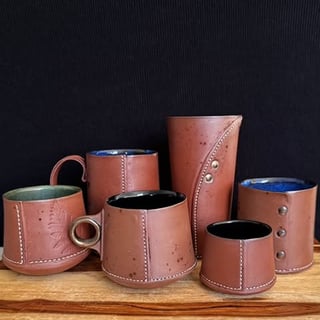
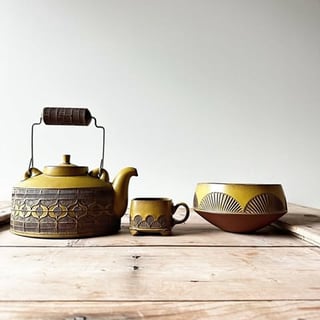
Speaker: So, so let's talk about your pottery. In one sentence, can you tell me what you make? Yes. So I make, well, now I'm making hand built. So both slab and coil, earth and, earth and wear. I fired to cone 011, which is hotter.
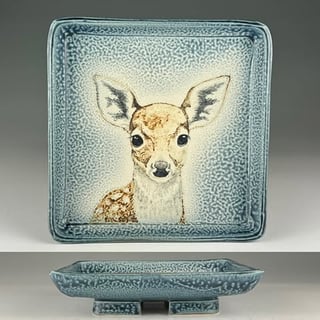
Speaker: you know, and then low fire. It's still in the low fire range, but hotter than, than earthenware it's typically fired to 03 or glaze. So I do hand built red earthenware and I'm decorating with a botanical inspired designs using colored slips. So tell me the story, how you started making the party that you make today.
Speaker: Yeah. So as I mentioned, I was, I was doing wood firing predominantly in, in an Anagama kiln that, that the art Institute where I took classes, we, they have an Anagama kiln out on some property that we rent. And so I was doing that for many, many years. I really loved that whole process.
Speaker: And then like the neck and shoulder thing started becoming an issue with, and that's a very labor intensive way of firing. So I knew it was kind of time for a change with my work. And I was also, this was, this was when I first was first looking into getting my own studios, renting my own studio space. So that just happened to coincide with a workshop.
Speaker: at the Art Institute with Victoria Kristin, and she's a pot, earthenware potter from Portland, Oregon, and she came in to do a two -day workshop. So I certainly knew about low -fire ceramics and had seen terracotta and owned terracotta planters and was aware of it, but I had never seen anyone working with that clay before. So I just remember first just seeing the color of the clay and kind of falling in love with it, with that rich,
Speaker: dark color and then I remember watching Victoria just take she took a plate that she had just made and poured this white slip over the plate and there was just something about that and seeing that white slip going on that dark red color clay that I just instantly kind of fell in love with and
Speaker: I remember at the time just thinking, oh, this is this is the direction I want to go in. And so we got to in that workshop, we got to make each person got to make a little vessel and then decorate it with some colored slips. And then so that was just my first, you know, I had my first earthenware piece to kind of get me excited about that. So that launched me into working with earthenware clay.
Speaker: So now earlier you mentioned that you used to primarily work on wheel thrown work, but now you are a hand builder. Can you tell me about your transition from wheel thrown work to hand building? Yeah. And so that's pretty recent, like within the last year. And, you know, so I have some arthritis in my neck and I have to like a bone spur pushing on my rotator cuff. So.
Speaker: I have some chronic pain that I just sort of have to deal with every day. Being on the wheel and sort of like being hunched over in this position and even just like all the wedging that you have to do was really doing a number on the neck and shoulder. So I didn't have a, you know, I see an orthopedic doctor for this issue, but, and he didn't tell me I should stop throwing, but I just sort of intuitively felt like,
Speaker: I needed to do that, like I needed to find another way to keep going with clay. I didn't want to give this up, you know, and I didn't want to make this problem worse than it was by this repetitive activity that I'm doing every day. So I made the decision to start hand building and it was really daunting, you know, like how am I going to make a
Speaker: How do I want to make a mug? How do I want to make a picture? How do I want to make a plate? You know, just suddenly it's like I had to rethink all my forms and how I wanted to do them. And initially it was, you know, like I remember trying to figure out how to make a picture and I was working with like.
Speaker: some coil building and then I tried some different slabs and I wasn't really happy with how they were turning out so just one day it occurred to me like maybe I can maybe I don't have to figure this out right now maybe I can just like let this go and what would I make if I just didn't have to try to think about replacing all the things I was doing on the wheel and so that just opened up
Speaker: um a whole world to me of freedom like oh I can maybe I'll just make a bunch of different things that I haven't never even tried before so I started I started working with bisque molds so I could make like some of my own shapes that I could drape clay over for slab building
Speaker: And right now I'm doing a mix of some of my forms are coil built and some are slab built. For a while I was thinking, oh, I need to like pick one direction and, you know, either be a coil builder or be a slab builder. Because, you know, I see people out there, some of whom have like a whole line of slab built work or have a whole line of coil built work. And I just realized, you know, it's funny how we, I don't know if this is,
Speaker: common for most people but for me I tend to box myself in thinking like I have to pick this one way of doing things and it's like why am I doing that there's just these different tools these different ways of working why can't I just go back and forth between the two so now I'm in this place of just embracing that I can do both and actually maybe it's better physically for me to be switching so I'm not just always pinching you know coiling and pinching
Speaker: because then I could end up with maybe some, you know, arthritis in my thumbs or hands. And, you know, so like slab building is a little bit easier on all the joints. So I think just like longevity, to have like this longevity with this material and have it be in my life forever, which is what I would love to have happen. So now I'm in this place of just wanting to, you know, embrace all these new ways of working and not limit myself by thinking I have to choose one way of working.
Speaker: Absolutely love it. Shaping Nation. Maybe what you're doing right now isn't something that you can be doing further. Maybe it's an injury or something and you have to move on. There's always something new in part that you can do. And on top of that, you don't have to limit yourself to just one single thing. You can branch out and do many different things if you want to. I love that so much. Yeah. It's so great.
Speaker: So like Sunshine Cobb, I don't know if you're familiar with her, but she's just such a cool person and she's a hand builder, but she also has a wheel in her studio. So like some of her forms are coil built. She does some stuff with slabs, I think a little bit with slabs. And then like her mugs, I think she's throwing those on the wheel and, you know, she's just like, yeah, like I just really like a wheel thrown mug. And like it's, but all of her work looks cohesive, you know, like it's speaking, it's, they're all talking to each other on the pots.
Speaker: it looks like a cohesive body of work and so there's something about just sort of watching someone like that navigate all those different ways of making that felt like it was like permission for me like oh I can just let go of that you know like it needs to be one way I can just really let go of that and how much freedom I'm now feeling okay
Speaker: for just 100%. I love that so much. Yeah, something I found interesting from your website is you said I've learned about my own determination as I struggled when first learning to throw in a potter's wheel. And today when I faced an obstacle in the studio, I could see how much I've grown to love solving problems. Can you explain to me to this some more?
Speaker: Yeah. So I mentioned earlier that I really was eager to get on the wheel when I was first discovering clay and I was not, it did not come easily to me at all. Like I really, really struggled with it with centering, even just a pound of clay. And I just remember struggling for months and I repeated the beginning ceramics class multiple times just to try to, you know, keep getting refreshed on techniques and skill building.
Speaker: And I just had this determination about, you know, I don't know, I watched other people who would say like, oh, I don't like this. This is, I'm going to go back to handling or this isn't for me. And they would maybe like just move on and.
Speaker: stop taking clay classes. But I knew I wanted, I felt this kind of calling to clay and the material that, to be honest, like even though I'm a good writer and like I had all those great skills for writing, I never felt that kind of calling to writing. Like I remember being in my MFA program and people would just say like, oh my gosh, if I couldn't write every day,
Speaker: I don't know what I would do, like my life would be over kind of, you know. And I just remember feeling like, gee, I don't feel that way about writing at all. So I couldn't really relate to it. But when I came into clay, I, I pretty see, you know, when then maybe the first year or so, I felt like this is what I'm supposed to be doing. I wasn't good at it yet. Like it wasn't because I had these great skills or was exhibiting, you know, some kind of innate, innate talent for it. It was, it was deeper than that.
Speaker: You know, it was it was like a call to the material itself. And so I just I think that was what was leading me to just have this determination about like, I'm just going to come in here to the studio and practice on the wheel for as long as it takes for me to be able to center this lump of clay. Like, I just really felt this determination. That was kind of a new feeling for me to just have this dictativeness.
Speaker: to it so I think that's you know and like I said I've had troubleshooting things like either with the clay I'm working with or with my glaze recipe and I noticed that same kind of determination to like figure it out and when there's a when there's a problem with something it's this opportunity to learn and grow you know so to learn something so now I'm
Speaker: I'm working with a colleague and they've been helping me try to figure out, you know, what's going on with this blaze and how I might be able to fix the problem. And so I'm learning a ton about, about all of that, which is kind of exciting. So even though it's been a frustrating problem, it's exciting to have a chance to learn more. So, and I know in the end, I'll be grateful for, for the challenge. So.
Speaker: Absolutely love it. Shaping Nation, it's so important to, when you are facing a problem, take it as a learning opportunity. See where you can learn, see where you can take your pottery from there if you are struggling with something. I love that so much. Can you give me a simplified explanation on how you create your pottery?
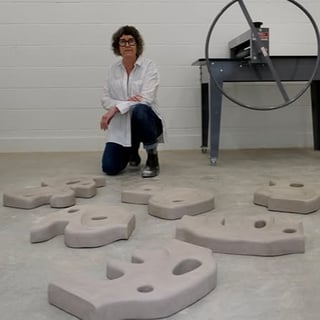
Speaker: Yes, so I'm either coil building form. So I'll start with like a, what's called like a footprint. So maybe like I want to make a bowl that has a, that's sort of a soft square. So I'll have like a template that I've created and that'll be sort of the footprint that I'll start with. So I'll make a slab for the footprint and then I'll coil build on top of that. So some of my forms are coil built and then some of them are slab built using templates.
Speaker: So usually starting out with, you know, I might like roughly make a form by coil building it and then come and then not have a bottom on it and then cut it down the center. And then if I lay that shape out, that could be a template for me where I could replicate that form. So there are like a few vases I make that are like in two parts and they're two different templates and I'll
Speaker: joint stack them together just to create some interesting shapes. And so it's kind of a combination. I go between the coil building and the slab building. Occasionally I'll make a little pinch pot or something because I love pinch pots. Love it. So let's talk about discovering your voice. Can you tell me about the moment when you knew you were heading in the right direction with your pottery?
Speaker: Yeah, well so the what I talked about earlier with that red clay and really feeling like call to that to that way of working that was maybe one aspect of starting to find my voice. So even though I had loved wood firing, I don't know if I ever felt like that was really
Speaker: unique to me, you know, like I don't know if it ever really felt like that was a full expression of me. So I think like first discovering the red clay and then working with slips at the beginning, I didn't really know what, you know, I had to think about surface doing electric firing, right, where there's no there's no reduction atmosphere, there's no wood ash flying around the kiln landing on the pots.
Speaker: it's just this neutral atmosphere. So I had to dictate what was going to be on the surface. So that was a whole new thing for me. And I didn't really know what I wanted to sort of say on the pots at first. So I was just doing these very loose kind of gestural brush marks with different colors and just kind of letting myself be sort of free with how I was putting color on the pots. And so that those started out as more abstracted kind of
Speaker: designs. And then over time, I just got a little bit more into, I was looking at a lot of Mayolica pottery, which is traditional, you know, that's like a glaze, a white glaze.
Speaker: that's, and then color glazes over that. So it's similar looking to what I'm doing with slips, like I'm using a white slip and then I lay color on top of it. I'm just putting the color on before the bisque firing at the leather hard stage. So I think I was influenced by some of the meolica work that I was seeing and I got more into, and I've always loved, you know, I love gardening and flowers and I'm inspired by the natural world, you know, in those ways. So it made sense for me to
Speaker: of get into more of this more botanical theme that I'm that I've been now exploring for the past few years. So that really feels like I feel like I've, you know, that really feels like a true expression for me of what I'm doing on the pots right now. I love that so much. So you contribute your growth as an artist to being part of a community. How has this helped you?
Speaker: Oh, well, yeah, that's just been a tremendous part of my initial attraction, I think, to ceramics. So taking art classes at the Kalamazoo Institute of Arts, I really was meeting and connecting with people down there. And we're really lucky to have open studio hours at the studio too. So outside of class time, I could go in and practice on the wheel and
Speaker: I would see other people there and just got to know, got to know people that way. And I really felt like I found like a family down there by taking classes and just getting more involved. Now today I teach down there. So that's just continued. That's just been a really important place to me. And, you know, like just being able to talk pottery, talk pots with other people and
Speaker: take advantage of their expertise or, you know, if I'm encountering a challenge or struggle, being able to talk to colleagues or other students and try to come up with solutions. And it's just fun, too, to see what other people are doing. You know, that this material is so interesting. You could give
Speaker: Like, 20 people lump of clay and each person would do totally something totally different with it. You know, so it's just always inspiring to see what others are doing within this medium. And I mentioned earlier, a colleague who's helping me fix this solve this problem.
Speaker: Who's the studio tech at, at the art Institute. And just having resources like that, it's just been really instrumental. I also, you know, there's, there's some great online communities too, that people can connect with if they don't have access to a public studio. So I know like through ceramic arts network, there's. What is it called? Well, ceramic arts network has a link to like a clay community online. Now I'm drawing a blank on what it's called. But if you googled like ceramic arts network.
Speaker: You'll find you can find access to that on there where you can like, upload a question and other people will can respond to your question. And it's just like, that's I've used that in the past too. When I've been dealing with issues where I've struggled.
Speaker: So, so community has just been really important. And I feel like the clay community is so welcoming and you know, people are just willing to share what they know and be generous in that way. So I try to do that for others too, like to sort of carry that on that tradition on. And it's great to be part of that shaping nation. It's great to be part of a community like that. Yeah.
Speaker: Shaping Nation, it's important to go out and just be a part of the Clay community, because if you ask something, somebody's gonna know an answer, they're gonna help you out. So just don't be afraid to ask people. Yeah, definitely. What are you doing to evolve your voice even further?
Speaker: Yeah, so I mentioned this glaze that I've been having some troubleshooting things with, but I'm working with this new glaze that has a small amount of lithium in it, and it's reacting. The reason I switched my glaze up was I was trying to get the color purple in my work. And my old glaze, I used mason stains that added to my slip for the color palette that I use. My old glaze would just turn all these purples blue.
Speaker: So then I did some research and found out like there has to be just the right amount of calcium in the glaze for the purple to show up. So anyway, I tried a bunch of different glazes. I finally found one that was letting me get that color and it ended up like the lithium in the glaze like kind of creates a pulling effect on the slip, which really was intriguing me because it felt like
Speaker: It's not just about my marks that are on the surface, but like the material is kind of like having this conversation with my mark making, which really felt interesting to me. So I've just had a few little technical troubles with the glaze that I'm trying to tweak. So I think I'm almost there. I just did some tests recently and they looked promising. So I'm going to keep exploring with that. But that kind of, you know, interesting
Speaker: reaction with the glaze is really speaking to me now. So I feel like, you know, it's just like another, my voice is continuing to evolve from that change happening in my work. I absolutely love it. So as we're coming to a close here, what advice would you give to someone trying to discover their own unique voice with their pottery? Yeah, so I would just say, you know, trust your instincts.
Speaker: And don't doubt yourself. So follow your instincts when you're in the studio working. And make time to play and experiment too. So I try to incorporate that into my practice where it's just like, oh, what if I wasn't looking at a list of what I had to make for this gallery or for this show or whatever it might be that I'm doing? And what if I just made some,
Speaker: what if I just like dropped all that and like gave myself a little bit of time to play an experiment and sometimes and like oftentimes new ideas for new forms will show up for me that way so I think it's just important to build that into your studio practice whether it's just like one day a week or maybe it's just like for one hour you know
Speaker: every other week or whenever you can do it but just to make sure you're carving out some time to just play and then see from that play like what's exciting you or what feels invigorating to you about the time you spent playing and maybe just like
Speaker: carry that thread into, like, make more time to explore that. So, I mean, I guess that's what I mean about trusting your instincts. So, like, something will excite you, right? And then it's like, okay, how can I keep going in that direction? I absolutely love it. Shape Nation, trust your instincts, make time to play, and continue making pottery. Susan, it was so great chatting with you today. Where can my artists go and learn more about you?
Speaker: Yeah. Thanks so much. Nick is delightful to chat with you too. So people can follow me on Instagram at Susan McHenry ceramics, or they can go to my website, which is Susan's McHenry ceramics .com. I'm on Facebook too. I'm not on Facebook quite as much as mostly I'm on Instagram, but my, my posts all end up on Facebook too. So, so I'm on Facebook at Susan McHenry ceramics as well.
Speaker: We hope you enjoyed this episode of Shaping Your Pottery with Nick Torres. Do you have questions about pottery that you'd like Nick to answer? Send them to us on Instagram at Nick Torres underscore pottery. We'll see you next time.