Transcript
Speaker: Hey everybody, real quick. The first step to discovering your voice is finding what you actually like to make with your pottery. That's why I created a quick start guide so that you can start discovering what you like to make with pottery without having to give up experimenting on your pottery. Now let's get started. Go to shapingyourpottery .com forward slash ace to get this free guide.
Speaker: Do you love pottery and are ready to stand out from the crowd? Then you're in the right place. Welcome to Shaping Your Pottery with Nick Torres, where we help you discover your own unique voice. Now let's get started. What is up, everybody? This is Nick Torres here. In this episode of Shaping Your Pottery, I got to interview Dedum Merck. Dedum has been featured in ceramics monthly and has won various awards in the ceramic community. In this episode, you will learn how Dedum makes her pottery, the power of making lists and the power of community.
Speaker: Deidum, welcome to Shaping Your Pottery and share with me what is one thing you believe potters should be doing to have success in pottery. Yeah, thanks for having me, first of all, Nick. And the first thing that I would say in terms of how to have success in your pottery is if something's not working, change it up. You know, even if you're throwing a certain wind,
Speaker: It's just kind of like wonky. Figuring out how to try something a different way is super important. And even if it comes to sales, like if you're trying to sell your pots, then maybe you're not getting a lot of hits on your website. Well, there's a reason for that. So change it up and see what happens. Don't change too many variables at once. That can be bad, but yeah. I completely agree. Change little things at a time. That's where you're going to start seeing like little successes.
Speaker: Yeah, exactly. Can you tell me about your time when you led a residency at Watershed Center for the Ceramic Arts? Yeah, so that was a fantastic residency. I love Watershed. It's like definitely in my top three destinations for residencies. The people that work there are wonderful, the staff that they have there.
Speaker: that come in for just the summers even. And it was a great experience. I reached out to a few friends that I have in the ceramics world, asked them to join in. And then I also reached out to some people that I didn't really know that well, that I wanted to spend more time with. And I think that's really important. Like I was just talking to a friend about potentially setting up another residency at a different
Speaker: a craft school residency program and I was like well we shouldn't really invite everybody that we know because we want to get to know and connect with other potters right. So at Watershed it was fantastic where everybody had a different sort of thing they were doing some people were hand building some people were throwing and everybody had a different decoration technique so we got to collaborate with one another and we just got to have fun too like
Speaker: I think when I first started doing residencies and workshops, I was more invested in the idea of making, making, making, making, making. And I've started to learn that, no, it's also about just like hanging out, having conversations, getting to know one another, partying. So it was a great experience and I hope to do it again sometime because Watershed is fantastic.
Speaker: So you are also a resident at the Archie Bray Foundation. Can you tell me what is one thing you learned from either of the residencies that you still use today? Yeah. The biggest thing for me in going to a residency at this point is to be around other makers.
Speaker: I remember when I first applied to the Archie Bray, I was in grad school when I first applied and I was like, oh, like I want to go and use these amazing facilities and whatnot. And like, of course the community was a part of that. But when I had left grad school and I was working in the studio by myself that I was renting, I was just like, wow, I really miss being around other makers. So for me to go and do a residency, it's more so the idea of
Speaker: I want to go and be around others where we can chit chat, talk shop, all those things. And the Bray happened at a time when I needed it the most because I was in such isolation in my own studio. So it was fantastic. I totally agree with that. I feel like the more we connect, the more we can actually grow our pottery better. Yes, definitely.
Speaker: So how did being a resident at these places help you with developing your voice further? Yeah, I think whenever you change up your setting in terms of like where you're making that changes the work. I'm definitely the type of maker where I take a lot of little bits and pieces of like what's happening within my surroundings. So for instance, when I was at the Archie Bray, like I love watermelon, I would put that in top list of five foods.
Speaker: Um, but I was eating so much watermelon while I was there. And so I started making these like watermelon inspired sort of mugs and cups. Um, also just being at the Bray and realizing that I was getting out of that more regimented, uh, sort of schedule that I had when I was just a potter in Cincinnati by myself in isolation. Uh, I started to make these pieces that
Speaker: had a lot of grid structures on them. And that kind of had to do with the idea that like, okay, I felt that everything was just like very regimented, organized day by day, and it kind of felt very repetitive. So I think being in those places and also talking to the other makers that are there, you start to gain other ideas and you kind of mesh everything into one from what you were doing previously to what you make at a residency.
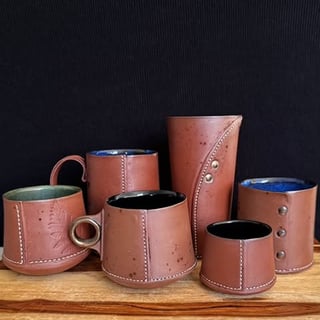
Speaker: But you make some really wonderful designs and shapes. Can you walk me through how you make your pottery? Yeah. So I have several different bodies of work. That's always been like the goal. When I was in grad school, I even wanted to do that. But I was kind of focusing on one body of work while I was there. So I throw some pieces, just strictly throw them. I hand build some pieces. I throw an altar.
Speaker: So as far as materials go, my whole idea with that is use whatever you want to and whatever you got. I have a stupid collection of commercial glazes, low fire and mid range. And I'll take those low fire glazes and I'll test them for mid range and see how that goes. And with clays,
Speaker: I don't know, I have like seven different clays that I work with. I'll mix different clays together. I'll make my own colored grog and mix that in, wedge that in. There's not really. So yeah, there's no limit to anything really. So oftentimes when I'm throwing, I'll, you know, start off with mugs and then that'll transition to, okay, well, I want to work on some lamps now. I sketch a lot. I make a lot of lists. So,
Speaker: The first thing that I'll really do is make a list of like, okay, well, what do I want to make for the week or the month? So sometimes it's okay. I want to make mugs and like each mug will kind of build upon the other, um, in terms of trying different things and changing it up. Um, and then with my hand built work, I do a lot of like colored porcelain veneering. Like I said, I make my own law grog. Um, I make and use terrace sigilatas, which gives that like nice waxy surface on the pieces.
Speaker: And I strictly fired a mid -range. Nothing's low fire, even if it looks low fire. That was sort of what I was working with while I was in graduate school. So I like that look of low fire. I like all the colorful aspects of the work. And I use a ton of stencils. And with those, I actually draw with just pen on a bristle board. And then I'll scan those into the computer, clean them up, and then make vinyl stencils and paper stencils from those.
Speaker: So you mentioned these lists. Why do you make lists? Oh, boy. I find that I'm all over the place. If I don't make a list, I have like severe ADHD. So I'll just like start doing random things like, okay, I'll go over there and like clean up one spot. And then all of a sudden, something over there reminds me of something else. So throughout the day, I'm constantly looking at lists.
Speaker: that I make and like I have several different kinds of lists. So there's one that's like the daily list, right? Um, and then I'll have like the weekly list and then I'll have the monthly list and it sounds crazy and like overly organized. Um, but it's more so just to like keep me on track and what I'm trying to do, especially since I try to have one shop update like every couple months. And so I need to be thinking about, well, when do I need pieces done from,
Speaker: all the sorts of bodies of work that I want to have for that shop update. And when do I need them done in order to photograph, send out a marketing email of like a preview and all those types of things. Um, cause I will just derail if I don't have a list. So I was so glad that you sent me a list. Yeah. I find that sending the questions beforehand really helps like people prepare completely.
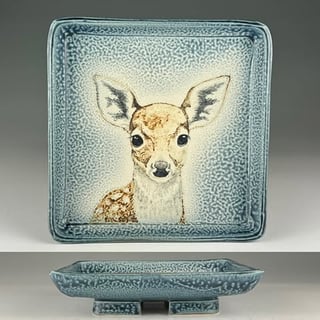
Speaker: So something that I really love is that you are inspired by a lot from the world itself to colors, the world itself to colors. But what I find very interesting is that you are inspired by your Turkish heritage. How does this help determine what you plan on making? Yeah. So some of the pieces are more inspired by that and others aren't like different bodies of work. Right. So the body of work that's more inspired by my Turkish heritage is
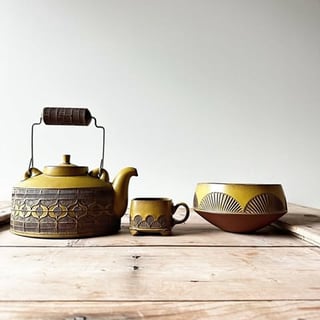
Speaker: the work that you see that has the sort of speckled clay and it has a lot of imagery on it. Um, so I grew up looking at, you know, Turkish rugs, Turkish pottery. And one of the things that I loved, especially going to Turkey several times is all the symbology that happens within that and the different motifs that are in the work. Like if you see a pomegranate that symbolizes like fertility and growth,
Speaker: So I've kind of taken that aspect of the almost like hieroglyphs, right?
Speaker: and push that within my own life. So each of the different stencils that I have that I use on pots, it's almost like, I call them collage pieces, right? But it almost tells a story. One of the things that I wanna do in the next month or so hopefully, or after the holidays really, is I wanna go through and create a key of what each symbol actually represents in my own life.
Speaker: Um, so that's how we bring in a lot of that. And you know, traditional Islamic pottery is highly decorated. Um, so that also is an inspiration for that. When did you start making like this type of pottery? Yeah. Um, so the body of work that I was just talking about, I started making that. It was about a year and a half ago and I had always
Speaker: wanted to take more of my drawings and this, uh, these motifs and symbology and push that in the work, but I wasn't necessarily sure how I wanted to do that. Um, so I, yeah, I'm super happy with pushing that body of work more and more. Yeah, I love it. I'd love it. It's like, you can really see your heritage coming out with it. Yeah. Thank you.
Speaker: What is something in pottery you hate to do or you see other potters doing? I laughed when I saw that question. Wedging. I can't stand it. I can't stand it. So I have a friend, Jane, here in Cali, and then I spend a lot of time in Kentucky, Cincinnati, and a friend, Emma, there, and they'll come over, we'll chit -chat for the day, and I'll pay them to wedge clay and make a colored porcelain and that sort of thing.
Speaker: Occasionally I'll do it myself, but like I cannot stand it. And like everybody's like, Oh, well you could use a pugger. And I'm like, no, like even that's just, it's too much work. I want it. I don't want to be spending my time making clay. I want to spend my time using actually making. Yeah. So that is something I just cannot stand.
Speaker: Yeah, I feel you there. That is just such a waste of time, but you have to do it. And he's like, I know. Yeah. And I would say even like the thing that I don't like watching other makers do. And I'm going to add a little note to this. But when makers make their own clay, it just boggles my mind. Now, with that said, like if you have a specific clay body that you need to made if
Speaker: you know, the cost of material for, you know, cause you're paying for water when you buy boxed clay. Um, if those are things that you take into account and you make your own clay, then yeah, sure. Like I totally get that. Um, but if like you buy a bag of B mix from Laguna that's dry and make your own, like why just buy it wet. I totally agree. So it just saves that much more time when you do it that way. Time is money.
Speaker: So since you started Pottery back in 2005, what has been the biggest lesson for you? I would say the biggest lesson for me is being a part of the community, really. Ceramics is surrounded by community. And you can kind of isolate yourself within that more or reach out more.
Speaker: And that's been huge for me because like, you know, my parents immigrated to the States over 40 years ago. And so a large portion of my family, except for my brother, my mom and my dad are in Turkey. So for me, I grew up with a very small family when in reality, there's so many family members in Turkey and sort of in the surrounding area.
Speaker: Um, so the community for me and ceramics really gave me a sense of family and that sounds so cheesy, but it's true. Um, so that's the biggest thing that I've learned is that it's much more, it's not just about, you know, making in the material and the love that we have for that, but it's also about others that have that same, uh, that same thought process and love for it.
Speaker: I love that. I find that really, really inspiring because it really is a family, this Clay community. It really is a family. Can you tell me the story? Why you started teaching workshops? Yes. I adore teaching workshops so much. I love getting to meet new people that I've never met before. If I'm traveling for a workshop, going to travel and see a new place.
Speaker: you know, we didn't grow up with an excess of money in order to, uh, take vacations. So like I've seen the places that I've seen in the U S I've seen because of workshops. Um, and that to me is like incredible. Uh, and teaching a workshop, I love that it's more specific to like what I make versus teaching. Um, and I do actually love teaching introductory classes.
Speaker: but it's so much different, right? You're usually working with students that are a little bit more advanced, and if they're not, then they're gaining a lot of information from what's going on. I also love the aspect of like, I'm very open about my life when I teach a workshop. So I'm gonna tell you all about like, who I've dated, my mental health, like, and how that all relates back to the work. I don't see,
Speaker: I don't see the work and my life separated. It's like one and the same. And yeah, it's it's all one. So teaching workshops allows me to fully express, you know, where the work is coming from. So you mentioned it was like the work and the life and the pottery is one the same. Can you explain that a little further? Yeah. So I know that there's some makers that they'll kind of keep their private life a little bit more shut off, especially through social media.
Speaker: And I've always just kind of felt like social media specifically and just what I do, it's so integrated into just my thoughts and my life in general. So I like to show both of those things together as much as possible. So like, for instance, let's say,
Speaker: or I guess it was about five years ago, I was making a lot of vases for flowers and I was going through some heartache at the time from a previous relationship. And so I was thinking like, okay, let's brighten the mood and also kind of dive into the feelings of that and then
Speaker: being able to share that with everybody, I think is really important. Because we all connect on a basis of what is actually happening in your life. I don't want to do the small talk. I can't, unless I'm at a bar and I'm talking to somebody for 10 minutes, fine. But otherwise, I cannot stand small talk. So I kind of feel that way when I'm sharing what I make. I want it to be everything, not just the work itself. I love that. For those that are listening,
Speaker: It's important to just kind of let your true personality just come out and like share parts from your life into your pottery. You're going to find your voice a lot like that. Yes. So when you are teaching workshops, what are the most common mistakes you see students doing? Not scoring enough, like not scoring deep enough. So I always will show a handle demo during a workshop and I'll show how deep I score.
Speaker: Um, and I'll be like, okay, don't, don't make it look like a tiny little bird landed on like a little patch of mud. You want to really dig in there. So that's definitely the one thing that I see students often, uh, not doing enough of and a compression, especially when hand building. How does that affect with a hand building? Yeah, with a hand building, you can get a lot of pieces that warp, um, crack.
Speaker: And yeah, so I'll just sit there and compress and compress and compress, especially when slab building. And then I paddle work to death when I am coil building. So when you discovered your voice, what changed for you? What changed for you overall? Yeah, this is a conversation that I have a lot with students at workshops, actually, and
Speaker: Kind of similar how I'm talking about like life and making and how it's all one. I don't feel like I ever had this moment where I was like, okay, I need to find my voice. Because I'm trying to come from a very honest place in making and so the voice kind of just like takes over in itself.
Speaker: Uh, one of the things that we would often talk about when I was in critiques in graduate school was my professors would say, you know, I'd put out several different bodies of work, like, okay, I'm just testing a bunch. Um, and they would always say, you know, even though it's so different at all, I can tell that you made it. Right. So I think that just coming from an honest place is the best thing to do. Um, so.
Speaker: I don't know that I've ever had that aha moment of finding my voice, to be honest. So what advice would you give to someone trying to find their own unique voice? I would say, as stupid as it sounds, lists, again, going through and writing down things that you want to push in your work. So maybe color, or maybe you want a grayscale on your work.
Speaker: Do you want to fire electric or wood or both? Just kind of starting to narrow down things and creating these variables that you can constantly look at and like take that list and put it up on your studio wall so that you're always looking at it. I think that's really important. And then just taking pictures of your surroundings because you'll start to see like what, what are you being influenced by? Because we're looking at
Speaker: things all day. So that is going to push the work. So being able to take images, look back at those images and say, OK, well, let's break this down. What is it that I want my work to portray? I love that. I always say that before we should start making, we should start with a little bit of research first and find out what we do like. I always think that is like a really crucial step that people often skip. Yeah, I love that.
Speaker: So as we're coming to a close here, what is one thing you want to hammer home with my audience today? Yeah, I would say just keep your options open. Like never, never say never in a way and notice what you notice. Love it. Didam, it was really great chatting today. Where can my audience go and check out your work?
Speaker: Yes, on Instagram, you can go to Deedemmert underscore pottery. And then on my website, which is www .deedemmert .com. Thanks for listening to this episode of Shaping Your Pottery. If you have questions about developing your voice or just pottery questions in general, send them to me my way. Go to shapingyourpottery .com forward slash contact to send me your questions.