Transcript
Speaker: If you would like to support the podcast and get bonus content every single month, then come support me on my Patreon, where I will give you bonus content on about how to make pottery, how to find your voice, and a bunch of other things just around pottery. Come support me on my Patreon, just go to shapingyourpottery .com forward slash Patreon to come support the podcast.
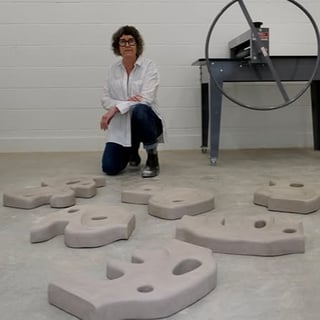
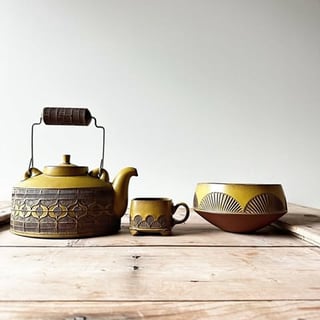
Speaker: If you love pottery and want to take your skills to the next level, you're in the right place. Find your own pottery style right here on Shaping Your Pottery with Nick Torres. Let's get started. What is up, Shaping Nation? This is Nick Torres here. And on this episode of Shaping Your Pottery, I got to interview Naomi Clement. Naomi is an excellent teacher, advisor, and she makes some really wonderful, decorative, functional pottery.
Speaker: On this episode of Shaping Your Pottery, you're going to be learning about how to create decorative functional pottery. You're also going to be learning about how you have to make the crappy pots first in order to really find your voice later on. You have to get through that stage of making crappy pots, and then you're going to be going a lot further if you can get through that stage.
Speaker: The last thing you're going to learn about is you're going to learn about asking questions, asking the right questions so that the questions that you ask will lead you to finding your voice. I'll see you guys in there. Naomi, welcome to Shaping Your Pottery and share with me, why are you so passionate about pottery?
Speaker: Awesome. Well, thanks so much first off, Nick, for having me here. It's always great. I love talking to other people about pots and geeking out of bottom. Yeah, I mean, I think pots do such a beautiful job of connecting. I always say that I envy how well and beautifully my pots connect with others.
Speaker: allow us to connect with ourselves with others and you know the world around us in a really sort of special and there's these small moments so um and it's also just fun playing with clay so in a nutshell yeah i'm so glad you said that it's about like connecting because i always say that pottery is about making a connection like your hands to the clay once you're finished with the pot to the customer and then everything else in between i love that you said that
Speaker: So can you tell me the story about why you decided to get your BFA in Nova Scotia?
Speaker: Yeah, so I was lucky enough to go to an arts high school that had a good arts program and ceramics program, which is really unusual in Canada. I know in the US where I went to grad school, there's lots of awesome high school art programs. In Canada, there are very few, less than a handful, and they're kind of a dying breed, sadly. So anyways, the school that I went to, we had sort of, I guess, what are the equivalent in the US to like AP courses?
Speaker: that you could take in this the school that I went to for my BFA accepted the some of these classes as like college credits.
Speaker: So I'm sort of part of it, and a lot of my friends were going there. I actually did my first year university in Montreal, Concordia University, largely because I wanted to live in Montreal for a year. And I wasn't quite ready to, Nova Scotia is fairly far from home. I wasn't quite ready to go there, but I like the small town feel of Halifax and the Nova Scotia College of Art and Design, where I went, often referred to as Nascad.
Speaker: It's a really nice small university, you know, there's less than a thousand students, but it's part of this, you know, nice size community that has a lot of other post -secondary institutions. So it's like just had a good vibe to it and really good program. And yeah, I always like the East Coast. It's a beautiful spot, sort of more mellow, friendly way of life. What would you say from this time that kind of helped you start developing your voice with your pottery?
Speaker: Yeah, so I've been making pots before I went to NASCAD. I think a big part of it there, you know, it was just such a great community. The ceramics department, the faculty were really involved and there were a lot of alumni in the area that were involved as well with the school and like where you could go work as an apprentice or who would, you know, come and teach classes, things like that. So it was just, it felt like a really vibrant,
Speaker: connected place and yeah I think the other side too you know I grew up in a home I was lucky enough to grow up in a home where we had lots of art and it you know wasn't like the kind of art that just matched your furniture but you know when I and we did have handmade pots growing up but it was sort of the 70s when my parents were collecting
Speaker: And so like art was colorful and pots were brown. And so when I went to NASCAD, it's got this really rich tradition of really bright, vibrant colors and like pottery and like decorated and just, you know, I think it's sort of that East Coast sort of maritime vibe was sort of brought into the pots as well. And so that was kind of
Speaker: really eye -opening to me. I was like, oh, pots can be colorful. And I love color. That's a sort of a big part of my identity is like this love for color. And so that was the first place I could sort of realize you could melt those two together. So I think, yeah, that was probably the first first step along the way. Love it. So you have attended many residencies. What is something you have learned from your residencies that you still use today?
Speaker: Oh, that's a good question. This probably won't be the answer you'll think it'll be. Don't be an asshole. You know, our field is really small and the caveat always don't be an asshole is that also doesn't mean, and hopefully it's okay to swear on here, that you should eat shit or anything or not stand up for yourself in situations of discrimination or bullying or anything like that. It's more just
Speaker: Again, our field is really small. And so if you're a nice person and someone who's like engaged and curious about others and, and willing to help out and, and be connected like that, it will just serve you in good stead, uh, later on in your career, again, because it's, it's just such a small field. Um, so if you're someone that people want to work with, they'll remember that and they'll invite you to shows or invite you to other things or,
Speaker: or recommend you for things like that. And also, it's just nicer when you're a nice person. Yeah. I definitely agree. Shaping Asia, if you're listening right now, as Naomi puts it, don't be an asshole. Be kind of everybody. Help other potters out. If they're struggling with something, try to give them a little bit of tips and just show your kindness and your knowledge and just spread it throughout the pottery world. I love that you said that. So you have called yourself a pottery nomad. Can you explain this further for me?
Speaker: Yeah, so in the years, I guess there was quite a gap between when I went to undergrad and graduate school. I think I graduated my undergrad in 2003 and then went to grad school in 2014.
Speaker: So after grad school, I spent a lot of time moving around, doing different jobs, residencies, trying to sort of figure it out. So I think I moved something like nine times in six years.
Speaker: Um, and that included the three years that I was in one place for grad school. So I was just constantly on the move in my car and, and yeah. Um, which was great in a lot of ways, cause I met a lot of really wonderful, amazing people and got to work in some awesome spots and, um, got lots of, you know, great.
Speaker: great work and life experience, but it was also kind of exhausting in a way. So yeah, that's why I'm not a pottery nomad anymore. Sometimes I miss aspects of it, but I like having a home base now. So where did you settle in for your home base? Yeah. So right now, now I'm, I have a house in Stratford, Ontario, Canada, which is a treaty 29 territory.
Speaker: Um, uh, yeah, and it's a, it's a sort of small town, about 20 ,000 people, but it's close to the big city. So it's like two hours from Toronto, which is, you know, 3 million people or something like that. So it's like, I can get the city fix if I need it, but I prefer a smaller town. So. Love it. So let's talk about your pottery. Tell me the story, how you started making your functional decorative pottery.
Speaker: Yeah, well, you know, I don't know that we have enough time to go through the whole thing, but in a nutshell, you know, I've always been drawn, as I said, to making pots. I think they're the original interactive art and they're way more radical than most people give them credit for and sort of have this great ability to convey ideas and connect with people across space and time in a really
Speaker: powerful way. So I've always been drawn to making functional objects. I like being useful. And I like, you know, having art that people live with every day, you know, I often talk about when I do an artist talk, you know, the apparently the average time that anyone spends in front of a piece of art or sculpture in a museum is like 17 seconds. But you know, someone could
Speaker: live with one of my cups and use it every day for decades. So I think they're really powerful in terms of finding
Speaker: You know, my way through it, it's you just got to make a lot of really crappy stuff before you start to get to things that are any good, especially in ceramics. So, you know, there were certainly a lot of entries to what we always called the Blue Steel Gallery in grad school, otherwise known as the dumpster. And just, you know, trying out a lot of different things and, you know, and then things just started coming together towards the end of grad school and
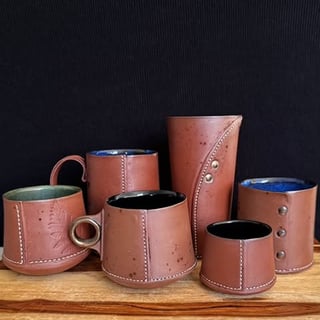
Speaker: Yeah, integrating sort of part of that was switching from throwing to hand building. So becoming a hand builder and kind of the freshness and newness that came with that. And then, you know, addition of texture to my work, the color and like layers really in the surface and the larger, all supporting the larger ideas behind it.
Speaker: I'm glad you said that you had just had to make a bunch of crappy pots right now. I am currently like working on something new and I literally just making a bunch of crappy things and that is so like perfect right now. So can you walk me through how you create your decorative pottery? Yeah, so all pretty much like the majority of the decoration on my work about 95 % of it happens at the leather hard stage. So the
Speaker: But also, I'm thinking about the decoration before I'm making the pot. I roll out the slabs, and then I texture them. And that texture then interacts with the decorative stuff that I'm doing. So it's like I'm thinking about surface as I'm making the work. It's not this thing that's added on later. It's an integral part of the whole process.
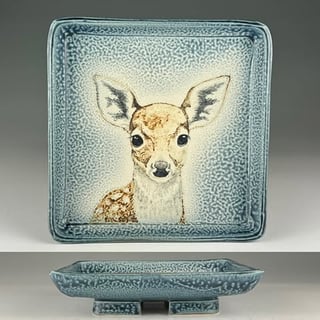
Speaker: And then once the pots are made and leather hard with these textured slabs of clay, I decorate them with layers of commercial underglaze and then a sort of translucent white slip that I make. And newsprint elements that I use as sort of like a stamp and a resist with the underglazes and slip. And those newsprint motifs are laser cut and they are derived from
Speaker: the decorative elements are derived from old family letters and correspondence. I scan the text and then enlarge it and manipulate it, as I said, and then scan it and print it in newsprint, cut it in newsprint so that I have these really delicate
Speaker: sort of text fragments that are often, you know, from, as I said, it started with the love letters that my grandparents wrote to each other and sort of as a way to commemorate and honor these like really small domestic moments that can otherwise seem fleeting in something a bit more permanent. And then, yeah, peel the newsprint away, bisque fire them and sand them a bunch of times because I leave a lot of bare clay in my work.
Speaker: but I want it to be nice and polished and smooth and then you know glaze and inlay some color at the bisque stage and there you go. So what are you trying to convey with your pottery like after it's finished? Yeah I mean I want to create sometimes you know there's some stuff in the work that's just ideas in the work that's just for me and doesn't I don't necessarily care if other people
Speaker: get it or not, or if it's conveyed, like moments that are a bit more private and personal. But mostly, you know, I want them to be objects that people that are a record of me and sort of a record of the idea of time passing and allow people to sort of pause and notice the moment at hand and sort of, you know, also, you know, bring some joy and beauty into everyday life while also celebrating everyday life.
Speaker: in the content of the pots. I love it. That's really powerful. So let's talk about you being an instructor. Tell me the story about why you started making online courses about pottery. Yeah, so that kind of came about really just through necessity with that little thing we had called a global pandemic there for a couple of years. And prior to that, a big part of my income was traveling to teach workshops in person.
Speaker: And I would, you know, that was a huge, like probably over 50 % of my income. And then, you know, COVID happened and I just wasn't able to travel anymore. So all of these events that I'd spent all this time booking were canceled. And in the meantime, people were at home wanting
Speaker: to feel connected and wanting to do things and feel creative and inspired. And so I initially had partnered with an organization that I'd previously worked with, the Sonoma Community Center, where I was an artist in residence, and they were helping facilitate online workshops. And so I did a bunch with them and it was fun.
Speaker: I was able to translate my love of teaching and connecting with others through this new platform of virtual teaching. It has become a whole other thing that I do now and really enjoy.
Speaker: you know, really nice to be able to, I love teaching in person, but it's, you know, it's always going to be limited in terms of, you know, there's only so many places I can travel to. And it's also, uh, resource heavy in terms of flights and cars. And like, so like, it's not great for the planet. Um, and expensive for people to attend in person, you know, maybe you get 10 or 20 people in an in -person workshop versus I could have,
Speaker: you know, 100 people in an online workshop. So the cost, it's nice that to be able to deliver content to people that, you know, otherwise wouldn't be able to come see me in person. I love it. I think that is really a great way to think about like making courses and online to help people. So something I found interesting is you are passionate about challenging the way society and artists value the arts and debunking the myth of starving to press artists. Can you explain this further to me?
Speaker: Yeah, I mean, part of that came about through the pandemic, again, having this whole other way to make money virtually and sort of starting to see, to really approach what it is that I do as a business as opposed to, you know, obviously it's a passion as well, but, you know, and realizing how much my own sort of negative mindset and limiting beliefs were getting in the way of that at times, you know, we're all, I think,
Speaker: I can't tell you how many people when I told them what I was going to graduate school for were like, well, how are you going to make any money? But like, what's your real job going to be as opposed? So we're constantly from day one as artists told by society that you're never going to make any money doing this. So we don't expect to make any money doing it. And we are not taught how to make any money doing it. So it's sort of we're kind of starting right out of the gate from a negative situation.
Speaker: Yeah, so I think it was just sort of feeling frustrated with that and feeling frustrated by seeing other artists devalue themselves, whether it be in how they price their work or how they talk about money.
Speaker: and wanting to kind of change that story a little bit. And also like why shouldn't artists make a fair, like a good living? Just because we're doing something that we love doing doesn't mean we shouldn't. My dad was a doctor, he loved being a doctor.
Speaker: didn't mean he didn't get paid well to do it. So, you know, I think just sort of changing some of that narrative and I constantly see artists, as I said, devaluing themselves, whether it's like just not charging enough for their work or their time and teaching workshops, things like that. It's, yeah, so it's something I feel passionate about sort of kind of changing that story for myself and for other makers.
Speaker: I am so glad you mentioned about pricing because I believe that we should be charging more than what we actually think because we put so much time and effort into making our pottery. Why shouldn't we charge more? I think that is such a powerful thing that you said there. So let's talk about finding your voice. In your opinion, what does it mean to find your voice? It's funny because I have a mentorship program called Finding Your Voice.
Speaker: do in the the winter every year with a small group of students and you know it it sounds saying it like that it sounds like this very like it's this
Speaker: finite event. It's like, oh, I found it. Now it's here. And it's like, I've got it forever. Whereas it is actually more of a journey. And it's always kind of changing a bit. So I think finding your voice is partly just getting to the root of what it is that you're wanting to say and having some tools in your toolbox to do that and kind of stripping away. You're always going to be influenced by other people.
Speaker: in the early stages of making art, all of our artwork is pretty derivative. And that's just a normal part of the world that we live in and having lots of influences, but sort of starting to find something that feels a bit more uniquely you in its makeup and that feels exciting and that feels authentic to you and also
Speaker: recognizable as you. So you mentioned, and I was gonna bring this up eventually anyways, but you mentioned that you actually have a program for helping people find their voice. What is something that you teach in there that really helps people discover this voice?
Speaker: Yeah, I mean, I think the reality is that the voice is always there. It's just like learning how to listen to it and unearth it. It's kind of like sorting puzzle pieces and, you know, they're like all spread out at first and backwards and in the wrong spot. And you just sort of have to kind of sift through them. And part of it is
Speaker: a lot about learning to pay attention to what interests you. There's an assignment that we always do with students. It's called Notice What You Notice, and it's like paying attention to what your interests are in a really concerted way and what visually draws you, what excites you visually.
Speaker: and what are the things that always sort of like catch you in your tracks or like catch your breath, take your breath away from their beauty and starting to sort of almost catalog them and pay attention to what the similarities are and starting to see patterns and then just trying to kind of listen more to your own instincts. I'm glad you mentioned like
Speaker: putting like finding what you like, like what draws your eyes. I think that is the most biggest thing I think, in my opinion, to like actually finding your voice. You have to like look at things that you like. And I think that is really powerful way like you set it to look at things and then write it down and find those patterns that you like. That is amazing. What are some of the biggest struggles you see potters making when they are trying to find their own voice? I mean, I think it's just people just get really frustrated because we want it to happen on our timeline and and we
Speaker: we get for IC students to just get really down on themselves because they have some preconceived notion about how quickly it's supposed to happen or how it's supposed to happen. And it's sadly not one of those things you can force. It's just like the work comes from the work. What's the favorite quote of mine? I'm a bit of an inspirational quote, Junky. I don't remember who exactly said that.
Speaker: But you just have to keep asking questions and keep doing the work. I think, too, it's hard in social media times. I feel really grateful that I didn't have that when I was an undergraduate student. I just didn't exist. I'm that old. And then in graduate school, I was really cautious with how much I put my, I didn't really put much work out there on social media until it was,
Speaker: it felt like it was something a bit more resolved. I think I see a lot of, especially students, really get kind of sucked into the social media thing or just put too much emphasis on that. And if some, oh, this got a lot of likes, but this didn't, or, you know, and sort of judge things based on other people's opinions as opposed to listening to themselves.
Speaker: So I think that can be, social media is great in a lot of ways, but I think it can be dangerous for early stage art making or like art making when you're really working through new ideas. I think it's risky in a, not in like a, there's good risks and then there's like bad risks and I think it's a bad kind of risk to put your work out there before you've
Speaker: develop your own opinions about it because then you're much more likely to be swayed by other people's ideas about it. And, you know, it may be a really great idea that you just need to refine and resolve a bit more. But if you get negative feedback on it or don't get, you know, no feedback on it, then you run the risk of, you know, you may abandon that idea too soon. So I think that would be one of the major ones is
Speaker: Is that and then also just being afraid to make crappy work like it no one You don't get to the good work without making a lot of crappy work. So
Speaker: Definitely agree. Shaping Nation, Naomi mentioned asking questions, asking the right questions so that you can find what you kind of like hone in on what you want to make. I created a 15 question template so that you guys can ask better questions for yourself to help you discover your voice. Go to shapingyourpodtery .com forward slash questions to get these 15 questions and start honing in on what you really like your voice to make. So as we're coming to a close here,
Speaker: What are the top three things Potter should be focusing on to help them discover their voice a little bit faster? Uh, yeah, I think just, you know, what, what they're in, you know, what, what excites them, like what, what, what do you feel like you can, um, you're excited to keep pursuing, like really listening to, to the questions that the work is presenting itself, presenting to you rather. Um,
Speaker: And also tuning in and paying attention to how you feel when you're making that work. There was an earlier body of work that I was making in graduate school when I was still throwing. And I remember when my professors in a critique noticed the throwing lines on the inside. She was like, these are just so tense and so tight. I was like, yeah, I think I'm really tense and tight when I'm making the work. And it was showing up in the works. I think it's also like, how do you
Speaker: you physically respond to the work. How does your nervous system respond to the process? I think that's something we're not really taught to think about. Yeah, I think that's only two. That's fine if you only have two. Those were two excellent pieces of advice. Naomi, it was really great chatting with you today. I learned a lot about discovering your voice. Where can my audience go and learn more about you?
Speaker: Yeah, thanks for the time and taking the time to chat with me. It's always nice geeking out with others about this stuff. So folks can find me on my website, www .nyomiclement .com, or social media. Instagram is the best place to find me. It's at www .nyomiclement .com, just the initial K Clement. Yeah, and if folks have
Speaker: questions about things, I'm happy to answer them on my website or on social media. This was a really great interview I had with Naomi Clement. I loved the part when she was talking about asking the right questions and really trying to slow down a little bit so that you can find your voice eventually but not go too fast.
Speaker: I really love that part so much because I think I resonate with that a lot. And I think a lot of you will resonate that as well. If you would like to learn how to ask better questions, go to shapingyourpottery .com forward slash questions.
Speaker: where I put together a free 15 template question to help you hone in on what you actually like to make with your pottery and find your voice that way. Go to shapingyourpottery .com forward slash questions to get your free 15 question template.