Transcript
Speaker: real quick before we get started did you know that the questions that we asked are going to determine what our pottery is going to look like and it's going to determine what our voice is going to look like that's why I created 15 questions that you can use right now to start discovering your own unique voice go to shapingyourpottery .com forward slash questions to get this free booklet you have to be willing to
Speaker: So that's not good and scrap it, recycle it, self -edit. What is up, shaping nation? This is Nick Torres here. And on this episode of Shaping Your Pottery, I got to interview Tom Budzak. Tom makes some really incredible sculptures and dotted mugs. In this episode, you will learn how Tom makes his dotted mugs and sculptures. You'll also learn about the power of repetition and practice
Speaker: why Tom uses a variety of different techniques for his pottery, and finally also learn about self -critiquing your own pottery. And there's so much more in this episode, and I hope you guys enjoy it. I'll see you guys in there. If you love pottery and want to take your skills to the next level, you're in the right place. Find your own pottery style right here on Shaping Your Pottery with Nick Torres. Let's get started.
Speaker: Welcome to JP Pottery and tell me, what is something people might not know from you? Well, thanks for having me. Something some people might not know about me, I was a ranked tennis player when I was a teen and I had aspirations on being a professional tennis player. I was like 18. I got offered some scholarships to college, but decided to stay in state and go to ASU instead and pursue
Speaker: Journalism at first and then I decided you know, fuck it I'm gonna do ceramics like I've been doing in the past five years or so So I'll figure out money later. I Love that. So tell me story how you guys start in ceramics
Speaker: Yeah, so besides like taking one little like art center class when I was like five or six, I started when I was like 13 in junior high. We had a ceramics lab there in my junior high and then I took art classes there and then my high school
Speaker: I went to Chandler High School in Arizona, and our lab there was the lab for Chandler Gilbert Community College. So we had a pretty nice ceramic facility there, and I had a pretty knowledgeable high school teacher. So I just kept doing it there, and then I just never stopped. I just couldn't stop, you know? I had to do it. And ASU's got a really, really good program, so I was local and wanted to go there.
Speaker: Yeah, I just kept doing it. So tell me a story why you decided to get your master's in fine arts. Yeah, so I got my undergraduate degree in 2002 at ASU. And then as far as jobs go, I mean, there wasn't like social media like there is now, you know, you couldn't just like blow up online and sell your own work and kind of do it yourself. So it was like,
Speaker: doing art fairs or working for a gallery or teaching. That was pretty much the main paths. And I didn't want to teach high school. So I pretty much had to go get a master's if I wanted to teach college. So it just seemed like I could get a job the most easily that way. So that was where my first intentions came to go to grad school and then
Speaker: Right when I graduated, I applied to like a lot of places, didn't get in anywhere. So I worked for a production studio slash gallery for a year. And then that's when I was like, I have to go to grad school. I can't work. I can't, I can't be an assistant forever. So I applied to some smaller schools and a lot of schools and got into a few and decided to go to New Mexico state based off the professor there, Amanda Jaffe, who was doing a lot of work. I liked with tile stuff.
Speaker: Can you give me like a rough number on how many colleges you applied to? Oh, just like about a dozen. I didn't go crazy. But yeah, like about 12 that first year and then about a half dozen the second year. But I really narrowed it down to schools that I thought I could get into for sure. And I wasn't like just applying to like
Speaker: like RISD and Alfred and stuff like that. They're like the higher end places or, I don't know, higher end, but perceived prestigious places, I guess, just like places I thought would fit my work better the second go around. The first time, I actually didn't apply to Alfred, but that first time around, I was like, I'm gonna apply, you know,
Speaker: you know udub and florida and all these big places i just was like i'll get in everywhere you know i just was like why not but you know later on i realized there's like a hundred or two hundred applicants for like one spot so it's like you know and i wasn't going to and seek at the time and like meeting these professors in person and getting face to face with them so they got to know me i was just like
Speaker: a random name and a random applicant that nobody knew for the most part. So how did your time getting your undergrad help you with growing as a potter?
Speaker: So ASU was great at the time when I was there. The studio was open like 24 seven for the most part for us that were ceramic majors. I just like, I lived there for like, for the most part. I mean, I didn't like sleep there, but I mean, I was there all the time. I just like, I just worked. I just practiced. I tried to make pieces. I just
Speaker: You know, I just made a lot. I was there all the time. And there's a few other people I went to school with that were there all the time too. So it was kind of, it was fun. And then, you know, we were, ASU's got, you know, there's some fun stuff right around the Star Trek studio. So we could go take breaks and do whatever if it was like Friday night or Saturday night and then go back to the studio. So.
Speaker: Yeah, it was just, it was great. I don't, I think it's a little different now. I mean, it should be different now. It's like 20 years ago, but yeah, I just, I really, I didn't care about like selling work or any of that. You know, like I said, it was, you know, it was like 20 years ago. So I wasn't posting any pictures cause there was nowhere to post. I was just like making work for me. And I think that was great. Cause I just got to develop.
Speaker: And all that bad work I made, it's nowhere for the most part. You can't find it. So that's great. I didn't have to grow up in front of everyone artistically. So I think that really helped me find a way after years being there until what I really wanted to make by the time I was done.
Speaker: I love that. Shaping Nation, if you could find a way to just be in an environment where you're making pottery all the time, your growth will be exponential. I love that so much. So what is something you learned from your time here that you still use today? My time when? Your time at ASU. My time at ASU that I still use today. Repetition, practice. I think one of the first things I learned was like,
Speaker: to really get good at something you have to do like a hundred of them at least before it starts to like really kind of show the fruits of your labor. I remember like empty bowls like we got free clay to make bowls for empty bowls and this was like more when I was just hand building and not throwing ever
Speaker: So I took empty and I was like, I got to get better at throwing. I have to take throwing classes. I'm a ceramic major. I can't be a bad thrower as a ceramic major. I have to be good at this, even if I don't use it in my own work. So I just took as much free empty bowl clay as I could. And I just made bowl. I just made like a hundred. I just made a hundred just to get better. And then by the time I was at a hundred.
Speaker: they were decent. And I'm like, oh, okay, I just need to do a lot. And I just need to just go through it. And I don't need to be concerned about that first piece being good. I just need to make more because they will improve with anything, with handles or mold making or throwing, whatever. The more you do, the better you'll get. And that's something I try to convey to my students when I'm teaching too.
Speaker: Don't spend an hour on one thing when you're trying to learn how to throw. Just try to make six in an hour and don't save any of them. You'll just get better quicker.
Speaker: absolutely shaping nation. The more you make, the more you are going to improve. So if you are struggling something, just keep busting out, keep busting out techniques, then you'll get better. I promise you that. So now you mentioned that during your time at ASU, you weren't interested in selling your work. Can you tell me when you started to start selling your work?
Speaker: Yeah, so I sold a few things through art one when I was at ASU, which is like a student local gallery that's still there. It's a great gallery for students, but I didn't really, I sold a few things through the art club, but I didn't really sell, sell until I was in grad school and I did a couple
Speaker: did a couple of indie fairs, I think, like my second or third year there, just because I needed extra money and I was making a lot of stuff and I thought it was good enough at that point to sell. You know, again, this is like, that's like 2004, 2005, like you couldn't just open your Etsy shop online and post like, you know, like sales on your Instagram, like, you know, shock drops or whatever.
Speaker: It just wasn't like that. You had to sell in person or sell through a gallery. So it just took me a while. I was almost done with grad school before I was even selling or trying to sell.
Speaker: I didn't really, I mean, I sold through some galleries and stuff right after grad school, but I think around 2010 I was like making more functional work. And that's when I started doing like more consignment, more wholesale and doing some bigger shows like Renegade Craft Fair and things like that in LA and some of the bigger local ones in Phoenix, like Phoenix Flee to where I was like, you know,
Speaker: selling a little bit more to supplement my income, but it was never really my main focus. It's more just I wanted to be able to make the work I wanted to make. It's not scarf, you know? I love that. So let's talk about your pottery. In one sentence, can you tell me what you make? Say I make
Speaker: functional one -off, pointillistic work with decals and also ceramic sculptures in the same vein that are based off historical pottery. So tell me the story how you started making the pottery today. Let's say that again. Tell me the story how you started making the pottery that you make today.
Speaker: Uh, so I in grad school and undergrad for a long time, I was doing a lot of textural work, a lot of crawl glazes, blister glazes. It was like, we had to take glaze formulation classes and I just thought it was like fun to like take, you know, like do crazy glazes, not traditional glazes in my mind. So I did a lot of layering and I liked layering and refiring work and just kind of like.
Speaker: doing it again.
Speaker: or the textural work, I'd fire it like six to ten times to cone ten and then I'd downfire it and I'd just layer and layer and layer it. But at a point, you know, I was getting tired of being my own best collector. So I wanted to do a little bit more functional work that was still
Speaker: in that same vein of layering. So that's when I figured out like, what do I like about texture? I like the patterns. So what can I do that's flatter, but still layered in pattern? So that's when I started dotting stuff and layering it with decals, which made, you know, then I can do more functional work, but still get like a look I liked. So it kind of just, in my mind, it was just like the same thing, but it's like,
Speaker: they're just complete opposites, but in my mind, it's the same. So yeah, that's kind of where it came from. It was like out of a need to like not collect my own stuff so much or not have to, I mean, I just, it was just wasn't, you know, I wasn't selling a lot. So I had to do something to change things up. And I was doing it, you know, I'd been doing it for like 15 years and I was kind of ready for something new. So that was part of it too.
Speaker: I love that. So something I found interesting is you use a variety of techniques. Can you explain this to me and why you do this? Yeah, I just, whatever is necessary, whatever makes the most sense to achieve the form I want to achieve. That's, that's where that comes from. I just like being able to do whatever. I like having the knowledge that I can accomplish whatever I want to accomplish in clay. So.
Speaker: If I wanted really ornate spouts or handles, it makes more sense for me to cast them. If I want a square form, slab building makes more sense. If I need to make a lid, usually that makes more sense to throw out the potter's wheel, things like that. So it's just whatever makes the most sense to me, that's what I'll do. I'd say my functional stuff's primarily thrown, my sculptural stuff,
Speaker: It's a lot of mold making and sculpting and then casting although some of that's turning into throwing out too with more of my like wall sculptures, my like growth sculptures, I call them. So yeah, it's just whatever is necessary. I'll do whatever makes the most sense. I love that. Shaping Nation, you don't have to be stuck doing just one technique. You could use a variety of different techniques, especially if you're trying to expand the way your pottery is trying to look. I love that so much.
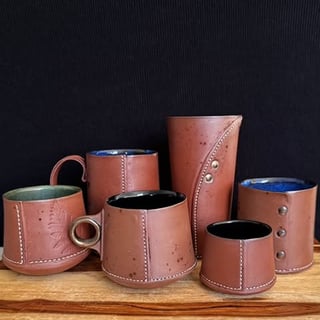
Speaker: So now can you explain to me how you create both your dotted mugs and your sculptures, starting with your dotted mugs? So the dotted mugs, they're just thrown, trimmed, hold handles. Then I use a slip trailer, basically. I use a precision decorator one that is a little bit more rigid, that I have a little bit more control with the flow of the underglaze. And I just apply the dots one by one. So I usually do rows.
Speaker: and do spaces in the rows. And then if I'm doing multiple colors and I just go back in and fill in the in -betweens. And if I want to do three layers, I just go over that. So it's just layer, layer, layer. So if it's like an all black dot and mug, it's like,
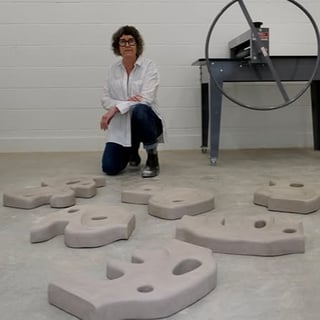
Speaker: I can usually do like three in an hour. If it's multi colors, it takes me, you know, I always work on multiple pieces at the same time, but probably a multiple color one will take like an hour to do. So that's how I do that. And then the sculptures, like the gross sculptures on the wall that I do on the walls are just thrown individually then put together on a slab.
Speaker: The more sculptural ones, I just make a solid mold and then usually make a two -part mold to cast those. And I do that for the bigger sculptural pieces. I do them in casts.
Speaker: because I don't have a lot of loss when I slip cast. It's almost like a 100 % success rate on those pieces, not cracking or not warping. So if I'm putting like 10 ,000 dots on a piece, I don't want to do that and then have it crack. So that's why I started mold making those instead of just building them as one -offs. So I didn't have any technical issues later. Again, what makes the most sense?
Speaker: making a mold for something larger that I'm gonna spend 20 hours decorating, it better not crack, right? So yeah, that's how I do those things. I love that. So let's talk about discovering your voice. Can you tell me about the moment when you knew you were heading the right direction with your pottery?
Speaker: I mean, do we ever know if we're heading in the right direction, you know? You know, it's like, I think it's a self -awareness, like self critique of your work and something probably in grad school I learned just to kind of
Speaker: challenge yourself and ask yourself questions like, is this good? Is this worth putting out there? What can I do to improve it? So somewhere around grad school, I knew somewhere, some of that work, I was like, this is good. I know this is good. This is good work. And so yeah, it comes from self -critique and being self -critical too. You also have to be aware of not everything you make is golden.
Speaker: you have to be willing to say that's not good and scrap it, recycle it, self edit. Which I don't know that a lot of people do nowadays with how easy it is to just like, I made this, I'm gonna put this out there in the world and show everybody.
Speaker: and then it's out there it's out there forever right so i still try to like self edit before i put things out there because now it's like it's out there it's out there and you can delete the post but you know somebody
Speaker: Took a screenshot of that if they liked it and they saved it because I do that. When I see stuff I like, I screenshot it so I can go back to it and look at it later. So yeah, it's just like self -editing kind of thing. That's how I decide if it's good or not. But yeah, I still don't know if I'm making good work sometimes.
Speaker: I love that. Shaping Nation, it's so important to self critique yourself because that's how you are going to improve. That's how you're going to find your voice and beyond. I love that so much. So you contribute your growth as an artist to being stubborn. Can you explain this to me some more? Yeah. So, I mean, I think it's important to be stubborn when you're making and, you know, when you start like, like the wheel, like learning the potter's wheel for the first time, right?
Speaker: for everyone who's ever like, just started out. It's not easy. I don't know anyone that just ever sat down with a wheel and was like, Oh, this is so easy and fun. And I'm making these beautiful pictures and teapots and whatever. Like it's hard at first. It's like learning the guitar or something like you sit down and, you know, like the guitar, you're maybe trying to learn jingle bells, like the first time you're playing, right? Or something just really simple. It's the same thing with the Potter's wheel. Like,
Speaker: everything wants to be a bowl when you first make it for multiple reasons. And if you're not stubborn, you're going to stop at bowls. You're not going to get very far if you're just not persistent. So it's just, it's again, it's going back to like making repetition and not giving up and having like an inner fire to keep going. So that's what I mean about being stubborn is like not giving up because
Speaker: I don't think I realized at first what I was doing. I was just like, no, I'm going to get better at this, especially with like I go back to the potter's wheel because like I was terrible at the potter's wheel when I first started. I just could not throw. I could not get it. I tried to muscle everything in. And now I just like I teach the potter's wheel and like I'm really quick at it. I'm really good at centering. I'm you know, I'm just proficient at it now. And I you know, if I went back and talked to
Speaker: me from my first, like, go around on the potters, we all be like, you're gonna get good at this, like, just keep with it, you know? So that's what I mean about being stubborn, is not giving up. If you like it, you know, don't give up. Definitely agree. I love that so much. So what are you doing to evolve your voice even further?
Speaker: So I'm just trying to push myself, get myself out there more, apply to more shows at the moment, make different, bigger work. I've always wanted, I've always made work that was, that I could ship, basically. I never really wanted to make these huge things. I was always like aware of like, I have to transport whatever I make. I have to, it has to go somewhere, right? I can't just make this like,
Speaker: you know, 10 foot sculpture with no idea where it's going to go. But I feel like now I can make, maybe not, I don't really want to make 10 foot sculptures, but you know, I would like to make like larger work that's, that doesn't just fit in a 12 by 12 by 12 inch box, you know.
Speaker: which if you don't know, that's the biggest box you can ship at the cheapest price. So heads up for everyone making work and shipping it. Like that, that's the size. That's as big as you can go without it like jumping from like $20 to $50 to ship. Anyway, that's a side thing. So yeah, I'm just trying to make bigger work, better work, push myself to make more work, to not like make the same work over and over again. You know, always trying to make new stuff and evolve.
Speaker: Which is, you know, the more you do it, the longer you're doing stuff, the harder that gets. You just kind of fall into like, this is what I make. But I always want to make new stuff. I don't want to just like make the same stuff. So, yeah. Definitely. Love that. But shape your day. It's so important to always be trying new things because that's how you're going to grow and fall off your voice even further. I love that. So as we're coming to a close here today, what is one thing you want to hammer home with my audience today? You know, just make the work you want to make.
Speaker: Don't take everything that is said to you, if you're in critiques, if you're in school, to heart so much, take everything with a great assault. And then, you know, if you're getting offered opportunities, learn how to say no. You know, not everything is good. You don't need to do everything. And I wish I had someone that had told me that earlier, like I used to get
Speaker: Like when I was first at grad school, I said yes to every show, every teaching opportunity, everything. And not all of it was good. You know, like some of it like didn't pay well enough. Some of it just was a waste of my time. So learn, learn, think about things. Learn to say no.
Speaker: do a lot of things, but you don't have to do everything. It's okay to say no, and it's okay not to listen to everyone, especially when they're saying batshit crazy things about your work, like go, okay, that's not me. I'm going to ignore that person, because not everyone has your best interests in heart either. You do. That's what I like to end with, yeah. That is some excellent parting words of advice. I love that.
Speaker: It was a really great chat with you today. Where can my arms go and learn more about you? So you can follow me on Instagram at Budzak or my website at tombudzak .com. And I got some news and events coming up. I'll post there so you can follow me and sign up for my newsletter there.