Transcript
Speaker: fairy tales, very exciting adventure stories. And to round up that volume of work, I was looking at others' fairy tales, and I came across this idea that is an oak tree, a thorn tree, like a hornborn, and ash all grew in the same spot. That would be like a little magical bite for a fairy. So I started putting those leaves on my pieces, and I started thinking a little bit more and more about symbolism of different natural elements.
Speaker: What is up, shaping nation? This is Nick Torres here, and on this episode of Shaping Your Pottery, I got to interview Dawn Candy. Dawn makes some really incredible illustrative pottery that she tells stories through her pottery and through her clay. In this episode, you will learn how Dawn creates her storytelling pottery. You'll also learn about why you should be always making pottery that you are proud of, especially if you're trying to sell your pottery
Speaker: And finally, you're also going to be learning about learning to take inspiration outside of pottery. And there's so much more in this episode. I hope you guys enjoy it because I know I did. I'll see you guys in there.
Speaker: Don, welcome to Shaping Your Pottery. Thanks for listening to this episode of Shaping Your Pottery with Nick Torres. I really love music. You are going to start discovering your own unique voice. But as an adult, I'm learning how to bring it down. That's right. I put together a free 15 -question booklet for you to start discovering your own music. So tell me the story, how you got started making pottery. All you have to do is go to shapingyourpottery .com. I kind of fell into it. So I read in a high school, I read and I did a bachelor's degree in university.
Speaker: And then after that, I wasn't quite sure what I was going to do. So I took some time off from school. I figured I would go back to school and try to do like a master's or something like that. And I actually got quite sick. I had a little trouble figuring out what exactly the problem was. But I signed a draft amendment that I should already class as kind of blacks.
Speaker: which as we know isn't just relaxing. I think it would be very challenging and really exciting and it really helped divert my attention a little bit or I fell in love with it. So I decided to close course and I moved to Red Deer where they have a visual arts program and I enrolled in that program here and then investing in a city in front of my business. I love it. So tell me the story how you came up with the name Little Sister Pottery.
Speaker: Oh, that starts easy. So I may have four older siblings and the side of us are all within seven years and we're from a really small town. So no matter where you went, meeting one of the youngest, somebody would say, oh, you look like you can't, you must count like you had a little sister or you've got a big day for a little sister. They're just kind of stuck. And I like the idea of being a little sister, because I think little sisters are scrappy and they are curious and they, you know, have to kind of sight in there and be part of the group.
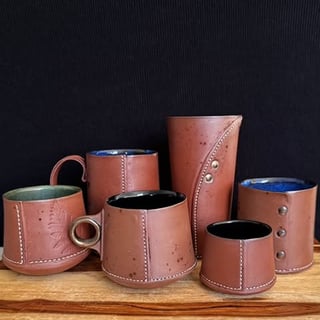
Speaker: I love that. I experienced the exact same thing because I'm literally the youngest of four myself. And like literally I'm in a small town myself and everybody would just recognize, oh, you're that person, that person. Yep. I know the exact feeling. So let's talk about your pottery. In one sentence, can you tell me what you make? I make richly embellished functional pottery. So
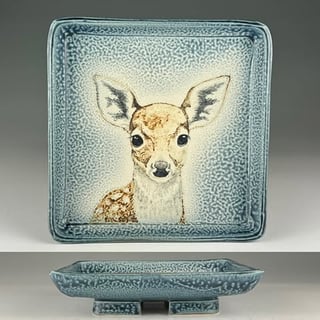
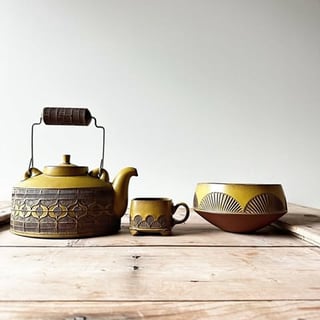
Speaker: perfect one sentence. That was great right there. So tell me the story, how you started making the pottery that you make today. Well, I've always liked to draw. And I did a lot of drawing when I went to school. I went to school to learn about ceramics, but I did a lot of programs. So you kind of take a little bit of everything. And I realized I really love drawing. And then I wanted to combine them two. So I started drawing on my pots and trying to develop more rich surfaces and layering. And it kind of still goes from there.
Speaker: So, you are inspired by the natural world, but how we interpret it through folklore, mythology, and superstition. How do these things impact the way you make your pottery?
Speaker: Yeah, so they're impactful in the choice of imagery that I employ on the plot. So my previous growing is in religious studies and philosophy. I'm not particularly religious myself, but I'm really interested in a ritual and belief and how we practice our beliefs and how we embody them. And it can kind of cross over into superstition as well. I'm interested in how we interpret the world through storytelling and how we create these stories about things.
Speaker: And so earlier, probably, I think it was maybe 2013.
Speaker: I made a series of work that was based on stories that my great -grandmother told my mom growing up. Fairy tales, very exciting adventure stories. And to round out that volume of work, I was looking at others' fairy tales. And I came across this idea that is an oak tree, a thorn tree, like a horned thorn, and ash all grew in the same spot. That would be like a little magical bite for a fairy. So I started putting those leaves on my pieces.
Speaker: and I started thinking a little bit more and more about symbolism of different natural owners, breeds, birds. I like birds a lot because they're these kind of messengers between the sky and the land and I'm interested in ambiguity and borders crossing over between different different areas so it's just it's nothing that somebody has to know about I think to appreciate the work but it's something that I think about when I'm when I'm thinking about what I'd like to think about.
Speaker: I love that shape nation. If you have like a little bit of a meaning behind your pottery, like what you think the meaning is, it can make it a little bit easier to actually make the pottery and come up with new ideas as well. I love that as well. So your illustrations have a unique kind of design to them. What would you call the illustrations that you make on your pottery?
Speaker: don't really have a name for it. I just layer a lot of different techniques. So I use in line. I mean, some people call it initial mouth. I use that technique a lot. I use flip trailing. I use a squeeze bottle to tell underglaze. I brush underglaze or slit. And I use low fire commercial glaze. I just honestly combine a whole bunch of different techniques to try to create a field of depth in the surface. So I should come up with any board that I have.
Speaker: What made you start using a variety of different techniques for this?
Speaker: I had a really great drawing instructor when I was a student, and he talked a lot about line variety and embedding information. So we did a lot of figure drawing with a model, which I wanted, but he was really encouraging us, you know, embed your own interests and your own thoughts into these drawings as well as just drawing that model. So I would do a lot of geometric patterns on my paper before I would get to class. So then I would cover it all in charcoal and erase the way to show some of the patterns with pencil crayons.
Speaker: I just tried mixing a bunch of media on the paint while I was drawing the model, and I carried that over into working with clay. I think that all of the rules that we have for drawing are the same that we should have for drawing on clay, but clay is soft material that you can carve into, and it can create rings text on. It gives you the more added possibilities for creating depth within the picture plane on the surface of the clay.
Speaker: So I want to come back to your time at your college. How did attending and learning more about art in my college, how did that help your own pottery? It really formed it. I mean, I didn't, I didn't make much pottery to speak up before I went. I got really excited about it, taking a couple of classes and I was in a really small town or they didn't have, they didn't have a lot of instructors. So you could join your guild.
Speaker: on science for the place for like $35 a year. It was really crazy. Like nobody will ever have that opportunity, but it was so cheap. But at the same time, and then you had 24 access to the studio 24 hour a day, seven days a week, just go in there. So I lived there, but I didn't know what I was doing. And I was before anybody was putting our video.
Speaker: you know, kind of doing tutorials. I saw her throw from a book, and it just wasn't going all that well. And pestering everybody that was there, and they finally said, you need to go and actually take a course, and we only invented softness. So that's what I did. And because it is a full visual art program, they do require that you take drawing every semester,
Speaker: pick two concentrations. And the other one that I chose was printmaking. And I think that that offered probably as evidence in the type of surface divine that I do. Because it's a lot of similar techniques. Yeah, I didn't, I didn't have a line of pottery before I went by it. All of those techniques, those can just design, right? Like design is design, competition is competition. It doesn't really matter what you're working on. All of that background knowledge really helps to define
Speaker: pots that I hope are to be grown and also. So what is something you learned from your time during this time that you still use today or helped you with your own pottery?
Speaker: I'm going to go back to layering, layering different techniques. I love it when I see a pot that has one type of technique done really, really well. Like a beautifully inlaid surface on a pot. But I get really excited when I see a surface and I have to really kind of think through it. How can I do that? Like it feels really cohesive and really natural and I have to kind of
Speaker: worm my ring into what methods they use to create it and then kind of think like reverse engineer what would they have done first and because my mind works out like that's how I like to to make my cause I want them to have that that rich service that feel really cohesive like it's it's all kind of melded together but that has separate components to the thing
Speaker: rare of richness and I think that's that really changed through from my drawing and from my ceramics instructor as well. She was really encouraging that you have to remember all of the things that you learn in your other classes when you go to draw on a pot. Sometimes people just forget and all of their lives are exactly the same and then all of their rough strokes are really boring. It's just really neat to think I'm still painting, I'm still drawing, I'm just doing it in a different way.
Speaker: I love that shape nation. If you have experience in other art forms or other things, you can apply that to your own pottery and make some really amazing looking pottery. I love that so much. So now can you walk me through how you create your illustrations onto your pottery?
Speaker: Yeah, everything starts with a pencil. I do most of my work bone dry for, which is really cleaning it. I used to try to do everything at a leather hard stage. And it's tough, right? To kind of get to pods at the right stage. I would literally, really do eye climate. I was like putting in plastic containers with blaster and trying to keep things at the stage that I don't normally think about doing research. And then I started doing more.
Speaker: work right on the bone -dry clay because I wouldn't get to it in time. And that gives you an opportunity to draw with a pencil and not worry about making marks or carving into the surface or anything like that. So I always draw. We don't always draw. But I typically draw with a pencil, like my design on the bone -dry piece. And then I just work with a spray bottle and a tool to carve lines. I use a spray bottle and flip a flip trailer to actually lay lines on top of the pot as well, as long as I'm spraying the tool
Speaker: It still adheres really well. I don't have to worry too much about that. And then I do a lot of stains. So I'll water down after glazes. I used to actually make my own stains, but now I just, I like my, my arsenal of products as minimal as I can. So I use underglades a lot now because they're so versatile. So I usually water down after glazing is all to stains and wash the back and I'll brush and stroke. So then I use a squeeze bottle and I trail more lines.
Speaker: It's pretty time consuming. But I like the effect that I'm getting with being out of my area where I'm doing. I love that. So let's talk about the business side of pottery. Can you tell me about the moment when you decided to go full time with your pottery? Yeah, I was thinking about that. I don't think I had a moment. I think it kind of gradually happened. I was really, I was really lucky. Like after I left school,
Speaker: one of my instructors and his partner have a visual arts and advanced and most scientific artist and they needed somebody to help work in the studio. So I worked in their studio part time. I worked retail part time for quite a while and then I started to get classes. I always offered the opportunity to teach for the sitting in Red Deer to teach some recreational pottery and drawing classes. So I was doing that and kind of just adding more and more
Speaker: gig work you know like contact work to the point where it becomes both high so I didn't have to do the retail work anymore and then at the same time I was building my skills with a potter and make the work that I wanted to sell eventually.
Speaker: So what would you say was your biggest obstacle when you went full time? Yeah.
Speaker: I think having the belief that it's sustainable. It's really difficult to know when you have a job that you're paid for, you know, hourly or however that works. You can kind of calculate forward how much money you're going to be making like next year or the year after that.
Speaker: And I think mentally it was very difficult for me to let go. I'm only teaching two or three classes a week now, so it's just sort of supplemental. And I mostly do it because I really love it. The mind is nice, too. But I really do like teaching. And dropping those classes back down to the point and not working part -time for my friend's studio anymore, having that belief that I don't need that as a safety net, that one's very challenging.
Speaker: And sometimes it still is, and you still kind of think, am I going to make the same amount of money next year as I did this year? Like, it's harder to find, I think. That was my big obstacle, was mental. So if you could go back to when you were first going full time, what is something that you would do different to help you have more success? I think I would be better at documenting.
Speaker: just keeping a really good note. I used to be pretty good about keeping a sketchbook and I still had a sketchbook for ideas but I used to be a little bit better about keeping track and things that I did that didn't work out and I wish I had been even better at that because I tend to repeat some mistakes because I'm very processed and I'll think well what if I did this
Speaker: particular technique before this other technique instead of after it. I mean, let me try that and see how it turns out. And then I get excited about it. So, you know, like half a tonel boat like that. And then it'll come out and I'll go, Oh yeah, I did that before. It's bad. Bad now. So I think records you think. I love that. So what advice would you give to someone who is looking to make their first 10 sales with their own pottery?
Speaker: I think, well, I think with the work that you like, I don't think looking at a market and trying to figure out what our market wants is the best way. Like solid and trends, that kind of thing. I don't think, I'm sure there would be more successful doing that, but I'm not sure that that would be advised. I think you have to make work that really excites you. And then that excitement shows me to work to potential buyers. And I think you have to put the tide in to make work that you're really proud of.
Speaker: It's for some that got inspired selling. If you are able to, and you're not ever going to be able to do that, you can really put the time in and be super, super proud of the work. It should be your best work, but you can make any given time. And sure, 10 years from now, your work might be way better in your opinion, but still, every time you sell a fun thing, you really should be very, very proud of it.
Speaker: I love that advice. Shaping Nation, the most important things are to one, to make sure that you are having work that you are enjoying that you're making. And then number two is always putting your best foot forward with your work, making sure it's the best possible piece of pottery that you can make. I love that. So let's talk about discovering your voice. Can you tell me about the moment when you knew you were heading in the right direction with your pottery?
Speaker: Yeah, I think it comes down to excitement, again, as well. I don't know, again, that I have a specific moment that I can look back and say, oh, sorry, when I knew that I was feeling good, specifically about what I'm making, I think there's always an element in front of chasing what you're making. Like, you're always kind of thinking, well, what else can I do? How can I change this? How can I grow? I think that when you have the level of excitement that you can't wait to get back in the studio, well, that is a really good institution that you're on.
Speaker: Definitely. That's a very good indicator. So you contribute growth as an artist to being able to support yourself in other works so you could find your voice without having to worry about selling your work. Can you tell me more about this?
Speaker: Yeah. I, I was really lucky. I have that kind of gig work that I could pare down the gradually. I didn't have to take a moment to trade. I'm going to quit my, my full time job and really start pots and support myself. I know not everybody has that luxury of being able to kind of care to work now gradually, but for me, it was really important because I had the opportunity to find the work that I was excited about before I started to rely on it for an income.
Speaker: I don't think if you are relying on pot really early, you're going to be driven more by the market and what any particular market is really excited about than you are about what you're excited about. Definitely. That is some excellent advice right there. So what advice would you give to someone looking to discover their own unique voice with their partner?
Speaker: say look outside pottery for influencers is one thing. I think it's good to look at other people's work and I think it's good to look at other people's work with a critical eye and try to figure out you know that whole thing of like how do you do that and maybe even try it yourself to to get a sense of it and to get a real deal for temple. But I think when you're looking for and to find your own voice
Speaker: It can be really difficult right now. I think we're flooded with images of other people's work and it can be really difficult to step outside of that. You might see something very excited about, but you don't know how to make it go.
Speaker: And so giving yourself some breaks, like we're constantly looking at our people's work, I think is really important. And thinking about other areas, like look at furniture design, think about like a piece of furniture you really love the design of, and think about that, like what kinds of, do you like things with lots of right angles? Do you like things that are very curvy? You know, just really basic questions like that, because design is divine.
Speaker: Look at look at all kinds of things outside or a party. I think I saw that you had put up a post about isolated if you like somebody's piece isolating what it is that you like about it. I thought that was really good advice, you know, isolate back and kind of springboard from that and your own.
Speaker: voice will sign through eventually instead of replicating somebody's work and then going, well, how about this work? And then replicating their work. That's all really good for skill building. But if you're wanting to really figure out what makes you super excited, I think being a little bit more critical about what you are
Speaker: doing in the studio in that respect is to really analyze what it is that's perfectly about something that excites you and then figure out how you can do that yourself without frequently replicating somebody else. Absolutely reshaping nation. Look into other people's work but find what you like about people's work
Speaker: Don't just copy it straight up, find what you like, and then try to model that and work with that and keep pursuing those things that you like. I absolutely love that. So as we're coming to a close here today, what is one thing you want to hammer home with my audience today? I feel like I'm processed. And this is just my own personal advice because this is what I think gets me excited and really engaged. It's thinking about the process and staying really curious about it.
Speaker: Really trying to stay open and not shutting yourself into a box like I made this type of work. And this is the type of work that I'm going to make for the next 10 years. I think it's important to give yourself out to explore. So my instructor, I'm talking a lot about my instructors that you haven't been thinking a lot about.
Speaker: trajectory of how I got to where I'm making the pots and anything now. I had an instructor who said that whenever she fires a kiln she'll have an experiment in it and that's that's a lot like if you do that with every kiln you're that's that is a ton expectation for yourself but I think trying to keep that in mind and if you have a thought and while you're making something like what if I did this all over differently let yourself do that or that's that's genuinely I did my best advice when I'm
Speaker: in the middle of the big new field screen. And I'm putting a bunch of policies on, a bunch of mugs. I'm saying, what am I doing? But eventually, my mind will start to kind of wander. I'm the type of person that gets a little bit creative while I'm working. It's not so much isolated where I sit down with a sketchbook and think of an idea and draw it. I think of things while I'm actually working. And I find if I write it down and think I'm going to come back to it later, I don't always. So if I can, unless I'm really, really young or young, if I can, I will.
Speaker: take the opportunity to actually try the thing that popped into my mind. It's important to stay open and to stay curious and just to try it. You never know. It might be something that really revolutionizes your work. Definitely. Some excellent parting words for us. Dawn, where can I go and learn more about you? I have a website. It's www .willslister .a and I do have an Instagram page as well.
Speaker: Thanks for listening to this episode of Shaping Your Pottery with Nick Torres. If you want to start discovering your own unique voice, you must first start with the right questions. That's why I put together a free 15 question booklet for you to start discovering your own unique pottery voice. All you have to do is go to shapingyourpottery .com forward slash questions to get this free booklet.