Transcript
Speaker: Hey, real quick before we get started and get into the episode, if you want to figure out how close you are to discovering your own unique voice, I put together a free little quiz for you to see how close you are to finding your own unique voice. If you would like to take this quiz, go to shapingyourpottery .com forward slash quiz, or you can just go to shapingyourpottery .com and it'll be right there. I'll see you guys in there.
Speaker: If you love pottery and want to take your skills to the next level, you're in the right place. Find your own pottery style right here on Shaping Your Pottery with Nick Torres. Let's get started. What is up, Shaping Nation? This is Nick Torres. In this episode of Shaping Your Pottery, I got to interview Doug Pelton.
Speaker: Doug makes some really incredible pottery where each step leads into the next step and he makes some really incredible handles as well. This episode is jam packed full of information, full of great stuff. But some of the things I learned was that one is that we need to be using repetition, repetition, repetition in order to find our voice.
Speaker: Two is that you have to, if you have an interest in whatever you are doing, dig deep on that interest and keep on going. And finally, the last thing that you will learn is that how you need to be stubborn. You need to be stubborn in order to make your voice come to life. And there's so much more in this episode and I really hope you enjoyed it because I know I did. I'll see you guys in there. Welcome to Shaping Your Pottery and share with me what is something you believe pottery should be doing to make the best possible pottery.
Speaker: Thanks for having me. Yeah. The best possible pottery. I mean, I think, you know, you have to have a burning desire inside of you to go to the studio every day. I mean, I think that is the main mechanism to creating good work, whatever type of work you do. You know, pottery, especially pottery, you benefit from repetition.
Speaker: You benefit from, you know, practicing and making, you know, potentially the same object over and over again with the goal of making it, you know, whether your goal is making it lighter, more consistent, more in line with your ideas about the pot you want to make.
Speaker: you know sometimes our ideas about the pot we want to make aren't in line with our skill level and we need to find a way to make those two things meet. You know so for me it like something I always say when I teach workshops is the work feeds the work so you know going to the studio
Speaker: whether your back hurts a little bit or you slept funny like I did a couple days ago, my neck is all tweaked, but I'm still finding a way to just be comfortable throwing pots even in my discomfort. So yeah. We agree 100%. You got to put in those reps. You got to put in that work in order to make the best possible part you can. Absolutely love the way you started that. So tell me the story how you got started with ceramics.
Speaker: It's actually the 20 -year anniversary of that. I started making pots in January of 2003.
Speaker: And it was sort of on a whim, you know, to sort of pack it into a nutshell is I was a lifetime skateboarder from the time I was pre -teen, deep into my twenties. That's what I wanted to do with my life. I didn't really have a plan to go to school, but my mom, my parents sort of nudged me in the direction of applying to art school. I had always had a natural ability to
Speaker: draw well from observation. So right out of high school, I went to school of visual arts and then transferred to Pratt Institute. Was a semester away from graduating with a BFA in painting and I dropped out of school, took two years off. There's a lot packed in there that I'm going to kind of glaze over for time, but in the two years I took off, I was working as a cabinet maker
Speaker: And I was a finisher, so I would sand and stain and lacquer cabinets. And during that time, my little brother enrolled, graduated from high school, and he had always been a graphic designer from the beginnings of the internet.
Speaker: And so he went to SUNY New Paltz and then I went up there and visited him probably in the fall of 2002, stumbled into the ceramics studio, never really had experienced ceramics before.
Speaker: And just thought to myself, maybe I need to go back to school and take some ceramics classes. You know, having had four years of school already under my belt, I had most of the electives and sort of things out of the way. So when I went back to school for clay in the, in the winter of 2003, I was able to just focus on ceramics and really, uh, really dive deep, you know, and
Speaker: you know that that winter I walked into my first clay class and my future wife was in that class and you know it was just
Speaker: How do I describe it? It was sort of a whole new world opened up to me in that moment. You know, like skateboarding saved my life. I say pottery saved my life because it gave me something to obsess over. It gave me, you know, just a new, a new journey, a new path that I didn't even know existed. And I haven't had a job or made
Speaker: income outside of the clay world since that moment. So that's the great story. So can you describe to me the moment when you decided to establish a pottery studio with your wife? Well, I sort of touched on, you know, walking into my first clay class and my wife
Speaker: Pam, her name is, she had already known how to make pretty nice pots. And it was like sort of shocking, you know, when you could barely center clay and you see someone making pots, it's magic. You know, you really think, you don't realize that there's physics involved at that point. You're just like, wow, that's like out of this world. How do I do that? And so we were friends for a year and then we started hanging out and
Speaker: and our relationship grew from there. So we knew right away we wanted to have a studio together. From the moment we started hanging out, from the moment we were friends, we had studios next to each other. So it was like our relationship
Speaker: and sharing a studio go hand in hand and always have. And that's another true advantage I feel like I have is I always have someone that I can rap about pots with. She has a very different aesthetic than I do, but she also has no problem letting me know
Speaker: when something's working with my work and when it's not because she knows me so well. And she's also taught me over the years to, you know, not be so defensive. That's a family trait that I have. So, so much. So can you tell me what impact has your wife had on you with your pottery journey? Another thing I've touched on, but you know,
Speaker: That level of support, whether it's my relationship with my wife or if I could speak to anybody out there looking to begin a life where you're going to really prioritize your work, you need support. You need someone in your corner, at least one person, but somebody in your corner who
Speaker: you know, understands the rigorous nature of that lifestyle, you know, and like living and breathing something like, like really, you know, for me, like to make pottery is to breathe, like I really need that is to, you know, to be a decent person to feel good about myself to be a good parent, you know, I need to be actively
Speaker: you know, getting out my ideas and following through with the things that I have, you know, in my head. So, you know, she's always been there for me to help support that. And, you know, and I've always been there for her to, you know, prioritize, you know,
Speaker: whatever is most important to her at any one time, which for over the past decade, it's been our kids. And she has prioritized our children over the studio. And we've come to that agreement to get, not even an agreement, but it's just the nature and the natural progression of where she wanted to spend her time and how I spend my time and where a partnership or a team
Speaker: And every decision I make about my business, about my pottery is mulled over with Pam. You know, whether it's as simple as like me, not, not really simple, but as stopping making my porcelain pots three years ago, which sort of, you know, you know, helped me by kind of break into
Speaker: you know, selling my work with and defining a clientele, you know, and having a body of work that you become known for and then stopping and stopping to make that while it's financially successful. And then switching to making, you know, reduction fired stoneware pots, which are quite a departure from, you know, electric fired
Speaker: you know, really bright colored porcelain pots and, you know, how is that financially going to affect us, you know, me being a full -time potter and that's how we make our, our income. So, you know, those decisions are all, you know, they're all not unilateral, you know, they're not me making those decisions on my own. They're, you know, a process of us talking about this stuff morning, noon, in bed at night, you know,
Speaker: kind of things. I love that shaping nation. It's important to have somebody in your corner through this pottery journey because that's how you're going to progress with pottery, how you're going to make better pottery, and she's going to be that more enjoyable. I absolutely love that story. So let's talk about your pottery. In a short sentence, can you tell me what you make? It's tough. I will do it in a sentence, but I've made porcelain, earthenware, stoneware, black porcelain. So my work
Speaker: you know, material wise jumps around. But I think in a nutshell, what I do is I make crockery. I make crockery for the home. I really feel like that sentence is like, the information is all there. I make pots that I hope, that I hope bring, you know, sort of pause and reflection and that, you know, really try to hit home the intersection between art and life. I absolutely love that.
Speaker: Tell me the story how you started making this type of pottery. Well, you know, I had been making pots for about, let's see, about five years before I landed in graduate school at Penn State. And graduate school
Speaker: You know, I wouldn't say it's for everyone, but it's a path that some of us can take. If the financial situation is right, and if the support is right, and if all these things kind of coalesce, you know, I found myself needing that time. To me, it was like an incubator of time to focus on my ideas and my work, and it's a pressure cooker, and to see what comes out of that pressure cooker.
Speaker: Right. So you're amongst fellow graduate students. You're amongst faculty that hopefully in my case did have your best interests in mind and try to help you continue on the path that you were on when you got there. Right. And help you sort of figure out what's important to you and what is interesting to you.
Speaker: and find ways in which to bring that into your work. I think that's the sort of nugget of figuring out how to make pots that are authentic to you. It really is about being vulnerable.
Speaker: and sort of looking at yourself, your experiences, your own history, the context of the things you're interested in, and digging deep on those things that you're interested in. Whether, you know, if you're interested in a type of pottery from a culture that you're not part of, well then
Speaker: you need to do the research and understand what the references are that you're making. You know so for me it was like I went to graduate school making a type of pottery and I came out of graduate school making a different type of pottery but it had the threads of the pottery that I've always made you know because I feel like
Speaker: You could give a group of basic ceramic students who have never touched clay before an assignment to make a coiled cylinder 10 inches tall, three inches wide, and every single one of those cylinders are going to have a different character. And so right off the bat, you can show a group of people how each one of us touches material differently, which I think is profound.
Speaker: you know, we talk about, you know, the original question I believe was like, how did I come to making the pots I make? Well, they're removed from what I was making when I got out of graduate school now. But, you know, it was a matter of questioning what I'm interested in and trying to figure out how to insert that into the work. And that happened through
Speaker: a lot of ways, but you know, certain sizes along the way. I mean, one of the things I, I remember in graduate school was I put down the work I was making and I did an exercise. I was really interested. I've always been interested in teapots and the complexity of teapots and that form. So I made, I can't remember now, but it was anywhere between 50 to a hundred teapot bodies, all out of earthenware. I had no intentions of firing them.
Speaker: or glaze firing them all the way through. It was just an exercise in form. So I made 50 jar -shaped bodies, lids, spouts, handles. Some of them were pulled, some of them were thrown, some of them were slab -built. Everything was just out there, right? And then I had all these parts that I kept wet, and then I constructed everything.
Speaker: And it was like this laboratory, to think of your studio space as a laboratory, as an experimental space in which you can stumble upon things. Because so often if we put ourselves in a too serious of a position, we're not going to like where we end up. Or we're going to be stagnant in what the outcome is. But if we create all these variables,
Speaker: and then approach them and then look at what we've done, there's going to be a handful of things to take away from that, right? And so, you know, I feel like my undergrad professor, Mary, her name was Mary Raim, or is Mary, Mary Raim, one of the things she would always say is you have a hundred ideas on that pot, or you have 20 ideas on that pot, pick one.
Speaker: Right. So, you know, so often when we get started in pottery, it's like, we want to put all these things on the work, but really, you know, if we broke all that down and did one or two of those little ideas on a pot, you know, it might communicate better what we're trying to say. Absolutely agree. I love that so much. I learned a lot from that right now. So shaping nation, just a little bit of a recap here. So be vulnerable about what you want to make.
Speaker: Make things that you find interesting and dig deep. Think of making your pottery like a laboratory. Don't be too serious about it. And finally, the last thing I want to recap is pick one thing, one idea from your brain and stick to that and keep working towards that. I love that so much right there. So now, can you give me a simplified explanation on how you create your shapes and designs for your pottery?
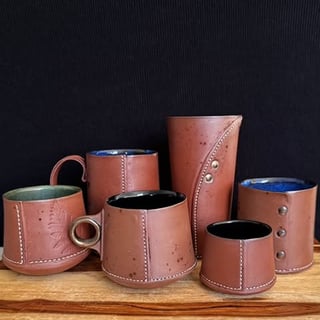
Speaker: Sure. You know, a lot of the shapes I make are of course a product of making those shapes over and over again. But I like to think of my pottery as having hard edges and soft edges and thinking about the way in which one transition can move into another. You know, I have a cup, I'm holding a cup here right now. You know, it's a simple shape, but look at how the handle sort of transitions into the body.
Speaker: of that cup and how the handle is its own independent sort of negative space. And then there's another cup here next to me that I made, which is a stoneware pot, right? And you could see there's multiple planes of surface on this. There's the plane here, and then it shifts into sort of this
Speaker: anti -volume where the volume's pulling in and then it shifts again. So I think about all those different shifts in composition on the pot, not only formally, but how I can accentuate that throughout the glaze process, right? So for me, making my pottery is like a series of steps that eventually lead to the culmination of opening up a kiln, but the formation of pots I'm creating
Speaker: I'm creating a composition for which to carve and then for which to glaze, right? So I think about the wet state as an opportunity to make a statement about form, whether it's just a simple sort of soft gourd shape, straight walled pot, or a pot that has many different shifts in it. And then the more dry state, so when you move into trimming,
Speaker: and glazing as an opportunity to define what you did in the wet state, right? And help communicate or accentuate what you did in the wet state. That's my... I love that. I love the step, taking it step by step and then have each step goes into the next one, how it flows. So it's like the pots you make
Speaker: already give you clues as to how you might treat it, right? In the glazing and in the trimming, right? You made decisions when you made those pots, whether you threw them or hand built them. And then you are going to follow through or look at those pots for clues as to how to glaze them.
Speaker: Yeah. Yeah. I mean, because for a lot of people, glazing is the daunting thing. Oh, I hate glazing or oh, it's like so difficult to think about this pot that I've labored over and now I'm going to ruin it with glaze. Well, in my mind, you're going to bring it to life and you're going to find ways in which you're as excited about glazing or making handles as you are about making the pot.
Speaker: Love that you have some really good tips here. I love that. So let's talk about discovering your voice. You contribute your growth as an artist to never having a plan B. How was this helped you with growing as an artist? Yeah, because it was like right off the bat, I was very stubborn, you know, it's like, I mean, I, I most likely would credit that to
Speaker: my upbringing, my parents owned a small business that they ran together and they had a lot of hard times, but they worked through that. They always were able to pay their bills and put us through college and all those things. So seeing that sort of struggle and then also as a skateboarder,
Speaker: You know, you know, the way in which, you know, I lost track. What was the original question? I'm on a good path, but. Not having a plan B helped you with growing as an artist. You know, and then, and then with skateboarding, it was like, I never, like once I started skateboarding, everything else was.
Speaker: secondary, like, or not even existing anymore. Like I didn't play baseball anymore or sports really, even though I was super athletic, like I don't, I, I, I dedicated all my time to learning how to Ollie. And then once I knew how to Ollie, it was like, learn how to kick flip, learn how to 360 flip, learn how to, you know, do a kick flip down a flight of stairs and whatever it was. And it was like, those goals were set and those goals had to be met. And so when I.
Speaker: came to making pots, it was like, this is all I want to do. And so how do I put myself in a position, whether it's, you know, jumping on opportunities that presented themselves or seeking them out to always keep my hands in clay. You know, it's like I saw
Speaker: I mean, most of the people that Pam and I went to graduate school do not make pottery anymore. I mean, not graduate school, went to undergraduate school with, do not make pottery anymore, right? But yet they have a BFA in ceramics, which can offer you a multitude of skills to go do whatever in life. I'm not saying that that's a bad thing, but what I'm saying is it's like,
Speaker: When we got into undergrad, we knew from past experiences and seeing people that had graduated before us, we needed to set up a studio. I mean, it was like fight or flight, you know. And so we put ourselves in a position to continue making pots right off, right out of undergraduate school. We just
Speaker: like what you did back then. We were looking for a job. We picked up the newspaper. We found an ad. And this older man who owned a 300 -acre estate was looking for caretakers. And you were given a house. And he liked that we were potters. He supported us to set up a studio in the basement. And we were just able to continue the momentum that we had in school. And that just led into other opportunities.
Speaker: So.
Speaker: You know, it's a combination of never, yes, never having a plan B and being really stubborn. Like, I just want to make pots. I will, you know, eat ramen noodles and, you know, work on jobs and do this caretaking thing, but 40 hours a week, I'm going to be making pots. You know, and this other thing is secondary. That's going to be happening. That's going to be keeping us going, but it's all the, the, the, the work was always the most important thing to us. And then.
Speaker: you know, that led to, you know, doing a technician job at University of Hartford, which led to graduate school. And when I got a graduate school, you know, I applied to a couple teaching jobs and it's just like the academic world didn't want me or it just didn't work out. You know, I, I've, you know, and then, you know, when I think back on things, I'm like, wow, I was really,
Speaker: born to be my own boss, you know, born to make pottery full time, born to sort of set my own hours because of, you know, possibly my history with my parents and their small business. And, you know, my dad was a locksmith. I mean, granted, he didn't set his own hours because he was always on call, but he was his own boss. And yeah, there's so much to that never having a plan B, but I think a lot of it was just stubbornness.
Speaker: and really being obsessed with making pottery, you know, so. From the Greek shaping nation, sometimes we need to be stubborn. We need to like be a fricking brick wall with our pottery with what we're trying to make because the only person that can decide our voice is you and you have to be stubborn about that. I love that so much. So if you were a beginner in making pottery, what are the steps you would take to find your own voice? If I was a beginner,
Speaker: I would not worry about that. I would really try to block out the outside voices or influences or the media noise that is all around us that is telling you that you need to, you know, create a brand or find your own voice or, you know, like you need to put in
Speaker: you know, to quote Malcolm Gladwell, those 10 ,000 hours, you need to, you know, make other people's pots. You need to look at history because there's thousands upon thousands of years of history of pottery. Like it's like, it's like, how do you know a good pot from a bad pot? Well, go to a museum. There's a reason certain pots are in museums, you know,
Speaker: you know, because there is like 10 ,000 years of history and pottery of making bad pottery. And then, you know, realizing formally certain things work and certain things don't work. And, you know, I would just say be a student for as long as you can and absorb as much information as you can before you sort of worry about trying to create pots that are fully
Speaker: your own or fully your individual, you know, expressing your own individuality because, you know, it's very difficult, you know, it's like not only will you, you know, think like I've become known for, you know, these handles that I make, which are like these,
Speaker: sort of where the negative space is sort of independent, they're their own unit that get applied to the pot. But I'll go to the Met and see the handle that's like 4 ,000 years old and be like, oh, there it is. And so it's just like a matter of like putting in that time and being patient
Speaker: and the work will reveal itself. What you're interested in, what sticks and what you let go of will reveal itself through
Speaker: the rigor of making and going to the studio and that voice that you may or may not be searching for can reveal itself. I really think it's a combination of actual work that you put in and then also things you can't explain, like some sort of penetrating magic, like one day something comes to you
Speaker: that works on your pot, whether it's the way you attach a handle, the way you, you know, you know, sort of, you know, belly out of form when you're throwing or the way you, you know, pinch, you know, all of these things. And those things can only reveal themselves through the act of experiment and the motions that you have to go through. Yeah.
Speaker: Absolutely agree. Shaping Nation, don't worry about literally just finding your voice. Focus on improving your pottery one percent of the time. Focus on learning and getting better. That's how you will find your voice. I love that you said that so much. So as we are coming to a close here, what is one thing you want to hammer home with my audience today?
Speaker: I mean, one thing to him or home is just, you know, love yourself, you know? And like, you know, if you can find a way to bring that love into your work, you know, regardless of the fact if your work is taking on a serious subject or if the subject of your work is just color or clay or materiality, you know,
Speaker: you know, you know, find a way to create space, create a comfortable environment that you can work within because that's important too. It's like a lot of times environments that we find us in aren't, aren't necessarily conducive to creativity. And so we need to, you know, before we even wedge the clay, make sure we're in a space that we feel comfortable making in and
Speaker: and support other potters too. It's like buy other people's work if you financially can and live with other people's work and not only worry about making work but
Speaker: You know, create a lifestyle around pottery, which is, you know, not just making pottery but using pottery, gifting pottery, you know, waking up in the morning making coffee or tea and drinking out of pottery because, you know, I always think about that relationship between pottery and poetry.
Speaker: And I'm thinking, why, what is that? You know, like, cause poems are like these short, they can be long, but the information's all there. There's like a message being, being told through, whether it's more direct or it's through a metaphor. But, you know, the, the, the analogy is there to pottery because with pottery, the information's there. You know, it's like the decisions that that person made or you made are right there in that cup. And that's an intimate thing that you can do.
Speaker: with your own work and with the work of other people. So I guess that's, that's kind of, you know, tangential and kind of moves around, but that's kind of, kind of what I, what I would say is just love, you know, find the love and try to, you know, put that into your work. I always say pottery is all about a connection. And I love that you just summarized that right there. Doug, it was so great sharing with you today. I learned a ton. I know my audience will learn a ton. Where can my audience go and learn more about you?
Speaker: So I'm on Instagram at Doug Peltsman and then my website is dougpeltsman .com. And then every year I open my studio here in Shokan, New York for the Hudson Valley Pottery tour. And you can find out at Hudson Valley Pottery tour .com.
Speaker: We hope you enjoyed this episode of Shaping Your Pottery with Nick Torres. Do you have questions about pottery that you'd like Nick to answer? Send them to us on Instagram at Nick Torres underscore pottery. We'll see you next time.