Transcript
Speaker: I can envision myself in the sea, see a red couch. I can imagine myself sitting on that red couch and drinking my coffee or tea in the morning. And I think it's just something that you can kind of get lost into the detail.
Speaker: What is up Shaping Nation this is Nick Torres here and on today's episode I had the great pleasure of interviewing Josephine Koppinger. Josephine makes some really incredible illustrations that she takes, apartment scenes and she applies them onto the muds and the pottery that she makes. In this episode you will learn how
Speaker: Josephine makes her apartment scene illustrate a pottery. You also learn about why Josephine keeps a sketchbook and she answers the question whether you should keep a sketchbook or not. She also talks about dealing with perfectionism and how she has dealt with perfectionism and how this has helped her and also not helped her at the same time with her own pottery.
Speaker: And there's so much more in this episode. I hope you guys enjoy it and I'll see you guys in the next. If you love pottery and want to take your skills to the next level, you're in the right place. Find your own pottery style right here on Shaping Your Pottery with Nick Torres. Let's get started. Josephine, welcome to Shape Your Pottery and share with me what is something you believe potters should be doing to have success in pottery.
Speaker: success in pottery, I guess it really depends on what the potter just determines as successful. So I think success can come from a lot of different things and it depends on
Speaker: if you're doing it for yourself versus for a business. For me, success in my own pottery looks like continuing to have creative flow and really enjoying what I'm doing. I'm trying to experiment with a bunch of different styles and just keeping myself happy and making sure that I feel creative in those moments.
Speaker: but also making sure that it relates to another group of some kind. So if it's a very niche space, making sure that people can relate to that and that they're excited about my work as well. But the main focus being, am I happy with what I'm creating as the potter? I absolutely agree. Shape Nation, the most important thing is rather if you are happy making what you are making. I love that. Yeah. Tell me the story how you got started making pottery. So I started
Speaker: Making pottery, I would say, happened pretty recently, just stuff that I was keeping, but actually started because my best friend in middle school and elementary school's mother was a ceramic pottery teacher at the high school. And so after we would get out of school, we would go and mess around in the classroom and clean the wheels, which we thought was super entertaining at the time, get a chance to throw that kind of thing.
Speaker: I have always been a creative and a maker and so ceramics came along and just felt really right because I'm also a utilitarian. So the fact that I could create and use ceramics and pottery as something where I could add a lot of surface texture and design
Speaker: just felt really right. So starting in high school, I was taking classes that way. After college, I went and I knew that I wanted to do something artistic and felt like ceramics continued to be that way I connected with the art. And so I was looking for experiences that gave me the most knowledge. So I joined
Speaker: a studio where I could start teaching. I joined another studio that was a non -profit where I started teaching and then I was also an artist assistant for two different artists all at the same time, very busy schedule. But it gave me a lot of knowledge into how different ceramicists and students were learning and how I could also learn at the same time instead of starting
Speaker: you know fresh out of college starting a business seemed a little naive knowing there's so much that came before me and so I started just on the research ground as far as that went and here I am about a year into my own business and I feel like I've been doing it for so much longer. I like because it's been 12 years just since messing around on wheels in middle school so I guess maybe that answers your question maybe not but it's been a long time coming
Speaker: I love that. So you spent a few years as a ceramics teacher and an artist assistant. Can you tell me a story about this? Yeah, absolutely. So I started teaching. I found out that I also am someone who process it through talking. And so oftentimes I'm talking to myself. And so transitioning that into teaching really helps because I had students asking me questions that I inherently do because of the amount of practice I had.
Speaker: but I had never described for someone before. So I actually learned so much while teaching because my students were getting information as I was processing it through on how to use your hands and pulling and how to create a handle, what design looks like, form over function. So teaching taught me, I think as much as it did all of my students and it was an incredible experience.
Speaker: to just learn how studios function as well. I was also doing a work trade so I was able to experience recycling clay and loading kilns and unloading kilns and just learning entirely about that process as well. Being an artist assistant that was for two different designers so as a husband and wife and the wife did much more surface design and texture and
Speaker: very washy beautiful watercolors and the husband of that group was doing very different work was drilling holes to make really lacy beautiful designs. So I got to work underneath both of them quite a bit in a production studio and that showed me a lot on how
Speaker: production design works, which was really interesting, throwing the same shape over and over again gave me a lot of practice in that as well. So that all started just by me reaching out to different studios and asking for opportunities that I was interested in and getting connected through the very small ceramic community and seeing what was available.
Speaker: So that's how it started, but it definitely started as a curiosity and research based. What does this look like as production? What does it look like as nonprofit and what does it look like as private studio? So how did this time when you were being an artist assistant and teaching pottery, how did this time help you with your own pottery?
Speaker: It helped me take a step back from my own focus in my own work, just because I was working so many hours at different studios and my, a lot of my ceramic energy was going towards them. So by the end of the day, I didn't want to focus on my own things at all, but it gave me a good opportunity to step back from what I had been doing as creative and tapping into different techniques and different ways that studios are run, how each one was marketing.
Speaker: themselves and what their target audience was. It also showed me what production pottery looks like and what burnout looks like for the artists I was working with, what holiday sales look like. And it gave me more and more insight on what other people are doing and how that may relate into my preparation for creating my own business. So you mentioned burnout. What is something you do to help you prevent burnout?
Speaker: Stay creative. I try and make sure this is something I actually learned from the king in the flower. Their Instagram handle is thekingintheflower. He said, who talked a little bit about staying creative, he said something that really stuck with me, which is in every single kiln or every batch of ceramics you make.
Speaker: make one thing that's completely different that's maybe off course a little bit of a tangent to stay mindful and stay creative always have something rolling in the background so that you're not go -go -go on production schedules. So I took that with me and every time I make a batch of ceramics it's supposed to look like I'm always drawn to a different element that was string course of what I initially had planned which keeps my burnout level really low. It's also
Speaker: really enjoy what I do and so I haven't hit. I've also only been doing this for a year and don't put a lot of pressure on pleasing other people at this time. I'm very much in my own creation and I think that others might have a better response to how burnout feels because I'm staying very creative and not doing too much people pleasing on my end. So I think that really helps staying true to myself.
Speaker: I love that. Shape Nation, stay creative. And even if you are in that production sound mode, try to find ways where you can just make experiments and add them to your own pottery, even if it's just one thing. I love that. Yeah, absolutely. So let's talk about your pottery. Can you tell me the story how you started making the illustrative pottery that you make today?
Speaker: Yeah, absolutely. So I love little apartment scenes. I love interior design. Actually, the first time I started illustrating on pottery was when my grandmother, we moved in with her in 2020 to do Asian place living. And we were coming in a family of five and renovating her kitchen, which she had had and lived in for almost 60 years. And she was really sad that her kitchen was being
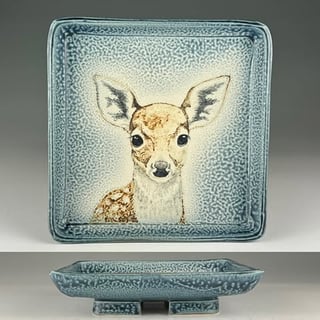
Speaker: demolished and so I created a really nice large platter for her that sort of memorialized her old kitchen that she loved being in and created an illustration that she can always look back on and have a sort of sentiment of what she used to have and when I was finished with that project I really had enjoyed replicating a scene that existed in my life and others and that meant a lot and I thought that
Speaker: that would be a really amazing way to continue to create spaces that feel really good for myself and for others. And I just started putting scenes, apartment scenes, some home scenes on the outsides of mugs and really just continued to like doing the small detail. I also
Speaker: really love illustration in 2D. But I, again, am a hardcore utilitarian, so things have to function more than anything to bring me joy. And so by having both the illustrative aspect as well as the ceramic function, it was sort of a blend of both of my passions for 2D and utilitarianism at the same time. How do you find like an apartment scene or apartment like room and put it onto your own pottery?
Speaker: I am an extremely visual person. I can see a space or a memorable place in my head and sort of pan around the room and decide what sort of clips feel good to me. So most of the time when I'm illustrating onto pieces, it's coming from these or thoughts that I'm having at the time of what I would like to go next to this couch, what I would like this lamp shape to look like. And so it's really mostly just kind of dreaming up what I would want and where.
Speaker: I love that so much. Before you were making these illustrative pottery, what were you making before? How has your pottery evolved? The evolution, I think, of my pottery has looked similar to most, which is you're starting out with bowl shapes and mugs, and you're dipping them in one color, glazing them one color, and then seeing how that comes out. So it evolves, I think, pretty quickly into home scenes. But I also, because I leave so much open ended,
Speaker: for what a piece is going to look like. It changes all the time. I have always really loved flowers as well, and so drawing and illustrating on my own time using the notebook, creating little designs and doodles on my own, those are all aspects of illustration and illustrated pieces that I like to incorporate into my work. So the evolution has gone very quickly from doing standard bowls and cups and mugs and dabbling a little bit in hand building
Speaker: and then narrowing in on what satisfies my eye and my hands and how I'm interacting with each piece to where I am now, which is putting little apartment scenes on relatively simple forms. Can you tell me, why do you like putting apartment scenes onto mugs? What is it inspires you about that?
Speaker: I think it's because I can envision myself in the sea, see a red couch. I can imagine myself sitting on that red couch and drinking my coffee or tea in the morning. And I think it's just something that you can kind of get lost into the detail, the amount of detail that I'm putting into each piece. You could continue to turn it around and see something new each time. And so it's...
Speaker: pretty immersive as it feels to me. Also like the texture and the feeling of holding a piece that you want to
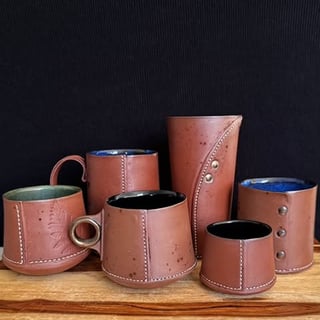
Speaker: have and you know keep in your kitchen and decide which mug you're waking up to using that morning as they're also a really exciting piece for me. I like the simplicity of the design having the body of the mug not overtake too much on form and shape and having the illustration really pop as a piece that can wrap all the way around where you're turning it you're interacting with the handle you're putting it to your lips which is a pretty intimate moment to be able to lift a cup
Speaker: to your mouth. And so yeah, each element of it is sort of thought over and can continue to look at every day. I absolutely love that. Now can you walk me can you give me a brief explanation of your process of how you create your home designs onto your pottery?
Speaker: Yeah, well, I start with sketching. So I will go into great detail with a pen and decide all of the little details that I want in a scene. And when I take a step back from it, I decide that that is going to be a lot of work that I might not be able to accomplish on a piece that has a lot of grog in it. Something that, you know, it has just too much detail is going to get some pieces sort of cut out of it. And I can pull back and simplify, but it starts with a sketchbook.
Speaker: Would you recommend for people to keep a sketchbook of their own and why, if that is true? I think it's personal. I think if it helps you, you should absolutely sketch. I find that I will come across imagery in my everyday life and be really, it's something that's appealing to me. And I don't put it in my sketchbook. I'll be thinking a week back and thinking, what was that idea? I want that idea back, but I don't have any recollection of it.
Speaker: other than the faint memory of that it had happened. So a sketchbook is the best way for me to keep track of those ideas. It helps an artist to keep track of that kind of thing, then they should keep a sketchbook, but otherwise it could be a notepad. You may have a better memory than I do, so your thoughts don't get as lost quickly, but yeah, if it helps you, you should.
Speaker: I love that shape nation. Another thing that you can also do is simply just take pictures and have those pictures on your phone for you to look back later. I love that. Absolutely. So let's talk about the side of pottery. Can you tell me about the moment when you decided to go full time with your pottery?
Speaker: So after I had been working at my various three jobs all at the same time, I just decided the scheduling was a bit of a mess, changing for two different studios and working underneath two different artists. And so I decided that I was going to cut back on one of those for teaching. I was going to continue with the other artists and start doing more of my own creative work and give myself more emotional bandwidth to create ceramics while working with
Speaker: you know, three other studios. The moment that I decided to break away from all of it was when I felt like I had absorbed about as much as I could from those experiences that I felt would perpetuate me into running my own successful business. So for me, that was about a year and working in all those different places. I continued to teach at the same time. So in November of 2022, I went to the clerk's office and registered my business and just
Speaker: I continued to teach at the same time so that the financial burden of starting my own business wasn't so large. So I cut down my hours to be able to afford my day to day and not have the business demand an immediate income.
Speaker: It really took a lot of stress, half of the fact that I had just stepped into this huge endeavor which is starting your own business it's not a simple task. There's a long learning curve, and you learn very quickly if you're doing it all yourself.
Speaker: Once I had sort of absorbed everything I felt like was necessary and had the resources to fall back on and the mentors to help me guide into the business venture, I just I started and made sure that I was financially able to support myself at the same time. I definitely didn't want the draw of having to support myself full time with ceramics while I very much was in a place where I
Speaker: needed to find my creative voice and figure out what it was that I liked and what people were responding to. So you love that shape nation. If you're thinking about going full time, you don't have to have that be your sole income. You can replace it by teaching. It may be a part time job as well. But that doesn't have to be your sole income to rely on. I love that. So now, what were you feeling when you finally decided to make the plunge and go full time?
Speaker: It wasn't, it wasn't anything dramatic. It was exciting. I felt like I could go in any direction because I had that financial backbone of also having a part -time job teaching. So the feelings were somewhat muted. It didn't feel intense or scary just because I had decided to ease into it and just having the excitement of having more time for myself to be creative.
Speaker: and decide how I wanted to interact with my work felt really easy. So I was able to ease into it rather than it having it be an intense emotional investment with the business. So I think I did have a little bit easier in that way. What would you say has helped you most with being able to sell your own pottery?
Speaker: Being passionate about the work, I think really helps. I have really enjoyed selling Cloterie in person. Being able to connect with people over the work, having them pick up the piece in person and really connect with the scenery or whatever they're responding to has been a sort of launch point for me to stay passionate about it.
Speaker: I love being able to see someone interact with a piece and feel immediately connected with it and knowing that that's going to go home with someone who is going to love that cup or that piece. So that's what's really helped me stick with it and sell sort of in person. I also have an online store.
Speaker: I've created my own website, which I would not recommend doing, but if you're going to go online, you should. That has also just been sort of word of mouth, having a support system, having a community of ceramicists and members and students who all really sort of uplift each other was a big one. And so being able to launch off of social media, which is just great free advertising, has really helped with the store online, but I much prefer being in person
Speaker: that really helps me to continue to stay passionate about the work. So what advice would you give to someone that is looking to start selling their own pottery?
Speaker: for selling your own work. Let's see. I think that it's important to love what you do. There is a certain amount of validation that comes externally when you're selling your work because people will walk by and have mostly what I have found as supportive comments. There also will be people who tell you that your price points are too high and that you
Speaker: should be someone who stands strong behind your work and that knowing that you are not going to place everyone knowing that you can't please everyone is really important and come from a place where you have enjoyed the process you're putting yourself out there because you want to and that you're putting a heavier weight on the people who
Speaker: are enjoying and giving you good feedback than the ones who don't understand what you do or don't see value in what you do at the price point that you have and just continue to give yourself validation because you decided to do this, you decided to sell your work and you should have your back 100 % on that. Totally agree, I love that. Shaped Nation, stand strong in your work, be passionate about it and you're not going to be able to please everyone and that's okay. I love that.
Speaker: So let's talk about discovering your voice. Can you tell me about the moment when you knew you were heading the right direction with your pottery? Right direction? Well, so I'm a bit of a perfectionist. And so I, whenever I get back a piece, I'm sort of half satisfied and half I wish I had spent a little more time on this aspect of it. But making sure that I am fully invested in what I'm making, I think keeps me grounded in that way. What else can I say about that?
Speaker: Will you repeat the question for me? It was, can you tell me at the moment when you knew you're heading the right direction with your pottery? Right direction.
Speaker: I think the right direction is just what feels good. So I'm much more of the journey part, whereas the ceramics is making me feel good while I'm doing it. And when it comes out, I can be satisfied with that. So the right direction is really sort of how you create continuing to provide that self validation for yourself that you're enjoying what you do. And if you're not enjoying it, make a change.
Speaker: So you mentioned that you are a bit of a perfectionist. How has this either helped you discover your voice or actually made it a little slower with you discovering your own voice?
Speaker: So with being a perfectionist, I would say I've been unhappy with a lot of my work in the beginning as I'm striving to create what's in my vision, especially because ceramics is one of those processes where you have multiple firings that could go wrong at any point. So when it finally comes out, the blaze could be wrong, the design could be wrong, it could have shrunk to be
Speaker: Size of a dollhouse and you wanted a size big enough to hold tea there's so many different fails that can happen within the very long process of ceramics and so That perfectionism has definitely been something of a downfall when I'm critiquing my work from an unfair standpoint others are saying that they like it and at the end of the day I'm the one who has to be happy
Speaker: with what I'm creating. And so I try to stay true to that. And if something's not coming out the way I want it to, I can refresh. I can usually recycle that clay and know that it's going to be reincarnated and such something else that I like better. I love that shape nation. If you aren't happy or satisfied with whatever you're making, you don't have to keep it and you can keep reiterating it, keep reading it until you'd like it. I love that so much.
Speaker: So what would you say are some of the new opportunities that came your way when you were able to find your voice? New opportunities. I think that after I
Speaker: And what pleased me, I was able to be more confident in the work that I was making and be able to back myself with it and know where I was headed. So I think the opportunity is just looking into future work that I'm appreciating that I create and being able to continue to be inspired
Speaker: By that and wanting more looking to explore looking to learn more and that those opportunities are now a clear path in front of me before in contrast when I didn't feel like I had a specific direction.
Speaker: I didn't know exactly what I wanted to do with the skill set that I had. It, it was not clear what was going to come out. I would sit there with the sketchbook and I would sort of have a writer's block not knowing what to create. And so I think the opportunity is that when you find your voice and you find what inspires you, it flows a bit more easily in what you can create. Totally agree. I love that.
Speaker: What advice would you give to someone that is looking to discover their own unique voice with their pottery? I think this has been said a bunch, but just keep practicing. Keep looking at what you love to do. You need to validate what you're feeling about your work. You have all of the answers and you need to expose yourself to new work. I think it's important looking at things, deciding if you appreciate them or not is completely subjective.
Speaker: But it is really true to who you are. And so you can continue to look at that and think critically about your own ideas as well. Decide why you don't like something. Decide why you do like something. Is that something that you can replicate in your own work or is it something that you don't like? I think a lot of the time the work that I make, I appreciate making it. I'm excited when others enjoy it.
Speaker: It's a very different choice that I would make when I'm buying something. And so when I'm looking at a piece that I really enjoy, I'm deciding why I like that. Is that something that I would creatively choose to make? Probably not, but I enjoy it in my own way. So our likes and dislikes can relate to our worth or not.
Speaker: And just to recognize that, put a critical thought to why you're feeling that way and that your voice will come through with enough thought and practice into it. You can't expect it to just fall into your lap. It does take time. It takes, it takes time, but you have all of it in you anyway. So continue to stay true to that. Absolutely agree. That was some excellent advice right there. And Josephine, it was so great chatting today. And as we're coming to a close here, what is one thing you want to hammer home with my audience today?
Speaker: Ooh, just keep creating. I think that for all of you that are looking to be a creative, start your own business, and just think about what success means for you. The first question we touched on, why you're doing this? Are you doing this for yourself, other people? Are you looking to make a gift through it? People, please, your own creative thought, it does not have to venture into you're a full -time potter now, but if it goes there, then you should run with it and continue to
Speaker: Surround yourself with people that say that you can. I think the big thing about starting anything is that if you have people around you telling you that you can do it, you're much more likely to venture and look and find the mistakes and correct and having your support system along with you. It's super important. That was some excellent parting words of advice. Josephine, it was so great jamming today. Where can my arms go and learn more about you?
Speaker: You can find me on Instagram at JosephineMayDesign. You can find my website JosephineMayDesign .com. I'm on lots of social media, so you can find me there. Thanks for listening to this episode of Shaping Your Potter.
Speaker: If you are struggling with finding your own theme for your pottery so that, you know, you are known for something, I put together 53 themes that you can use and you can take. All you have to do is go to shapingyourpottery .com or slash 53 themes. That's five three themes to get these 53 themes.
Speaker: it's really important for you to find a theme for your pottery so that you're not going to get burnt out you can have multiple styles with your pottery and you can be known for something so again go to shapingyourpottery .com forward slash 53 themes that's five three themes to get these 53 themes thanks guys i'll see you guys next time