Transcript
Speaker: Repetition is key to becoming better technically. And so once you get the technical thing, it allows you to make those more fluid artistic decisions. Hey, real quick before we get started. If you would like to find your own theme for your pottery so your voice really stands out and you're not getting bored with making the same thing over and over again,
Speaker: I put together 53 themes for you guys and it's completely free. All you have to do to get it is just go to shapingyourpottery .com forward slash 53 themes. That's shapingyourpottery .com forward slash 53 themes. If you love pottery and want to take your skills to the next level, you're in the right place. Find your own pottery style right here on Shaping Your Pottery with Nick Torres. Let's get started.
Speaker: What is up, shaping nation? This is Nick Torres here. And on this episode of Shaping Your Pottery, I got to end with John Hamilton. John makes some really incredible space theme and rocket ship theme pottery. In this episode, you will learn how exactly John makes his rocket ship pottery. You'll also learn about the power of repetition and why that's the best thing you can do for your pottery. You'll also learn about how John watches movies to gain inspiration for his own pottery.
Speaker: Finally, you also learn about using failure as a tool instead of letting it deter you. I hope you guys enjoy this episode and I'll see you guys in there. John.
Speaker: Welcome to Shaping Your Pottery and share with me, what do you love besides making pottery? Hey, Nick, how's it going? Thanks for having me, man. Besides my pottery family, it's a hands down, no brainer for me. I've got a 13 year old soccer player. I've got a seven year old who's into gymnastics. And then my beautiful wife, we've got a couple dogs and a cat. So it's my family. It's very important. It's my driving force, my support system. So I mean, yeah, that's no brainer for me.
Speaker: Absolutely. So tell me a story how you got started. Yeah. So let's see 2005 I decided to take a class in pottery and community college. I grew up in Colorado Springs and my mom pulled us out to a small town in Kansas completely uprooted and changed my world. And I kind of lashed out for it. So I really didn't have many interests. I knew I liked art. So I went into community college as a graphic person in graphic design.
Speaker: and I realized pretty quick that I didn't want to sit behind a computer screen all day. I needed something else. So I've just taken electives and decided to take a pottery class. Just had no idea what I was getting into. I played with a little bit with Clay in high school and you know a lot of drawing and stuff but pottery just I never experienced a pottery the way I did in community college. Jeannie Quinn was my instructor and I think it was just the way that she
Speaker: She kind of approached it. We did RACU, which that was the selling point. For me, I'm a pyro, so lighting anything on fire was a plus for me. But she's just very understanding, hands -on. She reached me the way that I think I needed, as I was somewhat troubled, I guess. I had a hard enough life up to this point, and like I said, not many interests that kind of settled me down. And so she found she had a way of just connecting, I think, just with all of the students.
Speaker: And that was the thing that really just, just set it off. And I mean, I think that that was the moment that I realized like I had, I had something to maybe offer the world. I mean, just in hindsight, I didn't get it then, but it was just, I was just having fun and enjoying it. And yeah, started, started making pots at that point.
Speaker: made horrible stuff all the way through even my BFA, I think. I mean, you know, I had the BFA show and did a solo show, one of the things that wasn't required, but I just, I felt like it was something I wanted to do. And I think that's what actually kicked me off into realizing I think I want to be an artist. And yeah, just, I mean, like I said, all the ups and downs and failure is what really pulled me in, knowing that failure is not a bad thing. It's, it's how we learn.
Speaker: So you mentioned that your teacher had a really big impact on you pushing you to pursue pottery further. What impact has it had on just your total career as a potter? Everything, man. I mean, I don't remember specifics about what she said or what she did that made, I think it was just a connection, right?
Speaker: And maybe that love for pottery came because she found potential in students. She got them excited. And that's probably the biggest thing, just kind of thinking about that.
Speaker: without surprising myself, I don't feel like I have much of a purpose. I want to be excited, you know, as excited as the person that walks into my booth at an art fair and starts getting excited because of the nostalgia that rushes through their brains. So there are times in my studio that that excitement just flushes in. I'll open a kiln and it's something new that I've tried and I've completely just jump up and down like a kid. I'm excited. I'm just, I need that. I really think that that's probably what she did for me is just
Speaker: She instilled that art does more than just looks pretty. It needs to be more than that to grab people's attention and pull them forward. I mean, that's my driving force is how can I get people to practically run up to one of my pieces and want to experience it? And I really think that that's just what she did. She laid that foundation.
Speaker: I love that so much. So tell me the story about when you became an assistant at the Arvada Center of the Arts in Hemia. Yeah. So after I went to this community college, Colby Community College in Kansas, I actually wanted to come back home, but I had hung out with some friends from, from growing up and realized that they were all knuckleheads. So I had met my, my now wife in community college and we decided that we were going to just push further into Kansas and I went to Fort Hayes State University.
Speaker: They're my mentor instructor, Linda Gantstrom, as I was getting ready to graduate. She, she said, Hey, I know you're going back home. I know of this woman, Bebe Alexander at the Nevada Center. She's, you know, got a great ceramics program. She's very, you know, very notable in the community. And I just, yeah, if you're interested, I'll reach out to her and link you guys up. So she gave her my email, my phone number, moved back home to Colorado.
Speaker: And she reached out to me and said, hey, whenever you'd like to come by, let's set up the time. And went in, she kind of gave me this loose interview. We walked around the studio, just kind of talked. And she actually then became a new mentor for me. She set that foundation for the looseness that I actually operate now on with the instructors that I have under me. And I just want them to feel comfortable, be themselves. And she really established that for me.
Speaker: walked in the doors after she said, yeah, I'd love to, you know, have you around. I mean, here's what we need. And it was, I mean, exchange for classes. I was, you know, cleaning up the studio, sweeping and wiping surfaces and helping unload and load the bis kilns. And that quickly evolved to, she had asked me to help the guy who makes glazes fix our raccoon kiln. The cable had snapped on it and
Speaker: you know the counterweight needed to be reset so we got a new cable and some pulleys because the pulleys were rusted and kind of made a new friend and mentor in this guy and it just started evolving from there. I started she asked if I'd be interested in doing more around the studio and so I was like yeah definitely so she started talking to me about the kiln and I you know really been itching like a lot of people that walk into these community studios to learn more about the process I mean I knew a decent amount. I was you know firing kilns in college you know
Speaker: electric and gas cones and raccoon but I think I needed more so she started showing me some things and just really I think at that point took me under her wing and she asked if I wanted to teach so I started teaching my first class.
Speaker: I was making horrible work even still up to this point that I just look back at and I'm just like, yeah, I was just making pots. I was wanting to do the thing that I was seeing and I wanted to emulate that. Slowly started at one point teaching up to five classes in a session, went from that to becoming the artist in residence.
Speaker: and just it continued from there. Anything that was about ceramics, I almost needed in my life. It was a necessity. It wasn't just, oh, I want to do this. This is fun. The fun was the product of doing it, and it was the payment for me. And I slowly started getting compensated financially for some of these things, not a whole lot. I was still, you know,
Speaker: with teaching I was also the artist residence was a small stipend at one point I had to basically quit working there and work a full -time job so I could get my family that step forward and get us into our first home so it was just this roller coaster of getting in there and just like establishing myself in this community of art yeah it evolved into even working in the gallery there doing kids camps all sorts of stuff throughout that that arts facility
Speaker: So now you also run that, that art center, right? That actually, no, I actually, so after a while of doing art fairs, I actually got into it's the art students league of Denver and it's another studio actually further away. So the Arvada center is practically in my backyard. The art studio that I manage currently is down in Denver, which is about 15 minutes, 15, 20 minute drive. And that came from, from this. And so now I manage the F that program.
Speaker: So you mentioned that you teach a looseness to your other instructors. Can you explain that? Yeah. So when I was brought into the league.
Speaker: Their immediate goal was to expand the program. So they had a hand building studio and a wheel room where we could fit up to 12 students in each of those studios. And they had another studio that they were evolving into a ceramic space. And they wanted me to go in and do that. So I obviously, you know, on top, they had limitations for what their current teachers, where all teachers can teach. And that's two classes plus like a workshop every session that we do. And so they were like, we're going to need to hire more instructors.
Speaker: I never hired anybody. I've never been in administration. But I think going back to what Bibi had shown me just with how her walking me through just the studio at the Arvada Center, I wanted to emulate that. I thought that was important, that it was just BU. And so my first interview
Speaker: It wasn't me that made this interview so amazing. This instructor, she was actually running a small art program or ceramics program at a rec center. She just wanted to get slowly out of that and start teaching more and not have to teach and manage her space. But a lot of that was walking around the studio. It wasn't formal. It was just getting to know somebody, finding a comfort level with that person so that they didn't feel like they had to impress me. It wasn't about impressing anybody.
Speaker: I had my second interview, my third interview, my fourth interview. And it's almost like I didn't want to make people feel like they were competing for a job. I just wanted them to come in, express who they were, show me their work, no matter how good or bad they thought it was, and just be loose. It's intimidating to be in front of a person that you're supposed to report to. And I don't want that relationship with my instructors and even my current instructors that were already established in this community.
Speaker: I wanted them to know that we're more than just like, I'm not a boss. I don't like that word. It's like a four letter word to me that when you get in trouble for saying bad words, I'm like, don't call me a boss. I mean, we can be friends. It's cool. We have this hierarchy that we have to respect and understand. And as long as we can do that, that's all that matters. And I wanted to encourage people to be the best that they could be.
Speaker: And the one thing that I constantly stress to them is just show up. You don't have to be 100 % every time you walk in this door. The best things that happen to people are because they showed up that day and you could be having the worst day your cat just died. You know, you had a fender bender on the way into the studio. You know, show up with that energy. Show people that you still care. That's all that matters. And that looseness allows people to just show up in the way that they are and be accepted and respected and feel valued.
Speaker: And I think that that's probably the biggest thing in this world that we need to share is that the value is the most important part. And what I can express to you and how much I appreciate you for being here is huge. Yeah. So I just want them to understand that that looseness is I'm a high octane person. I don't stop. I'm constantly beating the drum, changing the pace.
Speaker: I don't want people to necessarily emulate that, but I want them to see that we can do this all day every day and have fun with it and be exhausted. It's still a great thing to do, but being loose about it and not expecting people to emulate it and come in and just show up. There's days that I've had to show up to work and just be there.
Speaker: and my co -workers and the administration have said, you know, I appreciate that you just showed up and you're still having a good attitude. It's important. Just be loose, spread fun and joy, and show people you value on. I love that. Shaping Nation, show up and be yourself. Be yourself whether you're making your own pottery or whatever you're doing, just be yourself because that is so important. I love that so much.
Speaker: So let's talk about your pottery. In one sentence, can you tell me what you think? Make functional pots. And I like leaving it that my work I feel is went to the place that I want people to be shocked. I want them to be excited. So when I say when I'm in an art fair or when I'm not even an art fair, because people get to see the work, but when somebody asks me, Oh, what do you do for a living? It's just small talk.
Speaker: I tell them, well, I'm a potter. And I leave it at that because I kind of want to throw the bait out there and just see if they'll take it. Most people were just, oh, that's cool. And they move on. It's an ego thing for me to then show people, but I don't feel like it's necessary for me to throw myself out there and make them want it. So you want it or not mentality.
Speaker: When they bite is when I get to play and have fun with it. And so then I go into a deeper meaning of what I do. Oh yeah, I'm not your typical Potter. What does that mean? So you have, you know, a kiln and a kiln or whatever, you know, I mean, and I let them just be them and have fun with it.
Speaker: I want them to express interest. I don't want them feeling like I'm forcing them to like me or like my worker. So I then get into, no, I make space pots. And I just keep giving them a little bit of a breadcrumb just to see if they want more. And they're like, oh, really? So you just put...
Speaker: pictures of stuff on your work. And I'm like, yeah, kinda. And I just keep wanting to feed that. And that's the ego part of me that I have fun with, but like I said, I just want them to know or have that interest for themselves. And so then I started to show them work. Oh, oh, that's cool. And I just filmed cups and then I start getting into my rocket ships and the surface designs. But yeah, it's about, I don't know, creating a dialogue with somebody. It's, you know,
Speaker: I want it to be simple, but I also want them to want the complexity of it. And that's where it starts to develop from there, is throw them the bones, see if they want it. And if they want more, then I'll start talking to them about more of it. And yeah, like I said, I don't want people to feel like they have to be bored with my story.
Speaker: I love that. I kind of do the same thing. I'll leave it very broad and then go deeper if they ask. I like a putt. So tell me the story how you started making the party that you make today. Yeah. So I think the whole thing about pots is repetition.
Speaker: And I actually had a conversation recently with somebody about my work. And they totally disagreed with me, but I was actually having a discussion. My point of the discussion was to say, no, I agree with them. I make very cookie cutter things. That's what repetition is.
Speaker: When we make pots, we have to make the same thing over and over. I think I've gotten out of the, because now I manage mostly, I've gotten out of that repetition of making a pot to fill a booth. And I get to explore those pots in the surface more. So a lot of my process is very, very simplistic. I'm making cylinders, but I want to bring life to that cylinder. So at the time I was making anything that would catch nostalgia and get somebody excited about, you know, oh, I remember when I used to do this and I was huge into paper airplanes. I got kicked out of school.
Speaker: for throwing excessive amounts of paper airplanes and not stopping. Pretty disrespectful amount of paper airplanes. And so that was one of the things that I wanted on my pots at the time. So I was, you know, drawing and making these, these slab pieces and stick them on the pots. And then I would, after working at this facility that I worked at, I learned how to cast resin. And so I made stamps and I would impress, you know, these, these paper airplane stamps into the surface of my pots. And then I was doing nostalgic onomatopoeia with comic books saying, boom, pow, bam. Wow.
Speaker: And then that evolved into rubber ducks and like firecrackers and cherry bombs, stuff that kids used to do, like kids do all the time. And I wanted people to be excited about just looking at something and thinking it was cute and fun and playful. And so then I've always loved spaceships. I've always loved rockets. I've always loved the idea of space exploration. And I put a, you know, 50s style rocket ship on one.
Speaker: That was like the turning point. And I said, that's it. I can't take a paper airplane and turn it into a vessel. That would be a pretty damn big piece to do that. So I realized that the rocket ship was already a vessel. It was what it was made for. It was to hold things.
Speaker: It became bigger than that and I woke up in a cold sweat one night after I was just putting images of the rocket ships, different trajectories going up and coming down and maybe looking like they're crashing and all sorts of stuff. And I woke up in a cold sweat one night and I ran down to my basement studio at the time in this last house that we were in.
Speaker: And I sat at the wheel and I threw my first rocket ship and I knew what it needed to be. And it was going to be my first cup because I wanted to explore beyond just an image on the surface of something. And I wanted it to be bigger than, you know, a relief.
Speaker: And so I threw a closed form, a friend of mine, the guy that I had replaced the part on the raccoon kiln with, Steve Bober, he showed me how to throw closed forms and I knew exactly what I needed to do from that point. So I started making cups and then those cups evolved into cookie jars, lamps, and
Speaker: I just wanted that rocket ship to be at any scale, just different functions, created a shot, got more and more into mold making, and started making my shot glasses. I wanted to evolve the shot glass into something new. I want to keep that retro rocket ship, but I also want to evolve that into more modern sci -fi type futuristic stuff. Evolution was really what started it, is knowing that
Speaker: I can make that same form and that same shape, but bringing it to life and making it feel new and refreshing every time that I do it, I wanted that rocket ship motif to be a part of that journey. And I don't see myself stopping anytime soon, which is exciting. I keep finding that new thing that I want to evolve the work into. I want a new surface. I want to bring it and incorporate a new element of design into it. And it's just constantly about the evolution of pottery and
Speaker: How else can I excite myself in order to excite other people that see it? And I mean, I'm just playing and having more fun with that every time I sit in my studio and add a new element to this spaceship design. I mean, I'm a huge Star Wars fan, huge Star Trek fan across the two. I love cheesy sci -fi movies. Marvin the Martian. I mean, you name it, if it has a connection to that retro 50s style rocket ship or is something that's
Speaker: You know futuristic alien, you know, I just I want all of that and I watch those movies to get inspiration and I've always looked at movies that way I watch them once just for the excitement and the wow factor and just to be entertained and then I'll watch it again and again and again and again and again and again and
Speaker: until i find things in it that i'm just like oh that would be cool on this pot or i could put it on a cup like this or like Buzz Lightyear is my favorite you know or Lightyear is my favorite new movie that is my my aesthetic to a core and i just like seeing and getting excited about those things and finding ways to add them into my work
Speaker: So it's just, like I said, it's evolution that really started it. Starting from the basics of making pots repetition wise, just to make a good pot and then what can you do with that pot and evolve it. And I feel pretty comfortable with what I'm playing with right now, so it's working out well.
Speaker: So it's very interesting that you said that because yesterday when I was, I was watching the Ahsoka show, like episode two or something like that. And I saw like one of the characters, one of the Sith characters, and I thought that design looks so cool. And I literally paused it, took a picture of it. I'm like, I want to make this. That literally just reminded me of that. I love that. Thank you. Thank you. So something I found interesting is that no two pieces you make really never look the same. Can you tell me about this?
Speaker: I'm kinda gonna disagree and that goes back to like, and this is actually the same conversation that I was having with my friend. And it's Dee Good actually, Delvin Good. Like we constantly were back and forth and constantly talking art. And I do sometimes just mess with him and get under his skin, but he was like, he was talking about repetition and slip casting and attainment, just selling yourself out to, you know, mass production in China and all sorts of stuff. And he, I had said, no, my pots are very,
Speaker: cookie cutter. Like I make the same cylinder for 20 -30 cups and there are some slight artistic decisions that I make to make them slightly look different, but it's the same cup.
Speaker: When I start playing with other things is where I think I get a little bit different. Like my steins, my rocket cups, like there's a lot of similarities in everything that I do. They're very small artistic decisions on those. But it's my plates. It's my cover jars. It's my, I mean, I'm doing the moon mugs now. I'm starting to do some more sculptural work that I sell in the gallery.
Speaker: Those are the things that I think that you're maybe referring to. I want people to explore the piece from the top, the bottom, the inside, the outside, the edge. I want them to find something new almost every time they pick that piece up and interact with it at home.
Speaker: in the booth when they come to my house and see the work that I do. I want them to use their cameras and zoom in on it and what is that? And I'm using a lot of parts that are, they're slip cast that I wouldn't make myself because of the time that it would take to sculpt this thing. So like toothpaste lids.
Speaker: the handle to some, I've got some pieces over here that I've just kind of looking at, but the handles to some of my things are slipcast elements that I've seen and known that I was going to use that as a handle. How to integrate it into the piece is more important. But then with what you're noticing is, okay, now I'm going to start making these artistic decisions.
Speaker: that allow people's eye to carry around and start playing with the element of design. The simplicity of the direction that, oh this connects to this and this connects to this because I want that mechanical feel to feel like it means something and it does something.
Speaker: when it's completely stationary and it has no function beyond aesthetic. I want people to see that little rivet has a position and a purpose, not just, oh, I put it there because it needed to be there. It almost wants to feel like you're investing yourself and evolving yourself in a world that you have to use some make believe in order to be a part of and use. And so those things are probably what you're talking about where I'm driving, you know,
Speaker: not necessarily the scale or the shape but the surface parts. And I think I do want to get more and more into that where there are more one -offs. I'm thinking of some sculptural wall pieces that feel more like that to me and maybe that's it like you might see it and I don't because
Speaker: I mean, any artist can attest to this. I'm in the studio doing that thing, that repetition, and it feels very similar the same every time I'm in there. So, not to disrespectly disagree, but to disagree in the sense that I see this repetition, and I was trying to prove that point, even with Adele, that
Speaker: There's a lot of similarity that we have to do to make the work that we make. Repetition is key to becoming better technically. And so once you get the technical thing, it allows you to make those more fluid artistic decisions, change shapes, you know, make this, put place this here, put this here, wipe this this way. You know, I mean, there's several different things that come in at that point.
Speaker: I definitely shape a nation. The most important thing that you can do is to keep on repeating pots that you're making. Repetition is the most important skill that you can learn. The more you repeat things, the more you're going to get the basics down and you're going to be able to evolve your pottery even further. I like that a lot.
Speaker: So can you explain to me how you get your pottery to look mechanical and give it that space theme that you have? Yeah. So a lot of it does come from just deconstruction. So I did a lot of mold making, casting of iron, aluminum in college. In order to make molds, you have to think backwards. You have to know what you want and how to get there. So it taught me to deconstruct what I needed out of that end result piece.
Speaker: And that's carried significantly into my teaching, into my mentorship, when I help people out into my own personal pottery world. I want myself to break things down in a way that it's...
Speaker: It's parts to a whole, it's a puzzle. And that's when, you know, I see something, I'm like, well, I want to take a mold off of that because I know it could be this. I use a lot of packaging from random objects, you know, that you would purchase. And it's great because those things, you know, we talk about how art is all around us.
Speaker: Not many people think about something as simple as how the packaging holds something and how that makes the piece look like the thing that's inside of it. And it's not only because it's clear, it's because it wraps around the body of it in a way that allows it to hold it off of the background like an action figure for instance.
Speaker: pulls it off of the background of that product card. So you can see the artwork underneath it. You can see the parts that come with that toy, but you can see that figure. And those things I look at not as trash. I look at them as, ooh, that could be something. So I'm looking at it from the perspective of an artist, the perspective of a mold maker.
Speaker: perspective of somebody who's trying to put those parts together to make the whole. So one of the big things that I like are how can I make a handle that's not a traditional pulled handle, extruded handle, rolled handle, and I want those things to feel a little more exaggerated.
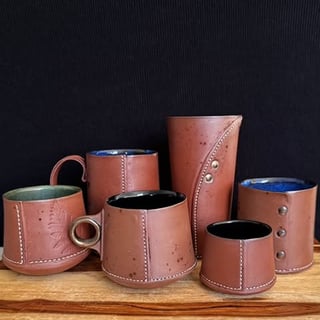
Speaker: So like on my Stein, I have a handle to that came off of a Ryobi leaf blower. I knew that that felt like it belonged on that Stein when I saw it. My handle for my mugs is extruded, but then I dipped it in slip and then I added these components to make it look like it was a strap for a hose and they needed to be bolted to the surface.
Speaker: All of my nuts and bolts and screw heads are just, they're spring molds. I was rolling them out when I started, like the flathead screws, rolling out a little bead of clay, I'd push it up against the pot, and then I'd use a flathead to actually push in and cut that line. That got really old, so I started making spring molds out of bisque, so I would just push the screw head into the piece of clay, I would bisque it, and then I would push beads of clay into there, and that's how it would attach it.
Speaker: And then the metallic look that I'm going for is a combination of what I'm using to tint the slip or the clay with and on top of using glaze and using glaze to stain, I guess, to pull back the color but allow the
Speaker: thin particles to get into the surface of the clay so it looks metallic. I want a distressed look so I'm finding ways to pull the color off of the pot after I put it on. So a lot of redundancy I guess I think that's what pottery is is you got to do this thing to do this thing and there's a lot of steps involved.
Speaker: its placement of certain lines and how they interact with the surface. I think from the beginning of making that piece, this panel is going to be red, this panel is going to be orange, this panel is going to have the caution tape on it. There's going to be a wire that goes here, there's going to be a battery pack that goes here.
Speaker: And so I'm constantly looking at it from the beginning, and I tell students all the time, make with intent. Start and start. When you start something, know what you're making, but then know how you're going to finish it so that when you get to that glazing stage, you know the end result. And people are always asking other artists, like, oh, how did you know you were going to glaze this like this? It's because we're thinking about it at the very beginning of the process.
Speaker: We might make 30 cups that look the same but I'm going to dip it in this and overlap it with this and sprinkle some of this on it because I know it's going to have this effect and that's all trial and error. That's doing the thing that I was sick of hearing and that was well you're going to have to test it. Like everything that we do is a result of testing and I look at my pieces every time that I put a piece in as a test tile opposed to it being a finished object. So I don't have that attachment to it that is oh well this has to look this way like expectation ruins it for us.
Speaker: So all the things and components that I'm adding, how I add them, those things are very important to how that aesthetic starts to take shape. And each space piece has to start to feel individualized, as you were talking about earlier. Because I do want people to have their own experience with it. And even if that, for instance, my shot glasses or slip cast rocket ships, I still want people to feel like there were some artistic decisions in that.
Speaker: even though the body is just the same thing, but I'm gonna put two portholes on it. I'm gonna, you know, maybe it's okay that the line isn't exactly straight. I'm gonna tilt it a little bit. I have an assistant that helps me make those sometimes. So there's...
Speaker: There are some things that I want people to know that, yes, this is a very produced thing, but then I want them to feel like it's a toy. I want them to feel those components that I'm adding, give them decision to
Speaker: how they're going to use their coffee cup that morning. What world are they going to transport to? So each of those little components is added just based off of more excitement of, oh, I could do this now. Oh, I could do this now. Oh, I haven't done this yet. I like this color scheme. I work a lot with secondary and primary colors. So just simplifying, I guess, as well to make things look more complex.
Speaker: Definitely. I love that so much. So let's talk about discovering your voice. You contribute your growth as an artist to failure. How has this helped you with your growth? Oh, failure is everything. I think once when we stop looking at failure as the thing that is an end, it's the thing that allows us to push forward. Failure is a tool. It's for learning. It's to say, oh, that didn't work. That's all it says is that didn't work.
Speaker: I like to break the pottery rules. I like students to know that you can break those. When they come into our studio, we as teachers teach them how to do something a certain way. And it's how we were taught. It's informed by our decisions, it's informed by our failures, it's informed by our successes, who taught us the time that we are taught, the age that we are, all those things, what our jobs are, our day -to -day jobs, all those things are based off of life experience.
Speaker: And failure is a huge part of life in general. So when somebody does fail and they're beating themselves up for it, I'm there to reassure them. That was just a mishap. That was a misstep in this process that you're doing.
Speaker: We need to let that idea that failures is ruining work or that's a big one too when students see a pot and it's like, oh, that's ruined. How is it ruined? Like you had an expectation of that pot and we need to kind of drop that expectation and lower those expectations so we understand what we're doing. It's easy for us to get trapped up in that world really and feel that
Speaker: We have no control, but we have a lot of the control, even in these community studios. If you do the pot right, the pot will turn out well. I mean, it's on me at that point. I'll, I'll fess up too when I mess up and I want to kind of overfire the kiln this time. I'll let people know, but I don't want, I want people to understand that failure is the key to success.
Speaker: And we have to quit looking at it as the thing that brings us down and stops us, because that's just giving up. That's the bad thing, is failure, if you allow it to do that, it becomes that you're letting it win. And failure's a good puzzle part. I mean, I tell students and people all the time that they see my best foot forward as an artist. Anytime you go to an art fair, you go into a gallery, you see that artist's best forward set of work.
Speaker: The things that we, I had some X amount of pieces that I just opened to kill them the other day that they didn't work. I fixed a couple of them, I figured out how to fix them, but that's because I didn't let that turn into a failure that was gonna defeat me. And we gotta let that stop that and help people overcome those things so that they don't allow failure to be the end of them. Definitely, Grease. Now, can you tell me about a moment when a failure led you to future success?
Speaker: I think that's just kind of piggyback. That's everything. I guess what we define as a failure is another expectation. So if I feel that the rim of a pot is not what it should be, I stopped worrying about stuff like that because I knew it was going to get better technically as I continued making work.
Speaker: I mean, I'm kind of coaching, so my studio tech right now, he's doing a lot of slip casting, pulling pots out and they're warped. They look like eggs. They look like ovals. He sees those as failures and they're not. There's this process that you did something in there to cause it to do that. The kiln might've had an effect on that. Like we're making this collaboration with the kiln. So, I mean, all these things are components of.
Speaker: of success that failure is a part of. I would say the biggest thing, while I was at the Arvada Center, and this is a, it's kind of a badge of pride right now, I over -fired the shit out of a kiln. I'm, you know, firing the kiln. Bebe said, hey, I'm leaving, do you wanna shut the kiln off? Cause we would tag team it while she was at work sometimes, and sometimes she would take it, sometimes I would just take it. And so it was a Friday, and I had a date night clay class, and I was like, yeah, I got it, go ahead.
Speaker: It's like I'll be here all night. 9 .30 rolls around. We typically shut the kiln off at about 5 .00, 5 .30. And 9 .30 rolls around. And this kiln was the most efficient kiln. Like clockwork would be done at 5 .00, 5 .30. Like eight and a half hours was the most that we ever had to, half an hour was the most we almost ever had to wait. And I'm talking to a student and I know I flushed white. And I'm like, I'll be back.
Speaker: I stopped what I was doing with them, I casually walked to the door where they couldn't see me, I sprinted to the killing yard, and like I said, I have this little badge of honor with this cone pack that I have. We fired cone 10 reduction and cone 11 was flat and you could barely see the outline of it. I put magnets on it, it hangs in my office at work.
Speaker: I sweat that entire night. I didn't sleep. That wasn't my work in the kiln. It was the studio work. I was so, I felt so horrible. I wanted to throw up. And even in that moment, I couldn't have saved, with my positive attitude, I couldn't have saved me for myself. I was ready to quit. I was done. I felt that I had ruined everybody's work.
Speaker: So I go in the next day and I'm there at like 6 .30 before anybody's even there. And I open the kiln and I'm just like, fuck. And I knew it was bad. Like 50 % of the pots had slumped onto other pots. And you could tell where the surface tension from glazes running cracked pots and they fell in parts. And Bebe came in around nine o 'clock like she normally does. And I tail in between my legs, went down to her office and said, hey, Bebe, I got a problem.
Speaker: I'd already unloaded about half the kiln and was just practically like as close to tears as I could have been and just felt horrible. And she was like, I don't know what happened. And she thought like horrible, horrible, like hindsight. She came up and laughed. I was like, this isn't funny, BB. Like, this is serious. And she goes, it's not that serious. And she's like, the students will get over it. They have to. We can't do anything about it. And so she talked me off the ledge and I was like, all right, whatever.
Speaker: I finished unloading that kiln and students started coming in and I had left a note just saying, hey, I messed up. This is what the packs look like. This is what happened to a lot of the pots. I still have two of those pots that
Speaker: are gorgeous. 50 % of the pots were gone. The other 50 % were salvageable. I wouldn't have sold any of those, encouraged anybody to sell them, give them away even, because who knows how bad and compromised the integrity of the pieces were. And then the thing that happened that switched me around was, can we do this again? And I said, hell no, we can't. You have no idea, but lighten the moment.
Speaker: And the pots that people were excited about are one -in -a -lifetime pots. For them, for myself, for that studio, we'll always remember when John screwed up the kiln. But the entire body, the community was so supportive. And I do think that that kind of comes from what you put in and how you show up going back to that. I show up every day
Speaker: positive attitude, I want to engage and interact with people and they didn't allow my failure to be a failure and allow me to stew and fall into that as it was a problem. They wanted me to, you know, I think just unintentionally they wanted me to know that they got my back and it was a good feeling that like failure is
Speaker: the life lesson for success. And I needed that to jolt me forward. So now similar things happen at the studio, not as bad. But when something does happen, I teach anybody in that studio, own up. Just own up. It's okay. Nobody's going to be as mad as you think they're going to be. And if they are, they'll get over it. And it's fine. This is a blip in their grand scheme of life.
Speaker: I've got people who probably still hold certain things against me because I have a nonchalant attitude and they forgot to wipe the bottom of a pot and guess what? I loaded it. Because you need to learn. And I've had people who thank me for that. So we use failures as a catapult to move forward when we don't let expectation get in our way. And I think those two play cohesive with me. Expectation and failure is things that we have to utilize going back to being tools.
Speaker: absolutely great. I love that story a lot. So what is your best advice for someone trying to find their own unique voice with their podcast? Just do it. Don't like commit with confidence. Know what you want to do. Don't hold lower your expectations because people think that I'm saying that Oh, we'll just expect less out of your work. Yes.
Speaker: expect less out of your work. Lower your expectations enough to explore. A big thing teaching students is to cut pots in half. And they start cutting pots in half, but they're always cutting bad pots. Cut the good pot in half. That is the best teacher for a potter. If you're sitting there making these pots and you want to make good pots, you have a little bit more control as a hand builder, in a sense. So you could cut that pot in half, but you've already cut the slab.
Speaker: You know the thickness, right? When we're throwing pots on the wheel, we have to know what made that pot good. I will throw a face that is a demo piece. People are like, oh, there's something big. We want to see how you would navigate through that and talk us through it. I cut everything. Anytime I teach, I cut it in half.
Speaker: unless I tell them, hey, we're gonna finish this in the next class. And I'll still cut it in half. I need to show them that it's just, it's mud. And potters, hey, there's some potters out there that are like, you're disrespecting clay. I'm like, no, I'm not. Like, it's just dirt. Like, we've got this fancy dirt that does something. Like, we'll make it again.
Speaker: It gets okay. So lower your expectations a little bit. Explore. Don't be afraid to try that thing that pushes you outside of your comfort zone. Too many people stay within their comfort and they don't push the pot to its limit. So they're going to constantly make a pot with thick walls. I got two exercises that I think exponentially help beginning potters grow. And that stretch the pot until it collapses, but the goal is to not allow it to collapse.
Speaker: But I want you to make that pot collapse because then you understand the limitations of the clay that you're working with, how you work with it, the amount of water you add, the dryness you keep it. I mean, how are the stars aligning that day, right, or not? But challenge yourself like that every so often. If you're gonna make five pots, make that fifth pot the pot that you play with and explore with. And then the other one is constantly always layer your work and measure when you're trying to create consistency because you can always
Speaker: go back to doing something that's inconsistent. But then a pound and a half of clay.
Speaker: The final diameter has to be three inches across. How tall can you pull that clay and measure it? And then the next time you do it, can you pull it a half of an inch taller? Can you pull it a quarter of an inch taller? Can you pull it an eighth of an inch taller? Every time you do this, get better. Learn how to collar. Learn how to throw a cylinder the right way for you. Not necessarily because I taught you my way of making a cylinder, but what quirky thing are you doing that's allowing you to make that cylinder better every time?
Speaker: understand that the clay is actually thicker than it actually feels. And those are the things that they're teaching people. It's the tactability of what clay actually is. This wet, sloppy stuff is holding under its strength because of physics. And it teaches people those things without teaching them physics. Absolutely. Shaping Nation, don't be afraid to mess up your pots and also always try to improve your pottery, whether it's a little bit at a time or a lot. Just always try to be improving your pottery.
Speaker: John, as we're coming to a close here today, what is one thing you want to hammer home with my audience today? Oh, well, I'm gonna go back to that. Everything you do in life, try and put your best foot forward, know that you're not always going to do that. We have so many metaphors and pottery that work in life and vice versa. And if you just show up and do what you can for the day, sometimes it's all that's necessary. I was actually just talking to my daughter recently, she's
Speaker: She's 13. She's starting to learn that not everybody's going to be your friend. And I wanted to understand that, you know, when you show up, like people recognize that. And it's not always about
Speaker: you know, allowing somebody, how somebody else enters your life to affect it. So the statement that I told her was, you know, when people show you who they are, believe them. And that goes for the positive and the negative. But even if you show up on the days that you're having a negative, it's okay because people see how you typically show up.
Speaker: don't let others get you down. And I think that that stuff will carry into your creative world. It'll allow you to make leaps and bounds because you decided to show up that day. And I mean, like I said earlier, there are days that I walk into that studio, I don't wanna be there.
Speaker: I want to be in my studio making pots. I want to be at home with my family. I want, you know, I just don't want to I don't want to manage that day like stupid stuff, you know, I just I want to be lazy. I want to play video games. I want to whatever. But I still show up because one, it's a requirement. I have a family. But I also show up because I need to for me, the personal, you know, continuation of just how life works. And if I if I walk in with a bad attitude and
Speaker: You know, it's gonna show. And I don't want that to be seen as me as the person. I want the person that I put forward for myself to be a positive light for other people to rely on. When you walk in and you're having a bad day, you showed up too. Hey, guess what? I'm not having a hot day either. I showed up today.
Speaker: And it might be low light, and I might have some unleaded instead of some premium in the tank that day. But I came in, and I did the work that was necessary for me to sometimes just get through that day. So yeah, show up. Just be you, unapologetically for sure.
Speaker: Some excellent parting words of advice. John, it was so great chatting with you today. Where can my audience go and learn more about it? Yeah, so I've got a website. I don't sell a whole lot of work on there, but you can definitely see what I do. I try and update that somewhat, you know, quarterly year with new work. That's JohnRHamilton3Ceramics .com
Speaker: or JohnRHamilton3 .com. My name is Long. JohnRHamilton3 ceramics on Facebook and Instagram. If you're in the Colorado area, I have worked at Plinth Gallery. I have work in Arvada, Colorado at a small boutique called Bailfire Goods. I have some work in California at the last bookstore in downtown LA. I'm just, yeah, trying to find, continue to find ways that I can be out in the community. I'll be at Encica this year with Danny Meisinger and Spinning Earth Pottery. I'll be at Claycon West giving a small demo.
Speaker: which is in Utah, just yeah, constantly trying to grind harder and do bigger things for myself and my family.