Transcript
Speaker: I found I wasn't happy making that, even if some of the pots were turning out pretty nice. I wasn't getting excited about going into the studio. I didn't really want to keep going with it. But then I told myself, well, I hand build now. And so it's like, why do I need to set these rules for myself?
Speaker: Hey, real quick before we get started, if you would like to find your own theme for your pottery, so your voice really stands out and you're not getting bored with making the same thing over and over again, I put together 53 themes for you guys and it's completely free. All you have to do to get it is just go to shapingyourpottery .com forward slash 53 themes. That's shapingyourpottery .com forward slash five three themes.
Speaker: If you love pottery and want to take your skills to the next level, you're in the right place. Find your own pottery style right here on Shaping Your Pottery with Nick Torres. Let's get started.
Speaker: What is up, Shaping Nation? This is Nick Torres here, and on this episode of Shaping and Pottery, I got to interview Brie Larson. Brie makes some really incredible surface direct decoration pottery. In this episode, you'll learn how Brie creates her surface decoration pottery, how she thinks about coming up with new illustrations for her pottery. You'll also learn about how to slow down so that you can start coming up with new ideas. You'll also learn about
Speaker: Taking things that excite you and applying that to your pottery. Finally, you'll learn about focusing on the process of your making rather than trying to find your own unique voice. And there's going to be so much more in this episode. I hope you guys enjoy it. I'll see you guys in there. Bree, welcome to Shaping Your Pottery and share with me what is something you love besides making pottery.
Speaker: Hi, Nick. Thanks for having me. Something I really love to do is I love to play Dungeons and Dragons with my friends. And I also like knitting and bird watching. So it kind of depends. I want to be with friends or outdoors or just solo knitting. What's your character in D &D? Oh, so I really like to play. I'm playing this wizard character. That's like kind of an idiot. It's just so much fun.
Speaker: So by two favorite characters I've played so far, I've been a rogue and then a druid. I like those two characters. Yeah, my previous character was a rogue and that was fun. An arcane trickster. Yes, those... I haven't played an arcane trickster yet, but that one did seem interesting because you can use magic as a rogue. Yes, yes. A gloomstalker ranger is also really fun and similar to like a rogue. Ooh, that sounds interesting. So tell me the story how you got started in ceramics.
Speaker: So I started in high school. I was always into art classes and just doing art activities, but I waited to take ceramics into my senior year of high school because I thought I was going to be terrible at it. I love to draw and I love to paint. And so it was kind of the only art class I hadn't taken at that point. But then the first week of class, I was hooked and I was like, all right, this is what I'm going to do.
Speaker: It's like, why did I put this off for so long? So then I decided to go into school for pottery, and I studied at the University of Wisconsin, River Falls, and my professor is Randy Johnston. So we studied a lot of wood firings, salt firings, cone 10, atmospheric. And so that was a big, big part of my focus. And then
Speaker: In my last year of college, I took a two week workshop with Ursula Hargens and focused more on surface decoration. And so that was also really formative as well for my beginning career. So how did how did you that workshop help you with with what you make today further?
Speaker: So it kind of taught me to think about the surface decoration of the entire pot, and it gave me a lot of techniques. That's when I started playing around with the inlay technique, and that's kind of what I use today. Beforehand, I was doing a lot of slip trailing, shino, iron work.
Speaker: or iron, iron oxides with brushwork. So that was kind of like a lot of what I was doing. But then with Ursula Hargens, she does earthenware and like very beautiful colored pots. And so kind of helped me think of more of an electric firing way of decorating the pots. So tell me about your experience going to the Stillyard Residency in Providence, Rhode Island.
Speaker: Sure. So I'm originally from Minnesota and I moved to Rhode Island in 2018. And that's when I started the Steel Yard residency. So I was a resident from 2018 to 2020. And I went from working on my own after graduating and moving into a studio full of community.
Speaker: And there were also welders and blacksmiths and jewelry makers at the steel yard. And so it was really wonderful to connect with so many artists in the area and learn different techniques. And that's when I decided to shift my focus from wood firings and salt firings to cone six electric firings.
Speaker: where I work with porcelain and I heavily decorate the surface. And then the pandemic happened and that was during the residency so the studio shut down and I had about a day to maybe throw some work and take it home. So I had to finish out my residency pretty much from my apartment and I took my time
Speaker: just decorating these, like I had 12 mugs that I had thrown in a damp box and like six months to decorate them. So I took that opportunity to slow down and get more decorative with the surfaces of my pots and do more drying. How did slowing down help you?
Speaker: So I was able to, instead of trying to go from the grind of just trying to make as many pots as possible and go from this show to the next show, like shows are canceled, like in -person shows, affairs and stuff, where you would sell your pots. And so then I didn't have to worry so much about shoring up my inventory at that point. And so I could take my time and just think,
Speaker: what do I want to do? Because at first I was doing a lot of just simple patterns and like lines and herringbone patterns and using geometric designs. And then I decided what if instead of lines as the pattern I used imagery as the pattern. And so that's when I started making toilet paper mugs.
Speaker: So because we were running out of toilet paper at that time and so that event my life I was just sitting on my couch and Nothing to do and I started just drawing a toilet paper pattern and I was like well Let's put this on my pot and took a very long time to decorate it but it was okay because I had all that time and I really liked the process and I really liked the results as well and
Speaker: And so I think that experience was pretty pivotal to the kind of work I make today.
Speaker: I love that. Shaping Nation, one of the best things you can do to help you find your own unique voice through pottery is to literally just slow everything down and really think about what you're trying to make because that's where you can actually find your voice by slowing down a little bit and thinking through these things. I love that. What advice would you give to help people slow down their own process?
Speaker: Well, I think it's tough. Like during the pandemic, everyone is slowing down. So I think that was a lot easier. And it's hard when you have bills to pay and just there's one event after the other and you're constantly trying to go to the next thing. But if you're trying to slow down, I think it's important to just take that time. Like,
Speaker: Right now I'm kind of living in a weird time in my life where I'm working really fast but also working really slow because I've got a baby now and when she's awake I don't really work and so that is my time of slowing down. But I've also noticed that I don't really scroll as much and I don't like procrastinate as much because I have such little time. So almost like blocking out time to slow down.
Speaker: could be helpful. Just put away that phone, put away distractions, and just kind of sit with yourself and be with yourself. And if you have things that you need to do, make sure you do those things, but also schedule in some time to slow down, if that makes sense. I love that. I love that. Shaping the issue, you have to schedule time to slow down in order to slow down. I love that so much.
Speaker: So what is something from your residency that you still use today? I would say I learned a lot about plaster making or like using molds and stuff. I did take a slip casting class with Liz Haife and she's another artist at my current studio, but I don't really do much with slip casting, but I do use mold making for maybe press molds or even making damp boxes. And it's just really good experience to know how to work with plaster.
Speaker: So what is your best advice to how people start learning how to use plaster? Have a space set up for it because plaster and clay do not mix and have proper ventilation. But once you kind of get those things down, it's pretty easy. I don't really measure anything for plaster. You just kind of mix it up with the look and feel of it and yeah, just keep it away from your clay.
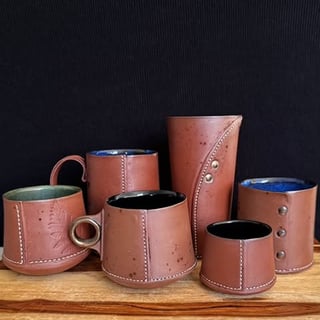
Speaker: Awesome advice. So let's talk about your pottery. In one sentence, can you tell me what you make? I make wheel thrown functional pottery using cone six porcelain. And it's adorned with hand drawn imagery repeating all across the surfaces. And there's always a colored handle. So tell me a story how you started making this pottery.
Speaker: So it's been a long journey because back when I was at River Falls, I was working with like cone 10 porcelains and stoneware and a lot of atmospheric firings. And so once I graduated, I didn't have as much access to those kilns.
Speaker: And so it was a huge shift. I even started working with earthenware a little bit, but I didn't really feel like that medium worked well for what I was trying to do. And then I started exploring cone six porcelain, especially in my residency at the steel yard. And so once I decided to just take a break from wood and salt firings and soda firings, which
Speaker: I still do on occasion, more for just fun, but I decided to really just hone in into this one medium and to try and do it well. And so that's when I, when I just kind of created that rule for myself, like just use cone six porcelain, use the electric firings.
Speaker: and utilize this inlay technique. I started getting more focused onto the surface decoration because it's so easy to get distracted by everything that you want to do in pottery because there's so much you can do. You can focus on different glazes. You can do highly decorated pots. There's so many different clays you can do and firing methods. So once I kind of decided to focus on one, I feel like
Speaker: everything really opened up for me. That is really powerful. Shaping Nation, if you could focus on just one thing at a time, then you're going to go miles ahead of somebody that is focusing on like 10 different things all at once. So try to narrow down your focus on what you're trying to make with your pottery. So something I found interesting from your website is you said, my work invites people to build connections and celebrate the objects and themes that reflect their loves and identities. Can you explain this to me some more?
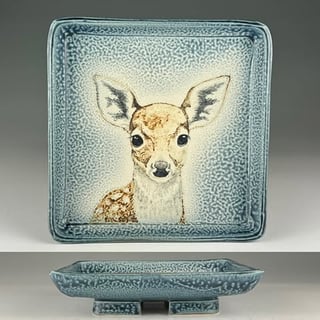
Speaker: Sure. So it started with birds often because I would get so excited when I saw a bluebird in my backyard and I wanted to honor these birds and kind of reflect my love of bird watching and connect with other people who love watching birds.
Speaker: And so once I did the bluebirds, I started doing dark eyed junkos and goldfinches and robins and chickadees and just getting excited about all of these different birds that I see in my backyard or nearby. And it's kind of a way to honor these birds onto the surface of the pots and
Speaker: that kind of reflects my own love of bird watching. Or it could reflect someone who buys my mug and loves bluebirds. It could reflect their love of bird watching or bluebirds. And there's often a lot of meaning that we have for birds as well. Some people really love my robin mugs because they know someone who loves robins or they know someone named robin. And so that can also build kind of a connection as well.
Speaker: And I'll also, you know, do things not bird themed, like I'll do donuts and strawberries, pancakes, kind of reflect some of my favorite foods, especially when I was pregnant. I tend to do a lot of my food cravings, which is donuts and strawberries for sure.
Speaker: Then I've also been kind of exploring more local landmarks. I currently live in New England, and so I am exploring some lighthouses, humpback whales, schooners, just kind of local imagery. You wouldn't find this imagery in, let's say, the southwest, but it is very New England. And so people in the area would really identify with these images as well.
Speaker: I love that so much. So can you share with me how you create your illustrations onto your potter? Sure. So everything starts out hand drawn. It depends on the pattern. Sometimes I'll draw it freely onto the pot. Sometimes I'll draw it on my iPad and print it out on the computer. I'll do that more for birds or for anything that requires a lot of detail or to make sure I get the proportions correct.
Speaker: Then I'll print it out on paper and then trace that onto my pots and then go over my drawing with an exacto knife. So everything is carved by hand with an exacto knife and then once it's bone dry I'll inlay some underglaze in it and then wipe it away and then that creates my imagery on there.
Speaker: And then I always like to have, especially with my bird themes, something else that goes with my pots. Like the red wing blackbird would have some cattails with it. And I'm currently working on a Baltimore Oreo design. And so that's going to have oranges with it. And the handle color of the Oreo.
Speaker: is orange, so to kind of tie the whole thing together. So trying to think of all these little pieces that can make one pot and celebrate this overall theme. I love that. So what does the process look like when you're coming up with new illustrations?
Speaker: First, I kind of start with kind of what's going on in my life or like what I'm excited about. For instance, when I was pregnant, I really was excited about drawing the food cravings. And so I'll also do like what birds do I currently see or any landmarks nearby or anything that's really exciting me in my current life. Like I'm definitely going to expand some more Dungeons and Dragons themes once I kind of work out some of the design.
Speaker: And then I'll draw it out of my sketchbook. I'll kind of map out what a pattern might look like. And then I'll take that and add it to my pot. I love that. Let's talk about discovering your voice. Outside of the residency you attended, you also contribute your growth as an artist to becoming a mom. How did this help you with your growth?
Speaker: Sure. So after the residency, I moved into the Nicholson File artist community. And there's a lot of artists there that have actually been involved at the Steel Yard. Some of my mentors like Dave Allen, he helped build the Steel Yard to what it was today. And so he has been in my current studio for a very long time and
Speaker: He's great to ask questions with, bounce ideas with, and he's taught me a lot of techniques as well. So having this community of artists has been really important to me.
Speaker: love just kind of like going in the studio and then seeing who's all here and connecting with other people and seeing what other people are up to and like all their different projects. And so I had that at the residency and having even some of the residents I was working with are even in my studio currently. And it just feels like a continuation of that.
Speaker: And I also found that recently being a mom has been very inspiring and helping me find my voice. I actually think my work has gotten better since I've gotten pregnant and had a baby. And I think that also kind of keeps me going as well.
Speaker: because I kind of just want to like show up every day. Like I'm a full -time potter, but I also care for my baby. So it's like I have to keep making pots and that also helps put food on the table, helps buy her diapers. And so having that pressure is really actually good for me to keep me going and to keep coming up with new ideas. And so
Speaker: So yeah, I think that's kind of like how this is all kind of going. I love that shape nation. Sometimes you need a little bit of pressure to help you create new and better things. Maybe it's your family, maybe it's bills you have to pay, whatever it is, you need that pressure to help you continue to grow your pottery. I love that so much. What would you say was your biggest obstacle when it came to finding your voice? Oh, the big one.
Speaker: So I think I was always so focused on what I should say. There's always like so much pressure to find your voice and you're so focused on finding your voice that you never really do find your voice. You're so focused on the macro, the big picture. And I never really knew what I wanted to say. I guess it's easy to focus on the macro if you know what you want to say, and then you can find the tools and materials
Speaker: and processes to help you. But if you don't know what you're trying to say with your pots and you don't know like why you're doing what you're doing, it can be hard to start with that big picture. So then I shifted focus instead just focusing on the processes that I like.
Speaker: and the techniques I like. So I was always struggling to make consistent work that I enjoyed doing because I could make a good pot, but maybe I just wasn't really into the process. Like I've even dabbled into hand building exclusively. Right now I love making pots in the wheel, but I decided to take a break from the wheel and just try out hand building. But I found I wasn't happy making that even if some of the pots were
Speaker: turning out pretty nice. I wasn't getting excited about going into the studio. I didn't really want to keep going with it. But then I told myself, well, I hand build now. And so it's like, why do I need to set these rules for myself trying to find my voice as a hand builder?
Speaker: So then when I started, you know, working with porcelain and going back to the wheel and discovering the types of forms I like to throw, I don't really like trimming that much. So I don't make pots that need to be trimmed anymore. I appreciate pots that have been trimmed and that have nice trimmed feet.
Speaker: But it's kind of nice to depreciate that onto someone else's pot. I don't need to make those pots with delicate feet or anything because I don't want to trim. So then once I kind of released myself from those rules of like, oh, you need to make a pot with these proportions and a trimmed foot, and instead just being like, well,
Speaker: I like to throw a certain way and I like to make these forms. It kind of felt liberating. And I realized that your voice is essentially just the techniques and tools you like to use. So the glazes you like to use. If you don't like to glaze, you don't have to glaze.
Speaker: If you want to make functional pottery, you know, you might need to like glaze the inside, you know, like, but then just pick one color, do the bare minimum, you know. And so I just do like a simple liner glaze and then a simple clear because I don't really like to focus on all these wonderful, beautiful glazes that I see.
Speaker: I think I can appreciate them. I don't like mixing and testing glazes. So it's like I'm just going to stick with the clear and focus on the surface decoration. I love to draw. So I'm going to draw on my pots.
Speaker: And once I just started doing all the techniques and using all the materials that I like to do, then I think that's how my voice started emerging. I started with the micro and then that macro started emerging into, you know, illustrative pottery. And that is kind of how I found my voice.
Speaker: I love that so much. Shaping Nation, focus on the processes that you like to do. Maybe you like wheel throwing, then continue wheel throwing. If you like hand building, continue hand building. If you like to draw, add that to your pottery. Just add the things that you enjoy with the process and add that to your pottery. And that's where your voice truly starts to shine. I love that so much. What is the best piece of advice you received that helped you discover your own voice?
Speaker: I think that I had really good advice from my professor. He pretty much just told me to keep making. He said that he was blessed with the desire to constantly make. And I've had
Speaker: some really good advice where he's like, how can you sell pots if you don't have any pots to make? Because there was a time where I didn't make as much as I did now. And he was like, well,
Speaker: you should make, just keep at it, like find something every day and just keep going with it. And he also really encouraged me to explore other mediums. He was a very strong advocate at the time.
Speaker: of different mediums. He also taught drawing classes at the time and ceramics and so I was able to take both classes from him and yeah he like would experiment with gunpowder drawings and just like that constant experimentation and just the process of making was very much stressed on me and even there were times where I didn't have a studio I still drew or I still thought about pots and I think that was very helpful advice just to keep me going.
Speaker: I love that advice. So something I believe that is part of finding your voice is also learning to sell your pottery. What is something people can do to help them start selling their pottery? I agree. There was a time where I was so focused on trying to make work that would sell that it was hard to find my voice. So instead, I think you need to focus first on the work that you like to do and then price that accordingly.
Speaker: And I found that it's hard to think that markets can support a certain type of pot or a certain price point, but it's like you can always find that market. You don't have to make a certain type of pottery to fit a market, like make the pottery that comes from you and then find the markets for that. And then I also think that you really need to factor in your labor, your materials, your overhead.
Speaker: and all that into the price of your pottery. It's not just, oh, this is a pound of clay and this is the time I made it. But you need to factor in like, what's your studio costs? What are the recurring costs? And kind of make sure that you can cover all those with your pottery sales as well. And if you sell to galleries, you need to make sure
Speaker: that those costs are covered when you get that check back because oftentimes 50 % is taken from galleries. You need to make sure that 50 % can support you and never undercut the galleries too. Don't sell to a gallery two times the price that you would sell on your website because that doesn't really foster a good gallery relationship.
Speaker: So whatever you sell at a gallery, that is your price. And just make sure that price can sustain you. I love that advice so much. So as we're coming to a close here, what is one thing you want to hammer home with my audience today?
Speaker: keep going. There is going to be times where maybe you don't want to work and you're not feeling inspired and you feel like no progress is being made, but progress isn't just like a linear, linear like focus. It can be, it can go up, it can go down, but it's still progress and
Speaker: So practice and repetition just really help you find your voice. Go to the studio, make repeating objects that can really help you. When you see 20 of one idea executed, you'll see all the very varying details between each piece. And then that can kind of help you discover what you love about your piece.
Speaker: And if there's a time where you aren't able to make a pot or you don't have access to a kiln or a studio or anything, just keep making even in other mediums. If you take a break from clay for whatever reason, other mediums can be inspiring for helping your voice and your path as an artist in a potter because
Speaker: Like I said, I love to draw and I kept drawing and those have merged onto my pots. And I think it can be a really good thing to work with other mediums and to keep going. That was some excellent parting words of advice. Bree, it was so great sharing with you today. Where can my audience go and learn more about you?
Speaker: You can find me on Instagram at Brie Larson Art, all one word. And you can also go to my website, BrieLarson .com as well. I'm also on Facebook at Brie Larson Art as well, if you use Facebook.