Transcript
Speaker: I feel like it actually, it like really helps me thrive in what I make because I don't feel this need, I don't feel this need to try to change the style of my choices or the style of my pottery in order to fit, you know, better fit the ocean. What is up Shaper Nation, this is Nick Torres here. And on this episode of Shaping Your Pottery, I got to interview Annika Ray. Annika makes some really incredible ocean themed pottery.
Speaker: In this episode, you will learn how Annika makes her awesome ocean themed handles. You also learn about using imposter syndrome to your advantage to make some awesome, incredible pottery. And finally, also learn about why you should be evolving as a person to help grow your own pottery as well. And there's so much more in this episode. I hope you guys enjoy it. I'll see you guys in there.
Speaker: If you love pottery and want to take your skills to the next level, you're in the right place. Find your own pottery style right here on Shaping Your Pottery with Nick Torres. Let's get started. Annika, welcome to Shaping Your Pottery and share with me what is something you love besides making pottery.
Speaker: Yeah, thanks, Nick. Well, I was a high school English teacher for several years. That was actually how I got into pottery, which I'm sure we'll talk about more later. But I obviously love to read, so I'm constantly listening to audiobooks while I'm throwing or working in the studio.
Speaker: I of course love creating even just beyond pottery. I was the kid for years who went through phase after phase of crafts. So yeah, I just, I love learning new skills and creating things. And, um, I love baking. My studio's Kiln Tech is a huge fan of that hobby. He is the benefactor of many attempts.
Speaker: Yeah, I love my family, my little puppy, Ru. I was in the background, but I'm working hard to turn him into a studio dog. And then as you'll see in my pottery, I love the ocean. I love being anywhere near the water. Yeah, which is definitely reflected in some of my pieces. So I could keep going, but those are my, those are my top. For sure. Absolutely love it. So tell me the story, how you started making pottery.
Speaker: Oh gosh, well, I technically started in high school with a hand -building class. It was one of my art credits, which I loved, but, you know, I was 15 and just like wanted to hang out with the cool art teacher mostly, with all my fun friends.
Speaker: without having to say, you know, any hard call. I also took a course in college, funnily enough, as another, as my final art credit. I didn't actually fall in love or grow this passion for pottery until COVID. And like I said, I was teaching high school English and my students at the time weren't required to have their cameras on.
Speaker: So I was literally all day just talking to black screens and like little, you know, like anime character, you know, the like little logos that pop up on their things. It was like, Spongebob's and anime characters and that was it like all day and almost none of them responded like 90 % of the time. So I like a lot I think of people during COVID.
Speaker: You know, my mental health completely plummeted. I felt like I was starting to lose my sanity talking to a black screen all day. And I was just kind of desperate for some in -person, like, human interaction. And so I did a bunch of research on local art classes in the pottery studio that I'm actually still at to this day and had decided to stay open and move a bunch of their wheels out into their parking lot. So they had all their wheels, like, fully spread out across the lot.
Speaker: And everyone was still masked up and whatnot, but they were open and I just jumped at the chance to like have some non -screen time, real humans. And I just found it was, it just kind of turned into like an art therapy for me. I just totally fell in love with it. And that was definitely when it stuck, like getting on the wheel properly and having kind of like the tactile piece of art therapy just was really, really good. So I've been two and a half years and it's,
Speaker: Here we are. So yeah. Absolutely love it. So what would you say has been your biggest obstacle along the pottery journey?
Speaker: Ooh, I always will say time. Um, you know, I still work full time, so I'm still balancing pottery as this sort of like side passion hustle. And, you know, of course I want to just spend all my spare time in the studio, but I'm at a communal studio, which in LA, I live in Los Angeles, so can take anywhere from like
Speaker: you know, 10 minutes to a half hour of the time of day. And so it's just difficult, you know, when you don't have your own space and time to just like, you know, do it in your backyard or whatever, like some people can. It's just hard, it's hard to balance all of it. And, and that's definitely been the biggest obstacle, I think, is just getting, getting into the studio is always the biggest obstacle. So what is something you are doing to help you manage your time a little bit better?
Speaker: Yeah, that's a great question. I think it's dependent. My work that I do now, I took a break from teaching this year, I'm grant writing and it's really cyclical. So I've just kind of like any time that I have any downtime or have finished a submitted something or I'm not in the throes of like them being in the middle of a project, I am like using all my spare time to get to the studio.
Speaker: Yeah, I think that's just part of life, right? Like finding the weird balance of like, how do I move my body on a regular basis and not just like sit hunched over a wheel and over a computer. And I'm definitely still, I think as rhythms and life pieces change, there's always, I'm always trying to find a healthier version of my life. And we just got a puppy and he's, you know, wasn't vaccinated for a long time. So we were kind of landlocked anyway, but I don't know if I have a good answer to that. I feel like I'm just kind of,
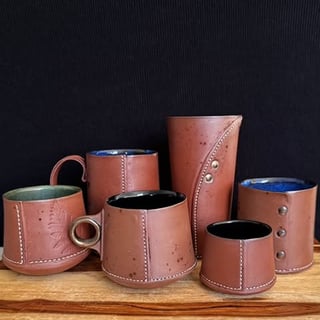
Speaker: doing the best I can or thought I have whenever we have it, right? Like taking advantage of whatever time I can find. Absolutely love it. So let's talk about your pottery. In one sentence, can you tell me what you make? Ooh, in one sentence. I typically make ocean -inspired pottery that is, I guess I would describe as like simple yet special. So like beautiful, but still like simple and practical and functional.
Speaker: I love it. Tell me a story how you started making this ocean inspired pottery.
Speaker: Yeah, you know, funnily enough, I feel like I kind of stumbled into my style because of my mom. My mom is a swimmer. She's been swimming her whole life. And so she swims with this group of gals that call themselves the mermaids. And she asked if I would be up for making a mug with like some type of mermaid tail on it. And so I brainstormed for a while and ended up with like what is now one of my most sold pieces, which is basically a mug with the handle that has been turned into like a mermaid tail.
Speaker: So yeah, I loved it. I had so much fun with it and trying it out. And so that was kind of like the entry into all of these other pieces that I now make. But that was kind of how I got started. And I love the ocean part of it is just I love the ocean. So any excuse to make something ocean related, I took her up on. I love that. So you are inspired by the ocean, as you just mentioned, how does this impact the way you make your pottery?
Speaker: Well, I will say first and foremost, you know, trying to pull inspiration from nature gives me the absolute worst of bluster syndrome. The ocean is so magical and beautiful and big and mysterious and there is just no way to ever recreate anything with a proper sense of accomplishment.
Speaker: So I think that's part of why my work is very intentionally pared down. It's like very pared down versions or renditions of things. I'm just not really willing to compete with nature fully. You know, just kind of allude to or show inspiration from nature. So I think it definitely impacts my style and stylistic choices for sure. Know myself well enough to know that my skill set is not realism with sculpting.
Speaker: And I also know like as much as I, I wish that this was my skill set. I'm, I'm just not a great illustrator or like.
Speaker: you know, grade at like facial features or whatever. Like there's a lot of really amazing potters with these really sweet, like kind of cartoonish illustrative pieces. And I just know that that's not me as well. So I kind of landed somewhere else on the spectrum of work. And I think I kind of found myself in my work that way. And just figuring out what was like in my, in my skill set, something that I enjoyed doing and yeah.
Speaker: So you mentioned that you were feeling a little bit of imposter syndrome from trying to take inspiration from nature. Can you tell me more about this?
Speaker: Yeah, you know, nature on its own can stay on the test of beauty. And so like there's no, even if I was a, you know, had, sorry, even if I had the set of, you know, realism or being able to like fully sculpt all of these incredible, you know, whales or, or whatever, there's just no way to do it. Even if I was, you know, one of the most talented sculptors, I mean, there's, it's,
Speaker: The ocean, there's so many just beasts and beautiful things. I grew up on the ocean. When you look at stuff, there's huge blue whales all the way down to tiny, tiny, tiny little barnacles. I don't say necessarily imposter syndrome as a negative, just as
Speaker: I didn't make any of those things originally. It's just really hard to recreate in a great way, in a way that is awe -inspiring. I don't even want to try to teach the hell with the 10 -yard stick. I want it to be something that I said alludes to its beauty, but isn't trying to recreate by any means. If that makes sense.
Speaker: Yeah, so what are you doing to help you overcome this imposter syndrome a little bit?
Speaker: I don't know if I necessarily see it for myself as something to overcome. I think there's definitely other forms of imposter syndrome as a potter that I am still permanently working on overcoming with just skills building or ever else. But with this specifically, I feel like it actually, it really helps me thrive in what I make because I don't feel this need
Speaker: I don't feel this need to try to change the style of my choices or the style of my pottery in order to fit, you know, better fit the ocean. Like, my pieces aren't going to go down and live in there. So, yeah, I definitely think with other forms of imposter syndrome, I'm working through a lot. But with that one specifically, like, I'm going to keep that one. I think, again, let it push me to kind of stay within my style choice.
Speaker: I love that shaping nation. It's okay to have imposter syndrome and you will probably have imposter syndrome. You can also use that imposter syndrome to make better work. I love that so much. So something I love about your pottery is your handles as you kind of hinted at earlier and how you make them look like ocean animals. Can you tell me the story how you started making your handles like this?
Speaker: Yeah, like I said, it was actually my mom who had asked for a mermaid on a mug and I kind of just played around with this idea. Like, how do I want to add that in there? Where does that even go on a mug and like have it look good? And so I ended up with the idea of turning the tail into the handle and I ended up loving it. She loved it. Her friends loved it. And so it kind of stuck.
Speaker: And so I've kind of been playing with that idea ever since in various forms. I started with mermaids and went into several whale variations. Recently been exploring like octopus tentacles as handles. For Halloween I did bats, that sort of thing. I think part of it is the ability to keep the simplicity of something like I mentioned before. I mean, you have to have a handle on a mug for it to be a mug.
Speaker: And so turning that functional piece or functional part of the piece into the creativity as well has really helped me kind of balance the simple yet special aspect of where I feel like my thrive. Yeah. So can you give me a simplified explanation on how you create your handles onto your pottery?
Speaker: Ooh, yes, they are different for whatever it is. I started with whales and mermaids specifically. I like kind of drew out my shape. I cut it out into like a thick cardstock and I actually just roll slabs and cut them out and then sculpt on them. I pull on my other handle and those ones I did not.
Speaker: or I do a very kind of similar process where I like cut out my original shape and then sculpt onto it with like the bat wings that I did this season for the octopus handles that I make they are fully pulled but they're just pulled to be like more circular of a handle and obviously I make several of them per piece those just get you know added on like a typical handle kind of
Speaker: wonky and then I go in and sculpt on again, go in and sculpt on top of them with all the little tentacles and stuff. But yeah, I don't know if that answers your question. I basically just kind of start with an idea in my head, either cut it or pull it out. And then yeah, I make
Speaker: I am not a potter who I'm sure people out there are cringing, but I almost never draw anything out. One, because I'm not a great drawer. And it never looks anything like what's in my head or what ends up on the pots. And so I just have kind of...
Speaker: Given up on that and I just typically be like a couple testers out the gate with different ways that I You know kind of see it in my mind see which one works evaluate test them all and glaze them all a little bit differently and then kind of find what What I like from from the set and then I kind of start trying to repeat or recreate off of that but yeah, they're all a little bit different in terms of process, but I guess the basic
Speaker: outline would be like IDA cut or pull and then I sculpt on top of them all. Absolutely. And I definitely agree with you on the not drawing part because I hate drawing for that stuff. It's like a four year old. Yeah, exactly. I'm like, we would save time here if I suffer right now and trial and error as I go. So definitely great. So let's talk about discovering your voice. Can you tell me about the moment when you knew you were heading in the right direction with your pottery?
Speaker: You know, I know this is the whole point of your pottery, but I still don't know. But it's true. You know, one of the pieces that kind of started me down this entire path was, like I said, the mermaid -handled mugs. And now I look at those pieces and I cringe. Truly, I think if I ever revisit those mugs, they are going to have to be like pretty drastically revamped or improved because I'm just not happy with them anymore. But even knowing that, I know that that piece
Speaker: brought me in the right direction because it's opened my mind to all of these other pieces that are now
Speaker: sort of like riff offs of that piece, if you will. And I'm ever grateful for it. I think it was still something in the right direction. But I think part of, I guess part of discovering one's voice that is so challenging is that people are constantly evolving, right? I feel like what's a really accurate and representative of me right now might not be tomorrow or in six months or in six years.
Speaker: That's okay. So I don't know if I necessarily have a great answer to this other than like finding your voice in art. I think especially when you're selling arts is finding this like kind of weird yucky balance of doing something that you love and are passionate about and are really proud of and creating something that sells. Which like a lot of people don't want to talk about, but it's true, right? As that's what you're trying to eventually, you know, if you're trying to do pottery full time, there has to be this kind of balance of
Speaker: you know, of both. And so I still feel like I'm finding that this weird balance of there are pieces that I absolutely love that never sell and there are pieces I debate even listing that are like sometimes the very first thing that sells out. And so, you know, I think
Speaker: I don't ever want outside to be my compass necessarily, but I also think typically I know I'm headed in the right direction when I love, love, love making a piece and when I love how it turns out. So I not only love the outcome, but enjoy the process. And that was part of, like I mentioned before, the mermaid thing. I don't know if I'll ever go back to it because I just didn't like making them. They turned out really cool and I was really happy with how they turned out.
Speaker: The process of them for me was just not worth it. And there's other pieces, like the octopus mugs that I'm doing right now is a great example where I love how they turned out and they're therapeutic for me to sit there and make them. I absolutely love, love, love making them.
Speaker: Yeah, I think I don't sometimes know if I'm headed in the right direction while I'm doing it until later when I'm reproducing them. And I think, oh yeah, I really love these or I really love doing this. And so, yeah, I think there's just kind of this weird triangulation of like all of those things put together, right? Am I proud of it? Do I love it? Do I enjoy doing it? And are other people gonna on some extent or in some way connect with it or love it as well?
Speaker: Absolutely great shape nation. Your pottery will evolve, whether it's from the first time you started making something, you thought it was really cool. And six months down the road, it may be something different, but your pottery will evolve. And if as long as you keep making what you love to make, then that's what really matters. I love that so much. So what is something you are doing to evolve your voice even further?
Speaker: I think, yeah, attacking onto what I said already, evolving as my own person and self. I feel like, you know, I'm still in, I'm barely still in, but I'm still in my 20s. And I just feel like there are seasons where I wake up, you know, like a different version of myself, you know, every week or whatever. I feel like I'm still a little bit of the toddler.
Speaker: changes their mind about what they want to be when they grow up. And I think your art reflects that. I think that as I continue growing and knowing myself deeper and continue to know who I am and who I want to be and who I'm becoming, it's deepening my relationship with myself and landing closer and closer every day. To that lands me closer and closer every day, I think, to my artistic voice.
Speaker: Because no matter what you do, your art is always an overflow of who you are, right? And so I think, like I said previously, I describe myself as simple yet special, or my piece is that way, and I would describe myself that way as well.
Speaker: I think my art is really representative of who I am, like practical and functional and also a little bit cute and special. And so I feel like as I know myself better, that's how my pottery voice has evolved as well. I absolutely love that. So as we are coming to a close here today, what is one thing you want to hammer home with my audience?
Speaker: You know, I guess back to imposter syndrome, there's nothing necessarily that I feel like I need to hammer home because I do kind of feel like as artists giving out advice and information when I'm still such a amateur and figuring out who I am and my voice, it's easy to feel out of my league with everything that we've talked about, but I would say, or for myself, I guess, than anyone really, the beauty in art
Speaker: of pottery is that your art will feel authentic to somebody in a way that no other style or type of art wants or can't.
Speaker: Because I'm still at a communal studio, I'm surrounded by these people throwing these epic five foot tall vases or pepper on the wheel. And I have to walk by Miss Ceramics every day in her corner who makes these phenomenal, incredible sculptures and animals and houses and all of these just epic pieces.
Speaker: Like oh my gosh, these people are like I this is like I feel so out of my league, right? And I just have to constantly remind myself that like what they're doing is is authentic to them like it matches exactly who I know them to be and even if I woke up tomorrow with their skill sets like those pieces would not be authentic to who I am and so I
Speaker: I guess what I'm trying to say, I'm saying to myself and whoever is listening, you can deeply, deeply appreciate other people's talents and gifts without disqualifying yours and without having to create those pieces to be gifted or whatever. So just knowing and learning your own self and what is authentic to you is super, super helpful. And I think what we're talking about earlier, the more negative side of imposter syndrome, I think,
Speaker: That's kind of where I've found my safe space for creating. So that would be it, I think, to myself. Some excellent parting words of advice. Annika, it was a really great challenge today. Where can my artist go and learn more about you?
Speaker: Yeah, my Instagram is at onyraecreates, it's ony, like my first part of my name, A -N -N -I, and my A store is the same, it's at onyraecreates on Etsy, and that gets updated every, you know, every job probably every month and a half or so. But yeah, those are my two spots now. I am not on TikTok or any of the other, you know, other posts these days, but working on it may be some
Speaker: Hey, thanks for listening to this episode of Shaping Your Pottery with Nick Torres. If you want to discover how close you are to actually discovering your own unique voice with your pottery, I put together a free four question quiz. It's very short. It takes 30 seconds for you to take. If you want to know how close you are to finding your own unique voice, go to shapingyourpottery .com forward slash quiz or you could simply go to shapingyourpottery .com and it'll be right there at the top.
Speaker: I hope you guys enjoyed this episode and I'll see you guys next time.