Transcript
Speaker: If you love pottery and want to take your skills to the next level, you're in the right place. Find your own pottery style right here on Shaping Your Pottery with Nick Torres. Let's get started.
Speaker: What is up, Shaping Nation? This is Nick Torres here, and on this episode of Shaping and Pottery, I gotta interview Steven Phillips. Steven makes some really incredible pottery that he took a lot of time to discover his own style. In this episode, you will learn how Steven makes, combined three different cultures, made it into one to find his voice. You will also learn about putting your own personality into your pottery. And finally, you'll learn about learning how to fix your pots
Speaker: if you mess up so you can continue to evolve your voice even further. I'll see you guys in there. Steven, welcome to Shaping Your Pottery and share with me what is something people might not know about you. Something that people might not know about me is the fact that when you look at my work, I am a BFA.
Speaker: student BFA graduate. Most people think that I have a master's degree, but I do not have a master's degree. I only have a BFA. So just put that out there. That is something most people don't know. And I guess to add to that, that I am a assistant worship leader at my church. Most people don't know that either, because I really don't post a lot of stuff with me singing.
Speaker: other than just me singing by myself at home or something, but not publicly singing like over the microphone. I was trying to get used to doing that, but yeah, that's something else. I'm sorry. Love it. Love it. So tell me a story how you got started with ceramics. So I always tell people when I do interviews and when I talk to people about ceramics, I always tell them the truth, which is I got started as a kid playing in the mud.
Speaker: like here where my studio is. I live in the countryside of Mississippi and there's a lot of dirt and stuff here. We even have like little clay deposits and stuff like in ditches and stuff like that. So I was one of those kids that kind of like grew up playing in the mud and stuff like that. So to me that's my start because I used to actually try to cook my stuff like fire it up like using because I used to be one of those bad kids that played in the fire. I don't know if you were like that or not but
Speaker: I was one of those kids who always wanted to play in the fire. I almost burnt the house down a few times, but that was me. So I used to actually try to actually cook my little stuff that I made out of.
Speaker: like the mud or whatever. So that's like for me, that's my start. But I actually didn't get into actual class or a ceramic class was until I got to junior college. I never had ceramics through, you know, elementary, middle school, high school, none of that. I took my first class in junior college in 2007. So yeah. So what made you take that first class in junior college?
Speaker: So it made me take that first class. I needed an elective. At that time, my major was computer science. And I wanted something fun to do. You know, I've done art all my life in high school, the real high school and stuff like that. So I was like, okay, I want to take a class. And then they had a pottery class, a clay class. And I was like, oh my God, you know, I used to play in the mud all the time.
Speaker: This is going to be interesting. Let's go see what I could do. And I was doing this stuff. I started off like little flowers and stuff, the stuff that I used to do as a kid, make it out of mud. Like so I was just like, yeah, this is pretty much close to home. And from there, my professor and my first teacher, Mr. Terry Cherry and my other teacher, Mrs. Lisa Spinks.
Speaker: It was just like, you're natural. You can really do this. And so I just started with hand building. That was my start with hand building. I didn't master the wheel at that time. It was a struggle to do the wheel. I actually still had the first piece I made from the wheel somewhere around here. But yeah, that was it. That was my first class. And that was the start for me is because I saw something that tied me to my childhood.
Speaker: love that. So shaping nation, there's something that you said that I love. So shaping nation, you don't always have to go and do the hardest thing right off the bat for pottery. You can start with the easiest thing or whatever is working for you. And that will help you grow your skills a little bit at a time. I love that you said that. So tell me about your time attending the Mississippi University for women and how this time helped you with growing your skills as your pottery skills. Okay, so that is
Speaker: when my pottery skills really took hold. My first professor was Al Holin and she would have us doing our kind of different techniques and stuff like that because I've already had like a lot of pottery classes. I came in under her like with pottery too, like clay too. And so that was like, you know, with the wheel, introducing the wheel and stuff like that. And like I said, I already had like a natural ability to manipulate clay
Speaker: But once I started the wheel and she showed me how to actually center and all that kind of stuff, it just took hold from there. Like, and I've learned, like we learned, like in junior college, I had to back up. We learned throwing on the wheel in junior college, but I
Speaker: struggle a little bit and so I shied away from using the wheel mostly in junior college. I used to just maybe one or two times here and there throughout the semester or whatever. I'm gonna say one or two times but maybe five times I guess but I tried it and every time it was failure so I was just like you know what I'm not gonna do again but once I got to MUW
Speaker: That is when I got under adholing and she really helped me like horn in on my gifts and ability to use the wheel as a tool to manipulate the clay. So yeah, like that was my start. And then like working under her, she had us, you know, you do all the cylinders, you know, you gotta be consistent with the cylinders. And then before you move on to the next stage, you start with cups. Then I think we did from cups, we went to bowls.
Speaker: And then we went from there to like, linen jars and handles and all the other extra stuff like that. And like, she would have like, different tasks set up for us to like, pretty much learn the skills and stuff. But yeah, she pulled me up to the side and she was like, you have a natural ability for this. And she also had me to research other African -American potters because it wasn't that many of us. And she wanted me to actually look to see.
Speaker: how many I combined and I did that, and she's like, you have the ability to stand out. And that was the first time somebody just really, you know, for speaking to me as it relates to my culture, my community, and pointing out and showing me that, you know, it's not that many of you actually doing this, so you have a natural ability and a gift to actually, you know, prosper and make it and be successful. But yeah, like being there, working under her, and then after I got under her, we had Professor Ian Childers,
Speaker: which is amazing guy with throwing like bottle forms and he does crystalline glazing, but his bottles and stuff like that was just so amazing. The semester before Al left, he came and did like a demo for us. And so like watching him create and throw, that was like my ultimate, like, I guess you could say my, my. Mitter or my goals was set to actually throw like him.
Speaker: to throw forms like him because that was my for me the eye candy was bottles for me like I love bottles like the nice curves and the shapes and I was just like oh my god like this dude is a beast like he is killing it I want to be just like him so yeah like being under him and he taught me more so discipline and consistency with you know throwing and stuff like that oh my god I used to hate like the cylinder projects and stuff like that because it's just
Speaker: You had to be so consistent with your cylinders. And like his whole thing was, you can make anything from a cylinder. And I was just like, oh my God, I'm hating cylinders. Like, can I just throw anything else? But like being under him taught me a lot of discipline. I tell everybody, he bullied me. You know, I joke around with that. But we play back and forth, like even when you go to like conferences and stuff like that. But like, he used to actually throw stuff in my pots. Like,
Speaker: I had to throw a nice big pot and all of a sudden, some flying across the room is just like, ooh, and it just slammed to the side of my pot. And then I'm just like, dude, you just put a whole little more pot and then he'll look at me and he'll fix it. So having that
Speaker: was the whole thing. I used to get upset about it, but what he was teaching me is about how to actually be able to fix your stuff. If you run into issues and stuff like that, you know, how to actually discipline yourself enough not to be so attached to your piece that you can't get in and actually try to fix it. So that, you know, having training like that, that was one of his training tactics for me. Like having that training like that just really
Speaker: changed my whole life because now I'm able to teach other people how to fix their pots. You know, I can go in a room and to workshop area and show other people, you know, this is how you fix it. If you're going to fix it, you know, this is how you patch it up, especially if it's something you're trying to save. If it's like that project and you really, really, really trying to save that piece, you know, that comes into hand trying to help you fix it. If you're in crunch time for finals,
Speaker: you know, saving the pot. I mean, every pot could be saved at some point. So yeah, that was that was just my whole thing with being there to W in my training and getting me into where I am now. So I love that. So there's a little off topic. But same thing kind of happened to me with like throwing people throwing stuff in my pots, except it was just kids doing it. And they were doing it just to kind of mess around. And
Speaker: And I remember I would get, there was one time I got so bad because he kept on doing this. I took a ball clay next to me and I literally threw it at him, but I missed by a mile because my hands was like all wet and he never threw it again. So I'm like, all right, he learned his lesson. That's funny. So let's talk about your pottery dough. In one sentence, can you tell me what you make? So in one sentence, what I make is
Speaker: What I love making is yellowy quality display pieces. So tell me the story, how you started making this party that you make today. So the way I got started back to Ian and I have to tell the story because like, for me, this is like the last conversation, the start of the conversation that pushed me to where I am now with my work. So I started out.
Speaker: I can make just about anything like my forms and stuff. I love linen jars. I love bottles and vases and stuff like that. And
Speaker: He pulled me to the side, like my senior year in college and he was just like, okay, so you can make just about anything. Like you can, you got good forms and stuff. You can make just about any form, but the forms you're making, anybody can make. So how do you take your work and make your work stand out and be your own? And so like, that was like one of the last conversations we had. And so he was just like,
Speaker: do some research, you know, play with some textures and different things like that. So I went down the whole little rabbit hole, trying to find myself and playing with textures, looking at different work. And I still kind of do stuff like that to this day, like looking at people work on Pinterest, Instagram, Facebook, whatever, Google, just looking at what everybody is creating. And so I started off with like matte colors versus gloss colors.
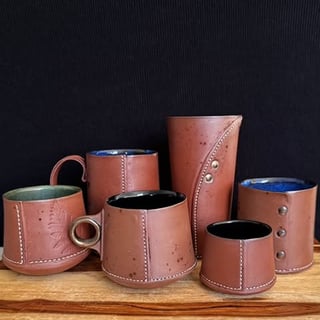
Speaker: and having that on a piece. And so I gravitated a lot towards Native American pottery, like the Black on Black Maria Martinez work. I love the Black on Black. I love the whole contrast with the things that the Native American pottery was displaying and showing on the surfaces. I did love African pottery as well, but it's just like the decoration treatment for the Native American pottery kind of stood out to me. It felt
Speaker: natural and home to me so I was just like okay let me play with that and so I started off with using different like slips and stuff to kind of create different textures and then that's just stuck with me like so once I got out of college it stuck with me and so then because I love the black on black
Speaker: I started off in my studio where I once had my studio in my bedroom. My mom let me throw in my bedroom. I had a tabletop Chippo Aspire wheel. So I used to throw in my bedroom on the little small wheel on my desk. And I started playing with underglazes. So the color contrast series actually for me started off in my bedroom and I had like this. What was it?
Speaker: Teal. It was the Teal Blue by Amaco. Amaco Teal Blue. I had that at the base and then I had some of this black slip I had, quote unquote, borrowed from the YouTube. I had, actually what I did was I poured some of the slip into like a Sprite bottle and I brought it home with me. So I borrowed
Speaker: never to return it back but to use from our own. I borrowed some of the black slip because the black slip we had was really really nice. I had like a nice finish and stuff so I started playing with that. And my bedroom put in all the little bottles and stuff and I do the the blue teal on the base and then I did the black slip on top trying to create little shapes like it was Native American pottery or whatever.
Speaker: And it turned out okay. It wasn't bad at all. And then I started exploring from there. And I know I'm going down like a long rabbit hole. But I started going from there. And so then I started because like the shapes and stuff that I wanted like to be really, really crisp. Like if you look at Native American pottery, they paint this stuff on by hand.
Speaker: But for me, I am not good with straight lines. So I was just like, how can I do this? I tried. Painters tape, painters tape didn't do what I needed to do. And then I finally discovered using electrical tape because electrical tape is flexible and it sticks to the surface. So I started doing that. Once I started doing the electrical tape, I was able to get clean lines and all that good stuff. But then I started falling into the underglaze pilling off.
Speaker: And so then I got into, OK, well, let me figure out how I can keep this underglaze on. And so then what I would do is I started bisque firing my work and then put the underglaze on that because the underglaze went on nice to the surface and very smoothly to the surface on the bisque where. And then I bisque fired again. And then I put the electrical tape on. And then that's how I discovered keeping the underglaze from chipping off or peeling off when I used the tape.
Speaker: and so pretty much yeah that's how I get into the work that I am doing now when it comes to my color contrast series because I wanted to create something based off that last conversation that I had with my professor is how will I treat the surface and that's when I got into the matte and the gloss colors on top of each other creating textures and creating like the visual
Speaker: visual texture I guess you could say from what I was creating and then like I have another series which is my Black Panther series. I stumbled into that a little bit just looking at different things online and I saw this piece on Pinterest and it was like this copper color and black and then I was like oh I like that so I'm gonna try that and so I end up
Speaker: trying it and then I had this gold wax that I got from somebody who gave me like this old pottery like glazes and underglazes and overglazes and I had this metallic wax that I used to create these gold lines and that's how I got it to create in the Black Panther series volume 2 and volume 1. Volume 1 actually for me was Nicky Red crew firing which I had this
Speaker: Raku alternative technique book that I saw some naked record pieces in and I wanted to try and I just bought some slip Instead of making my slip from scratch. I just bought some slip slip casting slip and put my pieces in and created naked record pieces and then I added the gold metallic wax to it and I think I posted it on my Facebook and like I had just seen that movie Black Panther 2 and Black Panther, you know by the first one. Yeah, and I
Speaker: I posted it, like I thought of, I was like, ooh, there's like something from Black Panther. And then I posted it and then like my family members and stuff and friends on Facebook was like, ooh, they look like something from Black Panther. And I was like, yeah, they was like, you shouldn't name it after the movie. And I was just like, no, I didn't want to do that. Because I was just like, I don't know what would be plagiarizing or anything. But I went on ahead and I did it. I was just like, OK, this is going to be Black Panther volume one. And then I created volume two, because like I said, I was on Pinterest looking at some stuff. And then I wanted to create some more pieces.
Speaker: based off of just like simple, but then having kind of like that African reference with like the motifs and stuff that I was creating and putting on the surface, but not really being literal with the decoration, but at least giving some kind of sense of African pottery and Native American pottery kind of combined together. So I try to at least
Speaker: combine the two structures together even so I like Asian pottery as well so the shapes and stuff like that I do kind of combine like all three of those together to kind of create my work and find my identity but yeah so that's how I got into creating my my work what I'm creating right now is pretty much based off of that last conversation I had with my professor and that sent me down the whole
Speaker: whole line of just trying to find myself, you know, with my creativity, looking into seeing what other people was creating, what other people were doing, and then trying to find myself to stand out from what everybody else was doing. And I think I did okay. I don't think I've seen anybody else pretty much doing what I'm doing. There are other people who work here, be compared to kind of similar, have some kind of similarities, but for where I am now, I think I'm okay with where I am because I feel like I have my own voice of my own.
Speaker: Signature to my work with both of the series that I work working. I think I have my own little thing going but yeah Love that so shaping nation. How can you combine? different cultures and Combine them into one to make your own potter your own culture with your pottery That's my question you so you could start really start thinking about these things. I love that so much Yeah, so can you give me a simplified explanation on how you create your pottery?
Speaker: Simplified explanation, I just get on the wheel and create. But yeah, that's pretty much what I do. I sketch out ideas. I do, do sketching. It's always good. And then for the most part, like I say, I will get on the wheel and I just throw. Like I get in, put my worship music on or whatever I'm planning to listen to for that day that kind of mellows me out. And then I go from there, like I create something
Speaker: just having this ideal in my head and then I create it and then I go back from creating that one piece and then I start sketching other designs based off of that one piece that I create and then just birthed more pieces from there. Love that, love that. So let's talk about discovering your voice. What was your biggest obstacle when it came to finding your voice? Like my biggest obstacle with finding my own voice was
Speaker: Just that, just finding my own voice. I guess the biggest obstacle was to make sure that I am not repeating something that is already out there. But it's hard to do that because everything you see has already been created. There's nothing new under the sun. But I think what really makes your work yours is your own personality, just being who you are, just being you.
Speaker: And I think that's the best thing that I tell anybody just be you create what you like creating and people will buy into what you create because of who you are and your enjoyment of doing that. So just just be yourself. Absolutely agree. 100 % add your own personality into work and that literally is becomes your voice. I love that so much. So what is one piece of advice that has helped you with discovering your voice?
Speaker: One piece of advice that helped me discover my voice, and I guess I could piggyback off the conversation I had with Al Holen, and that was that it wasn't many people like me. It wasn't many African -American people like me.
Speaker: And because of that, that helped me find my voice because I wanted to be that voice to stand out for other people who look like me to say, oh, that is possible for me to do. And so because of that, that is the thing that really helped me find my voice is to make sure that I am putting myself out there enough to be exposure for others who would like to participate in what I'm doing today. So what is something you are currently doing to evolve your voice even further?
Speaker: that I'm doing to kind of early evolve my voice more is so doing like work stuff and stuff like that being how one of the things that I do here in my community is they may have me to come in at the library and do like classes they have to have people sign up with classes like getting like home school students signed up going to different schools here like the elementary schools may call me to come in and do like presentations or
Speaker: little sections with the kids or you know just being out and about within the community to kind of give more like I say exposure. So that is one of the things that kind of helped me involved to take my voice to the next level or to move to the next place and that is making sure that I am constantly creating and I and I guess that's the best way to just say that to simplify
Speaker: you can never evolve if you are not in a place where you're constantly creating. There's no growth if you're not constantly creating. You cannot grow if you're not actually putting the work into place. So yeah. Absolutely agree. You have to put in those reps if you want to be able to grow. If you're going to be able to grow, you want to put in the reps. I mean, it's just like if you go to the gym, if you want to
Speaker: continue to grow your body into the structure that you want your body to be, then you have to put in the work on a constant, persistent base. So absolutely agree. Love that. Love the explanation at the end, too. So something that I believe that helps us with finding your voice is asking questions and asking the right questions will lead us to find our voice. What is something you would ask yourself as you were trying to find your voice that helped you?
Speaker: Am I pushing myself farther enough or giving my all to my creativity? What can I do?
Speaker: to take my work to the next level. I have more than one question because those are the questions that tie in together to help me get to where I am. What's the next thing? That's always like, what is next? What can I do next to take my work from where I am now to where I want to go? What's the next move? What's the next thing to do? What's the next collection to create?
Speaker: I love that. I love that because it's really pushing your work further just by asking that question. What can I do to make it look a little bit better? What can I do to make it look just that much better? I love that question. So as we're coming to a close here, what advice would you give to someone trying to discover their own unique voice with their pottery? For me, I'd say you do like I did. Like for me, be yourself.
Speaker: But there is nothing wrong with researching, seeing what's out there, checking out other people work, you know, and pulling, you can pull the nuggets from what you see other people doing. There's nothing wrong with, because we always, we're always borrowing from other people. Anyway, when it comes to creativity, you may do something with
Speaker: Black that I like and I might take that and say well I'm gonna do this take the little elements of that how you use the black But I'm gonna compare it to a green. You know I'm saying and so like Watching what other people are doing Taking the things that you like and then bringing it back and putting it to practice of what you want to actually create so just tell it about it look look what you see other people are doing and
Speaker: do some sketches or figure out what can you do to have your own voice to have something that's like it, but not just like there's, you know, just doing what you like doing. And then from that, because your personality and everything like that, you will end up finding yourself creating those pieces that are specifically towards who you are as a person. Absolutely agree. That is some very powerful last word advice. I love that.
Speaker: Steven, it was a really great challenge today. Where can my audience go and check you out and learn more about you? Well, I tell people all the time. I live on Instagram, as you know. I live on Instagram. Instagram is my home. It's my virtual place. So you can check me out on Instagram on SP House production. I do have a person on page two, which is Steven, S T E P H E N P.
Speaker: 12 that's my personal page now if you go to my personal page I'm gonna tell you now you're gonna see a whole bunch of stuff because I post a lot of like Cooking singing whatever I'm doing. It's just like my little personal page But my business page is SP house production and that is where you get all of my pottery So if you're gonna look for my pottery stuff, you can go go straight there. You'll have to worry about that
Speaker: All the extra stuff because I am a little extra sometimes. But yeah, you can go to that page or you can also find me at SP House Productions on Facebook as well. I think I do have I do have a page on Pinterest. I'm not as active on Pinterest, but I am Stephen Phillips on Pinterest and you can check out my website. My website is stevenspottershouseproduction .com.
Speaker: And it's just like you spell my whole company name, which is S -T -E -P -H -E -N with an S at the end of the Stevens Potter House Productions dot com.
Speaker: It will be in the show notes as well, so that's great. Thanks for listening to this episode of Shaping Your Pottery. If you are struggling with finding your own theme for your pottery so that you are known for something, I put together 53 themes that you can use and you can take. All you have to do is go to shapingyourpottery .com
Speaker: slash 53 themes, that's five, three themes to get these 53 themes. It's really important for you to find a theme for your pottery so that you're not gonna get burnt out. You can have multiple styles with your pottery and you can be known for something. So again, go to shapingyourpottery .com forward slash 53 themes, that's five, three themes to get these 53 themes. Thanks guys, I'll see you guys next time.