Transcript
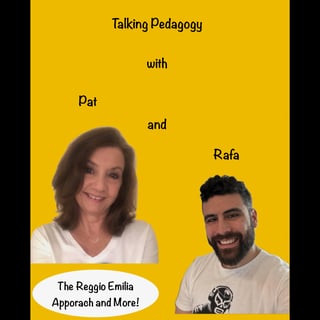
Rafael Perez-Segura: Hello, hello. Welcome to Talking Pedagogy with Pat and Rafa. I'm Rafa.
Pat Watkins : and I'm Pat. And Rafa, it seems like I just saw you just a few minutes ago.
Rafael Perez-Segura: We had our class last night at Bank Street College on theory to practice with the Reggio Emilia approach, which we really enjoy teaching. We've taught it for five years now, I think.
Pat Watkins : I think so.
Rafael Perez-Segura: Correct.
Pat Watkins : And what a great group we had last night. We always have great groups, but this was one of our larger groups. And it was just such an inspiring night of intense engagement around the beginning thinking of this approach.
Pat Watkins : And it was, I left feeling, you know, pretty inspired.
Rafael Perez-Segura: Yeah, me too. I'm also in Los Angeles right now, so it's earlier for me than normal, which is nice for me.
Rafael Perez-Segura: Maybe I should always be on the West Coast when we do the class.
Pat Watkins : That's a thought.
Rafael Perez-Segura: but But anyways, thinking of speaking of theory to practice, we were thinking of talking today about revisiting some of the basics, the tenets, going back to the the strong image of children.
Rafael Perez-Segura: And Amica Sita likes to talk about the strong image of humans, so we include the adults in that.
Pat Watkins : Yes.
Rafael Perez-Segura: And really thinking, talking through... theory to practice and then practice back to theory. And a big part of practice back to theory is telling stories about children and what it means to have a strong image or not a strong image and bring it back to who how it informs what we do in the future.
Rafael Perez-Segura: So Pat, I know had a, there was a story that was quite powerful that was shared last night by one of our students relating.
Pat Watkins : Yeah.
Pat Watkins : Yeah. Extremely powerful in connection.
Rafael Perez-Segura: Yeah. and yeah
Pat Watkins : Yeah. To the strong image of the child. And, it was told by, uh, a teacher who, remembered a time and when she was very young, only three years old.
Pat Watkins : where she was in her classroom and she had a straw and the straw had liquid in it. And she was very fixated on noticing how her movement of the finger being either at the top of the straw or taken away would impact the movement of the liquid in the straw. And she was trying to figure out all of the science behind what the liquid was doing in that straw and the pressure of her finger and taking it away. And it was time to clean up and she did not want to stop.
Pat Watkins : And the teacher became very upset and very punitive and actually took the straw and made the little girl while the other children were cleaning up, stand on a chair.
Pat Watkins : And that was her punishment. I don't know how long she had her stand on the chair. But this teacher was just recounting how this adult and her, obviously, image of the child, she didn't understand The deep thinking, critical thinking, the analysis of of properties and, you know, interest in the material.
Pat Watkins : She didn't think about this child's holding this child up for that type of thinking and celebrating that. And so Rafa and I were talking about it and this morning before starting the podcast and just how impactful that story was in connection to how adults, what their image of the child is. Do they have a strong image of children? Do they understand the complex thinking that young child children are capable of? And so that story really will always stick with me because in the Reggio Emilia approach, that could have looked so differently had the adult had that stronger image of the child and had the adult said, oh my goodness, even maybe ringing a little triangle bell in the classroom and saying, we have a moment.
Pat Watkins : Everyone come around. You know, there's an exploration here. Let's take a look at this. There's some mystery and we've got to figure it out. and celebrating that child.
Pat Watkins : It could have extended the learning for others. And so, yeah, that's what we were talking about. So I'm going to toss it back to you, Ryan. Ryan, I'm so sorry, Rafa.
Pat Watkins : I have two Ryans in my life right now and all the R's are getting confusing. And the other one is talking in the background. But anyway, so just, yeah, Rafa, what were your thoughts, further thoughts on that?
Rafael Perez-Segura: Well, I'll just first say that that reminds me of my my brother's Alejandro and my, or Alex, and my mom calls me Ralex all the time.
Rafael Perez-Segura: So I found it very endearing.
Pat Watkins : It happens. Thank you.
Rafael Perez-Segura: You know, that story just really struck me for a couple reasons. One is just the how much our actions can say about the image of children we have in any moment, right? That can change moment to moment.
Rafael Perez-Segura: And the the complexity, the question of complexity comes up to me of like, what were the conditions for the educator as well? Like how were they supported or not supported?
Pat Watkins : Absolutely.
Rafael Perez-Segura: Or maybe they were and they still were like that. that So I don't know. But centering the child really is really more fundamental here and recognizing that how much impact, what tells me how much impact I can have on a child for better or for worse.
Pat Watkins : Yeah.
Rafael Perez-Segura: And how I might forget things, but children often don't forget things or their bodies don't forget it, right? So it's just like such a strong example of being able to make explicit our images our stories of working with children is so important to start grappling with these realities not just within others but within ourselves i can tell you like i've definitely not held the strongest image of children in the past and i've grown from that and and it's still that those weaker images still live inside of me and so i always have to be
Rafael Perez-Segura: reflecting and and never stops is what I'm trying to get at. It never stops. The process never stops. One never arrives, I believe, to pure, strong image of a child forever.
Pat Watkins : Right.
Rafael Perez-Segura: It requires a lot of consistent cultivating, kind of like a garden, right? The garden inside each of us. So...
Pat Watkins : Yeah, I agree with you, Rafa. And I think that's why we always ask people like we did last night to walk around in their own childhood garden and remember what it was like to be a child. And to me, that's a big part of what we can all do is is stay in touch.
Pat Watkins : You know, so oftentimes adults in our busy lives, we are disconnected. it makes me think of the hundred languages when they talk about the poem by Malaguzzi, when he talks about separating the head from the heart or the hands, is that we've been separated from wonder and from joy, simple joy of learning. and and so and from We have this need to control a lot of our educational environments in certain ways that don't allow for a lot of that to happen. And so when we think back about your own image of remembering how you were as a child, it can really help inform you of what were those moments that you still remember and why do you remember them? Because probably they were magical because you didn't have the constraint of time in the same ways that we do now And, you know, I want to be honest, too, in saying that we understand that many teachers, especially those working in public school settings, do have a lot of
Pat Watkins : structures that they have to attend to in their their roles that they've agreed to do So we're not suggesting that, you know, you you have to let go of all of that. But what we're suggesting is when you have a strong image of the child, you start to look for it and create and curate those moments and to combat some of that pressure and that structured design of time and allow for some of the magic to happen.
Rafael Perez-Segura: Yeah, like having the cultivating or recultivating that disposition of curiosity the curiosity that lives by all of us about children and ourselves and what they're doing and why are they doing it.
Pat Watkins : Yes.
Rafael Perez-Segura: So it's not necessarily you don't hold limits, right, to when it's time to clean up, but there's a way to communicate limits. There's a way to, like, I think, Pat, you mentioned, like, ringing the triangle as being flexible with the flow, but still having a flow.
Rafael Perez-Segura: And that's just really difficult for a lot of us. I would say for largely large, largely because of a lot of how we've been conditioned, right?
Rafael Perez-Segura: And the time.
Pat Watkins : Right.
Rafael Perez-Segura: And so that's on honestly part of the reason this approach can be very challenging to understand, even in the context of the United States, at least, is that it requires a lot of space to calibrate and question our core assumptions about what's actually what are we actually doing here in this school? like What's the purpose of education? So big questions to tackle.
Pat Watkins : They are big questions to tackle. And I think, uh, That's what we we spend a lot of time in this class doing, but also it's what you and I spend a lot of time doing because, you know, this approach, which we hold so, you know, fondly and believe in so kind of so much with our spirits, is not available to so many children personally.
Pat Watkins : because of structures that keep it out and don't invite it in because they're too, the frameworks are too set and there's just no room for this type of teacher time to think, to collaborate, to plan.
Pat Watkins : And this requires this approach really requires a lot of that. And so how do we keep looking at our own system in America to figure out how we can bring some of these tenets into the classroom? And I think, yeah, having a strong image of the child is certainly always a good place to start. And that's something that we all can do is remember that children are so capable And that these early years, so much thinking is going on and so much of laying the groundwork for future learning. So how do we support that?
Pat Watkins : And having a strong image of the child is one way.
Rafael Perez-Segura: i want
Rafael Perez-Segura: absolutely i want to add, as you were a speaking, Pat, of how difficult it is to and structurally run out, the structures i get in the way of implementing the approach. I do want to shout out, there's a school Manhattan. I forget exactly where Manhattan, but the Chloe Day School.
Pat Watkins : m
Rafael Perez-Segura: And they are, i believe, a DOE school, funded school at least, that is really earnestly trying to to implement the Reggio Emilia approach.
Rafael Perez-Segura: with largely black and brown children. And so I just think it's really awesome mean to see that happening and to, yeah, for more people to experience this approach because it's it's so gate kept behind high tuition, very white, tend to be very white schools.
Pat Watkins : It is.
Pat Watkins : It does. And that is because i think of what we were just saying is that, well, the time for teachers to have community and critical thinking time is just not always, you know, it's not built into contracts. Right.
Pat Watkins : Or they have planning time, but how is that planning time used?
Rafael Perez-Segura: oh and yeah
Pat Watkins : And is it is it collaborative with other teachers? Or is it silo in your own classroom and just trying to get tasks done that you're just trying to catch up on that wheel?
Pat Watkins : And I think, yeah, that's what I've seen and noticed in a lot of the schools that I've been in.
Rafael Perez-Segura: The collaborate with other teachers part really big for me because yes, this relates to me about having a strong image of adults. like and of each other, right?
Pat Watkins : Mm-hmm.
Rafael Perez-Segura: Because if we have a strong image and we think it's worth talking to other people about what our children are doing, and we have the space to do that, not only are we deepening our practice, we're also deepening our relationships.
Rafael Perez-Segura: And I think that I come from a background where if we are deepening relationships, we can do even more thinking together, complex thinking.
Pat Watkins : Yes.
Pat Watkins : It also just enriches your, your, your whole world and time that you're spending on the planet is community. We know that humans need community and teachers we found in, especially through our class that we teach and also this cohort that we're doing now, that's free to people, which we'll talk about at the end, we'll invite you. But yeah,
Pat Watkins : Teachers need community. They need a place to think through things and to check themselves and to say, have I checked out? You know, am I not very inspired? What could inspire me within the system that I'm working in?
Pat Watkins : And what are some of the proactive things that I can do to change my circumstances? So, yeah, you you need support. Teachers need support. We all need support. But teachers, especially right now and in our country, have been having a lot of different things thrown at them from curriculum changes to DEI changing after having embraced that and been trained in how to bring more of that into their work. It's it's now being questioned. so it's just so many things, you know, that that teachers are having to hold.
Rafael Perez-Segura: And that reminds me to remind our listeners of the anti-fascist origins of the Reggio Emilia approach and us as a result, a strong image of children that we're trying to uphold.
Pat Watkins : Thank you.
Rafael Perez-Segura: And that is a form of countering oppressive narratives in schools and beyond. So this work goes, it's just it's just so deep, which I think is why partly why we both enjoy it so much.
Pat Watkins : Yeah.
Pat Watkins : Yes, I think so. But yeah, liberating children so they have more power from the very beginnings so that the things that they can create are limitless because they've been believed in and they've been taught how to believe in themselves and to have the courage to make things from nothing, which is what a lot of the art-based work is in the Reggio Emilia 100 languages.
Rafael Perez-Segura: We could do a whole episode on 100 languages and how that shows cognition. And there's a very provocative statement. I think it's provocative to an extent. I thought it a interesting statement I've been reading on so on some people's reflections after to coming back from Reggio Emilia that it's not really about art. It's really about thinking.
Pat Watkins : Uh-huh. Oh.
Rafael Perez-Segura: I'm sure you have. And i found I just found it very provocative. And I guess it's veering a little bit off of the tenet of the the strong image of children. But i that anyway, just want to say that I think we i i think that's it that's its own thing.
Rafael Perez-Segura: Obviously, though, if you have anything to say on it now, go
Pat Watkins : Oh, no. i think that, well, I mean, I think it's all so connected. And I think it is about thinking. And it's about believing in children to have the ability to problem solve. I mean, the the artistic endeavors and and projects and things that I saw when I was in Italy many years ago around the town that the children had done You had to be engaged in high-level thinking to to stay on task, to create these but pieces of art and these projects, the water fountains for birds, the the playground for birds. I mean, and this is something I think that in America, it's it's confusing a lot to educators, perhaps, maybe not all, but to some, is how the academics work.
Pat Watkins : are finding their way into all of this work and how Reggio Emilia inspired teachers are being trained to look for those moments and projects where math is being taught, where,
Pat Watkins : you know, literacy, science, sociology, where all of it is being taught. And I and i think that the a good project can teach all of those subjects.
Pat Watkins : And so... Teachers are being called upon in this approach to be so creative and to really be really thinking all the time about what are they going to bring in tomorrow that's connected to that thing that they saw the children interested in today.
Pat Watkins : That's one thing that I've been realizing too, is that sometimes books are not playing as much a part in sometimes the teacher's understanding of how to find invitations or to introduce ideas and thinking through, through really rich books for young children. And,
Pat Watkins : that that can lead into a whole a study itself, you know, the right book. So that's another thing that I've been noticing is that there's not as much reading, at least in some of the places I'm working, going on.
Rafael Perez-Segura: That's very interesting. Like I think of the academics and the literacies in so many different ways. Like there's definitely, i would say it requires a good amount of skill and background, not just in development, but in mathematics and literacy to, and it's all related, right?
Pat Watkins : Mm-hmm.
Pat Watkins : Right.
Rafael Perez-Segura: I'm talking about them separately, but they're all related to able to see to your point, Pat, the opportunities to extend. And that's why it can be challenging, but I believe that it's worth helping and getting educators to a place where they can do that because then all of a sudden you go from a lesson on the letters to letters are just everywhere.
Rafael Perez-Segura: Like it just and sounds are everywhere and a value of music and the connection to development of reading through, you know, phonological awareness, being able to hear sounds and play with sounds and which is necessary for being able to read letters, right?
Pat Watkins : right
Pat Watkins : Absolutely.
Rafael Perez-Segura: Or like the ability to pay attention to detail, like to letter F, let's say, different from the letter T. But where does that attention to detail come from? From when they were two, you're you're exposing children to more and questions and arts that require them to pay attention to detail.
Rafael Perez-Segura: The paint, the lines they're making, like it's all connected.
Pat Watkins : Absolutely.
Rafael Perez-Segura: But it's that's not obvious unless you know, right? we You know and have experience.
Pat Watkins : Well, Exactly. And that's where that planning with intentionality comes in. That I think a lot of times also teachers scratch their head when they're first being presented with this, you know, high level approach.
Pat Watkins : It is because they're, they're not sure what does it mean?
Rafael Perez-Segura: Thank you.
Pat Watkins : How am I supposed to be planning? And I think that what That's something that coaching helps with because you can really break it down. It isn't simple. And you do have to be trained.
Pat Watkins : And that training often is supposed to come from the community of learners that are all engaged in this work within your school. that internal training and that intentionality by the leader to make sure that the teachers and the adults are getting that time. So we started with the strong image of the child. And I think what we're now saying is it has to be a strong image of not only the child, but the adult and understanding the vision that you're going for.
Pat Watkins : Like,
Rafael Perez-Segura: yeahley Yeah, yeah, yeah. Keep going, sorry. was like, yeah.
Pat Watkins : No, no. That's all I was going to say is like, what image are you projecting overall of what you believe learning should be?
Pat Watkins : And how do you cultivate that in a school and how do you support it? And i go back to leadership is very important when being asked to, for a teacher to step into this approach. Because that time of grappling with some of these things together is just key.
Rafael Perez-Segura: Yeah, like this whole idea, i resonated, i felt it so much when you said that you know what you're like going for and know what you're going for in the sense, right, of not necessarily this is what I want it to look like, but know what i would and I wonder what you think, Pat, but for me, it's like, know what rhythm, look know what type of relationship you're going for, know what, you know, all those things that together we know will result in great outcomes eventually for our little ones.
Rafael Perez-Segura: But paradoxically, overemphasizing those outcomes is what the way of meeting those outcomes.
Pat Watkins : m
Rafael Perez-Segura: Yeah.
Pat Watkins : know Well, it certainly starts with relationships for sure.
Rafael Perez-Segura: Yeah.
Pat Watkins : Relationships to the children, relationships to their parents who we see as the other partner in the learning, honored partner in the learning. Relationships to your colleagues, relationships to the leadership and and the trust that you have to have in leadership to go and be vulnerable.
Rafael Perez-Segura: Thank you.
Pat Watkins : Like, I don't know what this what's going on with this project. I need some support. Come in. I need fresh eyes. So... Yeah. Yeah. It's.
Rafael Perez-Segura: Another aspect, we didn' and we're getting close to time, i guess, this is which is that of the strong image of children and adults is, I've been thinking about this in the context of the school I direct at the moment, Mi Casita, the importance of scaffolding just enough.
Pat Watkins : Yeah.
Rafael Perez-Segura: Scaffolding for the learning of children, but also scaffolding for the for developing educators, right? So the challenge of not taking away what can be difficult about a job, not taking away the doing the reflection to then act on and, but being with people through that and letting them miss, letting them fail, if you will, letting, letting the, knowing that offering the support, right.
Pat Watkins : Yes.
Rafael Perez-Segura: But also there's this, there's this saying in a relational cultural work I mix i work with, I'm probably not going to say totally correctly, but I think you'll get it.
Rafael Perez-Segura: The idea of like as much support as possible, no more than, than is necessary. Like both at same time, like it shouldn't, it's not a withdrawal of support, but like really caring, really supportive and like, you can do this.
Pat Watkins : Yeah. Right.
Pat Watkins : right
Rafael Perez-Segura: And, but
Pat Watkins : That dance is, yeah, we're going to make mistakes, right? Because sometimes you just don't get it just right. But having that lens that you're always looking through and stopping before rushing in say, wait a second, is it time for me to go in right now and help with this? Can I make more time to see if this child, struggle, is time for me to in right help with can can find their way through it. Is there another child that's also getting ready to support that child? Does it have, is it my job? And if it is my job, before I go in, let me be intentional about what I'm going to offer.
Pat Watkins : Yeah, I love that Rafa, your idea of of how important it is to when you have a strong image of children, to to believe that they can solve it, but that also support, that's what we're there for.
Rafael Perez-Segura: Yeah. right
Pat Watkins : We're their collaborators and we do have more life experience and we we can sometimes give them that next little missing piece that can help them then run. Yeah.
Rafael Perez-Segura: Absolutely.
Pat Watkins : Yeah.
Rafael Perez-Segura: i mean, often explicit teaching is great in those contexts when you have this big vision of like, oh, we're going to make a spaceship. What does it take to make a spaceship? Oh, what are some misconceptions coming up?
Rafael Perez-Segura: Oh, maybe I can just briefly mention during play or even during circle time, like just thinking like, they have The difference between a square and a so triangle that even playing with is not explicit.
Pat Watkins : Absolutely.
Rafael Perez-Segura: But again, just to emphasize that a strong image of children doesn't mean we don't teach things, right? But what if to your point, we're very intentional about when and how we intervene.
Pat Watkins : Absolutely.
Pat Watkins : and Rafa, I would love for us to, in our next podcast or and or some subsequent podcast, for us to revisit that idea.
Rafael Perez-Segura: Hmm.
Pat Watkins : Because I know in your Slack that you write, which is wonderful, Substack,
Rafael Perez-Segura: Substack.
Pat Watkins : substa
Rafael Perez-Segura: Yeah, yeah.
Pat Watkins : Sorry.
Rafael Perez-Segura: and let make group people work clear I'm not
Pat Watkins : Slack.
Pat Watkins : Like Slack. But just in that alone, like you brought up, this is just another resource that we're always, Rafa and I are always trying to create more resources.
Pat Watkins : But I just think that that tension of teachers in this approach knowing that there are some times where we're teaching. it It doesn't mean you're not ever teaching something. We're teaching some skills so that then those languages, those hundred languages can come to life.
Pat Watkins : You know, that's that is part of our role. and And that I really love the scaffolding conversation is that is like, how do we do that dance? And how do we get better at knowing, you know, when we're choreographing what what our next step should be with intentionality?
Rafael Perez-Segura: I'm just so energized now, Pap, because now I'm like, oh, we can talk about this also on the next podcast. Like this idea of the difference between an educator and a teacher. Like I've been playing around with this idea of an educator being a researcher, right?
Rafael Perez-Segura: Collaborator, curator, designer, and a teacher indicating the direct teaching part, right?
Pat Watkins : Yeah.
Rafael Perez-Segura: So anyway, we can and get into that.
Pat Watkins : Yeah, yeah. Lots to keep unpacking and thinking about. And we invite you to do that with us. And we do have a free offering once a month or sometimes in the summer. It's actually six weeks between our cohort sessions. But we do have a cohort that we've developed where we're creating community for Atelieristas or teachers who are also working maybe without an Atelierista to support the 100 Languages. But we have very rich conversations. I think we've now had six of them.
Pat Watkins : Rafa, I think this will be our seventh coming up in August.
Rafael Perez-Segura: I don't know, time frame, but...
Pat Watkins : So, yeah, it's flying by. So, Rafa, I guess there's a way for you to invite people at the end. You can post something to invite them to join us.
Rafael Perez-Segura: Yeah. In the notes, we'll have a link to a Google Doc that I have remember to check more often. But that's where you can send us your your information or inquiries and we can loop you in.
Pat Watkins : Oh, okay.
Pat Watkins : Please. We would love that. how And let us know how you found this podcast. We would really like to know that as well.
Rafael Perez-Segura: Yes.
Pat Watkins : So I guess for now, where yeah we should say goodbye. Enjoy the rest of the summer. We probably won't come back together to do another podcast for another another month or so.
Pat Watkins : But we look forward to continuing the conversations.
Rafael Perez-Segura: Awesome. We'll see you later.
Pat Watkins : Thanks, Rafa.
Rafael Perez-Segura: Until next time. Thank you, Pat.