Transcript
Rich: Welcome to episode 555 of the Grit to Greatness Endurance Podcast. We're your hosts, coaches Rich Source and April Spilde, and we are on a mission to help endurance athletes train smarter, race stronger, and build the grit it takes to achieve greatness.
April: And today we are joined by the amazing. Incomparable.
April: Sue Reynolds, author of Across the Line. Sue's story is one of transformation, perseverance, and continual reinvention. And in this conversation, we explore not only the journey that shaped the story in her new book, but also the latest chapter of her life, the lessons that she has learned through endurance sport, and the mindset strategies that can help athletes overcome seemingly impossible. obstacles.
Rich: Yeah, we're super happy to have you here. I'm just going to just, hey, welcome.
Sue: come
April: a
Sue: What? Thank you. And it's it's always nice to have an opportunity to talk with friends. And and that's every time we get together. I know we we just have lots of fun. So I'm looking forward to this.
Rich: We do. And, you know, just to set this up for our audience, you know, we go back a bit of quite a few years now and, you know, this is your second book and really this. This book, Across the Line is what we're going to cover. This is Sue's second book.
Rich: This is a remarkable. endurance journey and you know this most This is your most recent phase of your life too, right? so
Sue: yes
Rich: I think where people are going to really learn a lot about. resilience that was built over time by you. that major life transformation that was kind of a catalyst for growth in you know But...
Rich: now how endurance sport can now serve as a vehicle for other personal transformation and This conversation is going to highlight practical lessons about perseverance, self -belief. continued purpose.
Rich: kind of regardless of your age, circumstance, or setback. So we're excited to have you here with us. We're going to get into that in just about five minutes, Sue.
Sue: Thank you.
Rich: You are going to help us celebrate. Okay. You ready to help us celebrate?
Sue: For sure. oh
Rich: Okay, here we go. so We are going to give some shout outs to some of our grit to greatness athletes who have raced the last couple of weekends. We're really excited. And I missed some of these last week because we had a kind of a different kind of format podcast.
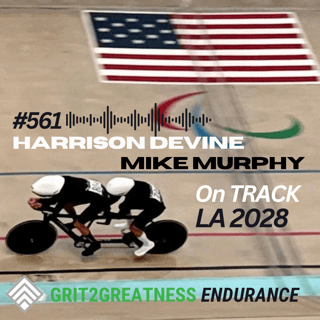
Rich: But I want to give a real big shout out to Mike Murphy, who is a blind athlete. He raced the USA Cycling, the Para Cycling Track Nationals. uh two weekends ago august 5th and 7th And. This guy got a.
Rich: Silver medal in the 4K.
Sue: Wow.
Rich: And also second place to the current record holder. Mike, we're really excited it's going on. well above the national standard here, our international standard, and he's kind of moving forward. He's on track.
Rich: for LA 2028. no pun intended. Following that, Mike and I actually did cycle to the summit that following day. on August 8th. So shout out to Mike for both of those accomplishments.
April: Yes. And I'll give a shout out to my athlete, Kevin Cole, who also ran on to Rich on this.
Rich: Oh, that's right. Yes, that's right.
April: For the summit, yes. Yeah.
Rich: Sorry Kevin.
April: It's so cool. No, no, it's so good. He saw the the grit, the get gritty green. And it's like, Hey, do you know coach April?
Rich: yeah
April: Do I ever.
Rich: Whoever.
April: Uh, special, uh, shout outs to coach KO, Lindsay Holmes, Anna Marie and Emily Hanson. who raced the Niantic Bay Sprint on August 9th. And then, Sue, you got to meet some of our athletes who were at USAT Nationals, but special shout -out to Alice Kostrich, Varan Thornhill, and Sarah Barr, and, of course, Ruth Fountain, who all raced in Milwaukee. they Had a great time. Alice, especially, just want to tell you this too. Rich and I were talking before we jumped on, but Alice got to meet you and you inspired her in a massive way.
Sue: Yeah, meeting her was fantastic.
April: So.
Sue: And we're chit -chatting and she's like... oh rich source do you know him oh april do you know her you know so and i'm like yes i know them so yeah that was it was really fun to meet her
April: Aww.
April: Aww. Wow.
Sue: That was great.
April: And then we have Paul Hunziker who raced the Lake Meridian triathlon on August 15th and earned a second place. Wow. In his age group. Congratulations, Paul. That's incredible.
Rich: And he's crushing it. He was having a lot of back issues earlier this year and has made a complete recovery and is just like on a whole new. level. So I'm super excited about.
Rich: Paul. And by the way, actually, I don't think we have anybody racing this weekend that i I saw, but next weekend, just a heads up. We've got Neetu Agarwal is racing her very first triathlon, Boulder Sunset Sprint.
Rich: on the 28th. So is Marcy D. She's also racing that. And then Paul Hunziker can't just get enough racing. is doing the bonnie lake triathlon on sunday the 29th so hey guys good luck to all of you and if you're new to grit to greatness listen you don't need to be coached to be a part of this committee community and get shout outs like this. If you're just looking to be a part of a cool team, a cool group.
Rich: have support, inspire others, be an inspiration to others. Listen, come join us. we we you know We really think a lot about how to integrate your life into what we do and kind of how.
Rich: Sport kind of helps life and life helps sport. We'd love to hear from you. We'd love to meet you. Come check us out. There's a link here to our Grit to Greatness community. You can meet some of our other athletes in our toast. testimonials page.
April: Excellent. Well we are excited. I don't think that. qualifies enough to say how happy we are and happy back sue this is our second time uh, having the privilege of interviewing you. I think Rich has interviewed you. This will be his third time, but we talked about your first book, the athlete inside and. coaching during a chapter of the journey that would eventually become. part of your newest book.
April: across the line. So just to give a little bit of a... teaser here, Sue's story is extraordinary. From losing 200 pounds and becoming a world champion masters triathlete to studying what truly drives elite performance. She's never stopped asking hard questions. You'll see that outline in her book across the line as well.
April: in her book she turns that curiosity inward taking us behind the scenes of working with elite coaches chasing higher levels of performance and discovering the hidden costs that can come with the pursuit of excellence.
April: So. I'm excited to have this conversation. We're going to talk about ambition. We will talk about resilience. You know, and and also the. What, pursuing greatness and grit? can actually do when we tip the scale over too much to the side of overtraining. So that's one of the things that I'm most excited to talk to you about, Sue, and and learn from you. But it's great to have you back on the podcast.
Sue: Yeah, it's great to be here. and Kudos to all of your athletes who have done these fantastic things. Wow, that's, I mean, what a list. That was impressive. Yeah.
Rich: We're so proud of them.
April: yeah
Sue: Yeah, you should be.
Rich: We're so stinking proud of our athletes.
Sue: Well, and I have to say too, that anytime that there is a... I always felt like when I was on a podium that my coach should be standing next to me on the podium because it's know it's not just the athlete, it's the coach that that helps as well.
April: oh
Sue: So kudos to you guys too. Yeah, great job.
Rich: Oh, thank you. Thank you.
April: Well said. i think about that too. And Sue, I'm I'm imagining how cool that would be to stand next to you on a podium as a coach like that. It would be a dream come true. So.
April: Thank you for that visual. Let's jump into our interview. When we first talked about the athlete inside, the narrative was about your personal transformation.
April: What made you feel that there was another story to tell?
Sue: Yeah, so for a long time i I didn't think there was another story to tell. The people, the first book did really, really well. It was the number one triathlon book on Amazon off and on for a couple of years. and People kept writing and saying they wanted a sequel, and I didn't feel like I had a sequel. I mean, I was just doing the same old, same old, trying to improve and train. and But then my my triathlon career...
Sue: took two different pathways. The first one was The coach that I had worked with for eight years and wrote about in The Athlete Inside decided to take a different direction.
Sue: And all of a sudden, I was coachless. And I started thinking, you know, well how can i how can I make an opportunity out of this situation? I was not happy that I was, you know, I really liked working with him.
Sue: And I thought, well, how can I turn this into an opportunity?
April: Hmm.
Sue: and i got really curious at that time i had I've been in the top 10 several times at Worlds. and i got really curious about like was there another another level of commitment that i didn't know existed and i was especially curious about mental strength and i i kept wondering
Sue: you know for an olympian like like you know do they do they suck it up in a way that's different than how i do is there a different level of of mental toughness at that level that that i haven't discovered yet So I...
Sue: decided to basically take an early retirement, although I was close to retirement age, but I quit my job and I hired Olympic level coaches, which was a surprise to me that they would even want to work with a 65 year old, you know, who had never been on a podium at Worlds.
Sue: and But I wrote to them and asked if they'd be interested in... coaching old lady and they both said they both they all said Well, one at a time. The first one said, yes, that was Bobby McGee and then Jim Vance.
Sue: and so all of a sudden I'm working with Olympic level coaches and I asked them to to train me not as an age grouper, but to train me as they would train a pro. or or somebody who was on an Olympic pathway.
Sue: Because I figured even though I was older, you know, why not me? Why can't I train with the meticulousness that a 30 -year -old might train with? Why can't I be just as mentally strong as a 30 year old? So I asked them to train me at a very high level.
Sue: and that was a huge learning curve but i stepped up and did quite well and the the first half of the book is about that journey of that continuing continuing upward mobility.
Sue: to to to in world's championships. and then And then everything fell apart and I ended up with overtraining syndrome and the second half of the book is about that. So really, to answer your question.
Sue: The second book came because all of a sudden I realized I had two stories to tell. One about working with Olympic -level coaches and what that was like, and then another about... pushing too hard for too long and not recovering well enough than going downhill in the second we were saying before we started the interview that that second part of the journey
Sue: especially as I was writing it, April, you had a lot of questions and I found myself in writing the second part of the book for April, you know, to just to answer those questions she had. And I figured other coaches had too, because none of us, I don't think really understands overtraining syndrome. It's not rare, but it's just like. It's just hard to understand how anybody would get in that into that position.
Sue: So. Yeah, until you're in it. But even then it's it's hard to understand. Yeah, so those are the reasons.
Rich: That's awesome. So, you know. The title... but by the way thank you for again just thank you for being here thank you for the beautiful inscription it was
April: us
Rich: Lovely. The book, the title, Across the Line. I read a lot of things into this
Sue: uh -huh
Rich: Would you share with us? what this title and how deep this title is. For you.
Rich: okay
Sue: it it was so because the the publisher actually selects the title so i was so happy that they like the one that I suggested.
Sue: the subtitle we we worked on but they everybody liked that title and it was it that That line...
Sue: speaks volumes to me like like the first line is that you cross is the start line and I think that that just takes a whole lot of guts I always tell people especially you have somebody who's doing their first triathlon and I always let tell first timers, man, celebrate that crossing that start line because it takes like courage and guts to get to the race, to step across that start line. To me, that's the biggest win there is. It's my favorite part of the race. I always feel like.
Sue: I always feel like I've won the race when I start step across the start line because that it just takes so much to get there. So, and then another line is the finish line that takes perseverance and, you know, and and and stick to it when things get tough in the race, if they do.
Sue: but then the The two lines that really the book is about is one is crossing the line between training like an elite age grouper and training like a pro.
Sue: I did not realize how much of a line that was going to be. That was kind of an eye -opener to me. And then the the main line is the line between having a passion that's healthy, and then having a passion that gets you into trouble because you push too hard or too far, or you know, you you're too all in. So yeah, so lots of lines that that that title represents.
Rich: Love that. I knew there were gonna be a lot of lines.
Sue: and
Rich: so my follow -up question is my follow -up question is on the subtitle Now. i have I have a sneaking suspicion that you have been chasing human performance and elite.
Rich: and you know just high performance in a lot of ways in your life. How much of that? of this experience and how you got here. is some of that hard wiring that you had in earlier parts of your life.
Sue: Yeah, I think... I think I've always... like like to work hard. Part of what I write about in the book is just the psychology of overtraining.
Sue: And I think in my family that I grew up with, achievement was was your one's value was aligned with achievement And so it was really important to you know get good grades in school. and you know, to have a respectable job. and
Sue: just to work hard. Both my parents were were highly successful in their fields that they both were engineers and for my mom to be an engineer in the 1940s was like unheard of for a woman.
Sue: So... So, yeah, so they kind of set the set the example and that, you know, I really kind of pushed hard. And then in my career. I had this amazing opportunity to study high performance in the business community.
Sue: as part of a three -year think tank where we spent like an entire day once a month. talking with you know just just like leading edge thinkers in performance that this think tank would bring in and then we would just pick their brains and and they would pick our brains because high performers are lifelong learners and they they wanted to learn from us even though we were there to learn from them. So it was just this wonderful opportunity. So I learned about high performance in the business community.
Sue: And then part of the this think tank was to take all the lessons that we learned and apply it to education. So we learned how to raise achievement in in education using high performance high performance process.
Sue: and then i just i got really curious when i started in sports and started looking at coaching, like even from the first day with my first coach, I'm like, like, you know thinking oh, that's the same as this in business or that represent that's like this in education. And so, i you know, I had this screen that I've been studying coaches for the past.
Sue: 13 years. based on this these other fields and to see what i could you know glimpse and it was fascinating yeah i took i learned a lot about high performance and not only will in sports not only what was there but maybe also some things that were lacking in high performance the other fields have so yeah it was really fascinating I'm not sure if that was your question but that was my answer.
Rich: It helps me understand how you tick, how you tick.
Sue: so
Rich: That's all.
April: Yeah, I definitely think you're...
Rich: Thank you that's great.
Sue: in
April: Yeah, your systems level thinking shows up not only... as a as an educator but also as a as an athlete and i think that's that's the line that we're we're tying here together is the the approach that you took to that question of what would it be like to train at an Olympic level.
April: And.
April: I would love to dive in a little bit more. into when you entered. the world of elite coaching. What surprised you?
Sue: Yeah, I had no idea what to expect. And. There were many things that surprised me. I... I knew...
Sue: One of the first things that happened is I was my first. Olympic level coach with Jim Vance who worked with Ben Knute. so Jim all of a sudden like started assigning two or three workouts a day and i think he just thought that that was normal for me but i'd only been doing one workout a day and like i but and i wasn't going to complain i just kind of stepped up and
April: Hmm.
Sue: and did it. and What I didn't realize was how, even then in the beginning, I didn't really have a sense of how important the recovery was.
Sue: And later Bobby McGee was helping me with my run. bobby's like one of the me. he's He is one of the winningest. running coaches like in history. He's amazing.
Sue: and i told bobby and he's really easy to talk to i told bobby like i'm dying and he said well let's sit down and let's you know let's figure this out and He said, oh, Sue, you have to like put time in between the two workouts. You have to take a nap and not just where you lay down, but where you maybe even put your pajamas on and get in bed and pull the covers up and take a good nap.
Sue: not a long nap but just one to help your body reset And then he said, you have to have a proper meal between your two workouts. So so we really started planting the idea in my head that...
Sue: it was my job to part of my job as a somebody trying to act like a pro athlete was to bring a body to every one of my workouts that was ready to train.
April: mm -hmm
Sue: You know, that that that was my job is to, when I wasn't training, it was my job to get my body ready for the next workout. so So that was Wanaha. Another one was just about, oh my gosh, the meticulousness of the coaching.
Sue: Like... uh, in my swim there, like I had been used to doing the same workout. warm up for every workout.
Sue: And then I started learning that. depending on what the main set was, I needed to vary the the warmup. So different workouts had different warmups.
Sue: There's a lot of lot of drill work, a lot of drill work in the running. in my latter part as i was becoming over trained and working like really hard and not recovering enough I did seven run workouts a week.
Sue: Four of them were actually running. Three of them were run drills, which had the same impact on my body. I mean, it was just the drills. So, so yeah, and then and then things like I mean, Daz, Darren Smith, who... who he coached.
Sue: He coached six Olympians from six different countries so that all made it to the 2012 Olympics in in London. and he he's like just legendary. and But he was so meticulous. He he lives in Australia.
Sue: And I get this workout in Training Peaks and it says, okay, I'd like you to read on i'd like you to ride on XYZ Road and then go over to...
Sue: you know, ABC road. And I'm like, You're in Australia. how do How do you know what my roads are? He had studied my whole environment and knew where he wanted me to do those rides. Yeah. And when I went to Worlds.
Sue: he he told me i want you to stay in this hotel here's where you're going to do your swim during race week to do the workout i want you to do during race week he just went in and planned everything so that you know, I didn't have to and so that it was the way he wanted it to be.
April: mm -hmm
Sue: so yeah so i think meticulousness And in really paying attention to recovery so that we could get the most out of my body as possible was was key.
Sue: yeah Those are probably the biggest differences.
Rich: Right. Speaking of differences, what would distinguish? between a good and a great coach? What does a great coach do that a good that a good coach doesn't?
Rich: And why is it? Why is it important to you?
Sue: yeah so i think I think the... i think a good coach looks different at different levels in the athlete's development.
Sue: So in the very beginning. when I knew nothing about sports, about my body about about triathlon I needed a coach to just tell me what to do.
Sue: you know I wasn't at the point where I... needed to know why to do it. I mean, that would have... just been overwhelming to me to
Rich: Hmm.
Sue: you know, understand all the details. So in the beginning, I just needed to know, I just needed someone to tell me what to do. And so that was mainly you know looking at my physical development planning my my my my program and then you know as i started to develop intellectually a little bit with with the sport i needed a coach to explain to me why we were doing what we were doing And I needed to bridge. to the point where
Sue: I was... I was understanding that the coach was after a certain adaptation. and that if I didn't implement the workout as he or she intended, that we wouldn't get that adaptation.
Sue: And it didn't matter if I was fast or if I was slow. you know It wasn't about the clock. It was about... taxing my body at certain levels to get the adaptation that that they wanted.
Sue: so So, yeah, so that so the second level was of the... you know what i would consider to be the good about the coaches that I worked with is that they started explaining. why I was doing what I was doing and teaching me.
Sue: that. and then i progressed to a level and i think this is the an interesting level that i've really enjoyed is Once I started understanding... the why
Sue: Then I started having opinions. about what we were doing. And it was all of a sudden it's like, okay, this coach used to like just give me orders, but now I understand why. Now I have an opinion and now I'm coming to the table to say, oh, you think this is what we should do? And so and that was a transition for me to be able to have opinions and for the relationship also to, you know, yeah from being told what to do to now I'm like.
Sue: having my my own thoughts. and so But I really like that collaborative approach. I think it's really healthy. I think if if it had started there it it wouldn't have worked because I didn't know enough to have opinions. you know I needed to just be told what to do.
Sue: but down the road as i learn more i just i love that approach now and you know being able even when i was working with darren daz the the coach i was with when i was over trained He worked very collaboratively with me. He told me...
Sue: that he had never coached an age grouper and he had never coached an old person and he had no idea what he was doing. And I told him that was fine. I had never worked with an Olympic level coach and I didn't know what I was doing either.
Sue: so we said we would figure it out together but and we did you know, figured out together.
April: that
Rich: Ha ha.
Sue: We made mistakes, obviously, but but it was a joy to just, you know, have that collaborative partnership with him. So yeah, and then there's one other way I can answer that question.
Sue: And April mentioned that I tend to look at things from a systems perspective. What and this is as I wrote the book I started Every time I... i i made a coach change, which there were several through the book.
Sue: I realized that The new coach brought something that the old coach hadn't had or maybe they did have it and I just wasn't capitalizing from it.
Sue: But I started to come up with what I called elements of of of high performance. In my work, in my career, I also came up with the elements of high performance for educators. And now I was just applying it to to sports. and so You know, it was like we talked already about the physical development, but it was also, you know, what does a coach do in terms of.
Sue: helping an athlete understand their their core values and life purpose and aligning you know what they're doing in triathlon with that. Because if they don't, their triathlon and won't sustain. When it gets hard, it'll...
Sue: you know it'll just fall apart. looking at a coach that has high expectations. And that was one of the things I loved about Darren Daz. his height His expectations of me were like...
Sue: Like. out of this world. he He really expected me to be meticulous and what I did outside of training, what I did in training.
Sue: he he He just really had high expectations of me. And because he had those high expectations, I wanted to meet them because, you know, we were like partners and he and I had high expectations of him, too, which which, you know, that was because we were working collaboratively. So it was his job to meet my expectations. It was my job to meet his expectations. But I love that the whole thing just function on high expectations.
Sue: the relational connection I think is really part of a good
Sue: coaching relationship i worked with with rich for a little bit and i you know the relational connection that we had was was wonderful and you know same with these other coaches with with daz the first time i ever met him we we did some run drills and all of a sudden he's sitting down in the grass and i'm like so am i supposed to sit in the grass so i sit down and we just start talking like people you know not like coach athlete just two people talking
Sue: And every time we zoomed, you know, there'd be we'd start with a little bit of, you know, he he lived on a boat for a while and he... you know, pan the ocean and I get to see where he was. And I talk about my grandkids and, you know, and then that lasted not long, five, you know, 10 minutes, and then we get down to business. So just having that relational part, I've already mentioned the intellectual development, you know, like.
Sue: If I had had a coach who kept telling me what to do without helping helping me learn, that, you know, that wouldn't have gone anywhere. the mental development, learning.
Sue: resilience attitudes and then And then finally, just the the performance environment, you know, a coach that looks at culture and equipment and facilities and and all of that. So there's all these different parts.
Sue: of of coaching. And I think as a beginning athlete, we think it's all just about the physical development. But it's really all of these areas. It's so systemic that for somebody to keep developing, not burn out.
Sue: You know, not not get tired of it. it is It has to be continuous growth and continuous respect. So yeah so that was kind of a long -winded answer, but it's something i get I get kind of fired up about. because i i think there's I just think it's exciting. so
Rich: You know, one of the things I remember us talking about Being something that. added value to the relationship was a coach with humility.
Sue: Mm hmm.
Rich: and willing to be vulnerable about what they don't know. And you just kind of talked about it a little bit, right, with Daz. you know because the Often they...
Rich: Coaches never worked with it. you know like A new experience with this athlete is a new experience with this athlete. Coaches don't. Can't, should not. i should but you know, apply what they know to with every other athlete to this athlete, right?
Sue: Yeah.
Rich: You're always going to be learning something.
Sue: Yeah. first For sure, for sure. i think you know it's just like teaching in the classroom every every student you have is a little bit different every student has different different interests and different needs and different personality and you have to kind of figure out how to draw that student out and get the best out of them.
Sue: and it's i think it's the same with sports and i i love what you said rich about being humble. you know i mean when you think about it coaches Triathlon coaches are expected to be experts in three different sports.
Sue: and and and also you know working like you guys do with athletes that are beginners to athletes that are, you know, like your blind athlete that's like way up there.
Sue: So it's it's it's not easy and it's impossible to know everything. And so i I just really value when a coach will just say to me, you know. you know i don't know but let me Let me do a little research and let's talk about that next week or whatever. And then they do the research and come back and we have a really rich discussion.
Sue: so i think that's yeah that's really important
April: Sue. Wow.
April: There's one thing that I remember. specifically from our last conversation our last interview and that was kind of the dynamic that you had with Daz about, okay, this This is getting harder.
April: But I'm going to meet that. Oh, this expectation is. bigger than what I imagined, but I'm going to show him that I can do it. And then there's also in the book, you point out him comparing Annie Haug's mentality, right?
Sue: mm -hmm
April: and And I thought that was... incredibly important to understand from your perspective, because being the athlete, it.
April: It is a game of, it can be a game of comparison, comparing yourself to your old self, comparing yourself to and yourself, and then comparing yourself to competition or to the greats. And you're working with a coach that has worked with the greats. So my question.
April: around this. this remembrance of what we talked about and then learning more about this situation in the book. When is, when does a Athlete, no. or What are some warning signs that an athlete might be in a a dangerous dynamic with their coach.
Sue: Yeah. I think that... you know I tried to write in the book about the dynamic with Daz because it it was certainly interesting.
Sue: and just for your viewers and listeners. Daz encouraged me to write the book. He encouraged me to be vulnerable with both of us. and i talked about about mistakes that that both of us or choices that both of us made and a lot of So I i really...
Sue: wanted to perform at a high level. But I had no idea what that meant.
April: Hmm.
Sue: And in my work. We used to take... low achieving schools. into... visit high achieving schools and just invite them look around you know what what do you see just to give them a new vision of of what's possible And then when we would come home.
Sue: We'd say, okay, you know what did you see that that you think maybe is making that a high and high -achieving school? that in you know what's what are the limiters why why aren't You know, what would we need to do differently to get that for our school?
Sue: And when Daz compared me to Annie Haug, I think that's what he, well, I know that's what he was doing. And and I welcomed it because I had no idea.
Sue: like really how does somebody who's really highly elite perform? and So, you know. there were I mean, there were times when he just very bluntly told me, well, Annie Hogg would never do that. you know And so I studied Annie Hogg and really looked at what she did.
Sue: and tried to replicate you know her her dedication her work ethic i mean just just just everything and i I told myself, you know, yes, I'm 70 years old, but I can still work hard for a 70 year old, you know, even though I'm not 30 i can still work hard i can still dedicate myself like like she did I think that...
Sue: with overtraining There's stages to it? and they're like in the beginning you know the part that everybody always writes about is just that there's an imbalance between stress and and
Sue: and recovery. Stress can come from a lot of different areas and that's something I didn't realize. That's one of the things that got me in the trouble. I thought stress just came from training.
Sue: And I looked at the the training load that Daz was giving me, and it really wasn't a lot different than the training load that Jim Vance gave me. I mean, it wasn't, you know, I mean, some of the workouts were crazy. I wrote about some of the workouts in the book, and people are saying, you know, well, that was ridiculous.
Sue: but I made it through them. And. arm Yeah, so... so So, but there was an imbalance in that I not only had stress from my training.
Sue: right before I became over... overtrained i made a a trip to Colorado to train at altitude. I didn't sleep as well. My grandkids were there. I missed my naps. So so I had that going in. Yeah, so the first stage is just this imbalance.
Sue: And then stage two is just normalizing fatigue. and i was skilled at that. I would be tired and I would tell myself You know, I'm supposed to be tired. And Daz later told me, too, that, you know, athletes are supposed to be tired. So if you're if you're properly overreaching.
Sue: You should be tired. It's just that... With recovery you recover So, so I, you know, there, and then all the cultural messages about suck it up buttercup and shut up legs.
April: Yes. Yep.
Sue: And, you know, the people we put on pedestals because they push through, you know, they had three broken legs.
April: Insane things.
Sue: yeah three broken legs but they're still completing their marathon you know so yeah we we push that up but we push that up on a pedal toll pedestal One of the things I learned about grit. And I love the name of your Grit to Greatness. But one of the things I learned about grit is that.
Sue: Grit means... Like... like having the guts to to be afraid of something or to be uncomfortable with something and pushing through it anyway.
Sue: but grit also means having the wisdom to stop. when you needed to stop. And another one of my problems was that I didn't have that wisdom.
Sue: I... thought that there was a level of mental strength that was so far beyond me. I didn't know it existed. And when Daz told me to keep going, i just thought you know i mean he's my coach he's he's smart and you know the way If he says keep going, he must see something in me that I don't see in myself.
Sue: So I kept going. So, yeah, so we we normalize fatigue. Communication, I think, is like key at this point.
Sue: I did not do a good job at communicating. i really had to do some soul searching and and this has been a lot of thinking since the last time we talked but i really had to do some soul searching like i really believe that daz is a good person he's kind -hearted and i'm thinking why wouldn't he why did he keep pushing me And then I really had to look at myself and what messages would i was I giving him.
Sue: And for example, the the crazy workouts that he gave well they weren't crazy because i made it through them but they were hard but Ready? each time i finished one i felt like i'd won an iron man i mean i was so like
April: Right.
Sue: I couldn't believe I could swim 40 hundreds at threshold. It was just like, holy mackerel. So when I did my my my feedback and training peaks. so I mean, often they would start out. woo I'm so happy. You know, i I finished the workout, you know, and and I never. Daz never knew what it was costing me.
Sue: to finish that workout. and he was not face to face with me so he couldn't see me he was completely reliant on my words I'm like... you know feeling like I'm doing a good job, I'm sucking it up, I'm proud of myself.
Sue: you know I'm making it through and I start every. you know. thing with woohoo and then there were other times when I just didn't want to be that person that complained I quoted a video that I made in the book.
Sue: two days because i was exhausted and i'm like mad and i'm like you know i i'm just going and ranting on and on about you know why are you doing this blah blah blah and then But I never sent the video because I didn't want to be that person that complained. you know so So yeah, so I learned a lot about how I normalized fatigue. And because I did that, it I made it really hard for my coach.
Sue: to know what was going on with me. So, yeah. And then when we got into it. Stage three, what I call confusion and denial. i like i denied so much my i i couldn't put down any watts in my on the bike and i decided that my power meter was broken i mean i just you know i just
Sue: just Every time something didn't work, it never occurred to me that it was my body. It had to be like something else. so yeah so that was That was part three. And then finally Daz realized.
Sue: he had given me some recovery and i wasn't recovering and i think that's one of the key things about overtraining and what makes it different than overreaching with overreaching you get tired your your your coach gives you a few rest days and you know you take it easy and then you come back with over training you don't come back you your body doesn't respond to recovery so yeah so so yeah so i think that i think communication is really really important and then also knowing your body like
Sue: I knew I was in trouble. but i doubted myself i kept thinking well maybe there's another level here that i don't know about had I had confidence in my ability to.
Sue: to trust my body in what my body was telling me. i would have said to daz nope we need to stop but i didn't i didn't know my body so So I kept going.
April: Wow.
Rich: Put you in a time machine here. If you were to go back in time. before this experiment started. What would you tell yourself?
Sue: I think I'd tell myself that I was about to start an amazing adventure. And... that there would be some really good times, you know, and and you know the good times were winning two world championships and, you know, just...
Sue: just you know having some fab fabulous relationships. and But i I would tell myself you're going to have a lot of good times. There will be a lot of challenges, but you'll learn from those challenges. So they will be successes because you'll come away smarter.
Sue: but i don't think i tell myself i wouldn't give myself any clues about what was going to happen because part of the fun of all of this was just i mean even with the overtraining it was fun to discover things that i didn't know before and if i gave myself too many hints i wouldn't be able to discover anything So, yes, I would.
Rich: I love that no regrets.
Sue: no regrets no it's been a fabulous adventure and a fabulous journey
April: No regrets.
Rich: Yeah. Awesome. Love that.
April: Can I read one of my favorite parts to you? So...
Sue: yes was I'm gonna cry.
April: Yeah, no. One thing that really stood out to me that stood out to me that. that just you know. made a huge impact as your Your willingness to learn.
April: And. Stay curious, even when you're. in a really rough spot. so It's on page 244.
April: After the overtraining syndrome, you... You had stated, I also learned about myself. I discovered that I'm braver and stronger than I ever imagined. I still can't believe that I had the courage. to launch myself through the air as I dove for the first time during a high stakes world championship in Hamburg.
April: I also have a hard time believing that. I could put push through pain to the point of passing out. and push through fatigue to the point of... developing OTS. I will never call myself a weenie again.
April: you You really did go to the ends of your toughness. And, you know, you quoted David Goggins a couple of times just because that is one of the people that gets put on a pedestal for his grittiness or his toughness.
April: And. I think that. People can be tough without having to destroy themselves to the point of. of irreparable damage.
April: And I think you just sharing that experience of you're not a weenie. You're one of the strongest people I've met. And Getting to live.
April: you know and see through your eyes through this experience I just think goes to show that you don't know until you you try. And I think that your experience and the the impact that you're going to have with it. not only showing the good stuff.
April: but also the the stuff that really was hurt. are harmful and hurtful. But also that you you got through that as well. And you're now sharing that to help people so they don't go to that place of.
April: of of serious harm. to to prove themselves right so i just wanted to read that because i i felt like there was a huge lesson that you learned about your own your own toughness.
April: That is going to be super inspirational, but also. The other side of that coin that we don't need to. kill ourselves. to to prove that we are tough.
Sue: Yeah.
April: We are all, we all have that.
Sue: Well, it has to be. Somebody said it it's like grit is good, but it grit has to be coupled with wisdom.
April: Yes.
Sue: and because of its like you say if if it's just grit you can just go way over the line and across the line. to go
April: Yeah.
Sue: book title but yeah but but grit with wisdom wisdom is what makes grit really gritty is to know when to stop i mean that takes and that takes toughness too and for maybe for some people and for me.
April: Yes.
Sue: Sometimes it's harder to stop than it is to push. so Yeah. But I think if we create a culture. that emphasizes that, that it's it's smart and it's courageous to stop.
Sue: as much as it is to go. that that's that's that's really important. so Yeah.
April: that's massive strength that is wisdom and strength rolled into one sue thank you for that
Sue: Yeah. I appreciate you reading that. that was That was touching.
April: No.
Sue: Thank you.
April: Many, many gems. i You know, I was telling Rich, like... man, I think I have like highlighted all sections of this book that I'm going to refer back to. And one other thing I'll point out with the book too, is that Sue provides some really great reflection at the end of it. So it's.
April: it's it's It's an opportunity to not only hear her story, but also for you to reflect back on your own athlete journey or your own coach journey, like Rich and I are. absolutely taking things as coaches to up.
April: uh up our level of awareness and that collaborative effort and and again that being a visionary versus a coach -led uh, I really appreciate that. And again, just. Just...
April: massive, massive appreciation for you, Sue, and the things that you're sharing with the world. and
Sue: Thank you.
April: how we're learning through you too.
Sue: I appreciate it, thank you very much Yeah, this has been fun.
Rich: Sue, I'm going to... ask this last question and I'm going to. t off of what you just said you know an athlete having the courage to know when to push and the courage knowing when to back off If there's a listener, if there's an an athlete that's listening to this right now and they're trying to figure out.
Rich: what's the you know How do they know they're pursuing yeah excellence or if they're crossing the line?
Rich: How would you advise them?
Sue: Yeah, that's... That's a really good question. because in whatever we do and we're trying to do it at a very very high level in our career in our at school, in sports.
Sue: it it takes hard work and it takes sacrifice and it takes takes toughness. so In sports, it takes physical toughness. And so then the question is, when is... being all in.
Sue: to all in? You know, what is the definition of all in? And I think in the in it's very specifically in sports. We're supposed to be tired. I mean, after you finish a training block, you're supposed to be tired. That's that's a good thing. That's part of over...
Sue: reaching and then your body recovers and you're and you're stronger. But I think when you start to see the other symptoms. that in addition to just being tired like you're your resting metabolic rate goes up.
Sue: you have trouble sleeping. There's... There's crankiness. you don't recover with was sleep.
Sue: when you have those secondary indicators in addition to just being tired. then you know if I'm ever in that boat again, there will be mega red flags going off.
Sue: And I think that as a coach too, I mean, It has to be so hard for coaches because... fatigue is so subjective.
Sue: you know One person may not be be fatigued at all, but they think they're fatigued and they tell you they're dying and they're really not. Where somebody else has a low very high tolerance for fatigue and they they are dying and they're telling you they're not. so So I really think it's those secondary indicators coupled with reports of fatigue that, at least in sports, is an indicator that you're maybe going across the line.
Sue: And then I'm going to add one other thing. the the other line that i crossed is was a line with my values I value very much my family.
Sue: I value my health. And when I found my... later as I was processing all this when I found that I was sacrificing my family.
Sue: Then I crossed another line. So if sports is not aligned with your values then you've crossed the line too and sports won't be sustainable. But yeah, to me, it's all about living by your values. and I certainly was not living by my family values when I was going all in with triathlon.
Rich: <unk> love Yeah, that's a great, what a great. you know. message to anybody who's going it getting into this sport because it's really easy to get carried away.
Sue: mm -hmm
Rich: Yeah.
Sue: For sure.
Rich: Well, that was great.
April: Well, let's get a... yeah thank you sue we're gonna we're gonna get carried away here with our fun segment we like to We like to end our podcast with a little little fun and just kind of just bring it back to, again,
April: full circle here with with the delight of talking to you. So I've got a couple of different points here, and I want to hear your first instinct. This is a lightning round, not a...
April: You know, give me what, what comes to mind first. So I'm going to ask you the first thing here is what is your best race day? mindset cue.
Sue: Do what you're prepared to do.
April: oh Ooh, that hits. That hits that's good.
Rich: It does.
April: All right. What is one book every endurance athlete should read?
Sue: I'm going to give you...
Sue: besides I'm going to leave. Yeah. So there's... Two books. One is The Way of Champions by by Brad Stolberg. I love that book. And the other one. It's this book, One Day Better. So the mental performance coach that I wrote about throughout the book, he was the one constant through the whole. book was Jeff Trosh. And just a couple months before my book came out, his book came out. This is a dynamite book. It's like.
Sue: 150 It has 150 chapters. And...
April: Wow.
Sue: Rich is like, what? What? But each chapter is like...
Rich: Let's go.
Sue: two pages and they're all little mental performance gems and so you can pick it up and like like i you know when When I first got it, I i would read like. you know two one night then every night before i went to bed i read two the next night and he he laughs because he he does it's like you i think it was like you said april that Every athlete is different.
Sue: And so Jeff doesn't, he's not prescriptive but at at all when he's working with athletes. But he thinks that with 150 different ideas in here that something's going to land.
Sue: for your own reason.
Rich: I tell you what, he's only a you know couple hundred away from just having a lesson a day, you know, just a daily you know daily stoic, you know.
Sue: software Yeah.
April: Yeah, truth. Yes.
Rich: The daily stoke of triathlon.
April: I love that.
Sue: But it's a really good book. yeah so so that's so that's so those two books i think would be mine and mine so and and my where's my first book my first book Ta -ta.
April: Yes.
Sue: Hmm.
Rich: Yeah, there you go.
Sue: we We just re -released this as a paperback.
April: So good.
Sue: So it's out there too, and it's doing really well. The the first book has influenced the sales of this book too.
April: Hmm.
Sue: And all of the proceed proceeds from both books are going to USA Triathlon Foundation to help people with disabilities with sports. so So it's easy for me to push the books because we're... we're hopefully raising funds for a really good cause.
April: Mm.
Rich: we will tag We will tag them also.
Sue: Okay, thank you.
Rich: Yeah.
April: Good stuff. Last one for you, Sue. What is the most underrated training habit?
Sue: Oh, my gosh. I mean, a million things just burst into my head when you said that. i mean probably The two big ones are are consistency. of course and then based on where I am recovery that doesn't.
April: Mm hmm.
Sue: You know, we don't look at recovery as like a discipline and it it definitely is.
April: Thank you. Thank you for indulging me.
Sue: Thank you. Oh, my God.
Rich: and having fun with us.
Sue: Oh, for sure. Yes, for sure. I love what you guys are doing and I love your organization and just how. how positive you are. and For the months that I worked with Rich, I mean, just...
Sue: So when I worked with Rich was at the very end of this book as I was mentally like trying to figure out how to get my feet back on the ground. And you can imagine as positive as Rich is that.
Sue: like it was so nice to just have a coach that accepted me where i was
April: Mm hmm.
Sue: and without judgment. and was just, and Anne was organized. and you know, was involved and engaged. and taught me how to use AI.
Sue: and so
April: and Aww.
Sue: So yeah, i just I just think what you guys are doing is is just lovely.
April: Wow, that's real high praise, Sue. Thank you.
Sue: Thank you.
Rich: Thank you. Well, listen. Whether you're preparing for your first triathlon or you are training for a world, to be a world champion like Sue here.
Rich: If you have a question. Send us a message. Connect with us on our website. you know connect with our community. links here in the show notes we would love to connect with you and help you through whatever journey you are working through.
Rich: This episode was brought to you by Vespa Power Nutrition. vestpa brings Steady, clean energy so you can stay. focused. strong and in the zone longer, less sugar, higher performance and faster recovery. Check out Vespa. We've got a link here in the show notes. You can get 15 % off of anything in your cart.
Rich: using the code g2gvespa15. Thanks for spending time with us today. on the Grit to Greatness Endurance Podcast. If you enjoyed this episode, please follow us and leave us a rating on YouTube or on Apple Podcasts. This helps us reach more athletes just like you. Stay gritty. Train smart.
Rich: and keep chasing greatness. We will see you all next week.