Transcript
Speaker: Medical Flyways, the untold journeys of migrant doctors in Australia.
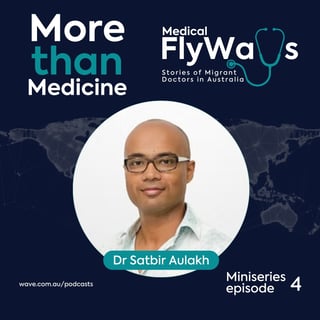
Speaker: Hello everyone. Today I have the pleasure of speaking to Dr. Ahmad Kazmi, someone who have waited a long time to speak to and he has so graciously agreed to give us his time.
Speaker: He is a colleague who is extremely multifaceted. So he is a Melbourne-based specialist dermatologist and clinical senior lecturer. Particular area of clinical interest is alopecia and is also involved in medical education.
Speaker: His general practice training, he does still say he's a GP as well, as well as his dermatology training was in the UK, where he grew up and resided prior to moving to Australia.
Speaker: Culturally, he is a proud Pakistani man. When he isn't consulting or teaching, he moonlights, which is a very humble way of describing it, in a very successful career in comedy and cabaret, particularly in comedy and fringe festivals.
Speaker: I have not yet been to one of his performances, but I am told by colleagues that it is one not to miss. He is about to debut as a doctor panelist for Channel 7's House of Wellness, the next feather in his cap.
Speaker: And to add to that, is also a father to two under twos. Now, if that hasn't vowed you and left me speechless, I don't know what else I can say. Welcome, Emmett. Oh, thank you. Thank you so much for having me. I don't know. I feel tired listening to it.
Speaker: um that But I'm really happy to be with you. And I do have to apologize because you did try ah hard to have time with me. And then I think in the time that we've you initially emailed me, I moved city, got a new job and had two babies, which is why it kept being pushed back. But we are here now, which is nice.
Speaker: Indeed. And I have to say that at no point did I feel that you were not going to be able to
Speaker: Definitely. And you know, I have to tell you a joke because I'm a little bit nervous about this podcast recording because I find podcasts are quite a different set of skills. Like it's quite different than face to face or performing.
Speaker: And I've done a couple, not many, but like in the last one, I accidentally swore a few times. And in another one, I didn't realize they were taking video as well as audio. So I was like gesticulating. I hadn't shaped.
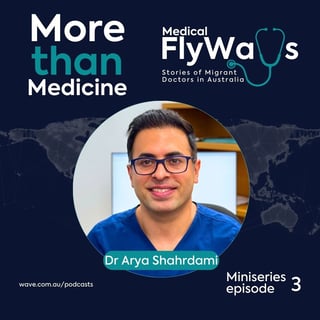
Speaker: So this time I'm like, I'm trying to do make sure I do everything right for you. I can also tell everyone that if we were using the audio, he would still be cutting a very smart figure, although you're going to only hear his voice in this. if Thank you, Ahmed. And I have to say, i i've ah this particular miniseries, which is called More Than Medicine, was kind of inspired by yourself and my friend, Dr. Janaka Perez, Malawata. He's poet. And it's when I've seen the both of you have such a passion for things outside medicine,
Speaker: When I went looking, I discovered there are more GPs and doctors out there who actually have a very ah balanced and full life outside of medicine as a career, which which in itself is demanding.
Speaker: So, you know, you do wonder how do you, like I get asked all this all the time, how do you fit everything in? Yeah, I tell you what I think it is. I actually think doctors, healthcare workers, having interests or passions outside of medicine is not um unusual. I think it's actually the standard.
Speaker: But what ends up happening for most of us is we're sold a kind of... fallacy, like a lie that once you become ah member of the doctor club, that must be your first and primal focus.
Speaker: And only focus. Exactly. And if you dare to make your family or your other interests outside of medicine equal to it, you've somehow sold out the profession. And I think so many people still subscribe to that. And I think what sets me aside is I just ah ditched that mindset ages ago.
Speaker: Like people try it with all sorts of things, like leaving the NHS when I used to live in England. How could you do that? The NHS trained you and then you moved around. No, I had training under the and NHS.
Speaker: I provided a service the entire time. paid tax and on all my earnings. Like this wasn't a, you know, we weren't in a marriage and I cheated on you. Like saying... yeah Yeah, with GP, when I started having, i remember I dual trained and alongside my MRC GP, I sat the MRCP exam and the trainer was like, why would you do that? That's a disrespect to general practice. I'm like, why on earth? like I just, I didn't subscribe to any of these sort of obligations, these pretend boundaries growing up.
Speaker: And I think that's what's helped me feel guilt-free in pursuing other interests and Yeah, there's a very long way of saying I don't think me liking to sing or dance or act is, you know, that different to a lot of doctors. I just didn't buy into the package that I had to make medicine my only first priority.
Speaker: Well, you saw the light much better, you know, or the wisdom much earlier than most do, yes. And I have to admit, yes, there was some guilt. And consider that I'd gone to the UK and got the the excellent training and then left.
Speaker: I'm pretty sure that I would have experienced that guilt at some point as well. Yeah, forget even just people try laboring, putting this guilt on people from moving country or changing specialty or taking a break in training.
Speaker: They even, I see it with them doing it, trying to put pressure on people when they wish to child rear or stop to become pregnant. I find it insane. Like, I don't know why we still tolerate this so much in medicine. Do you think it's about loyalty?
Speaker: I don't know. I'd probably use the word indoctrination more, to be honest. Okay. I think that reframe is quite welcome. But yes, I do wonder about that. Servitude as well. It's also a form of emotional guilt. Like, I know it sounds a bit strong, but I do see it with religious groups. I see it with cultural groups. I see it with, um you know, helicopter parents. It's the same kind of principle.
Speaker: Exactly. and And the press do it too, where you're only a good doctor if you're a suffering doctor. You're only a good doctor if you're suffering. But if you dare to be affluent, have business ventures outside of medicine, be happy with your job, be boundaried, not work weekends, not work nights, then somehow you're bad because you're no longer altruistic.
Speaker: So yeah, I don't really subscribe to that in any shape or form anymore. Well, I'm glad we've started there because that is the inspiration that many people out there will need to go for what they think is truly what they want in their life.
Speaker: so And if you need to justify your happiness in some way, which I don't think anyone does listening to this, but if you did have to and your well-being, I would frame it as this. If patient care is your ultimate focus, well doctors make well patients.
Speaker: If you are not fed and rested and happy and well, you know you are not going to be able to afford good care for your patients. So if you need that extra level of convincing, that's how I would frame that.
Speaker: Fantastic. So would you say that giving equal importance to things outside of medicine should be the default rather than, or should be the considered the norm rather than an exception?
Speaker: Yes, because if our sense of self, if the primary source of our sense of self, of our satisfaction, of our self-esteem comes from our work, then if you stop working or something bad happens at work, the impact of that becomes disproportionate. It becomes existential.
Speaker: So whilst I totally agree, we train for years, we work hard, it is part of who we are. It is just part of who we are. It's not that i must And this is why, for example, referrals to regulatory bodies or complaints at work are so existential for doctors because they are so invested in that being you know representative of who they are as people rather than seeing it as that was a specific interaction.
Speaker: This didn't go so well. This is how I learn. This is how I move on. It becomes I am a bad person. am not worthy. and And think that's a really dangerous, unhealthy place to exist in. Awesome. I mean, I guess from my perspective, the fact that you've trained in not one but two specialties, if anything, it indicates for you to have that mindset, it's more likely that you'll be able to strive towards the goals you have and actually achieve them rather than get stuck somewhere in the way.
Speaker: Yeah, no, I agree. I'm quite grateful for that. Sometimes I feel a bit sad and I think, you know, like, so I live in Australia, I don't own a home yet. I'm like, my finances a bit behind because I took a bit of a detour and retrained.
Speaker: But then other times I actually feel quite grateful because I think having done general practice training first, worked as a GP, then retrained as a dermatologist. I just think, you know, the holistic approach with which I approach my patients, the kind of ability to actually enter their psychosocial domain, the ability to carry and reflect on, you know, general medicine.
Speaker: I don't think I would have had that if I hadn't done my GP practice first. Yeah. I don't, I have to say, while this might disappoint you, is that you're not the first dermatologist I've met who's been a GP before.
Speaker: and And so there's certainly value in it. 100%. I agree. yeah and And I suspect your patients will see more than the rest of us in that sense. What drew you to dermatology? If you had, you know, are purely curious about, you know, it's a cognitive specialty as well.
Speaker: The answer I have to say is maybe not what you're expecting, but it was quite strategic because I enjoyed medicine, but I felt like I wouldn't be able to make it to retirement being a GP.
Speaker: I found it too emotionally draining and not financially commensurate with the amount of training I had done or the amount of work I was doing. And that was making a little me a little bit resentful and frustrated.
Speaker: And so I had enough insight to see that this wasn't going to work long term. So then I looked at my options and I thought, you've already spent so long with medicine, it would be hard to now adopt an entirely new career path. you Exactly.
Speaker: So i I kind of looked at my options and I had always enjoyed skin. You know, it had been badly taught. in my GP training. So I had done an extra diploma in dermatology to try and address that learning need, which had given me a bit of interest.
Speaker: I loved that it was ah an outside specialty where it's, you know, you can see the organ that you're treating. You're not reliant on other, less exact ways of gauging what's going on. Yeah, very high impact for patients. I love that it was also cradle to grave, a bit like general practice was. There aren't so many specialties like that left.
Speaker: I like that you could make it as medical or surgical or as cosmetic as you wanted. But I also just love the fact that it was no weekends, no nights, fairly well remunerated. I could become an expert in something, you know, a smaller area rather than with MedGP. I felt constantly I had to keep going on update courses because everything changed too quickly. That was my personality and I struggled with that.
Speaker: So, yeah. So for the finances, the hours, the variety, the retrain was only four years as opposed to like something surgical, which might have been five to ten. And also the level of stress is lower. Like people just don't die as much.
Speaker: like but mean That's true. I'd never considered that. But yep, that's spot on. There's about five things that can kill them and you can spot them straight away. and even that, it's usually not immediate. And like, I don't even lie, like the luxury of having really sick patients in Durham is that you don't have to look after them. Yes, someone else is. If you're really sick with like a TEN or pemphigus vulgaris or really bad dress syndrome, HDU help you, ITU help you, anesthetic, they're admitted under somebody else.
Speaker: You visit every day, you write plans, but you know, you don't, I don't have to worry about the dialysis and the and NIV and the, and you know, everyone's different. But certainly a few years ago, i was at the life phase where I didn't have capacity for that added level of stress and worry. Yeah.
Speaker: so yeah victor I can only think of one other and I don't know if that completely meets those criteria as well, but pain specialists are probably the only other I can think that would be close to what you're describing in derm. Yeah, no, I think there's a couple, like ophthalmology probably as well.
Speaker: Yeah, that's true. It's fairly yeah um similar to Durham in that more office-based, more calm, more sub-specialized. So yes, but no, i um I'm grateful, really.
Speaker: I'm happy with mine. Is it going as you had expected? Am I allowed to ask? Yes. So yes and no. i do love the job. I find it much more sustainable and less taking of me than GP was.
Speaker: The only thing is I'm starting also now that I've got children and I'm just tired all the time. that Yes, I know. I think if I had been in any job, I'd probably be like questioning some of my life choices.
Speaker: But there have been a few moments where I'm like, you know, if I don't go to work, I don't make money and my whole inc my whole household stops. So now I'm trying to think, oh what do I do? Do I like? make my own clinic where I'm the one receiving the service fee instead of paying the service fee?
Speaker: Do I try and buy some flats? And like my parents always telling me about property and I never really listened. And so I'm a little bit at a crossroad now where I do love medicine. I do love dermatology, but I just wish to spend more time at home with my children.
Speaker: And I'm not sure how to make that happen without a significant drop in income. well Well, I hope you find the answers. It's probably not going to be in medicine, I have to say, based on my experience.
Speaker: I agree. i spoke to a few friends about this, interestingly, and all of them said medicine will afford you'd afford you like a reasonable lifestyle, healthy, happy life, but you're never going to become rich on it. And all my medical friends who are financially very sound, it's often from totally unrelated pursuits. It's because they've got a property portfolio or they've got shares in a business or they, but it's a little bit hard now just trying to yeah Interesting.
Speaker: i don't this is fairly common in medicine as well, is that we are always considered to be high income earners. And while we do make a decent income, no doubt about it, but one of the financial planners I spoke to ages ago said, well, the trouble with the doctors is that you're already spending so much time making that money that you don't have time to do anything with it.
Speaker: and you don't have a problem, but i'm glad I'm glad some people. I think what he was saying was that people with lower incomes, then you have better financial planning. Oh, maybe, yes. and And I kind of went, is that what you mean? It was like, yep, there are people that earn less than you that are better set up for the next 10 years than you are.
Speaker: And and the fact is the fact that you'll enter late means you've already paid a price for it. And I was okay, well, I suppose now is better than never. Yeah, and I don't know. i and So both my parents are deceased and i I do love them. and i have But I don't know if you have this as well.
Speaker: I also feel a bit like my parents. Their sense of what you what they need to pass on to me was a little bit unusual. So education was really important. I had a math tutor, a chemistry tutor.
Speaker: You know, they taught me several languages. I know about um Indian classical music. and They never taught me about mortgages. They never taught me about finances. They never taught me about loans. And if you wanted to make more money, you just worked longer days.
Speaker: You worked more days. You worked harder. And so in adulthood, I've had to try and learn a little bit more about financial literacy, what stocks are. what it's really I just find it so interesting when education, both religious, cultural, you know was so important for me growing up, how this was such a blind spot for my parents with me.
Speaker: But I think that's not necessarily any different for people of our generation where this idea of if you work hard, everything will be fine was pretty solidly ingrained. And it maybe I certainly think that there are exceptions to that, but generally the rule is very much that. raised my kids with work hard and work smart, whereas I only got the work hard talk.
Speaker: Yeah, and I think they probably, they missed the have fun bit in the talk as well. Yeah, I agree. Which you seem to have found in your journeys, which leads me to ask you about the fun bits. As I see it, they are more than likely work for you because to get to the level you are in those, there would be work involved.
Speaker: But how how, like stand-up is one of those things I'd never ever imagined myself doing. So, How did you learn there, like, of all things? There's two answers, really. So one is that I think you always have it in you slightly.
Speaker: So I was always growing up a little bit extrovert, a little bit of a ham. I loved singing, dancing. let's go But, you know, I did grow up in quite a conservative Pakistani household.
Speaker: All of that was seen as sort of um superfluous or a little bit indecent. or So I never really was able to fully engage with it. so And then I went to medical school, and then it all just died to death.
Speaker: you know, where all that, as we mentioned earlier, all those bells and whistles that are part of you get sort of trimmed. And then it was actually ah my my father's passing that I decided I needed a little bit of a break from medicine.
Speaker: And my default up until that point to deal with stressful situations had been to do some form of academic study. So i just I signed up to a master's in public health because that's how i thought I was going to grief and bereavement because like exactly as you said, like holidays weren't allowed, time off wasn't allowed. There was always a guilt or shame associated with that.
Speaker: And then I was like, oh, why are you doing this? When will you break this pattern? So I was like, at that point, I'd been a doctor eight years. And i was like, maybe you've earned the right to pursue a different project.
Speaker: And so then I was like, I was living in Perth at the time. There was the Fringe Festival. I'd seen a few shows. and many of them had been terrible, but the audience still... Loved it. The audience was still very kind and very gracious, and they were nice. And so then I thought, maybe this is a safe place, because then even if I'm terrible, like these people are not going to turn on me, and I've got it out my system.
Speaker: So I decided, well, again, let me just try this. And again, I was a bit strategic about it. I got the impact report. I looked... which shows sell, which genre, which time of the day, what the average ticket price was.
Speaker: So I reverse engineered it. Then I thought, okay, need to do a comedy in the city center between 6 and 8 p.m. And then I thought sort of, what are my unique selling points? What do I have? And at that point, there weren't that many medical comedians. And because everyone has a relationship with a healthcare provider, there's that element of applicability to everybody. Everyone finds it a bit interesting. And Yeah, a bit voyeuristic.
Speaker: So I thought, okay, maybe I'll make a show about some of the goings on in the consulting room and funny things people do in general. And then, you know, I still had so much of this kind of religious cultural shame.
Speaker: For the first two years that I performed, I gave all of my earnings to charity, because otherwise I felt like it was too self-indulgent or it was indecent that I had done a show and kept the money.
Speaker: Surely you would not have worked for it, but I completely get that in many ways. Yes. And then I had this turning point. So it went much better than I thought. So I wrote this this comedy show, Doctor in the House, What Your Doctor Really Thinks.
Speaker: And it was just about funny anecdotes in general. So I never talked about real patients or their real specific circumstances, but it was just things like, you know, when people come to see you and you guess the relationship incorrectly.
Speaker: You know, everyone has done that. i be like, is this your mother? And they'll say, that's my wife. And then you die a death. Or where the patient would sit in the doctor's chair. Or where they would... So I just grouped all these kind of anecdotes that were relatable both to patients because they had done it and to fellow colleagues because...
Speaker: They had experienced it. And I got lovely reviews. I was in this tiny back room of this restaurant if for 60 people. And within a couple of years, I was doing the main venue in Perth, which is a 575-seater called the Heath Ledger.
Speaker: And I was selling it out. And it was lovely. And it was also then after a year or two that I realized that, you know, i don't think that performing is shameful. I don't think that it's immodest. I was you know, i'm not selling cocaine here. People come because they wish to have an even a fun evening. I present something. I always try and weave in something serious in there, some reflections.
Speaker: So i the first show, there was a bit about bereavement because it was about my father. The next show, there was a bit about Islamophobia. With my wedding show, it was about homophobia and familial rejection. So people leave having a sense of human experience. There's bonding, there's humor, and it is normal for the person to be remunerated for that.
Speaker: And I don't feel that guilt now. And also for me, it's kind of important. Everyone fills their tank differently. Some people do yoga, some people eat chocolate. And when I'm a doctor, I am there to facilitate the patient.
Speaker: So the patient is sort of the planet and I'm the little moon that orbits them. And that's all day, every day. And then at home with your family and your children, you orbit your children's needs.
Speaker: So when I'm on stage for period, people have come to see me. I get to be the planet. They are circulating me. They're orbiting me. I get to say my truth, heal, entertain, people clap for me, and it sustains me. It's a type of fuel, like people would get from something else.
Speaker: And now I see that as normal and healthy, rather than something that is a source of shame. or yeah So that's what it does for me. I love it. It sounds like you absolutely love it. And i hope i get to to I hope I really do get to see you on stage, because I'm sure it'll be so much worth the wait. I would like that too.
Speaker: ah the You know, you mentioned several things in that, in that I recall my father saying to me that, you know, I'd written something which is not in the public domain. And he said, oh, you must have been really angry to have written this. And I said, well, there's, you know, from my perspective, there's no anger in what I'd written. but But I guess art often comes from a place that is emotionally impactful for people.
Speaker: All art is therapy, whether it's sculpture, painting, performance, all of it. And it is therapy both for the artist and for the audience. You are attracted to something for a reason.
Speaker: In that way, there actually are some parallels with consulting, I have to say. It's like a therapeutic exchange between two people. The only difference is that the dance and the moves are different.
Speaker: And the direction of flow is different, I suspect. Yeah, so it it almost feels to me like what you're saying is if you are prepared to give as much as you do in a consulting room, you should be prepared to take that as well.
Speaker: Yes, and also it's it's almost the same set of skills, but the inverse. So in consultation, I'm trying to ascertain information elegantly, politely, respectfully, extricate it from the patient, weave together a story, elegantly examine them, try to present that information in a way that you know, helps them understand, facilitate them to arrive at health decision.
Speaker: And with performing, it's kind of the same thing. So what do I need to do? How do i get the audience to understand the story? What I'm trying to say? How do I lock in and connect with their life experience so it resonates with them more?
Speaker: How do I take them on a journey where I want them to laugh and cry and learn? And, you know, ah so it's very similar, just the opposite side of the same coin. I use all the same skill set in clinic that I do on stage, just in a different way.
Speaker: And so, yeah, so, I mean, in that context, when you get to your next gig, which is going to be very different, as you said, in compared to podcasting, being on stage, my understanding is when you're on stage, there's a very direct connection with your audience, you know, that you get that rapid feedback and you can modify things.
Speaker: You're going to be on television. I'm... um It's a very different gig. yeah what are What are your thoughts and feelings about that at the moment? Yeah, it happened kind of funny. So a few I got an email.
Speaker: ah last but i don't know when this will air, but I got an email just saying we're looking for a panelist. And they do crop up from time to time. And I kind of ignore them because most of the time the show doesn't even get made. But I had just said to somebody that, oh, you know, I'm working six days a week. i'm getting a little bit tired. Maybe I haven't performed for a little while because obviously i had the two babies and such.
Speaker: close proximity and I had been looking for a project. So when this landed on my lap, I thought, okay, maybe this is Allah and the universe saying, hello, you you put out a call, you put out a call and look what I said. Literally, I had said it on the Friday and I went into work on the Monday and this email.
Speaker: So then i did I spoke with them and we met, but you're totally right. It's a totally different Again, it's another learning curve. It's a different experience. So you you know you have to pretend to be spontaneous.
Speaker: You're looking into a screen or with with other panelists because you're constantly being watched and recorded. You have to constantly keep smiling and... you know there's what's the word the auto-prompter you have to think about someone is speaking to you in your ear in an earpiece while you're simultaneously speaking i still haven't mastered that i find it very difficult so it's it's nice it's it is totally different theater works way easier than tv but i've only done i've filmed a few episodes so maybe i will you know i think we i will learn and get better it it improves as you keep doing it i suspect
Speaker: But I'm also, again, I'm very grateful for the platform. Like, I feel like arts are also a privilege. And that's why I got to, when you have that moment and you can engender change, which is why I try weaving in um something useful in my humor. I never wish for it to be totally superfluous.
Speaker: And it's the same with TV. So when they asked me to be the doctor, I said, okay, that's fine. But I would really like to please do some of the following. And I said, I really want to do a section on alopecia to bring awareness about that. I'd really like to, I'm not going to downplay that I'm Desi and that I'm Pakistani. And because it is an Australian show, they're all white panelists. Most of the guests are Caucasian.
Speaker: And so I said, I'm going to bring my, I joked with them, I said, I'm going to bring my masala chai flavor to the table. And, you know, and so I just laid it down. They were all like, yep, that's great. That's great. That's great. So I feel a bit like maybe this is also another opportunity to try and Be yourself in your full version.
Speaker: Yes, 100%. So yeah my question, like, ah in your introduction, you'd already said that, and then interestingly, this is a question that comes up so often is in Sanskrit, there's a few words like, where you are born is called janma, you know, the place you're born. the Then there's karambhumi, which is the place you work.
Speaker: And, you know, in ah in that sense, when you When you describe yourself as a Pakistani man, it clearly says to me that you have a sense of both connection and belonging that is still very strong and rooted in Pakistan.
Speaker: How do you maintain that? like For many people, it is it's a concept that's interesting, particularly in the current times when we are hearing words like assimilation you know, integration and all these other things that are very verbs, that they're verbs in my mind that I need to do something.
Speaker: How do you maintain that part? I want to thank you because I think that's such a beautiful multifaceted question. And I'll try not to use all our time now to talk about it because it's done yeah such an important part of my life. But I'd just like to share a few of my thoughts on this subject.
Speaker: So as you mentioned, I do feel totally comfortable. And if people ask me where I'm from, i always say that I'm Pakistani. So I'm proud I'm a Punjabi man. And then when people ask me further and they realize I've never lived there,
Speaker: They are the ones that confuse. I'm not confused. So I was born in Canada. I was raised in England. I live in Australia. I don't have a physical connection with the Punjab or with Pakistan or with India anymore.
Speaker: But as a sense of my sense of who I am, my ancestry, my cultural heritage, who I see myself as a person, the first thing I would say is that I'm a Punjabi Pakistani man. And again, realized along the way, many people will have opinions about what they see you as.
Speaker: So some Pakistani people like you're not Pakistani, your father is Pakistani. Other people say, how can you be Punjabi if you are Muslim? Other people be like, no, you're English. Other people like you can never be English. or And when I was much younger, that bothered me.
Speaker: i really couldn't care less now. I do not need, i don't have, have no value on what a random stranger at a dinner party has, what thoughts they have about how I should categorize or classify myself.
Speaker: And, Also, generally, people from the subcontinent, we've lived through partition, and we're a highly migratory people. My mother was born in East Africa. My father was born in British India. I was born in Canada. They lived all over the world. So other people may not be able to understand why it feels natural or normal to me to be an Urdu-speaking Punjabi Pakistani who was born in Canada, raised in England, and living Australia.
Speaker: For many other people, it's totally normal. I'll be sitting down with my other Desi friends, and we'll be talking in One of them, I swear to God, we'd known each other for about 10 years and something came about Africa and she was like, oh yeah, my mom was born in Kenya. And I was like, oh, my mother was born in Tanzania.
Speaker: And then we we didn haven't hadn't even realized and we carried on with the dinner. Like it's such a normal part of existence. So that's the one thing I'd say is that I've got to a point in my life now where I have a really beautiful calm and growing up, I found it strange.
Speaker: with my mother, I couldn't understand it. So ah she was born in Tanzania, raised there, had never been to India. Her parents were from the Kashmir and the Punjab. and Then she moved to England when the British left. She met my father. She went to Pakistan once only after marriage to visit her in-laws.
Speaker: Yet she had a mastery of our language so much so that both of my parents were published poets in Urdu. My mother had You don't just speak a language in order to write poetry and publish it. Yes, you have to feel it.
Speaker: So my mother, who grew up away from the homeland, spoke our mother tongue so well that she was ah a literary force in it. She would go on the radio, she would host things. I never saw her really wear English clothes. She could cook this if you would...
Speaker: And I remember as a child, Diki, I find it kind of weird that you grew up in Africa, then you moved to Canada, then you lived in England, but you had like I couldn't place it together. And it was only in adulthood that I saw that it was nothing to do with where you geographically are located.
Speaker: It's everything to do with what you have internalized. I will probably listen to this more than once. And I have to add that I had not realized that you've never lived in South Asia. So that even for me, it has left me thinking about many responses I might have had in the past.
Speaker: Yeah. what Yeah, and and so to me, like i'll be I'll admit, i my children don't speak Hindi. where They do understand. And yes, Bollywood is very much a part of my home, but really unlikely they'll be fluent. that So that leads me to the second bit of your question, which is like, how does it manifest in my life and how do I see it moving forward? And this is a big worry for me, I have to say. So I went through this teeny existential, it lasted about six months when my mother died. My father had already died.
Speaker: And i just for maybe a couple months, I thought, am I still Pakistani? Because my parents were the bridge that connected me to the subcontinent, and that bridge was now gone. They were the only people with whom Urdu was my first language of of communication.
Speaker: I don't speak as my first language of communication with my siblings. I didn't have children at the time, and I was worried now, would this become extinct with me? And that's also, that had a ah big shift where I thought, no, this, your ancestors never become extinct.
Speaker: They are always with you. So from that point, I was happy, but I did have this panic about Burdu. And I do speak Urdu, I speak it fairly well, but all my education has been English medium.
Speaker: So i mean I make lots of mistakes, I can't write an essay, my literacy level is quite low. But I've just, again, I made the decision that I would try to immerse myself a bit more. I try really hard with my two children to speak Urdu all the time so that I rekindle a new relationship in my life, in my world, where Urdu is the first language of our communication.
Speaker: I do, I can't pretend I don't have a sense of worry or panic that the responsibility is on my shoulders to keep my language alive. And that is probably the link that I feel is the strongest to my heritage.
Speaker: That if someone, I hear a song, I understand the words. If I watch a film, I can understand the words. If I hear a poem, I can generally understand the words, although the register of speech is quite high. And so if I didn't have that, I think maybe I wouldn't have this feeling inside me, such an unwavering feeling of being...
Speaker: Diaspora Pakistani. And so I really hope my children have that. And going to try my best. But that's probably the only it that causes me worry. Well, i'm I wasn't expecting to take you where we have landed, however, certainly not when we consider all the other things we were discussing. but And we've kind of had this little dance around spiritualism this whole 30-something minutes, haven't we? But yeah my in my contribution to that, will say the things I worry about are the things that I tend to let go of these days.
Speaker: I suspect you will be in for a surprise and I hope that there will be more to this than you have expected, which will boomerang back to you in a pleasant way. That is my wish today. Yeah, if my children don't decide not to speak Urdu, if I'm not able to teach, obviously see i I'll deal with it. But at the moment, I would hope that that is something that they can have because I just feel like it's such a gift and one of the anchors for me.
Speaker: You know, sure, I love chole and biryani and... i like clin yeah i love I love listening to Abhita Praveen. She's like my favorite. And I can wear, sometimes if it's a friend's wedding, I'll wear like a kurta pajama or shervani. And those are manifestations or expressions of my culture. But the most profound one, the one that I feel is probably the most important is language.
Speaker: And you know, it's so funny because when I meet other, it doesn't, have to say, it doesn't happen anymore. Maybe just because I'm a bit old, but When I was much younger, if I met Indians or Pakistanis and I would speak to them in Urdu, they would often, you know, comment on my accent or my mistakes in a negative way.
Speaker: And it used to cut me so deeply. And then one day i just said to the person when we were talking, I said to them, i was like, yeah, but, you know, you speak English in the same way. yeah They just stopped in their tracks and I was like, you were born there, so you speak English with a deficit.
Speaker: I was born away, so I speak Urdu with a deficit. And I was like, oh my, this is so true. like that i have not done nothing wrong here. It's okay. It's natural. And ah it just totally evaporated that in one second.
Speaker: And now if people say, I'm like, and now if they say, oh, how funny you're speaking Urdu like an Englishman, I'll say yes. And isn't it so lovely that I still managed to speak my mother tongue fluently, even though I was entirely raised abroad?
Speaker: And then they're like, yes, you're right. and I'm like, yeah, I know I'm right. why did you Why did you call me out? from it I didn't call you out for your accent. I'm just English. And then the interesting part about accents, which I find fascinating, is people forget that accents are a two-way street.
Speaker: If someone's receiving one and thinks it's an accent, then the opposite is exactly the same as well. So, yeah, I mean, I think we have had similar experiences in different ways. Most people, many people have asked me which university I went to in the UK, not realizing that I am...
Speaker: not UK born and bred. I grew up in India and then moved to the UK. But I, do you know what? I picked it up because it was needed to do what I needed to do. So, and and in some ways it's interesting because post the post-colonial world is...
Speaker: largely responsible for many of our identity crises, but we shall leave it at that in that sense. I'll say one last thing about this, about language. It's also quite interesting that I also think one of the reasons I get criticized less for my Urdu now is because the new generation, the younger generation of Indians and Pakistanis there has been a linguistic shift and now so much of their education and culture is in this medium that actually their mother tongues now take second place. So their level is lower, their accent has changed, their verbiage, their parlance has changed.
Speaker: And many times I know more words for things in Urdu than other people do. Like I was speaking to somebody and we were talking about something and I said, agihaffen and they were like, pardon? And I was like, pa it and that's the word for eyebrows. And I'm like, oh, you mean eyebrows? We say eyebrows.
Speaker: And I'm like, okay, sure. You know we have a word for it. And i said to somebody as well once, I said, just up a massive subject, like however you see fit. And they're like, oh my God, that's so cute.
Speaker: No one talks like that anymore. And I'm like, oh. husband Has that made it to any of your stand-ups or not? Because I think it should. It is deserving of a place in the show.
Speaker: Maybe. No, it hasn't come in yet. But in my last show, I wrote a show about my experiences as a patient and it was called um Taste of Your Own Medicine. And it was just, you know, it was COVID and I had a kidney stone and I turned it into this big drama.
Speaker: And i I did decide in that show that I would be unapologetically desi, that it would naturally weave in. And so there were like lots of Bollywood references and lots of cultural references that when I was writing the show, people that were watching it and sort of the direction was, I don't think you should include it because not everyone will get the joke.
Speaker: And then again, I said, why do I have to write jokes that are only just ever for a specific audience, like the majority mainstream audience? So there were a few like, so beautiful, so elegant, just looking like a wow.
Speaker: And was like, if you know, you know, and that's why it's funny. And if you don't, it's okay. And then in when in the show, there was once I was like, Pooja, what is this behavior? um And again, many people laughed loudly because they knew what the reference was. so but But the fact that not everyone knows is not a reason to leave it out. Exactly. so And if I may also look back to that thing I was saying about just because I'm born abroad, you know what what I know or ah the way in which we experience our culture is a bit different.
Speaker: And i I think your name is a nice example because I was saying to you that every time I hear your name, every time I hear Srishti, it makes me think of that expression in the story. And you're like, which one? One which I didn't know, shall I add. And so you've then added another element to me knowing myself better. So go on, please let tell me as well.
Speaker: So growing up, I can't remember the context now about how it came up, but my father told me a story. And he said that there was a saint or a wise man speaking to a devotee once, and their conversation was interrupted by a passerby, somebody from a different town. And the the passerby said, oh, I'm just walking to the next village, and I've heard the people are very nice. Is that true?
Speaker: and And the saint says, yes, they're very nice people. And the the foreigner went on their way. And the two continued talking. and And a few minutes later, another outsider came and interrupted them. And he said, oh I'm just going to the next village. And I heard the people are very bad. They're very mean.
Speaker: And the saint said, yes, they are very bad. They're very mean. The outsider carries on. And then the devotee turns to the saint and says, I don't understand how can the... You just told the first person they were very good and told the second people person they were very bad.
Speaker: And then the saint replies, ja said triish less sristi So however is your gaze, however you see the world, that becomes your reality. That becomes your universe or your nature.
Speaker: And I don't know if many people born in the subcontinent know that story. It's ironic. No, I must submit admit, I've never heard it, but it makes perfect sense because, you know, everything now in the world today, including quantum physics, suggests that we all have our own unique reality, which we shape as we live the lives we get. So, you know, an opportunity to make what we want of it.
Speaker: Now, normally, are you ask this question at the start, but it turns out that we've waited and had so much to discuss that... What made you choose Australia? Now, we've kind of, you had it, you definitely, from what you've said, had a choice of where you would, you know, take yourself. So... Oh, again, I think, although people don't know me very well, i would hope from this they've listened that I don't do much by chance. So, i it was, again, very strategic, very methodical.
Speaker: I'd just finished GP training. I wanted a break from the UK. I'd wanted a break from the weather. My parents, my family was being kind of terrible and they kept trying to marry me off and I'd said to them about 50 times, please stop.
Speaker: So I just did a search for which countries would accept UK GP training like for like. And then I looked at that list and then I looked at which had the best weather and then it got shortened down to Australia. And then out of the Australian cities, I gridded them.
Speaker: And I said, I want the hottest city with the most hours of sunlight with the least amount of rainfall. And then it gave me Perth. and then And so that's how I ended up in Perth. And it was it was only supposed to be for a year, but I loved it so much I stayed for two.
Speaker: And then I decided that I loved medicine and I loved Australia, but I wanted to retrain. So I went back to England, did dermatology training and then came back to Australia. and And so realistically, and you say strategic, but saying that it's for the weather is one i will, I have agreed that said to many people with the signpost, it may sound fickle, but actually it's not really fickle. It's a huge part of our lives and it makes a huge difference to the quality. I'm phototype five. I need some good sun concentration for my vitamin D, for my mood, for my, yeah, so definitely it's an important, I think I'm still programmed to be living somewhere fairly warm. Okay. Warm and sunny is what, yes, indeed. And that's why Canada didn't make my shortlist. So just in case people are doing the shortlisting now. My father, when we lived in Canada, he was there 21 years and I was there for the last five or six.
Speaker: He used to own a snowplow. I think nature is telling you something. If you have to own a snowplow, you know, he used to get on our roof to shovel snow off because if you left it too many days, your roof would collapse. yeah He had two sets of tires. Like, I just, I can't imagine living like that.
Speaker: i ah I would say you're not supposed to live somewhere where you have to own a snowplow. I think I'd be in full agreement with you and on that one as well. And, you know, one of the things we do is, ah you know, try and think about someone who's, you know, maybe in your or my situation 20 ago,
Speaker: thinking about life, thinking about medicine, thinking about not necessarily staying where they are geographically or otherwise, what would you be your top three, and not that we haven't gone through 40 something minutes of wisdom already, but top three things they can be doing right now so that in 20 years time, they don't have many regrets.
Speaker: I'd probably say my first one is about prioritization. Everything can get done. It's just which order you want to do it. yeah Yeah. so from that point of view, don't feel sense of panic. Just rationally and from an emotional point of view, decide,
Speaker: What is the order? What's most important to That's one tip I'd give. And that's for yourself, may I add. You're saying you should be the center of that, not everything else. yeah Exactly. You only get one life, one chance. And so I would, yeah, it's fair.
Speaker: Patient-centered care doesn't mean, you know, doctor second, you know, it's it the two things aren't mutually exclusive. So prioritization would be one. The other one is I think I would probably encourage people to be a bit brave. like You do have to slightly break the mold. You do have to slightly go against the grain. like I love my religion, my culture, my family, but I'm ah a gay man, married to a man, created a huge amount of discord. But I realized very, very early on that your options were you make someone else's life miserable and your own life miserable. And I decided, i was like, no, this is going to be really hard path to walk, but it's my authentic path.
Speaker: And I went for it. And it's the same, actually, in many other areas of people's lives with what profession they wish to pursue, where they wish to live. So I would say from that point of view, you have to have a certain degree of bravery, remembering that, you know, this is your life and you have only one one chance to do it.
Speaker: And my third tip would probably be that things are probably as big as we make them. Having children has taught me that, like the profound reprioritization of things that I wish that had happened earlier.
Speaker: So maybe remember just because it feels really big for you at that moment in time doesn't necessarily mean it is actually really big. And sometimes if you can't see that perspective, you know, friends, family, a therapist, a good doctor are people that can help give you that perspective. And I think without that, it's hard to make big decisions like career changes or country changes.
Speaker: Well, I'm going to say that the universe has certainly brought this episode to me at a good time. And, you know, maybe when we catch up and I get to see you in person, there'll be more of for me to add on that. But so grateful for your time.
Speaker: Absolutely amazing that, you know, I've not expected how this would go, but it's been every bit and more than what I thought it would be. So thank you so much, Ahmed.
Speaker: You are so welcome. Thank you for having me, Susti. Thank you. At Medical Flyways, we're always on the lookout for inspiring stories from migrant doctors in Australia. If you have a colleague whose stories need to be told, head to wave.com.au slash podcast.
Speaker: Medical Flyways is recorded on terrible land in Minjin, Brisbane. This podcast focuses on overseas doctors and their families finding a home in Australia.
Speaker: We acknowledge and thank the traditional custodians of country throughout Australia and recognise the continuing connection to lands, waters and community.
Speaker: We pay our respects to Aboriginal and Torres Strait Islander cultures and to Elders past, present and emerging.