Transcript
Speaker: All right, welcome everyone to this week's Come Follow Me New Testament curriculum episode.
Speaker: We are going to cover, there's actually a lot in this week, but we're going to cover Matthew chapter 8, Mark 2 through 4, and then Luke 7.
Speaker: And the overwhelming theme in these chapters just from the outset is that Jesus is mighty and that through faith we are able to access some of the power that he wields and that he can exercise on our behalf.
Speaker: And across these chapters, there's so many great stories and it's so dense with examples of Christ healing people who are sick, who are
Speaker: He raises someone from the dead.
Speaker: He casts out devils.
Speaker: He calms the ship on the stormy sea.
Speaker: And we really just see it through these chapters that Christ can do all things and that through our faith, he can enable us to be able to be healed and to be changed.
Speaker: And
Speaker: I think we want to dive in a little bit doctrinally into some things here and then get into some of the more milk and honey aspects of these chapters.
Speaker: And the first that I would love to touch on, Cassie, is in Matthew or is it not Matthew?
Speaker: It's in Luke.
Speaker: In Luke.
Speaker: Actually, it's in Matthew 8 and Luke.
Speaker: But there's a story about the pigs, right, where Jesus comes across these tombs.
Speaker: And there's these couple men who are possessed with devils.
Speaker: And the devils are running rampant.
Speaker: And they don't let anyone pass.
Speaker: They're really violent.
Speaker: And they see Jesus coming.
Speaker: And they think it's the time of their reckoning.
Speaker: They think it's the time of their judgment where they're going to be cast into hell.
Speaker: outer darkness and they they try to strike this deal with jesus where they recognize who he is they say the son of man um and they they tell him let them depart and they'll go and inhabit the bodies of these pigs instead of the people's bodies that they're inhabiting um
Speaker: And Christ agrees, and Christ lets them go into these swine flesh, and as a result of them departing and leaving these people, they then run off the cliff and the pigs drown.
Speaker: And this is a really weird, interesting story, where it's not like a lot of the traditional Christ casting out spirits or demons or devils, whatever you want to call it.
Speaker: But there's a couple of, I think, interesting things that we can take from this.
Speaker: Firstly, the demons in this account are occupying the bodies of human beings, right?
Speaker: And the demons are making them extremely violent.
Speaker: And as Jesus approaches the scene, the demons think the judgment day is coming, and they recognize Jesus as their eternal judge.
Speaker: And the demons understand that there is a time of punishment in the future.
Speaker: but they say to Jesus that he's ahead of schedule.
Speaker: And in reality, Jesus is just walking by.
Speaker: Jesus didn't come at that moment to judge them in the day of judgment.
Speaker: So they weren't in jeopardy of premature punishment here, but they didn't wait for Jesus to answer their question.
Speaker: And instead, they just hoped that Jesus would accept this deal that instead of casting them into the abyss or whatever it is, he would cast them into the swine.
Speaker: Um, and Jesus, Jesus accepts that deal.
Speaker: Um, and in the first case does what he was going to do either way, which is he frees the men from the demons.
Speaker: Um, but the real symbolism here is in Jewish law pigs.
Speaker: And this will go into the second part of the story too, but in Jewish law, pigs are unclean.
Speaker: So they're the perfect symbol here for the kind of a harmless destination for, for an unclean spirit.
Speaker: Um,
Speaker: And that leads then into this next part, which is after this happens, the people go down to the city and they tell everyone that this preacher guy just cast these demons into the pigs and the pigs ran off the cliff.
Speaker: And everyone, they come together and they come to Jesus.
Speaker: And...
Speaker: And what it says is they found the man out of whom the devils were departed, sitting at the feet of Jesus clothed and in his right might.
Speaker: And they were afraid because they've known this guy for a long time as being this crazy possessed dude.
Speaker: And they also which saw it told them by what means he was possessed that the devils was healed.
Speaker: And then the whole multitude of the country besought him to depart from them.
Speaker: They were taken with great fear and he went up into the ship and returned back again.
Speaker: So they see this miracle and they're like, Jesus, get out of here.
Speaker: They're scared.
Speaker: And I found this great commentary from Bible Hub.
Speaker: So not LDS, but it says the recital had no effect upon the headmen of the neighboring towns and villages.
Speaker: They were probably for the most part owners of similar herds of swine, perhaps sharers in nameless sins, all especially hateful to the rabbi Jesus, who may no doubt knew well by repute.
Speaker: But he was, they saw, something more than a poor wandering moral teacher.
Speaker: He possessed strange and awful powers.
Speaker: Had they not had terrible experience of him?
Speaker: Which of them in that law-breaking dissolute neighborhood might not he be the next victim whose unclean possessions were to be swept away?
Speaker: So they wouldn't have none of him.
Speaker: Let him as quickly as possible depart from their coasts.
Speaker: They felt they could not keep both the savior and their swine, and of the two, they preferred their swine.
Speaker: So I introduced that as a kind of intro to some of the things we're going to talk about from this week's
Speaker: from this week's reading, um, because there is great examples of, uh, of miracles that happen in these chapters and where Jesus intervenes in people's lives and, and heals and helps people.
Speaker: Um, but there is a very important element of faith that's at the backbone of a lot of these stories.
Speaker: And these people were just burdened and, um, and held back by their fear, their, um,
Speaker: their vanity and and i think their their ulterior kind of possessions and motives that wouldn't allow them to accept the savior i think that's awesome thanks will um i wanted one of the stories of the miracles that stuck out to me this week is um the story of the man who is healed with palsy um
Speaker: And I really like this story because you're distracting me when you're texting me, Will.
Speaker: Anyway, I really like this one because
Speaker: What I think is unique about it versus the other ones is that he's brought to Christ by his friends.
Speaker: And I think I'll just kind of lay the scene here.
Speaker: So basically Christ is teaching in a house and it's really full.
Speaker: People can't get in.
Speaker: There's tons and tons of people walking.
Speaker: trying to watch and trying to listen to hear what he has to say.
Speaker: But there's these four friends who are trying to help their friend who has palsy and bring him to Christ so that he can heal him.
Speaker: And they can't get through the door.
Speaker: And so one of them has the idea that they can lower him down through the roof.
Speaker: So they take apart the roof and
Speaker: And they lower his bed down.
Speaker: And he's sort of just like lowered into the middle of the room and at Christ's feet.
Speaker: And Christ heals him.
Speaker: But what I really love about this story is when Jesus sees him and heals him, what he says, I think often in a lot of these stories, he often says like,
Speaker: Like if you think about the lepers, he says, your faith has made you whole.
Speaker: But in this situation, he says, it says, verse five of Mark two says, when Jesus saw their faith, he said unto the sick of the palsy, son, thy sons be forgiven thee.
Speaker: And what I think is really interesting here is he says their faith.
Speaker: It's not the man with palsy's faith.
Speaker: It's the faith of his four friends who went to all of this effort to bring him to Jesus.
Speaker: And what I really love about this is I've been thinking for a while about, you know, friends,
Speaker: who are leaving the church or who have questions or are just less sure about it than they once were and how we help them and what can I do.
Speaker: And often I feel like when we have conversations, sometimes I sometimes walk away from those conversations feeling like I didn't do enough and like I didn't really say the right thing or like what I was trying to convey.
Speaker: I didn't.
Speaker: It didn't come out the way I wanted to.
Speaker: I don't know.
Speaker: I just feel kind of let down.
Speaker: I've let myself and the Lord down because I had this opportunity to share and it didn't go quite the way I wanted it to.
Speaker: I don't really feel like they got what I was trying to say.
Speaker: But what I really love about this story is
Speaker: That they, it was, their faith was enough.
Speaker: Like it was a show of their faith that they had faith that God could, could kill him.
Speaker: And I think that oftentimes like we show our faith in, showing your faith in small ways can be enough to help your friends and it can be enough to help the people around you.
Speaker: It doesn't have to be, you know, you don't have to be perfect.
Speaker: You don't have to show, you don't have to say exactly the right thing.
Speaker: That's not what, I don't think that's what they need and I don't think that's what Christ expects of you either.
Speaker: But if you show that you have faith and you're willing to like
Speaker: engage, that can often be enough.
Speaker: And God can make your efforts and your faith work to the benefit of the people around you that need it.
Speaker: Yeah, I think there are a lot of aspects of faith there.
Speaker: And you kind of hit a chord with me on what
Speaker: how sometimes we can say one thing, it can be perceived in a different way.
Speaker: And I think the Lord loves effort at the end of the day.
Speaker: And that story is a great example that faith and effort are intertwined there.
Speaker: And our actions not being perfect doesn't diminish the value of our efforts or our faith.
Speaker: And you also mentioned that the story of the leper, right, being healed and some differences there.
Speaker: And something that I'll just point out from that story that I think connects to this is the leper was healed.
Speaker: And after the leper was healed, the charge from the Savior was, see thou tell no man, go thy way, show thyself to thy priest and offer the gift that Moses commanded for a testimony unto them.
Speaker: And however many hundreds of years earlier, it must have been like 1,000 or 1,200,
Speaker: Moses in, in, in his kind of revelations, he set forth a proper protocol for how one should present themselves after they've been healed of leprosy.
Speaker: And they, and Jesus alludes to it here.
Speaker: He says, show thyself to thy priest, offer the gift that Moses commanded.
Speaker: And it makes me wonder, you know, in today's day, I feel like people are less willing to accept miracles because there's more, uh,
Speaker: rationale for how that miracle came about and i think largely about modern medicine and how treatments for cancer or extending people's lives or are curing people um and that i don't think that should diminish from the miracle of of health and the miracle of of being healed um
Speaker: but it gives us a better understanding of what that process was like.
Speaker: But this allusion to there being a process for how one is healed by leprosy means that we can, I guess, reasonably assume that people would expect there to be a way
Speaker: to be healed from leprosy, right?
Speaker: Or maybe people in the past have been healed of leprosy if there's a formula for what to do after you've been healed by leprosy.
Speaker: And if we think about that, we don't need to think about nowadays, it's so much harder to believe because we have so many more
Speaker: Because we know so much more, right?
Speaker: Faith was necessary back then.
Speaker: It is necessary now.
Speaker: And the circumstances of what we know don't change the amount of faith that we need to exercise.
Speaker: Yeah, I really like that.
Speaker: It also made me think of...
Speaker: I think when we think about God's miracles, sometimes we think a lot of times they're going to occur in an old, like an old or new Testament context.
Speaker: And I don't think that they do.
Speaker: I think God tailors his miracles to match, um, how people best perceive, like best receive them now.
Speaker: So I think modern medicine is a miracle because, um,
Speaker: now what people would read about in the New Testament, like if someone was cured like that, they probably think you were like going to like a witch doctor.
Speaker: Right.
Speaker: But I think modern medicine is the miracle.
Speaker: That is how God is now acting.
Speaker: Um, and I think that changes with the times.
Speaker: Um, I think God speaks to us in the way and then in the language that we will best understand.
Speaker: And right now it's through modern medicine rather than, um, you know,
Speaker: just like the leper.
Speaker: I think, I think faith is intentional and I'll, I'll share this quote and then I'll, I'll leave that into Cassie.
Speaker: Then you can, you can tell us the story of, of the ship on the sea to close us out.
Speaker: But my friend shared this quote with me from about come follow me this week.
Speaker: And I think the message of the quote is that faith, faith is, and should be, and must be intentional.
Speaker: And, um,
Speaker: It says,
Speaker: Your faith is either growing stronger or becoming weaker.
Speaker: Faith is a principle of power, important not only in this life, but also in our progression beyond the veil.
Speaker: By the grace of Christ, we will one day be saved through faith on his name.
Speaker: The future of your faith is not by chance, but by choice.
Speaker: I actually love that quote.
Speaker: I think I've put it in about five different talks.
Speaker: So thank you for sharing that.
Speaker: The last thing I wanted to talk about was my favorite story probably in the New Testament.
Speaker: And this is a story of, it's in Mark.
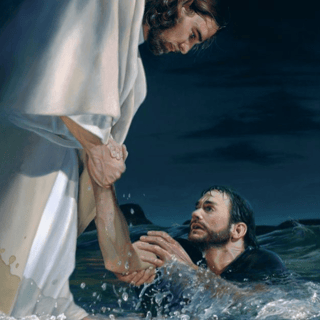
Speaker: And Jesus and his disciples are on a ship in a boat.
Speaker: And Jesus has fallen asleep in the rear of the boat.
Speaker: And it starts to become very stormy.
Speaker: And the disciples are scared.
Speaker: And I'm sorry, I am...
Speaker: Just pulling it up.
Speaker: And I think, and so they wake the Savior and they say to him, Master, care us not that we perish.
Speaker: This is in Mark 4, 37 through 40.
Speaker: And I really love this story because I think it resonates with all of us.
Speaker: I think there are times in all of our lives when we think or say, you know, don't you care that this is happening to me?
Speaker: And I think it's easy to become convinced that
Speaker: of however momentarily that God is asleep.
Speaker: And so we then rashly jump to conclusions that he doesn't know, so the equivalent of sleeping, or he doesn't care.
Speaker: Master cares not that we perish.
Speaker: But then the Savior awakes and he rebukes the sea and he says, peace be still.
Speaker: And the wind ceases and there is a great calm.
Speaker: And he says unto them, why are you so fearful?
Speaker: How is it that you have no faith?
Speaker: And I think...
Speaker: Oftentimes in times of fear and uncertainty, we often, we often lose momentarily that faith that all will be well.
Speaker: Um,
Speaker: There's this Emily Dickinson poem that I really love and I'm going to read it to you.
Speaker: It's a poem in which she imagines a future where she would have a personal interview with the Savior.
Speaker: This is what it says.
Speaker: It says, I shall know why when time is over and I have ceased to wonder why Christ will explain each separate anguish in the fair schoolroom of the sky.
Speaker: He will tell me what Peter promised, and I for wonder at his woe.
Speaker: I shall forget the drop of anguish that scalds me now, that scalds me now.
Speaker: And I think the key here is that when we have faith in Christ, we know that our stories, we can know with certainty that our stories will have happy endings, even if it's in the next life.
Speaker: And I just want to close with any thoughts from you, Will, and then this quote.
Speaker: Let me read this quote from Janelle Elmer.
Speaker: End with a quote.
Speaker: That sounds great.
Speaker: It says,
Speaker: besides us and often, I believe, weeps with us as sorrow and hardships transpire in his imperfect beloved world.
Speaker: The key is not to become myopic and see only what is right in front of you, just the beautiful or only the terrible and draw narrow and incorrect conclusions.
Speaker: It is a mark of spiritual maturity to be able to hold both of these truths in your heart at the same time.
Speaker: And it is a tested faith that is able to weather these paradoxes leading upon the Lord's pronouncements
Speaker: that his ways are not our ways and his thoughts are not our thoughts.
Speaker: Close quote.
Speaker: The last thing I just want to say here is,
Speaker: that I think when our faith is tested and when we're fearful, which is just part of the human condition, when we look to Christ, we can find peace.
Speaker: And it might not be peace in the way that we expected it or peace in the way that we want it, but we can find it.
Speaker: And I am very grateful for that.
Speaker: Awesome.
Speaker: Thank you for sharing that.
Speaker: And thanks for joining me.
Speaker: We'll close up here and we look forward to being able to share some thoughts next week.
Speaker: So thanks for joining us and everyone who did.