Transcript
Speaker: All right, welcome to this week's Come Follow Me episode.
Speaker: It is the March 27th through April 2nd, right before the Easter holiday, and we're going to cover Matthew 14, Mark 6, and John 5 through 6.
Speaker: And before I throw it over to you, Cassie, I'll just give a brief summary of what goes on in these chapters today.
Speaker: There's a few things.
Speaker: Jesus sends the 12 out on missions.
Speaker: They go out two by two.
Speaker: John the Baptist is beheaded by Herod.
Speaker: We have the story there.
Speaker: The Lord preaches to and feeds the 5,000.
Speaker: And then he sends out his apostles onto the boat to cross the lake and goes out to meet them and walks on water and
Speaker: there's a lot of other healing and miracles that go on and, and there's a lot to talk about.
Speaker: So I'll toss it over to you, Cass, and we can get started.
Speaker: Yeah.
Speaker: I actually think, well, you should go ahead and start in Mark 6, 48.
Speaker: Mark 6, 48.
Speaker: All right.
Speaker: I'll read it for us and we can pick up from there.
Speaker: Mark 6, 48.
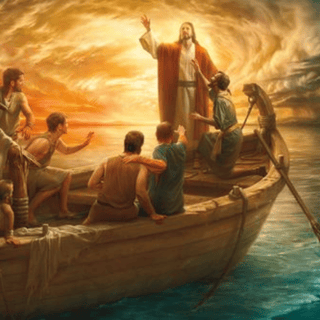
Speaker: So this is talking about Peter and about the story of, of Christ going out to the apostles as they're rowing on the boats.
Speaker: And,
Speaker: They're rowing on the boat and the winds and tempests are blowing.
Speaker: And a little bit of context for this and just great context if you watch season three of The Chosen.
Speaker: But the context is that Jesus had just preached to the 5,000 and then fed them.
Speaker: It's been a long couple days of teaching them.
Speaker: He just found out that his cousin John the Baptist was beheaded, and the apostles are trying to cross the lake to get back to Capernaum.
Speaker: And they have about an eight-mile row of the boats, and they're trying to do it over the course of the night.
Speaker: Yeah.
Speaker: And what happens is Mark 6, verse 48, and it says, And he saw them toiling and rowing, for the wind was contrary unto them, and about the fourth watch of the night he cometh unto them, walking upon the sea, and would have passed by them.
Speaker: And what I love about this, and I'm sure Cassie will pick up on where I leave off, is about the fourth watch of the night.
Speaker: So the apostles, we don't know when they set off, but the fourth watch of the night is between
Speaker: 3 a.m.
Speaker: and 6 a.m.
Speaker: So the first watch is 6 p.m.
Speaker: to 9 p.m.
Speaker: And then the second watch is 9 p.m.
Speaker: to 12 a.m.
Speaker: The third watch is 12 a.m.
Speaker: to 3 a.m.
Speaker: And the fourth watch is 3 a.m.
Speaker: to 6 a.m.
Speaker: So if we presume that they started sometime in the first watch, their trip across the lake, that means they've been rowing for something like eight, nine hours, maybe.
Speaker: Yeah.
Speaker: Which is really intriguing, I think.
Speaker: And I'm interested to hear your perspective, Cassie, about, you know, why Christ waited so long to come to their aid to walk on water and to calm the seas.
Speaker: Yeah, I mean, I think.
Speaker: It's to teach a lesson.
Speaker: I think... It usually is.
Speaker: Yeah.
Speaker: I think that often when we seek the Lord's assistance, and not even always when we seek it, I think asking for help in itself is a humbling act, and that's a reason why it's so important that we...
Speaker: And the gospel is so focused on like asking for things like asking you should receive.
Speaker: But even in situations where you don't necessarily ask for, but you still receive the Lord's assistance.
Speaker: I think you don't always first receive it when you expect to or when you necessarily want to.
Speaker: And often you don't receive it in the way that you want to either.
Speaker: But I think I really love this fourth watch idea because it's
Speaker: Really, the Lord's mercies and miracles, they come in his way and on his timetable.
Speaker: And so in this situation, it didn't come till near dawn.
Speaker: They'd been doing this all night.
Speaker: But he did come.
Speaker: And I think that's the point.
Speaker: He will come.
Speaker: Maybe just not when we had when he when we ideally wanted him to.
Speaker: That's a great point.
Speaker: And, you know, there's an interesting list that I have here of things that happened during the fourth watch in the Bible.
Speaker: There's Jacob wrestled with God and met him face to face.
Speaker: Moses led the Israelites across the Red Sea.
Speaker: Gideon defeated the Midianites in the fourth watch.
Speaker: Peter and Jesus, this story, right?
Speaker: They walk on water.
Speaker: The angels appear to the shepherds in the field to announce the birth of the Savior in the fourth watch.
Speaker: Jesus is resurrected from the dead in the fourth watch.
Speaker: The bridegroom woes his bride.
Speaker: or in the fourth watch, right?
Speaker: So that's a great point that, you know, we don't know the timing of some of the events of our life.
Speaker: And I think it's really interesting how quickly things can change.
Speaker: But the lesson here is about waiting on the Lord.
Speaker: And I'm sure there's a great talk by Elder Holland about waiting on the Lord.
Speaker: And part of waiting on the Lord is recognizing that we don't know
Speaker: at what watch, you know, Christ is going to come and Christ is going to perform a miracle.
Speaker: Cassie, you're fine moving on to the actual walking on water.
Speaker: Yeah, I just actually wanted to add one thing.
Speaker: So what I think is really interesting, and obviously these scriptures have been translated into English and before that Greek and before that probably Hebrew.
Speaker: So there's a lot of translations here, but I think the actual sentence.
Speaker: Aramaic too.
Speaker: Yeah, I think the actual sentence structure of verse 48 is super interesting because it says, and he saw them toiling in rowing, semicolon, for the wind was contrary unto them, colon,
Speaker: And about the fourth watch of night, he cometh unto them, comma.
Speaker: So I don't think if you take a semicolon and a colon, how you think about it in English, that's a pause.
Speaker: So I don't think it's that Christ awoke on the fourth watch of the night.
Speaker: And that's when he noticed them.
Speaker: I think he saw them the whole time toiling.
Speaker: The whole time he sees us and he sees our trials, but when he chooses to appear, and he will appear, but when he chooses to appear is significant.
Speaker: And that's why I think the fourth watch here thing is so important.
Speaker: That's a great insight from a liberal arts major.
Speaker: I don't know what we'd do without... Social science.
Speaker: Thank you.
Speaker: Without your field of study, we'd be in a bad state, is my point, I guess.
Speaker: Okay, let's jump into that.
Speaker: That is a great point, though.
Speaker: Let's jump into the actual miracle that then happens, is Christ walks across the water to where they are, and
Speaker: And I mean, you could even add into this a point they've been rowing for a while and yeah, they're not moving a lot because of the, of the wind, but they're probably, I'm sure they would have turned around by now if they weren't getting a little bit of progress.
Speaker: They're probably a couple of miles out there, right?
Speaker: So, so Christ is,
Speaker: I mean, he has a long walk to get to them.
Speaker: So there are events here that are planned, right?
Speaker: And the timing is very, you know, while we don't know the timing of all things, like Christ does know the timing.
Speaker: And events are put into place in advance to necessitate, you know, when they need to happen.
Speaker: But the actual miracle I think is amazing because of the context.
Speaker: And I didn't realize this until I watched the episode of The Chosen about it, which is these 12 apostles who are in the boat had just seen an amazing miracle.
Speaker: Like there was 5,000 people who were listening to a couple days preaching by the Savior.
Speaker: They were hungry.
Speaker: They were tired.
Speaker: And all they had was five loaves and two fishes, which would feed maybe one family.
Speaker: And by some miracle, and I mean, we don't even try to explain how it happened.
Speaker: But in the episode, Christ has them gather baskets, and then the baskets fill up with fish and with loaves of bread.
Speaker: But the amazing thing is they just saw this fantastic miracle of multiplying food where Christ just has pure power over the elements.
Speaker: Yet when he comes to them, they're nervous and they're scared and they're like, oh, it's a spirit.
Speaker: And even when they find out it's him, I think it's really interesting that the only one of them that has the faith and courage to
Speaker: to actually go and walk on the water and go to Christ.
Speaker: A lot of the symbolism I think of walking on the water isn't so much walking on the water, it's that Christ is on the water and Christ is amidst the storm and waves.
Speaker: And while the boat is the thing that traditionally seems like shelter and like safety from that, he ventures out into the waves, into the storm, because that's where Christ is and that's where he knows he'll be safe.
Speaker: But it's amazing that amidst all that, Peter's the only one who has the faith to do it.
Speaker: And at least in the episode of The Chosen, which I keep referencing, all the other apostles are like, no, don't do it.
Speaker: And they're trying to talk him out of it.
Speaker: I don't know where I'm going with this, Cassie, other than I just think it's an amazing—well, it shows two things.
Speaker: It's one, that it's really hard, and it's a process of developing faith.
Speaker: You can see miracles, but it takes time to really understand the overarching majesty and power and strength that comes from the Savior to do all things.
Speaker: And the apostles didn't even realize that yet, is that Christ had power over everything and has power over everything.
Speaker: Yeah.
Speaker: But a second point to that is if we exercise faith, if we yoke ourselves to the Savior, like he actually says in this sermon, in this chapter, we're pulling with his strength, not with our own.
Speaker: Yeah, I actually love that you brought up the faith of Peter because in the past when I've always thought about this scripture, what has always stood out to me more than the fact that Peter walked on water is the fact that Jesus rebukes him by saying, oh, they have little faith when he starts to fall.
Speaker: But I think what's...
Speaker: I think that's a poor way to look at it because you have to think about like how much faith it took him to step out of that boat.
Speaker: And the other thing that I didn't really pick up on until recently was,
Speaker: is there's a storm going on when Peter steps out of the boat.
Speaker: It's not just like he's walking towards the savior and suddenly the storm comes up and it distracts him.
Speaker: No, the storm was always going on.
Speaker: There was a storm when he stepped out of the boat.
Speaker: And so I think you just have to think about how much faith it took for Peter to step out.
Speaker: Um,
Speaker: And it's really an example that he had the faith to rely on the Savior.
Speaker: And another thing that I think is really interesting here is it says in 30, Matthew, it's in Matthew 14, 30.
Speaker: It says, talking about Peter, it says beginning to sink.
Speaker: It didn't say he sunk, like he's beginning to sink.
Speaker: So I think that, I don't think he lost his faith, but he maybe had a little doubt or he was a little bit distracted.
Speaker: And so in the past, I've always looked at this in extremes, but I really don't think it's that way.
Speaker: And the other thing I think that's interesting about this is you were talking about we don't know how far the Savior has walked.
Speaker: Presumably quite a ways if he like is walking out towards them.
Speaker: But then it also makes you wonder, like, how far did Peter walk?
Speaker: because when he does start to fall, the Savior reaches out and grabs him.
Speaker: And so he couldn't have been that far from the Savior for the Savior to be able to pull him up like that.
Speaker: So it's just something interesting to think about.
Speaker: And obviously we don't have an answer to, but.
Speaker: Well, even if he was far from the Savior, I think we can make the argument too that your distance from Christ doesn't inhibit his ability to reach out and pull us up.
Speaker: Yeah, that's true.
Speaker: I would say that the better point here is that distance doesn't matter.
Speaker: It doesn't matter if you are very close to Christ and you still have some doubt, he can still pick you up.
Speaker: Or if you're very far from Christ, he can still lift you up.
Speaker: Yeah, and the other obvious point that I think we glossed over a little bit, you touched on, was that when Peter's eyes were on the Savior, he was walking on water.
Speaker: And it's when he looked around and saw the waves and the tempest and the winds, that's when he started to sink.
Speaker: And that's a great metaphor for us.
Speaker: That doesn't matter what our circumstances or what's going on around us.
Speaker: If we keep our eyes focused on the prize and focused on Christ, you know, we're going to be safe.
Speaker: I think there's just one more thing I wanted to touch on here, Will, is back in Mark 6.
Speaker: So Mark 6, verse 40, when...
Speaker: The disciples see Christ.
Speaker: This is before Peter walked.
Speaker: He says to them, be of good cheer.
Speaker: It is I. Be not afraid.
Speaker: And what I really like about this is that it is I. And I think what's really interesting about the scriptures and the gospels do it in different ways.
Speaker: And Mark, you see a lot of skepticism on the behalf of the disciples of like, who is Christ?
Speaker: But he continues to introduce himself.
Speaker: And it's almost like, at least in Mark, they continue to be surprised about who he is.
Speaker: And he's never really quite what they expect.
Speaker: And it made me think about how many times in my life am I surprised by Christ?
Speaker: Or how many times in my life do things happen and I don't...
Speaker: correctly attribute it to being a tender mercy or I don't correctly attribute it to being like the hand of God because that's not really what I'm expecting from him.
Speaker: And so I don't think of it that way.
Speaker: And so that was just something.
Speaker: I mean, if you think about, you know, what these apostles are expecting and experiencing and what everyone is experiencing, everything Christ is saying is really not expected by them.
Speaker: And Matthew tries to help us see some of the parallels between the Old Testament prophecies of the Messiah and Jesus' fulfillment of them.
Speaker: But in many ways, the teachings and mission of the Savior were not what the Jews were expecting.
Speaker: And I guess we could get into like, they were expecting a military leader to come and conquer Rome.
Speaker: Yeah.
Speaker: But even breaking down his actual message that the gospel was extended to all and all were welcome at the feast, that was not the prevailing sentiment amongst the Jews, the chosen people of the time.
Speaker: The sentiment was that they were God's people and that they were the sons of Abraham and that they had
Speaker: had the rights of the kingdom.
Speaker: And Christ came and flipped that on its head and said, it doesn't matter who you are, who your father is.
Speaker: John the Baptist said this to the Pharisees as well, but bring forth fruits, meet for repentance and believe in me, believe in my ability to save you.
Speaker: And that would be a really hard thing to hear coming from a guy, I think just standing in front of you saying, I'm
Speaker: the way to salvation isn't what you've learned your entire life.
Speaker: It's not, it's not based on your lineage in the house of Israel.
Speaker: It's based on whether or not you believe in, in, in me and in my ability.
Speaker: And obviously I'm speaking from the savior's point of view.
Speaker: Um, but it's, it's really, it makes you admire the faith of these people even more.
Speaker: Yeah, I think that's great.
Speaker: Well, why don't we cut it there, Cassie?
Speaker: I think we covered most of what goes on in these chapters.
Speaker: There's a little bit more to study about John the Baptist and about Jesus' teachings on the Sabbath.
Speaker: But I really appreciate your insight and perspective on Peter and Peter's faith and walking on water and keeping our gaze and our faith focused on the Savior, regardless of where things stand in the world.
Speaker: So we'll call it there then.
Speaker: Thanks for joining me, Cass.
Speaker: See you, Will.