Transcript
Speaker: Welcome to the Solarpreneur Podcast, where we teach you to take your solar business to the next level.
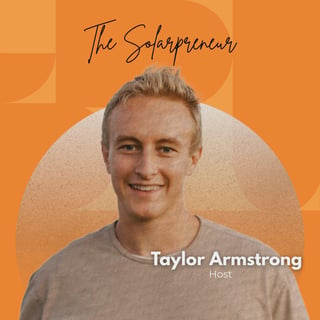
Speaker: My name is Taylor Armstrong.
Speaker: I went from $50 in my bank account and struggling for groceries to closing 150 deals in a year and cracking the code on why sales reps fell.
Speaker: I teach you how to avoid the mistakes I made and bring in the top solar dogs of the industry to let you in on the secrets of generating more leads, falling up like a pro, and closing more deals.
Speaker: What is a solarpreneur, you might ask?
Speaker: A solarpreneur is a new breed of solar pro that is willing to do whatever it takes to achieve mastery, and you are about to become one.
Speaker: Today on the Solarpreneur Podcast, three tips to avoid a burnout and how to last forever in solar cells.
Speaker: That's what we're going to be talking about.
Speaker: My name is Taylor Armstrong.
Speaker: As usual, here to help you close more deals, generate more leads and referrals, and hopefully have a much better time in the solar industry.
Speaker: I apologize if my voice is a little off today.
Speaker: I've been having some spring allergies, so that's why it sounds a little bit different, if you notice.
Speaker: But we're going to get after it, and I'm actually shooting this podcast for
Speaker: from Utah getting ready to go to Solarcon.
Speaker: So by the time you hear this, we will be at Solarcon.
Speaker: Hopefully you can come say hi or hey, if you're not piling on going, grab your ticket, come for the last day at least.
Speaker: Come jet on down.
Speaker: But excited to be coming with you, dropping some heat.
Speaker: And we got an interesting topic today, something I've been thinking about.
Speaker: And if you've been in this industry for any amount of time, it's likely that you've seen dozens and dozens of people probably quit this job, probably not last.
Speaker: Especially if you're bringing in local recruits, if you're using ZipRecruiter, Indeed.
Speaker: Those people, they just fly in and out.
Speaker: A lot of them don't last very long.
Speaker: So if you're just starting this journey, you might be wondering how you last so long in the industry.
Speaker: There's insane money in this, but if you don't have the level of focus, if you don't constantly improve your craft, if you don't do what it takes every day, then you're not going to be making the money that you want and deserve.
Speaker: And it's likely that you will get those feelings of burnout.
Speaker: So I think one of the best solutions for burnout
Speaker: is just go out and crush it.
Speaker: I mean, are you really going to burn out if you see $10,000 coming in every week?
Speaker: Probably not.
Speaker: I don't know.
Speaker: At least it'd be tougher to, right?
Speaker: It's tough to give up that kind of dough.
Speaker: But we're going to go over some specific things that can help.
Speaker: And another thing that got me thinking about this is the guest that we have coming up on next podcast, which you won't want to miss out on.
Speaker: That's Kenny Crosby.
Speaker: He's been doing this for 14 years now.
Speaker: He is the CEO of Home Nerds, their company out of Florida.
Speaker: He runs that with Taylor McCarthy, actually.
Speaker: They're kind of like Batman and Robin over there.
Speaker: So he's been doing this forever.
Speaker: He had some really cool thoughts on how he's been able to last so long and just always be grinding on the doors.
Speaker: So don't miss out on that one where we're going to go even deeper in on this, but just wanted to share a few of my thoughts before we do that podcast.
Speaker: So I've got three specific things.
Speaker: And some of them I'm actively working on.
Speaker: I am not great at all of these, but it's something that I realize I'm trying to work on.
Speaker: I know it's going to help me not have as many feelings of burnout, not have as many feelings of being lazy out there.
Speaker: So here's what we got.
Speaker: The first one is set specific times where you're away from work.
Speaker: I think so many of us in solar, we get home, we get a call from a customer, we get a text from a customer, we get a call from our manager, we get, I don't know, there's so many notifications coming in.
Speaker: And what are we doing when we accept call after call after call when we're home?
Speaker: Maybe it's when we're trying to do workouts.
Speaker: Maybe it's when we're trying to spend time with significant other, wife, kids, husband, whatever.
Speaker: And we're letting these distractions come in.
Speaker: What are we doing?
Speaker: We're letting other people control us.
Speaker: We're letting other people control our day.
Speaker: And a lot of times we're handling things that are urgent but not important.
Speaker: If you have not read Stephen Covey's Seven Habits of Highly Effective People, he has his quadrant of tasks.
Speaker: And it's basically divided into four sections.
Speaker: And it's urgent...
Speaker: but important urgent but not important and Then he says that kind of divided into four sections.
Speaker: So go check that out if you have it But how many of us are focusing time on things that are not important and not urgent?
Speaker: Because the truth is a lot of times these notifications are yeah a lot of times maybe customers people hitting us up after we're done working and
Speaker: Sometimes they're not urgent and they're not important.
Speaker: So do we really need to handle these tasks?
Speaker: Probably not.
Speaker: So this is something, again, that I am definitely not perfect on trying to improve on this.
Speaker: And so something that is really cool, if you haven't checked it out already, iPhone has a feature.
Speaker: Hopefully you're all using an iPhone.
Speaker: If you're using Android, throw that thing in the trash.
Speaker: Go get yourself an iPhone.
Speaker: I'm just kidding, but seriously.
Speaker: iPhones are better but they have a feature where now you can set focus and you should be able to go into your settings you can actually set it up you can set up a personal focus a work focus a sleep focus and what it is there's essentially different settings in there where you can handle the notifications that come in and you can basically tell it what you want
Speaker: to happen during those hours.
Speaker: So if you set up a personal focus, maybe you set so you're not bothered by any notifications.
Speaker: And so this is something that's super powerful.
Speaker: It's just if we can figure out how to not let work control us, but us control work, we're going to be that much more focused, that much more productive, and we're going to feel like we're in control of the day.
Speaker: We're going to feel like we can last a lot longer when we're in control of all those things.
Speaker: That's the first tip.
Speaker: Just set those specific times.
Speaker: And you can still work a lot.
Speaker: Work those 12-hour days if you want.
Speaker: But when you get done, set up those blockers.
Speaker: Just have a stop where you are not just constantly thinking about work.
Speaker: That's going to help you last a lot longer.
Speaker: That's the first tip.
Speaker: The second one is this.
Speaker: When I was, as many of you know, I did LDS Church Mission.
Speaker: They sent us down to Columbia.
Speaker: And in these missions, if you haven't heard, we're two years out there.
Speaker: And we had, we were doing our, you know, prospecting.
Speaker: They call it proselyting.
Speaker: But just contacting people, giving lessons, all that for six days during the week.
Speaker: And we had one day, it was called P-Day, preparation day.
Speaker: They give you that day to just kind of handle your stuff.
Speaker: Basically do whatever you want for the majority of the day.
Speaker: And this day, what I started noticing in the beginning of my mission, I would take this day, I'd take a nap, I'd hang out, maybe just go buy some food.
Speaker: And this day it went so fast.
Speaker: It was like done instantly.
Speaker: Like, we already have to go start teaching lessons again.
Speaker: Felt like 10 minutes.
Speaker: And that was how it went for probably, you know, depending on who I was with, but for a lot of times, kind of in the beginning of my mission.
Speaker: But then what we started doing, instead of just sitting around and taking a nap, whatever, on this P-Date, we decided, all right, let's go do something interesting.
Speaker: Let's go do something fun.
Speaker: Let's go check out this city, go on this hike, go to this museum.
Speaker: We started doing that instead of just sitting around.
Speaker: And what I realized is not only did I make a cool memory and get out and do something, but this day it felt like it lasted longer and it just felt like a lot more fulfilling.
Speaker: When I got done, I felt like I actually did something cool on the week and I actually felt less tired than me taking a nap.
Speaker: It gave me more energy doing this.
Speaker: So the point of that is, well first of all, I think you should be taking one full day off working.
Speaker: Even if you're doing a blitz in solar, even if you're going hard in a competition, I still think you should take the day off.
Speaker: Maybe some people are machines, maybe some people can go seven days straight and be fine, but I am not one of those people.
Speaker: Even during a competition, I will take the day off.
Speaker: Okay, so...
Speaker: Yes, that's my Achilles heel if you're in a competition with me So I suggest I always take at least Sunday off, you know go to church and all that But for this one day off a week that you're hopefully taking Again shut everything down try not to think about work Try not to you know have to handle notifications and all that But number two consider doing something cool.
Speaker: Don't just sit around and
Speaker: and get out and do something.
Speaker: Get out and contrast compared to the other days.
Speaker: Because every day you're going to rest, right?
Speaker: You're going to get your sleep.
Speaker: Every day you're going to probably, I don't know, watch some Netflix for a little bit.
Speaker: But you're not going to get out and do something probably every day.
Speaker: So especially if you're just doing solar for a summer, I think there's this key.
Speaker: Get out and go explore your city, do something cool.
Speaker: But think about doing something that is relaxing.
Speaker: I don't know, some guys I learned from Danny Pizzi, he likes to go to the Korean bathhouses, which is like this Korean spa with all these saunas.
Speaker: Some people is going to get a massage.
Speaker: So maybe you're doing something that relaxes you, deep meditation, but just get out and do something different.
Speaker: So that way you can contrast on that one day.
Speaker: You have something to look forward to and it's not just the same thing over and over.
Speaker: That's tip number two.
Speaker: Do something interesting, relaxing, or fun on your day off.
Speaker: Don't just sit around.
Speaker: And then the last thing I got here, this is just on a day-to-day basis.
Speaker: And that is take breaks during your work hours, right?
Speaker: So when you're out there, I talk about knocking mostly because that's what I'm doing every day.
Speaker: But whether you're just on calls or in appointments, take breaks during your prospecting, knocking appointments.
Speaker: Just take some breaks during it, right?
Speaker: For me, I cannot go.
Speaker: Usually more than like three, four hours max knocking.
Speaker: I need to take a little bit of break.
Speaker: between those hours.
Speaker: And I'm old, I've been doing this a long time, so probably, I mean, I could go longer than that, but it just helps me a lot to have a little mental reset.
Speaker: So something that I really like, I learned this from my first VP of sales at the company I worked for, Rob Reimer was the guy's name.
Speaker: But what he taught us is to divide our knocking hours, or whenever we're working, into halves.
Speaker: And he compared it to like a basketball game.
Speaker: college basketball.
Speaker: So you think they got two halves.
Speaker: What are they doing after the first half?
Speaker: They're going to the locker room.
Speaker: They're hopefully catching their breath, recharging a little bit.
Speaker: So this is something I think about when I'm out there grinding is I'm going to push hard for that first half.
Speaker: I'm going to go to halftime, go into my locker room, which is, you know, maybe by my car, maybe the nearest tree, bush, whatever, hang out.
Speaker: And what I do grab a little snack sometimes do a little meditation just recharge reset get ready to go all back out there And so I think that is cool and it helps me to think about like that if you're a sports guy Another cool thing this is from Taylor McCarthy
Speaker: He does, his schedule is this.
Speaker: He does everything before 12 is bonus time.
Speaker: He's out there knocking.
Speaker: And then what he does, he divides his prospecting into three shifts.
Speaker: So the first time it's 12 to 3.
Speaker: Shift 2 is 3 to 6.
Speaker: Shift 3 is 6 to 9.
Speaker: And same thing, he's doing a little reset after each shift.
Speaker: He fills his cooler fold.
Speaker: before he goes out and he goes and gets ice, fills the core full of drinks, that way he's not needing to go out and leave his area.
Speaker: He's just going back, grabbing a drink, recharging, resetting, and getting out for the next shift.
Speaker: So I think it's super powerful.
Speaker: Think of your knocking day in shifts, right?
Speaker: Or think of it as a basketball game, football game, a gymnastics match, whatever your favorite sport is, they all have periods where they're going to take a little reset, right?
Speaker: So hopefully these things helped.
Speaker: A couple tips to have some more longevity to avoid burnout and just have fun out there.
Speaker: Guys, there is no other opportunity that I know of where we can make this insane money and just be out there trick-or-treating for free for money, right?
Speaker: Or we just finished up with Easter.
Speaker: Easter egg carton for money out there.
Speaker: That's all we're doing.
Speaker: If you think of it that way, you're going to have fun.
Speaker: you're gonna make a ton of money and you're gonna last in this industry.
Speaker: So I hope those couple things helped.
Speaker: Don't miss out on next episode where we have Kenny Crosby
Speaker: really diving deeper on how you can last 14 plus years in this industry and grow and continue to get better and better.
Speaker: So that's what we're going to be jamming on on the next episode of the podcast.
Speaker: Hope you enjoyed this.
Speaker: Send it to someone that is struggling right now.
Speaker: And hopefully we'll see you at SolarCon.
Speaker: If not, we'll talk to you on the next episode.
Speaker: What's up, solopreneurs?
Speaker: Hope you enjoyed the episode.
Speaker: Before you run out and start selling more solar yourself, wanted to let you know about an exciting new cheat sheet we created specifically for you in mind.
Speaker: One of the top questions I get asked on Instagram, on Facebook, by our listeners is, Taylor, where should I start?
Speaker: What episodes should I listen to in the podcast?
Speaker: And
Speaker: You got too many podcasts, man, because now we have over 200 episodes.
Speaker: So what we've done, we created the top 10 most downloaded, most listened to, and I would say widely accepted, most useful podcasts that we've done here on Solopreneur.
Speaker: We put them together all in one sheet so you can go, you can hit the ground running, especially if you're new, you do not want to not have this sheet.
Speaker: So go download it right now.
Speaker: It's going to be at top10.solarpreneurs.com.
Speaker: Again, that's top10, the number 10,.solarpreneurs.com.
Speaker: Don't forget the S on solarpreneurs.
Speaker: We will have that in the show notes.
Speaker: Go download it right now.
Speaker: And especially if you have not listened to them, go listen to them and you can re-listen to them.
Speaker: That's going to show you how.
Speaker: So go download it and we'll see you on the other side.