Transcript
Speaker: Welcome to a special edition of Between Two Foils. Between Two Foils, yeah. On the Foil the Flow Radio Network. Yeah. I'm Jeff.
Speaker: Seth. Friends, foilers, frothers.
Speaker: Frenemies. I have to admit, and God damn it, I've been holding out for so long. Ah, the foil assist is a discipline in foiling. Wait, can I get this in recording? Oh, we are recording.
Speaker: yeah I really held out a long time against this. Okay, so we swayed from you have to be geriatric and incompetent and not good at anything else. Elderly, an invalid, a non-ealer. It has a place in your home.
Speaker: Go on, tell me more. i have to admit it does. There's times when this is the best option. ah the fo The powered foil is the best option in many cases. Telling me we don't have to call it foil assist?
Speaker: What do you, what you been calling it? be It's going to be like the rascal scooter. He's the leader of the pack. You've been wanting to work that in. I want to call it power foiling or motor foiling, anything but a foil assist. Although it is literally assisting the foil, particularly on days today. this is our first session together.
Speaker: wind. Power foiling. No wind, therefore no wind powered options. Definitely had the most fun we possibly could have on that lake of an ocean. Could not have winged it. There was a there was at least one waist high set.
Speaker: I think that came off the canoe. That came off the canoe that passed this. Probably. So why did you resist so long? Same same reasons as as anybody intelligent intelligent, I think. Not to discount anybody that ran out there and bought one straight away because you've got to have those lemmings.
Speaker: That's true. I wanted to see the batteries come along, the technology get a little further, the maintenance to get a little less, the prices to come down, the power to come up, the modularity to be actually modular. The prices haven't come down considerably ah compared to an e-foil. Compared to a lift default it's, it's cheap.
Speaker: That's true. And, and it you know, and you, when you weigh that up to like today, I could have spent a lot of time and energy, which calculates to me as money trying to do a whole lot of other things unsuccessfully. You could have just sanded your foil today.
Speaker: That would have been fun. No, right. Fine. It is still expensive, but ah the whole argument that it's too expensive is bullshit because I just went over to the continent and I didn't see a single kid pedaling a bike. That's true. They were on multi-thousand dollar electric bikes.
Speaker: That's right. the whole too expensive thing, even for youth, is bullshit. If you want it, you will buy it. You will buy it because it's fun and you're going to do circles around everybody else that's not having fun.
Speaker: So my option, I guess, today would be to ah paddle into some lackluster waves, go to a gym or run o or or do powered foiling. I mean, come on now.
Speaker: Before my um my my argument that, oh, no, I want to work out. yeah I don't want to work out for no pound, though. I don't want to go out and paddle for no reason and catch basically nothing. I mean, we had, there's like 20 people out there in the break.
Speaker: catching, they caught a grand total of three waves yeah right now. Not much. And we stayed outside of them. We stayed on the shoulder and they still weren't catching. Oh, no, no, no. I felt like i at least had to go through the, charge through the lineup at least once. Okay, we're going to to talk about etiquette now. Just to... Before we get into etiquette, we did talk about it being expensive a little bit. People wonder and they're going automatically ask, well, how much is expensive?
Speaker: Retailing right now for the starter kit unit is right around $5,000. Yeah, for if you want to get the... smaller smaller batteries and the standard charger and whatever else. It's full starter kit, about five grand. But it's BYOF.
Speaker: Bring your own foil. Oh yeah, yeah, sure. So you can't forget that part. So that's giving the But do need, you have basically the slick, one of the slickest foils out there right now, I feel. I think so. I have probably one of the cheapest foils you can get out there right now.
Speaker: Did it matter today ah Maybe a little bit. youli You were gliding a little more than me, for sure. But it's also you you have a few more sessions in. I'm still trying to figure out when to take off the battery or take off the power on the trigger and when not to.
Speaker: But you could go with a a fairly simple older model foil set and get a hell of a lot of enjoyment, almost as much enjoyment. and But you can't enjoy that foil until you're actually put in some time. Yeah.
Speaker: I'm glad you said that because you started this whole talk by saying that it's a discipline and we joked, but it it took me, there was a learning curve. I've been winging and before that I was a surfer. And before that I didn't have much wind sports knowledge. So each one of these things that I tried to get into with the foil had a learning curve. Yeah. This was the easiest one though. I'm going to go ahead and say that. And one of the things that I want to point out that I didn't really understand when I was waiting to get on board with a motor was that it could actually be a tool for all of the disciplines that i want to get better at. That's true. Yeah.
Speaker: So not only can I learn to foil. the easiest practice the other disciplines. Right. So not only can I learn to foil with this, I can also learn all the other foiling disciplines. Maybe we should talk about what it is that you're you're you're fondling right there.
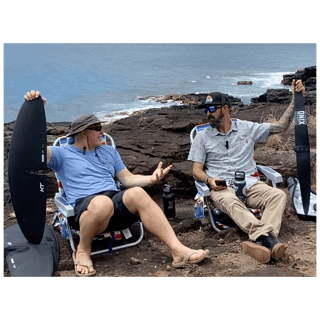
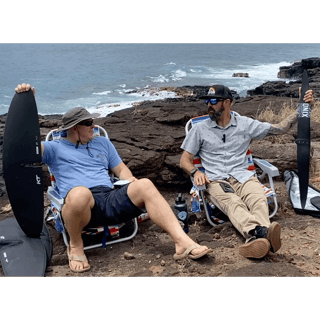
Speaker: What this thing? I had to make sure it was the motor and not something else. That's true. So this is a a motor that's attached to a mast that is attached to a foil that is attached to a board, right? So we're foiling. Oh, that's a good point. Is that a special trench board?
Speaker: Oh, that's amazing. I have an extra accessory. You don't need a board. I have a backpack that I put my main unit into. This is the Manta backpack that is also compatible now with foil drive and a couple of kits as well. Same kind of a mounting plate.
Speaker: The base unit goes here, whereas you've got yours mounted under the board. and So if you want to be as close as possible to prone foiling or toe-in foiling, you go with the backpack, I think.
Speaker: Takes all the way extra weight off the board. if you want as much, if you want as easy as possible, well actually, that might be easier to set up at some point than setting up onto mounting it and everything else. Yeah, yeah, yeah it could be.
Speaker: But yeah, you can go either way. And that's one thing about the Manta and the Evo that it's easily one of the most versatile units out there ah in the foil assist division. I think that it gives you the option of either mounting it to the board or as a backpack mount.
Speaker: Now asked about a trench. I basically, one of the things that i was waiting for before I wanted to get into this is I didn't want to have to buy more equipment. A special board. At the time when I was taking an interest in this, I didn't have access to a whole lot of different gear.
Speaker: I didn't want to have to buy a special designated mast just to use with my clamp on the motor. I didn't want to have to buy a special board with a trench back dug out of it that caused my shaper a hell of a time to build. I didn't want to have to buy a bunch of extra stuff for that.
Speaker: I wanted it to be truly modular so that I could strap it and use it with whatever I already had. And I think that there's a lot of middle of the road riders out there that really just want to have modularity, be able to put it with the kit that they already have. Simplicity. Yeah. The simplicity.
Speaker: Yeah. You don't need an extra bore. You don't really need an extra mass. You don't need a specialized mads. You don't need a, uh, any other special gear, it works great with whatever board you have, works great with whatever foil you have. For the most part. Some of the issues that you can have are connectivity.
Speaker: So this remote operates on Bluetooth, communicates with your your motor unit. with your Sorry, with your main unit that straps to your board or onto my back. So there needs to be Bluetooth connectivity.
Speaker: Bluetooth does not pass through water, and it does not pass through carbon very well, as well as some other components. It does pass through foam, and it does pass through air. It'll pass through your body even. So with the main unit out of the water and on my back, zero connectivity issues. I can use it with any board. Full carbon build, no matter what, what the bill board is built out of, I can use it with that. If your back is out of the water. If my back is out of the water, correct.
Speaker: but put it underneath the board and I've got a full carbon board, you might have some connectivity issues. So they have external remote or antennas and things like that, that you can strap onto your board. Older model boards or boards a couple of years ago with less foil carbon content, this board worked perfectly, no extra thing needed. It's a couple years old.
Speaker: And then almost There's a lot of boards now, a lot of the mid-linked boards, especially the higher end mid-linked boards are doing windows. Yeah, windows, yeah. That fiberglass windows to allow the connectivity to to still go through. So you can get a new board.
Speaker: A lot of them even even but advertise it as, hey, you will have full drive connectivity or foil assist connectivity for your board. So yeah we'll have to edit out any mention of foil drive. No, no. I mean, that's essentially that's become the Coke.
Speaker: You know, like everybody calls soda Coke. That's what's happening right now. So anything with a motor that's moving around in the ocean, full drive, you did a great job. You've marketed the shit out of your product. Thank you for leading the charge.
Speaker: Now you got a tough position to defend at the top of that tower. And it's a tall tower you guys have built. Data max. What sets Manta apart? I'm so glad you asked. Thank you. ah Power. I'm going to put power at the top of the list.
Speaker: So a lot of these units, they've taken some development. Again, thank you for some of those kits that came out earlier because you had to do a lot of- you remember the kit on the where people would lay on top of the battery box or our friend Mark would actually use an inflatable board or carved a box into his board yeah in order to put the battery box in and then the battery box would leak. And also nearly burnt down his house. Oh yeah, a few other through times. So yeah, there's some there's some things that come with- It's been through many iterations in the past few years. yeah yeah
Speaker: So power is a big one up until they put out the Manta, put out this Evo. There were a lot of Hawaiians, particularly we're on Kauai. There was a lot of bigger guys, 200 pounds plus that could not get these things going up out of the water unless you're huge boards and huge foils.
Speaker: But we've got powerful conditions here. So we want to use smaller boards and smaller foils. And so you're having no problems now. just So yeah, I, I tried every different iteration of the, of the previous models of, of,
Speaker: motor, right and battery combo. And I was never able to consistently get out the water unless I had a pretty big powerful wave yeah behind me. And but then I couldn't paddle, right, because I had the trigger. So it was all it was all very confusing.
Speaker: I didn't really know what I was doing. But yeah, and the very first session, sinker board 56 liter for me, I'm over 100 kilos. I didn't know what I was doing on the the Gear button, of course, but absolutely no issues whatsoever getting immediately and powerfully out of the water. On what gear? And foil. On 10. And then today on 5.
Speaker: So I was burning a lot of battery at first unnecessarily on gear 10 on my first session, not really knowing what I was doing or figuring out yet. But, yeah, now I'm on gear 5, probably 40 minutes, easily about 40-minute session ah on a sinker board.
Speaker: and getting out of water no problem. So yeah, that was awesome. So power, power number one, modularity. They are about to release their, their clamp on pod. I'm using the,
Speaker: the integrated mast, which is really nice for convenience because I've got all the adapters for different foil setups. They've got them for, for all the major foil brands. So if you do want an integrated mast, you get an integrated mast and they have a a different foot for every foil that's out there. The clamp's good, but I got to admit, you got to really take your time with it.
Speaker: You got to watch a video before you put the clamp on. ah It's a little, it's a little tricky. Let's say I can't wait for the, I guess that'd be V3. their first version of the clamp was a little, uh, was, uh, I think a little easier to use, but also, just bigger, it was bigger, bigger pieces. and just a you one They've got a strap. It's going to go around the front and and that'll be so quick to change out mass yeah like that. Yeah. This, at this point, I don't think I'd want to change out the mast very much. It's two screws that go into the pod and they're quite long and they're, they're machine screws. So you've got to thread them very carefully. And that is a drawback for sure.
Speaker: Minor, minor, minor issue, but still. So that was modularity. So we were talking about how we can use it with all kinds of different boards, light boards, small boards, big boards, trench boards. If you're really into that kind of a thing, these do fit almost all of the trench boards that have been made for foil drive.
Speaker: There's a couple out there that it's a little bit narrow. Um, and then the other thing was, uh, with compatibility was going to be air travel. There is still nobody out there that has an official battery that can,
Speaker: do air travel conveniently. There are some that are coming out. I know that there's a few that have them, but as far as convenience goes, I travel with four of these in my carry-on and each one of these is 15 to 20 minutes.
Speaker: So with two of those stacked under my unit, I've got 30 to 40 minutes. And with two sets of those, I have over an hour. Each battery is a hundred or 97 watt hours, which is the limit or a hundred watt hours is the limit to carry TSA. Yeah.
Speaker: Oftentimes you will know the rules better than the TSA people, yeah by the way. No wiring, no connections, no nothing. You just little bit of a battery grease, plug it right in and you're ready to go. Yeah. That's pretty amazing to have that modulary and, or you choose the big battery. If you're not going to be flying, you just choose the big battery and get 40, 45 minutes of, of, uh, writing time.
Speaker: No problem. Yeah. And the other thing about the motor we didn't mention though, is it's actually, Pretty much maintenance free. Yeah, that's right. yeah The other motors, I've had a few motor Cs. I had a little water go into the motor. I had to get a warranty issue with previous thing, with previous brands and previous ones.
Speaker: there there's Let's just say they weren't maintenance free. ah you see a I think you still see four-wheel drive guys spraying it down with silicone, right? So this this motor is pretty much...
Speaker: Fully sealed motor, so you just throw some water on it afterwards. Rinse it. Rinse it a little bit. You're good to go. No issues in ah years, right? Yeah. Stokes, are you entering the foilers of Aloha contest then in November? I don't. Actually, after this session, I think I could pull it off.
Speaker: But we'll see. Oh, we're going to set up a tent here. iffy if I would prove my own on on these waves or not. But I don't have much time to prepare, but we'll see.
Speaker: So we did talk about a little bit about the battery options you can use for those air batteries get a half an hour can use one of these Endurance batteries get about 40 minutes.
Speaker: You can use a combination of both But let's just talk about The the to me the elephant on the room is the elephant in the room, right? Batteries are heavy. Yeah, and we're not there yet for batteries so To me, I really, I can't wait to try the backpack option because I don't want all this weight on the board.
Speaker: And there's different things you could do to kind of maximize your battery life. You could use a bigger board. You could use a mid-length board. You could get better. Yeah. Yeah.
Speaker: Efficiency general. Or you can just come in and take a break. You could use this just only two two of those batteries, come in take a break, change out your batteries. So this kind of fits into the etiquette category too, because now that I'm getting into it, I'm about three months deep into kind of going regularly. It's nice because this one opened up glassy mornings for me where I i was a winger for the last five, almost six years now.
Speaker: I was only going out midday and pretty much choppy, windy conditions, which I got to really enjoy but I haven't had a glassy session since I became a foiler because I can't prone paddle I got neck issues so getting into my sunrise sessions was an amazing thing uh I sidetracked there for a second let's go with the uh spongebob several hours later de Efficiency.
Speaker: So that that encompasses a whole lot of things. That can be your foil size. That can be your technique. That can be your board. The more efficient you get your setup and your technique, but the longer your batteries are going to last.
Speaker: When I got into this, I definitely noticed that there were a lot of guys that would just get up on motor and they would just motor until the waves would come. You don't have to do that. You can be a surfer. You can you can wait for the sets. You can motor out to the back of the you know reef or wherever you are, the sandbar,
Speaker: sit Wait for the set. You don't have to motor the whole time. So you you can, you can stop for a second and then use the motor as an assist to get going when the set comes. So that's another really nice technique that I started adopting, especially at my local. Cause it's a lot further out. Yeah. If you are, if you're going that route, you could use a much smaller board and still use very little battery. If you're waiting for the wave to, to get you a little speed as well. Right.
Speaker: So. Additionally, on that etiquette thing, definitely giving others a chance to get a wave is good because you have a serious advantage over everybody. I'm not giving any wave to any canoe, though.
Speaker: That's it. Those guys were jerks out there today. I mean, come on now. I mean, they were charging right for us at least five it's because you just kept sitting right there and fiddling with your camera, right, where they're taking off. I mean, this is a – you know – Right away. i don't know. I think we have more maneuverability laws of the sea.
Speaker: They have law gross tonnage. If they run you over, they will win. Yeah, is accurate. All right. now Who is this Manta Evo for?
Speaker: Everybody. Okay. So we have a shark tooth guy wearing a shark tooth necklace. He has a man bun. He says he's a surfer. who Lives in the Gulf, Florida area. says he's a surfer. He does go out and sit on his surfboard, but he rides a wave storm.
Speaker: Is it for him? Yeah, it is. It's, it's, it's for him. It's for his mom. It's for his second nephew's cousins. I think his mom disowned him though.
Speaker: Good chance. Or he probably still lives with her. Who's supporting who in this case. Okay. That's a different topic. you know we We digress. You run a surf school.
Speaker: How do you feel about using this as a tool to teach people? No, this is the way to start foiling. Cause other than that, how are we doing it? ah behind a boat. yeah Yeah. Behind a boat foiling would come later in the winging.
Speaker: ah And that was the vast majority of people, unless you were really comfortable on a board, you wouldn't get very far in your first session. I think a lot of people can get foiling in their first session on this. yeah They're going to be tired. There's going to be a lot of falls, but I think a lot of people can get foiling.
Speaker: And certainly in a couple of sessions, the vast majority of people are going to be up on foil. Yeah. Yeah. The other questions that I always get are danger.
Speaker: Oh, that's a good topic. Yes. Safety wise. Yeah. You are like, as we've discussed before, the most dangerous thing for you would be to walk across this grass. That's where I hurt myself.
Speaker: Blew out my knee walking through a park just like this after skating half pipes. So how do you feel about the safety level of how much? So I don't wear the impact vest when I'm prone.
Speaker: I probably should. i do have some scars all over. Just about lost your kidney, didn't you? ah I had a, electronic order I was drawn I was drawn and quartered. Drawn and quartered by a foil.
Speaker: So, I mean, yeah, there's a there's a there's a prop here. This is a powerful motor. You could blend a margarita with that thing, no problem. You're probably going to dull the prop and it's not going to be very good for for motoring later. So, it has more than one purpose. I didn't even think of that. Yeah, good for margaritas. could blend.
Speaker: There are safety mechanisms. So, there's actually a timing device in here so that when, one, when this hits the water, it loses signal. right So that shuts the motor as well. When you take your finger off the trigger, there's like a microsecond it shuts off.
Speaker: So as long as this thing's not spinning, essentially the prop closes, you're really, really minimizing impact danger like that. You still, I still feel the stabilizers, the most scary thing on a foil. Yeah, I agree. Certainly still what I cut myself the most with is the stabilizer.
Speaker: Yeah. Yeah. Yeah. I agree. and just the fact that it's so close to the, to the board and you can put it higher, you can still put it even closer to the board for even less a chance of anybody hitting it. But the basic, there are safety measures you do. You don't turn it on when you're carrying, carrying it right next to you. You don't have the remote on otherwise your ear might become cauliflower.
Speaker: ah Any other safety tips in general? I mean, the same the basic thing of any time you fall off foil, you do a controlled fall, yeah I feel. You push away the board.
Speaker: And you don't try, if you're doing a really weird maneuver, you don't try to save the maneuver at first. Certainly when you're learning it, you don't try to save it. Oh, I can make it. I can make it. No. Just mail. Push it away.
Speaker: Do your Mario leap away from the board. That's the one. do That's the one. Yeah, yeah, yeah, you got it. You got to learn to fall. Same thing with a skateboard. You're not going to just go and nosedive, faceplant off a skateboard. You're probably going to tuck and roll a little bit, hopefully.
Speaker: and in you know Or just slide down on your knees. Okay, I'm around. Well, most everybody does the wrist. Stop it. oh Also. the Skateboarding is way more dangerous, by the way.
Speaker: Yeah, you're there's a... about a 95 chance you're going to hit the water before you hit anything else when you fall from a foil yeah anything else some other cool things like i just didn't even think about like i i got to ride on this on on a bigger day two times now and that's what i'm really excited about this winter coming towing i'm going to be using small foils and a very small board and basically self-toeing i don't need a team although it'll be fun because i'll have buddies and we can all ride waves rather than one of us towing the other one in
Speaker: Yeah, the unbroken, the the mythical unbroken wave at outer reef. Yeah. and Not only that, but getting out of getting out to the shoulder or back into the channel or something like that. If you get a a rogue set or something that comes in, you can motor out of the way, like no problem. You can also use the motor to duck dive. I did that today for the canoe.
Speaker: ah caroes coming ah So yeah, yeah, I mean, you can, you can, you could have ducked out the canoe actually, maybe with the motor. don't You really want to just kind of shallow. Yeah. i I'm not sure would sure you got some depth, but yeah, you can use the motor to duck dive too. Okay. Uh, the one other topic we didn't discuss E foil versus assist versus powered foil.
Speaker: Who's it for? What is the difference? it's blending a lot more now, I think. I don't think there's a whole lot of difference. I mean, there I still, as soon as you type foil assist, or you type power foil, you type E foil, you're going to get inundated with lifts ads of slow motion turns on a lake of the guy E foiling in a slow motion turn.
Speaker: Is there a way to avoid that those ads? No. But that is appealing to the masses. We've got to consider that while we are very radical, you know in our endeavors is way more appealing to the masses which actually brings up an interesting point we've got this guy also that's riding with us that's on a a bmx that he's converted into a foil bike uh this is also going to appeal to the masses there's a lot more people that have ridden a bike that have never seen a foil and don't live next to a coastline this might be appealing to them and don't go on the water for whatever reason right
Speaker: Um, back to the e-foils though, I would have said it was the dumbest thing ever until this summer. And then actually I went to a trade show with Manta and I put on the, the integrated e-foil mast and I can't believe how much fun I had.
Speaker: I was on flat water. I was on a lake. I was still able to ride wakes even with an e-foil mast. So the pod was still in the water and I was still able to catch waves on a tiny board with an e-foil setup.
Speaker: And it didn't feel like I was driving a Buick. Right. Which, Lyft and those guys have all come out with some really nice, really high performance E-foils, but those boards and batteries are still really heavy. 40 pounds, 45 pounds, I think is the lightest that they get. So I guess they'll use my high performance setup in an E-foil. Yeah, 70 pounds is the normal setup for an E-foil, which you don't see anybody carrying the E-foils.
Speaker: Maybe- You need a carton buggy. Yeah, they always carry the battery and then they carry the rest of the gear. Yeah. this This is, I don't know what, what's your setup. You think with the air battery 25, about 25 pounds, there's no, it's two different categories completely.
Speaker: And I would, I'm going to argue that the whole idea of this, you're going to hurt. So you see if I can just pick it up with one hand or you're probably to hurt yourself.
Speaker: There's no comparison. Really. I would argue that E foil is flat water. Maybe some boat wakes and foil drive foil assist or powered We've got to come up with a new name for the category here, I guess.
Speaker: But that is if there's waves. If you're going to play on the waves, this is the way you have to go. I think that you've just challenged me to come out with you and do a comparison side by side. While I would not really favor an E-foil setup in waves, I'm pretty sure I could pretty have have a pretty freaking good time.
Speaker: Yeah, of course. But it's twice as much money and twice as much weight. No, no, no. I mean on my E-foil setup. Gotcha. Not an actual E-foil, yeah. No, I'm arguing that you want...
Speaker: For a consumer, just looking to get into foiling and all that stuff. Somebody that completely knew, completely knew, do they go E-foil or do they go foil assist?
Speaker: I'm arguing that if you're going to be flat water, maybe catch a boat wake, E-foil is fine. You probably want that longer battery. they have They have things that you just click together. You don't need a screw.
Speaker: If there's any waves involved and you want um a faster board, more dynamic board, ah lighter weight. I think you have to go the foil assist side.
Speaker: What if I don't want to pick or choose between the two? What if I want it all, Jeff? Yeah. Yeah. Then you have a trust fund and you know i have little tar. No, have Menta. yeah Look, that's true. You could just put it down. Yeah. That's what saying. That's your argument. like this This is e-foil and foil assist all in one kit.
Speaker: right not Not with this setup, because this is the integrated mast. But with yours, they have a longer cable. You can actually put that motor right down to that foil. Slide it down right now if I needed to. And it's an e-foil. But yes, that's very true. Yeah. So you can have all of it in one kit. that's what's You just need two different cables. That is what's incredible about the Manta Evo kit here is it's easily the most modifiable kit. yeah Yeah. Fully modular, fully modular.
Speaker: Yeah. Way too many options out there. But we know that you like options because I've been down that toothpaste aisle. There are way too many options in the toothpaste aisle. All right.
Speaker: Manta Evo. Does the Evo stand for evolution? evolution yeah think that's right mati vo check it out between two foils well anybody any guest appearances no we should have had a guest appearance
Speaker: manta I've tried a lot of different Efoil assists and this one is by far the most powerful I've tried so far. What gear? And know I'm only in the half gear. How small are you? yeah I'm not, nobody has ever called me small.
Speaker: What about your board? How many liters are your board? 56 liters. It's actually a sinker for me. my i don't have to get another board. This board works awesome.
Speaker: Alright, that's it. a
Speaker: Oh, am I casting a big shadow on your head though? I don't like casting shade on people. It's not nice. Apparently that's that's that's not woke. You can't do that. Welcome to, ah what are we called?
Speaker: B2F. Best two friends. Damn it. I had a really good point.