Transcript
Speaker: I'm Jeremy. And I'm Tyler. Welcome to GoodPing. Humans to accept not knowing, and yet somewhere within self, in that knowledge of the good, there's a knowing that can't really be described. It can never be taken from Earth.
Speaker: that knowledge of the good. It doesn't matter how how the mind is functioning, really, not functioning, how the brain is functioning and not functioning, there's this knowing.
Speaker: Today's conversation and next week's conversation are a part of a complimentary two-part series. We are titling these two episodes as Making a Way Back Home.
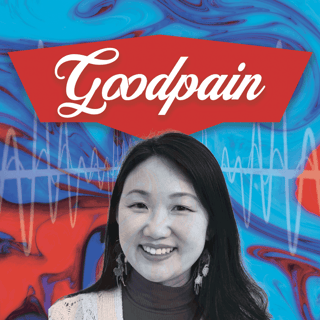
Speaker: And they explore many topics that contribute to an experience and process I was raised with, referred to as making my faith my own. Today in part one, we are opening up a moving and sacred conversation with Dr. Patricia June Vickers. Dr. Vickers is an indigenous psychotherapist, educator, and survivor whose life, work, bridges clinical science, lived experience, and ancestral wisdom.
Speaker: born into the Eagle Tribe in Kitkatla with ancestral connections to Bella Bella and Haida. Patricia has spent decades walking through the fires of deep personal trauma and transforming that pain into a sanctuary for community healing.
Speaker: In her career, Patricia has served as the Provincial Clinical Director for the First Nations Health Authority in British Columbia and worked on the front lines as a trauma and sexual abuse specialist.
Speaker: Today, she is the co-founder of Raven's Call, leading intensive trauma training programs for First Nations health directors and supports workers across the province. In her practice, she pioneers a unique integration of advanced neurobiological tools, such as deep brain reorienting and EEG neurofeedback, alongside traditional indigenous ceremonies like prayer and the sweat lodge.
Speaker: At the very heart of Patricia's mission is ancestral law, a sacred life cycle given by Creator that interconnects leadership, the land, the people, and the great mystery.
Speaker: Her life's mission is centered on true reconciliation, being reconciled to oneself, Creator, and family by relinquishing the toxic burden of hatred and choosing forgiveness as an ongoing daily practice.
Speaker: I learned about Dr. Vickers while watching a documentary titled If an Owl Calls Your Name. The documentary features indigenous elders, healers, and activists from First Nation territories who open their individual and collective stories of healing.
Speaker: The documentary follows the stories of violence through forced assimilation and the intergenerational impact of residential schools. Through trauma healing work, ceremony, land, and language, the storytellers navigate the deep echoes of intergenerational trauma, transforming disconnection, substance abuse, and cultural grief into profound pathways of healing and deep remembrance.
Speaker: Dr. Vickers was one of the prominent voices who shared her story. In this episode, we sit down with Dr. Vickers to explore the idea of making faith when stepping outside rigid church conditioning and the shadow of historical residential school oppression.
Speaker: We discuss the distinction between human curses and the great mystery, how trauma impacts the brain's seeking systems, and what happens when we reach moments of complete collapse. Patricia offers profound wisdom on how to surrender the need for total control.
Speaker: navigate deep grief, and make the simple daily choice to turn our focus toward love and truth. Get ready for a dialogue that invites you to slow down, take a breath, and step into this sacred space of accepting uncertainty. Here is our conversation with Dr. Vickers.
Speaker: One of things we'd stumbled onto was around the making of faith. I'd start with what that means for you. That phrase, making faith, almost feeling a little bit too limited to define all of what that means.
Speaker: I'd rather hear from you what what that means for you. First, I want to say that I don't think we stumbled. I think that it was more like a little bit of a dance.
Speaker: Yeah. um And isn't it difficult to find language? when you've been conditioned to a way of seeing and being and speaking into the in the world through the institution of the church.
Speaker: Yeah. And then I certainly have had language put before me or conditioned, let's say. I've been conditioned as the oppressed and then raised by a missionary mother who is of British ancestry and I i look like her. My brothers say I look like her and I don't look like her. I'm, let's say, an Indian version of my mother and not Indian India.
Speaker: It's Christopher Columbus's mistake, Indian. So the church that my mother eventually adopted was from the village of Kitkatla, where I say I'm from. I'm from the Eagle tribe. And my father was from the Killer Whale tribe in Kitkatla. So um because it was the Anglican church that missionized the village...
Speaker: That's what she adopted as her own. And so that was my conditioning was within the Anglican Church. It started when I was about 10 or 11.
Speaker: That's when my mother settled into it in Victoria. We left the north here. I'm in the north again. We left the North and lived in Victoria. So I think that our way of finding words and the conditioning of our mind is tricky to step out of, to observe and to see. I definitely needed mentorship in order to do that. But I think also if we speak of Christ, not primarily from the roots of the institution, not primarily from the rigidity of theology, but if we speak of this master shapeshifter,
Speaker: From a place of deep respect, from a place of accepting uncertainty, from a place of accepting not knowing.
Speaker: And we think of C.S. Lewis's Chronicles of Narnia. I love how Lewis says the deep magic. For me, but letting go of and finding freedom from the oppression of the Christian church, where when we look at Indian residential schools, where it was acceptable in the United States, in Canada, around the world, really, or for the colonized to be less than human, and furthermore, for children to be killed.
Speaker: because they're less than human, to be raped, to be tortured. That's not the teachings of great mystery. That's not the teachings of Christ. That's not about accepting uncertainty and not knowing. That's about evil. That's about a curse.
Speaker: And the dreadful thing with a curse is that you don't necessarily know that you're living constricted. it's compounded with even a false knowing that what what you are told is is that this is the truth. And if you don't believe the truth, then you will perish.
Speaker: Or, even more oppressively, if you do not believe the truth, if you do not conform, right here, you will be separated from your family, separated from your community, that it's used as a weapon for power. ah And if we think of the beginning, so we have in our Old Testament, in our ancestral creator-given principles. So this is how I think of the beginning. This is how I think of the garden. It's a sacred story.
Speaker: And if we think of the garden, when there was perfect, unhindered communication with creator God, it was just beauty. for the first man and the first woman. And then at some point, oh, and they had direction in how they were to live.
Speaker: And they abided by that, i' probably happily, peacefully. And then the serpent enters, and the serpent says, ah, no, no, no, no. no no If you eat of the fruit...
Speaker: You will become as, as God, knowing good from evil. Not even comparison, deception. There's a difference, right, between comparison, which we're still intellectualizing, yeah, what it is. We're still trying to figure out with our little puny mind.
Speaker: what that means when I think it's beyond we can't conclude yeah the conclusion is and that's not even a conclusion really is that it was deception it was deception and so this deception that humans could be as God when when really it's about then knowing evil and And before that, human beings did not know evil.
Speaker: But from that point on, because it's a spiritual law, all were born with that knowledge of evil. And so is he he you know so that's our struggle.
Speaker: Even when we understand the mystery and the power of the master shapeshifter, of the one, and we have a doubt sacred stories a dao about our human, our supernatural. So when I think of Christ with this way of thinking, i think fully human.
Speaker: And fully supernatural. How is that? Good luck trying to explain that. You know, it's so difficult for humans to accept not knowing.
Speaker: And yet somewhere within self, in that knowledge of the good, there's a knowing that can't really be described. And that it's that knowing that's with your daughter. You can never be taken from her.
Speaker: That knowledge of the good doesn't matter how, and how the mind is functioning, really, and not functioning, how the brain is functioning and not functioning. There's this knowing that can't be taken from us.
Speaker: So much of our interactions, at least in the Western world, is about deciding what control we have based on dominating knowledge, dominating perception. And yet, what I hear from you also is is a surrender to not knowing, is is that I don't need to...
Speaker: convince myself in order to find peace, in order to find wholeness, and in order to find connection to myself and to others. That seems like opportunity of surrendering to what is presented in front of us, believing that there's some promised land out there where we will never have to actually confront the reality of who we are. There's its own tragedy in that running away from the choice we have to love, to care, to embrace.
Speaker: the uncertainty or to be embraced by the uncertainty. There's something wrong with us if if we're suffering. There's something wrong with us if tragedy hit our family.
Speaker: And i think it's beyond embodiment. I think it's beyond any language, that any words, any constructive thought. that we might attempt to pull together.
Speaker: Because how can you comprehend eternity? How can you do that? Yeah, so so there is that too, that if you fail, if you lose your job, if you lose your home, um or if you're judged by everyone, that you're not conforming to this line of teaching, this line of thought.
Speaker: then there's something wrong with you. Living in faith that transformation, transformative healing is a free gift for me.
Speaker: coupled with love and forgiveness, it's not easy. It's a decision we make every day. Even just feeling the past and the darkness and the weight of it comes into our kitchen as we're getting ready to make our morning drink.
Speaker: It comes into our space. Just recognizing that that unwanted energy is too much for me. And all I have to do is just slightly turn my head to light and truth and love.
Speaker: That's all I have to do its just slightly turn my head, say, no, I need you in this moment. That's all I have to do. In my mother's missionary teaching, well you have to fast and you have to pray and you have to do things in a certain way. You have to refuse. No, you don't use plant medicine. She was really against our old cleansing ways.
Speaker: And so I learned to be very careful. Yeah. and I learned to be very careful because I love my mother and her approval was important to me as a young adult.
Speaker: So, but yes, I think that finding language to speak to this, what's that old way in Christianity? Oh, pilgrim's journey. Ah.
Speaker: Yeah, yes. A warrior's journey. Pilgrim's journey. you know and And really, we're all naked, or vulnerable, walking this narrow pathway, looking for the good way to relate, looking for the good, looking for the good.
Speaker: No, I don't want to think that judgment. No, I don't want to criticize in that way. I just want to want to keep focusing on what the good means in this moment.
Speaker: You talked about it's a daily practice to remember this. The journey to get here also has a lot of struggle within it, has a lot of pain within it. for For people that I speak to that are in the midst of being gripped by that pain, and they can't see past it. The only thing that they can see is the hopes of escaping that pain.
Speaker: For us, we we also had to learn or be taught how to surrender to that pain. How to stay, because we don't bring the change or the transformation. I don't, I just keep just turning my head. Just, no, I can't do this. I turn to you.
Speaker: Or when it was minus 20, I live in an ah RV because that's what I'm to be doing right now. And the winter, it was minus 18, minus 20.
Speaker: And the propane had gone. I'd run out of propane. And it was midnight. So i couldn't I couldn't get my furnace going. And I was racing because it was one degree in the RV. And um I was racing against the lines, freezing.
Speaker: and the propane line freezing, and I just fell on my knees. Where are you? Yeah, where are you? And it's kind of what happens is, oh, go to YouTube, look it up.
Speaker: First instruction was what to do with the thermostat, that was all i needed to do. and And isn't it like that while we're in the middle of it That's all we really need to do is say, where are you?
Speaker: Where are you? I can't see you. I can't feel you. I don't sense you. It's all darkness around me. You just tell the truth, tell the truth, tell the truth.
Speaker: And then this, what is that? You know, I see a child blowing the seeds off the the dandelion, you know, it's sort of like that. This breath happens and oh How difficult is it to remember that one step at a time of slowing down in a world that tells you it's on you. Figure it out.
Speaker: Change yourself. Conform yourself. If something's not working, it's because of you. Because you're not doing it right. Because you're not doing it right. Going back to what you said, there's something wrong about you. That world doesn't stop saying that.
Speaker: How do we navigate a world where we see it differently? I i think ah too, because I'm a clinician, I'm a psychotherapist. So immediately, I think of Yat-Banksep.
Speaker: He was known as the rat tickler. I think of his platforms of emotion and the first one being seeking and how when our children are born, being the mother and the honor of that, the first thing is my voice and connection with me.
Speaker: And then once they've settled into, not entirely, but they're out of the womb, Then they want to the nurturing and they're seeking connection with food and nurturing. So that's seeking that's in us. And then the other I thought about was Frank Corrigan. He's a psychiatrist in the UK and his deep brain reorienting. And I think it's soul retrieval.
Speaker: And how when we're seeking, we're often oriented in the despair or the anguish. And that's what we're oriented to. I'm turned this way and this way.
Speaker: And... So it's simply choosing what to orient to. Do I orient to judgment and criticism or do I orient to the mystery of love?
Speaker: Do I orient to the pathway of not knowing, of uncertainty, of deep mystery, of deep magic? Can I even catch my breath to be able to recognize the choice that I have? And that so much and so often we have a naive wisdom around us that says, well, if you're wronged, then retribution is justified, is rationalized. And yet what I hear you encouraging is we don't need to be enslaved by the automatic thoughts that are imparted to us. Going back to the Christ figure, the idea of turning the other cheek, which has this allegory also of, yeah, we, the equal math of if you get slapped, you slap someone back, gets broken when you recognize the choice, when we recognize the choice that is inviting us or beyond choice, which is that if I'm looking ahead, as Krishnamurti calls it a choiceless choice, looking ahead to mystery. Because sometimes in our finding ourselves in the midst of hell, it's come on us. We don't even have the ability to turn our head.
Speaker: We don't even have that ability, that strength. It's not in us. We don't have that energy. We're in a state of total and complete collapse. And in that state, there's this presence that's total, that's complete, that moves in into me to create this holding. And often I, that's what I want to be aware of. one And that energy, which is love, which is eternity, the eternal nature of love,
Speaker: That energy is the energy that I want in my being. So I can get caught up in saying that's my choice.
Speaker: But you know, really, a state of collapse isn't always dramatic. Sometimes, hopefully often, every day i can come to that place and that state of collapse, it's really me coming to the end of me.
Speaker: And as you were saying, Eric, from to have or to be, to have, to have, to have, to have. The word that comes to mind is is surrender, that collapse, and you have to be brought to this point of collapse. You have to surrender. And the first question they often ask is, so tell me the formula for how to surrender.
Speaker: And I can't tell them that. will You just say, ask, you'll be shown. Thank you for sitting with us in this conversation, for bringing your own story, your own questions, and your own hard-won wisdom to what we're building together.
Speaker: If you want to keep this going, subscribe to Good Pain on Apple Podcasts or Spotify, where you can also leave us a review that helps others find their way to these conversations. And for weekly doses of conversations that go beyond quick fixes or surface-level advice, subscribe to our Kindling newsletter at goodpainco.com.
Speaker: Good Pain is recorded in Colorado on Arapaho, Ute, and Cheyenne ancestral lands. And let's remember, we are not alone in this. Our struggle is not our shame.
Speaker: Whatever we are carrying today, we don't have to carry it alone. We will see you next time.