Transcript
Speaker: know the Oscars went to, but should they have gone there? Welcome to And the Oscars Should Gone To, a place where we discuss, debate, and decide certain Best Picture races from the Academy Awards, and then reveal who we think should have been awarded the Best Picture Oscar back then. Maybe our Best Picture pick was clearly the movie everybody loved back then.
Speaker: Maybe it was an influential work that filmmakers still discuss years later. Or maybe it's just the movie that everyone re-watched year after year As always, we recommend that you folks at home watch each nominee so you can make your own determination and then let us know how wrong we are. And with that, we thank the Academy. Let's start the show.
Speaker: Hello and welcome back, everybody, to And the Oscar Should Have Gone Too. this ah This episode, we will be dissecting and talking about the year 1986 and the five films that were nominated for Best Picture in that year. Let's start out with The Mission.
Speaker: It's a 1986 historical drama film directed by Roland Joffrey from a screenplay by Robert Bolt, starring Robert De Niro and Jeremy Irons. and also an unknown Liam Neeson in a supporting role. It's about the experience of a Jesuit missionary in 18th century South America, something that we all want to learn about.
Speaker: The the next movie is A Room with a View, a 1985 British period piece, a Merchant Ivory film. um adapted from an EM Forster 1908 novel called A Room with a View, set in England and Italy. It's about a young woman named Lucy Honeychurch, played by Helena Bonham Carter, and the final throes of the restrictive and repressive culture of Edwardian England and her deepening, sorry, developing love for a free-spirited young man, George Emerson. Also, both Maggie Smith and Judi Dench are in this movie, and they have a scene together.
Speaker: Something to look forward to if you see that movie. Children of a Lesser God is a 1986, well, around 1986, American romantic drama film directed by Rhonda Hayes from a screenplay written by Hesper Anderson and Mark Madoff and based on Madoff's 1979 play. stars William Hurt and Marlee Matlin, a 21-year-old Marlee Matlin in her first film. also Piper Laurie and Philip Bosco. it's the The narrative follows two employees at a school for the deaf, a deaf custodian and a hearing speech teacher whose conflicting ideologies on speech and deafness create tension and discord in their developing romantic relationship.
Speaker: Hannah and Her Sisters, an American comedy drama film written and directed written and directed, of course, by Woody Allen, It tells the intertwined stories of an extended family over two years that begins and ends with a family Thanksgiving dinner. It's actually three Thanksgiving dinners in three parts.
Speaker: Ellen also stars in the film along with Mia Farrow, Michael Caine, Barbara Hershey, and Diane Wiest as her sisters. It's actually quite an ensemble cast in this movie, so you can look out for other well-known actors in this movie. It was Woody Allen's biggest bus box office success until Midnight in Paris came along.
Speaker: And finally, the winner, Platoon, an epic character. Anti-war film written and directed. We'll discuss that. Written and directed by Oliver Stone, starring Tom Berenger, Willem Dafoe, and Charlie Sheen.
Speaker: um It's the first of a trilogy of Vietnam War films directed by Stone, followed by Born on the Fourth of July and Heaven and Earth. It's based upon Oliver Stone, the director's experience from the war, and follows a new U.S. Army volunteer, played by Charlie Sheen, serving in South Vietnam while his platoon sergeant and squad leader,
Speaker: Berenger and Defoe argue over the morality and the platoon and the war itself. So those are the five movies. So Dylan and Glenis, want to say hello? Hello, Dylan and Glenis.
Speaker: Hello. Hello. Dylan, what did you think about the mission? Well, gosh, golly. You know, it's the same guy that did The Killing Fields, a movie I quite enjoyed.
Speaker: And like the killing fields to see the mission on a big screen is really intoxicating. Unlike the killing fields, it does not translate to the small screen. um It's a pretty straight ahead story with not a lot of plot twists. And it's really a character study of the Robert De Niro character and the Jeremy Irons character.
Speaker: It's not developed that well. I think we're supposed to see how they change and their points of view shift as time goes on, but it's mostly a lot of beautiful shots.
Speaker: um And they are beautiful. And it's interesting. It's a part of the world. a Jesuit. I think they're Spanish. I'm not sure where it was exactly, but it's it was it's really pretty look at, but it's pretty long. Not as long as, you know say, Wuthering Heights because there's no egg yolks, but still pretty long.
Speaker: And again, I got the sense I was supposed to get more out of it, like a commentary on Yeah.
Speaker: but it just does not hold up the plot doesn't really go anywhere The character development is kind of flat. De Niro and Irons, who I think are really good actors, they don't seem to much to do or say except kind of react against cruelties and things. And I think the idea of the conflict between the the innocent natives, the sincere Jesuits, and the kind of predatory Spanish government was a bit heavy-handed.
Speaker: Bonus points. It's not a happy ending. So for the 80s, that's pretty cool. But um gosh, I can't really even recommend to see on the big screen. I think it wants to do a lot. And I think in the end, it really doesn't do anything.
Speaker: But I don't know. Glennis. Huh. Interesting to hear you talk about it that way. I think ah this is a movie I'd never even heard of until we decided to do this podcast. um And so we just watched it for the first time. I watched it for the first time couple weeks ago. And I would say, actually, it stuck with me more than a lot of the other movies. um Yeah, I think it it's... I don't know if I recommend it, but it wasn't that bad. It was kind of interesting. Yeah. So stuck with you in a good way or stuck with you?
Speaker: I just to remember a lot of scenes, which is pretty good. I have a terrible memory. And so sometimes as soon as I watch a movie, it's like, it's gone. I don't know what I saw, but this one, some of the scenes have stuck with me. And um ah yeah, I don't know. I mean, to say it didn't age well, well, it's already a historical fiction kind of thing so it doesn't really matter if it's ageable or not it just was kind of fun to see like oh look there's a youngish liam neeson and um you know there's there's robert de niro trying to do anything other than a new york accent um yeah i don't know i yeah it's
Speaker: It's definitely you can see that it was an ambitious movie. And I think the fact that it was so sort of, i think, Dylan, what you're speaking to is the socially justice, heavy handed thing the. Yeah. I think like given that it was the 80s, you didn't see a lot of that in the 80s as much ah unless it was sort of like a. Well, I mean, this unless it was like a white savior kind of movie. Yeah. So I think that it's interesting that it managed to avoid that to some degree.
Speaker: Yes and no. um So I think it was maybe ahead of its time, but also ultimately not the most exciting movie to watch. I think we maybe watched it over a couple of nights actually too. yeah um But I don't know. I didn't dislike it as much as Dylan. I thought it was kind of an interesting attempt. Yeah.
Speaker: Yeah, I kind of didn't mind it, which is weird that I'm saying that now. yeah Yeah, I think that it wasn't as bad as some of the other movies and that were nominated this year. So I'm revealing my hand too early. But um that said, i think there were other movies that could have been nominated this year. I'm not really sure this one deserved a nomination. I think it just got a nomination because it's, you you know, big in scope and serious movie. And that's how the voters wanted to think of themselves that year, apparently.
Speaker: nominating very serious movies. um I think that's why it got nominated because otherwise it has fallen to like nobody nobody remembers this movie. Yeah. So what Rob, what did you think? Yeah, no, i I agree with a lot of the points that both of you made. um I had never seen the movie before seeing it for this podcast. I'd heard of the title and I knew De Niro was in it. I didn't really know much more than that. Um, but Dylan brought up an interesting point that you have two actors, um, with, you know, that, that are great actors that you don't give them a lot to say, you know, that's, that's kind of shameful in a way. Um, you know, De Niro, this is a very different movie for him. I'm not talking about his dramas versus like meet the parents kind of different. I'm talking about like different compared to all his movies. Um,
Speaker: You know, there's there's not very many movies set in 1750 and there's not very many movies with Robert De Niro set in 1750. So this is the one if you're interested in those two.
Speaker: But he I don't know, to me, just seemed like silly in this movie, like out of place. Yeah, De Niro. Yeah, i keep saying he he he. But yeah, didn Robert Niro. Yeah. Yeah.
Speaker: yeah Yeah. He's not pulling it off. He's not pulling off that. No, I didn't buy it. I didn't buy it. And as far as the direction, I think a lot of the battle scenes seemed a little fake to me. You know, they just didn't seem real.
Speaker: Yeah. um This whole message of like the dead live on in the minds of the living. You know, that's just been overdone a bit. I mean, maybe not by 86. I don't Well, even by 86, I guess. But yeah.
Speaker: Then, you know, reading reviews and things like that that, there's a lot of mixed reviews out there, and a lot of people really don't like this movie, and the people who do like it don't really rave about it too much. they appreciate it more than enjoy it Correct, correct. And so, you know, why would a movie like that get nominated for Best Picture? I don't know. it's it It tries to be epic in scope, and whether they pull that off or not, I'm not quite sure, but... yeah You know, it's this whole, that the people named the Guarinis that were there to accept Christianity. And in the movie, I guess they accept it very readily. But I guess in reality, it took them generations and generations to. to finally accept Christianity. But it's ah it's a movie that's a religious movie as well. it's I think the Vatican would love this movie.
Speaker: yeah um Maybe. know Maybe. I don't know. I think it's sort of, yeah and yeah yeah. Yeah. Well, I guess you're right. They would love it. like I guess the last points I want to bring up was the film lost money was a commercial disappointment.
Speaker: Um, and then, you know, it's, it's just basically to summarize, it's a movie that's, that means well, but we don't really get, emotionally involved in the characters in a way that I think it wants us to. So that's my summary. Do I like it? Do I not like it? I don't recommend seeing it.
Speaker: I didn't really care for it. I'm kind of between the two of you, i think. um See something else. That's my thought. ah A Room with a View.
Speaker: Glennis, what do you think of A Room with a View? More Merchant Ivory all the time. There you go. You love Merchant Ivory. I am kind of a fan. And but when I actually look down through their... They didn't do that many movies together, but um the ones that they do, I think I tend to like. um So I am a fan of this movie. I actually remember it getting nominated...
Speaker: and watching the Oscars in the next year, 87, and thinking, oh, what's this movie? And then eventually did watch it and then forgot all about it. But I've read the book since, and I've watched the movie a couple of times since, and it grows on me every time. So I do really like this movie. It's pretty slight in terms of plot. It's definitely like got, again, another social justice theme for England at that time, which was more class. And it's so weird because it's like – the differences of people within the same class. Like it's talking about, you know, um Lucy Honeychurch is a proper English lady and she needs to get married to somebody who's some money or something. I don't know. That's always seems to be the plot of these of these books. um And then she meets a young man and his father, and they're sort of bohemian in their thought. Like, they're very open to art and very open to, you know, they're not very appropriate. People are kind of gasping at how loud and vulgar they are. And honestly, this would be something you would completely miss if you didn't realize, oh, they're actually just...
Speaker: they have like stratification within their class. Right. And so if you're not kind of attuned to that, you'd be like, what the fuck is this movie about? What, what, are what, what is going on here? What is the controversy? Um, so it's just, you know, it's ultimately a love story. It's, it's a pretty slight plot, um, with a, with a slight, you know, um,
Speaker: social commentary twist on it but i really enjoy it it's just a fun like movie to watch i think to cheer you up a little bit um it's very nicely shot it looks like a merchant ivory film if you don't know what that means you should just watch this movie and you'll get it um it's ah you know helena bonham carter's hair is great always and uh yeah it's you know to see it or you know, Maggie Smith and this, you know, I think that it the whole movie just works, but is it a, I mean, why did it get nominated? I think because it's merchant ivory and at the time people are just really liking that. Um, but it's a pleasant movie. It's, I recommend it if you just are on a Sunday afternoon, kind of wanting to be cheered up by, um you old stories about England and class, uh, and love. So I, I do like this movie. Um,
Speaker: Should it have been nominated? i don't know. Again, I think there were other movies that they probably missed that year, but I'm fine with it. I'm not angry about it being nominated. Dylan, what did you think about this movie? Oh, I mean, I think it's really good um you know for what it is. I can see why i was nominated because, again, they try and spread the field so they have different types of movies and...
Speaker: ah Yeah, for an Ivy Merchant, this is the archetypical Ivy Merchant film. And it's so archetypical that there are films out there that I thought, hey, that's Ivy Merchant. Oh, wait, that's Ang Lee. it's It's actually kind of influential in a sense because it is these types of movies for the next 15 years or so are basically copying this template.
Speaker: uh huh And like you said, Glennis, they didn't really do that many movies, but it seems like every year there are three or four movies like this. So it's kind of influential. Yeah. I think i think they produced a lot, but as far as directing, I don't think it was that many. e Everyone's really good in this.
Speaker: The acting's really good. it looks really beautiful. I mean, i think it's just an overall really good movie, and I can absolutely see why it got nominated. It's pleasant when the other movies have very rough edges around them, and it's classy, and it's lighthearted. So I would highly recommend it, actually.
Speaker: Yeah, I think Merchant Ivory kind of created like their own whole like genre. Yeah. You know what I mean? so yeah And that's that's pretty good to create your own genre with yeah three or four movies. um Yeah, I mean, critics love this movie. It was a box office success. It's it's lighthearted. it's And yeah at the same time, it could be considered intellectual if you're looking into the but British class system somewhat. or if you just want a Sunday afternoon movie to kind of breeze through, it fits that bill as well. It started out with, um you know, a room without a view, so to speak. They were a view of the river river ammo and um as promised, and it set off the film's like kind of whimsical nature, so to speak.
Speaker: um And so they they traded rooms, they got their room with a view and, you know, that they were they were a lot happier. And the movie ends with a room with a view as well. so It kind of is a recurring theme, but...
Speaker: Yeah. It's, uh, it's a, both, uh, like a romance and a humorous critique of British society, I would say at that, at that time. yeah think it touches on existentialism because the Julian Sands character is definitely like, he's, he's sort of like, uh, lost in misery at the beginning. He thinks too much about things. And, yeah you know, so I think it touches on a lot of little things that you might not notice. Definitely does. Yeah. And, and, um, I think the cast, like you were talking about was, was great. Uh,
Speaker: Bonham Carter was 18 the time the movie was made, which I thought was amazing. Yeah. Um, Yeah, it makes us think think about how we feel, yet it's very whimsical in nature and is there to enjoy. So that's what I would say about this movie. And I would say we liked it. So go see it.
Speaker: Children of a Lesser God. I thought it was a fairly complex movie based upon the fact that it was um a deaf actress um who played a deaf person and in in the movie. i think Yeah, that was a big deal. kind of You kind of have to. Yeah. It was, yeah, it was a big deal at the time. Marlee Matlin was only 21 years old. She won the actress for best act, act the Oscar for best actress, I should say. um i think she should also won it for Coda a few years ago. but she Was she even nominated? she with Yeah, she was great in that movie. she I don't think she was either. though It's a shame. She was good in that movie, yeah. Yeah, she was. She was good.
Speaker: um But... They had a conundrum in this movie with ah a deaf actress. Like she's using sign language. Like what do we do to have the viewers at home or in the theater understand what she's saying? Because most people do not understand sign language. So could they, would they use subtitles? And they they chose not to use subtitles. They choose chose to have William Hurt say out loud all of her parts. So he actually had to say all of her parts plus his own, which I thought was pretty challenging. I was going to ask you, what did you think of that?
Speaker: I liked it. I wouldn't have thought of that myself. I mean, I thought that was pretty, pretty good. um You know, it's almost like hearing him think, you know, and another person because you have to think when when I guess i would imagine when someone does sign language in front of you, you have to kind of think exactly what they're saying. And he was kind of thinking out loud. Yeah. And at the same time, moving his lips because she, if I remember correctly, wasn't a good lip reader.
Speaker: So he she she had to like their character anyway. So she had to like read his lips. So he was repeating what she said visually into verbal communication, which what I thought was pretty, pretty brilliant, if you ask me. But Molly Matlin, they have you know they have a a romance in this movie and she conveys her emotions through her signing. She's very visually authentic and very emotional with her signings. I like that part about the movie. I like the fact that as an actress, she held her own with with William Hurt, I thought. I mean, she must have. She won Best Actress. But yeah, she was amazing. It's kind of like a um ah silent film at parts where her eyes and her gestures had to do the acting. yeah which is very challenging. another Another reason to give her some awards for it.
Speaker: um But it was ah it was a very successful movie. um It made $101.5 million, I guess, on a $10 million dollars budget. That's pretty good. Yeah, not bad. It was a play right before before it was a movie.
Speaker: Oh, so that yeah that kind of maybe informed some of the directing choices around not having the subtitles. Correct. Yeah, that's true, too. I didn't think of that. Yeah.
Speaker: But it was praised by both the hearing and the deaf as to as to being, you know, not, you know, sometimes they they make we'll talk about this in Platoon about with ah African-American actors and things like that. And some communities don't like. how it's portrayed but the deaf community likes very much how it was portrayed as so as well as the hearing people and their their reactions yeah i thought the um the movie was well paced i think with the exception of the end i think the end dragged a bit um you know if you read plot summaries on this movie they don't really discuss the very very end like that much it's like a sentence or two for the last half hour or something like that yeah but um
Speaker: I liked this movie a lot. I enjoyed it. I highly recommend it. I think everyone listening should definitely see this movie. Clintus, what'd you think? um i probably didn't like it as much as you, Rob. And I am looking at this just from my modern eyes because I never saw it in 1986. I have managed to go all of this time and never see this movie. um And I, I knew it was one I probably should have seen, but I just never got around to it.
Speaker: But yeah, I think maybe I was afraid of some kind of cloying factor that was that was I was expecting. And i I do think it was there a little bit. But I don't think it aged well. I can see why, now that you said it was a play, i can see why they didn't use the subtitles. But I think i think that it doesn't age well because of the directing choices. I really feel that having William Hurt say all the lines for anybody who's signing really just makes him the only character, almost, that that matters. Yeah. And I think it kind of takes away from building her as more of a real fully formed character. um As far as him being like, he's like a teacher for the deaf. Like he's really bad at it. I think he barely knows how to sign He keeps expecting everybody to speak for him because he's not good at signing. Like, come I think he alludes to like, he had a checkered employment history that was like, I was, I was a, don't I was a handyman. Then I was, know, whatever. But also isn't he supposed to be a brilliant teacher somehow?
Speaker: I'll get to that. This is the 80s. This is the 80s. This movie is so the 80s. I do wish they'd use subtitles a lot. um I just found it very annoying for her to speak and hit for her to sign and him to speak.
Speaker: um And overall, I just kind of felt like it it felt very infantilizing towards the deaf. Yeah. they need a speaking hero to bring her, you know, to bring her out of her shell kind of thing. um It just felt very 80s. But I think the acting is good. I think that the mistakes are in the direction. i think the acting is very good. She's really good. William Hurt is good. um It's interesting. they had a They had a relationship off camera as well. They did? After this, they did. Oh, I did not know It did not go well. She accused him years later of abuse. And I actually thought that dynamic came across on the screen too. So i thought that was very interesting. yeah He seemed very domineering. And um yeah, and i I think it was good at the end. She sort of comes out of her...
Speaker: her shell that she's kept herself in a little bit. And honestly, I don't remember how it ends. Holy crap. So there you go. It didn't stick with me that well. um I only just watched it recently. So, but the acting is good. It is.
Speaker: I think landmark at the time it was like, Oh, we have a deaf actress in this role and she's not speaking. And it was just, ah i remember that being a huge deal and that she got the Academy award was a huge deal. So I think that movie benefited from that sort of piece of it. um But I would say I didn't love this movie.
Speaker: I don't know. I just felt again, it it also seemed a little bit long, but I can't remember. Was it long? I don't know. I mean, i i mean, I'm not gonna look it up. It didn't seem over. Okay. two hours Well, 106 minutes. Yeah. The fact that I felt it sent seemed long and it it wasn't, it was not great, but um yeah, it's okay. It's not, it's not a horrible movie. It's just, I, I don't love it.
Speaker: Dylan. Dylan.
Speaker: So I didn't see when it came out. I saw years later was catching up on Oscar pictures. I just remember it made no impression on me. And I got to say, after seeing it again, it's like you say, it's like, wait, how did it end? It really don't remember how Rob, how did it end? How did it end? Well, they, they agreed to like be, be, be friends at the end and kind of like, tolerate each not tolerate that's not the greatest word except each other's shortcomings and you know because they put so much work into this they thought they should still be friends so
Speaker: Yeah, it was fine. I could tell it was a play. And I think we looked at it later as, oh it was a play. i had all the hallmarks of a play, which isn't, that's not necessarily a detriment. I thought William Hurt was good. I'm a big William Hurt fan. To see him in the big chill and then Kiss of the Spider Woman, broadcast news, show Lesser God, all one after another. He plays very different roles. I do like William Hurt. Marlee Matlin was really good. I forgot, Rob, you're right. She should gotten nominated for CODA. I couldn't remember if she had her hand.
Speaker: I think it's very 80s. It's very like the characters are kind of symbolic and they they either say or act exactly how they feel so we, the audience, knows we know what's going on.
Speaker: They're not very subtle. I mean, i I'm making this up, but i I felt like every third line was like, can't you see I'm trying to get through to you or whatever. And her saying, can't you see I'm hurt? People don't really talk like that in real life. yeah so but But it's a movie. That's fine. And I'm sure for a play, you have to kind of be overdramatic. But I felt it could have been much more subtle because they had two actors who who are capable of being subtle.
Speaker: um I wouldn't recommend it. i mean, there's probably other movies similar to it. and But honestly, like Glenna said, i don't really remember much. And um they're both unlikable to an extent, which doesn't have to be a flaw of the movie. But again, when they're kind of...
Speaker: you know telling each other exactly what they feel and think, it it adds an air of unreality that was somewhat distracting for me. um So yeah, i I got to say, I did not like it. I was pretty bored by it. The performances are great, but I don't think it's a movie you need to see. No one talked about the year after it came out. So it's like, it isn't like a classic in the canon, you know?
Speaker: um So yeah, I didn't like it and I wouldn't recommend it. Okay. So I think I liked it the best of the three. I think it's safe to say. Yeah. Okay. Moving on to woody Allen and Hannah and her sisters.
Speaker: Dylan, you want to take this one? I think it's a delightful movie. A delightful movie. Honestly, I can see why I was nominated. i mean, the the Academy loves the Woodman. So he used to get nominated a lot for, especially if like best director and screenplay and stuff. Once he got his Oscar for Andy Hall, he kind of shifted to much more serious movies, like very Igmar Bergman type movies. Like they're not, they're not funny at all. They they are very serious and grim, but somewhere eighties, he started to integrate those two.
Speaker: I think that's his best period. And this is kind of the kind of the first fruits of that, where it's there. It's really comedic and lighthearted. has a sense of a French sex farce where like, oh, I'm in love with my sister and my sister is in love with whatever this, that and the other thing. And who's, you know, who's with who. But it's also very serious where it's talking about how these people deal with their relationships and they question the nature of it, if they actually are in love and what does that mean?
Speaker: And the acting is uniformly good in this. I believe Diane Weiss won for this, right, Rob? Yeah, there were two winners. And Michael Caine his first Oscar, if you can believe that. Yeah, Michael Caine as well. He was great. He was playing against type. He was playing kind of a nebbishy, like, I don't know what I'm doing, which is was against his type, where he kind of played...
Speaker: kind of rogues or like kind of, you know, menacing figures. But this really ah shows him in such a ah vulnerable, playful light. He deserved to win the the supporting actor.
Speaker: For whatever Woody Allen's fault, he's really good with female actors for whatever reason. Like he's really good with them. And Mia Farrow's never been better. Barbara Hershey's never been better. um You could argue about Diane Weiss, but this is the first thing that she was noticing. She's fantastic in it. So,
Speaker: um I think the themes are good. I think the direction's good. I think it's funny. I think it's ah poignant. And I think, again, the acting, well, it's just so good. um I would recommend this for for anybody, but I guess I can't see if you're going to see one woody Allen movie because there is Annie Hall. But if you're going to see two, this would be the second one.
Speaker: No, Midnight in Paris. Midnight in Paris. I would pick this because i think this covers so much ground. Well, if you're going to see three. Yeah. Yes, and then Crimes and Misdemeanors. No. um I think this covers so much ground kind of seamlessly where like all of a sudden it's shifting to like very serious territory and it kind of shifts out of it where it's really funny.
Speaker: um That's really hard to do. um So, no, I think this is such a great movie. Yeah. I think everyone should see it even if they aren't a Woody Allen fan. But what do you guys think? one One of the greatest things about him, I thought, was for many, many, many years, he'd come out with one movie a year. No no more, no less. yeah That's amazing. you know that That is just truly amazing to actually pull that off. But ah anyway, I like the fact that he was, um I like the movies that he's he's in. And of course, he plays a hypochondriac this Of course.
Speaker: Yeah, of course. And he does that so well. um he He has an affair with two of Hannah's sisters, correct, and that's in this film? Yeah. No, wait, Woody Allen or? um Oh, Woody Allen. No, it's one of them. Michael Caine.
Speaker: Michael Caine has one, and Woody Allen's the other correct correction there. um You know, after he is focusing on Woody a little bit at the beginning of this, ah You know, after he's cleared and he is healthy, he begins to like ponder the meaning of life, of course, as only Woody Allen can and kenon thinks that life is meaningless.
Speaker: But he comes to the realization that life is to be enjoyed and not understood. So there's our lesson that we can kind of kick this off. Very profound, I thought. Of the movie. Yeah, fairly profound. It's broken up into three parts separated by three Thanksgivings, which which it seems to be borrowed a lot from Fanny and Alexander with their Christmas themes. yep Yeah. ah Christmas themes, the plot arcs of different siblings and things like that. um But you're right. he He does amazing things with actresses. I think he appreciates...
Speaker: Females and how they're like sisterly relationships are more complex than brotherly relationships. i think Yeah. Yeah. ah You know, where ah women talk about their feelings and men just, you know, don't talk as much. They just kind of keep things inside or just dismiss them.
Speaker: um So, you know, Hannah and her brothers would not be as an effective movie as, you know, Hannah and her sisters, of course. But I thought it was equally smart and funny. um lot of people think it's his his very best movie among them.
Speaker: Roger Ebert. I always read his online. Um, I, I, I didn't like it as much as midnight in Paris. I still think that I have a soft spot for that movie. I think that's my favorite. I like, I like a lot of his older movies like bananas and take the money and run. Oh yeah. Slapsick kind of silly, you know, movies. I enjoyed that. I also enjoy the three stooges a lot.
Speaker: So that says a lot. Yeah. There you go. Um, yeah.
Speaker: So it balances kind of conflicting like desires and feelings without being too cruel at the same time. And I think that's something that was amazing to to pull off. And I think he did it. And it's definitely one of his best.
Speaker: Glynis. Well, i guess um i I guess I don't disagree with too much there. i I would not say this is my favorite Woody Allen movie. I remember watching it in the 80s after I got a VCR and catch it was catching up on movies. And I remember thinking this is the most tedious fucking movie i have ever seen. ever watched yeah but i was you know as a teenager maybe just not the the complex romantic lives of adults were not really i just wasn't tuned into that um when we watched it recently i did like it a lot more um but i do find there's a certain tedium to woody allen movies that i
Speaker: really struggle with. And I think the reason I liked midnight in Paris so much is that he avoids a lot of that tedium, um just the, the existential angst. And, you know, here's, here's the hero of the movie is this asshole character who is having an affair with his wife's sister. And I'm, I'm having a hard time feeling sympathetic towards him. I'm glad in the end that, you know, he,
Speaker: He doesn't really get his comeuppance, but he doesn't get what he wants in the end. And he kind of realizes, oh, yeah. I think he realizes what a mistake he was making. Of course, yeah. And that's all well and good. I did like some of the other plot lines. I like the Diane Wiest plot line. I thought she was really playing against the type that she often plays, which is very kind of neurotic and mousy. And in this, she's just playing somebody a little bit obnoxious. And I thought that was fantastic. Yeah. And I liked that Woody Allen was actually maybe also playing a little against his own type um in this. So he wasn't quite as good. How Well, I didn't think he was, oh, maybe I'm misremembering, but I didn't think he seemed as neurotic. um Well, he I think he was like with his health, like anytime he like a cold, he'd be it's cancer. And that's why went to guess that's true Yeah, i maybe forgetting that piece. But between him and Diane Wiest, he seems like the more reasonable person, which is not you usually how that plays out in his movies. so um
Speaker: But yeah, I think it's a pretty good movie. And if you're wanting to see the best of Woody Allen, this is probably one of them. um Yes. You know, it it's a very grown up movie and I enjoyed it. um Not as much as Midnight in Paris, probably. Yeah. And I don't i know I've seen Crimes and just Misdemeanors and I can't remember a thing about it. Yeah. Yeah, I think this is a pretty good movie. I can see why it gets nominated at the time. Woody Allen is still a darling. He is not. The quality of his movies did sort of go downhill. for When he did Matchpoint, when he did Matchpoint, was like, wow, are you coming back with this sort of whole new thing? And and then he didn't. um But i think I think it was that the quality of his movies went down. Or maybe he just was, it was everything he did was a retread. But also I think he had a bit of the stink of of his whole personal life on it.
Speaker: um But, you know, I don't know if Hollywood gives a shit about that. So I think this is a good movie. You should see you guys have already kind of covered everything. I do agree with most of that. I don't disagree. think it's it's great. And ah that's all i have to say about that.
Speaker: So we all like Hannah and her sisters. Very good. All right. The final movie we are to discuss was the winner. 1986 is Darling Platoon. Yeah.
Speaker: So was this an 80s movie? Was it a war movie? What was it, Glynis? What do you think? How would you categorize Platoon? It was 80s war movie. Yeah. An 80s war movie. Okay. You know, I remember not getting the big hype at the time. It was so huge. When Platoon came was like, Charlie Sheen's being a serious actor. And this is the first time we've really seen a realistic Vietnam War movie. And it was just so huge, so beloved. You couldn't go anywhere without thinking about Platoon. And years later, have not thought about Platoon very much at all. Yeah, I just I didn't care for it at the time because I thought it was very the directing was.
Speaker: Wait, this is Oliver Stone, right? Oliver Stone. So you saw it in 87-ish? Yeah, whenever it came out, I probably saw it. Or not long after. In a few years after. um I don't like Oliver Stone as a director, so maybe that is my problem with this movie. like He's super heavy-handed. I want to believe that there was some music that was like, ah! The music started telling us how to feel. and Was there slow motion? There was probably slow motion. like I feel like every...
Speaker: Vietnam war movie cliche comes from this movie for a reason. um That said, it was fine. i didn't... I thought the acting was probably as good as Charlie Sheen was ever going to get. um Willem Dafoe was always great. The, the plot, the loose plot about there's a bad Tom Baron, Tom Barringer, right? Yes. Tom Barringer is the bad guy and Willem Dafoe's the good guy. And it's sort of a good versus evil, but on their own team, not really.
Speaker: um Yeah. I think, ah and I think also it was a bringing up the whole, well, like, why are we here a little bit? um I think that kind of played around in the background. I don't know. you know, I don't remember shit about this movie either because it's not that good. So i I don't know why everybody liked it, but sometimes people like really crappy movies like avatar. And that's what happened with this movie. It's not that great. I don't think we think about it except other in the other than in like Vietnam war cliches and slow mo, you know, stuff like that and, and the music. So I would say I'm not the biggest fan of platoon still.
Speaker: Yeah, I couldn't disagree more. i yeah i expected that. It's funny because I have been dying to see this movie again because of seeing it back in, I'm thinking 87 because it came out in December of 86. So yeah, okay, sorry, 87.
Speaker: um I mean, I remember being happy that it won Best Picture when I watched watch the Oscars that year. And I had only seen it that one time. And I remember just thinking it is one of the greatest... Probably the well the best Vietnam movie, but one of the greatest war movies ever made, in my humble opinion. um So I wanted to see it again so badly. So I was psyched when we had 1986 for this podcast because here's my opportunity. so i So I saw it again. um Did I love it as much as the first time you, you probably, if there's, if there's one thing oh that that you got right, Clintus, it's the fact that it maybe didn't hold up with the the test of time quite as much as you think, as we thought it would have back in 87. If there's one thing, if there's one thing, there may not ah Yeah. Well, let's see. Um,
Speaker: I just thought Sheen Defoe and Barringer were amazing. I think the acting and the directing carried this movie as it should have. It's got it's got messages in it. It's got an anti-war message as everything involving Vietnam seems to. i mean, how many movies have you we seen that are like pro-Vietnam, pro-war movies?
Speaker: you know it It just seems that every Vietnam movie we've seen is like a war protest or or this is not a war protest movie, but it has the message that like, why are we here? Like, where are we getting out of this? Or it's how like, you know, we better have a pretty good reason for being here, that kind of thing. And they explore that theme.
Speaker: um So I'd say it was slightly preachy, but they let a lot of the battle scenes like speak for themselves, so to speak. um I think Vietnam War veterans greatly identified with the film because they said this is our...
Speaker: talking piece. This is really showing people what Vietnam was like. um And, you know, it does it does the job for us because words can only say so much coming out of our mouths as as veterans. I'm not a veteran, but you know veterans would say that.
Speaker: um And this movie you kind of spoke for them. Let's just talk about some other things in the movie. um you know i want I like to look at the other side of things, but ah I hinted about this back in the synopsis or back earlier in the podcast about how um the African-American or Black veteran community called it a slap in the face because all the Black soldiers were deprived, there were no Black officers, and they were only put portrayed as cowards. So I don't. Yeah, I don't think that like, you know, everybody they loved this movie. Every community loved this movie. um Stone was also criticized. You like this one, Gledis, for not reporting war crimes he saw because the film was based upon his autobiographical experiences.
Speaker: I thought that was an interesting point. And it was a very big success at the box office as well as with critics. Four weeks at number one in the United States for a movie shot in the Philippines on $6 million. dollars Wow. Is that little, huh?
Speaker: Yeah. Can you believe that? But i I, you know, it's hard to say you love a war movie because it's war ass you know war as hell. And that's what they try to where they try to depict. But I just, I i and enjoyed the acting of this movie.
Speaker: I give it two thumbs up. so Dylan, dylan you break the stalemate. I'm i'm dying. What's going on? Well, so... well ah well so He's definitely got opinions. He's just stalling, folks. So I remember when it came out and I'd already seen some Vietnam movies. And you're right, Rob.
Speaker: A fair number of them are from the left. ah Yeah. Especially as time went on. I will give credit to Platoon. In my mind, it was the first from the left. Yeah. that tried to be realistic. There was the deer hunter, but that was as much about family as anything and coming home. And there had been some movies that seemed like you said, private Benjamin.
Speaker: Oh wait, she's not not. Well, that was a pro army movie. Um, as well as go to Vietnam. Um, so, uh, yeah, I, agree with you, Rob. It was, it was, it was very anti anti-war, anti-Vietnam war specifically showing war as hell. Um,
Speaker: And ah it should get credit for that because I think there'd been smaller movies that done that, but none that had been this successful. A lot of the eighty s I'll remind you, there was ah a Rambo, where it's we didn't get to do the job right. We were right in Vietnam. We're gonna finish it. There was a Chuck Norris, Missing in Action. Okay. Our boys got let down. They were doing right. This is the right thing to do. We're going to go do it again. There are actually a lot of those movies. I fit the one with Gene Hackman. There's a lot of like, we didn't get a chance to finish the job in Vietnam, but we were right, and we're going to do it individually. and Because of these, it was surprisingly, actually, a number of pro... don't mean pro-war, but kind of pro-Vietnam. Like, we were in the right and should have let us finish the job. So for Stone to do this, actually, it was pretty ballsy.
Speaker: And he had covered this territory before. He wrote... ah I don't know if he directed, he wrote Salvador, which... skirted some of these issues about a civil war and why we even, why what do we have to do with it? So I want to give him credit.
Speaker: We're doing the first type of this movie and I think it opened the floodgates for like Full Metal Jacket and Hamburger Hill and Hanoi Hilton and Casualties of War because after this movie, there weren't those pro-Vietnam movies where Gene Hackman and Chuck Norris are going to go back there and finish the job. It became much more like, oh, it was pretty shitty to to be there and it fucks you up afterwards. So I think because of Platoon, those movies exist in a way that I don't know if they would have or wouldn't have.
Speaker: Having said that, and I'm not Oliver Stone fan either, um I think it was heavy-handed. I really don't care what veterans say. um you know People can express their beliefs and their feelings, but they can't necessarily explain them.
Speaker: it It seemed like the most unrealistic war movie I'd ever seen. Unrealistic. Whenever Willem Dafoe showed up, the sun shone. I think he's the good guy. And whenever Tom Berenger showed up with all the scars and talking, all of a sudden it was raining. a lot of times it was raining when he was there. so I think he's the bad guy. i don't know.
Speaker: Willem Dafoe kind of slapped us in the face with it. Well, I mean, the whole thing is Willem Dafoe in a Christlike figure being crucified. I guess he's, you know, good. and you know, Tom Barringer is just, there's not, doesn't seem to be one outstanding quality about him. Like why would John C. McGinley follow him if he's such an evil asshole bastard? And then the the the truth of the matter is not, this is Oliver Stone. He writes caricatures and he writes one dimensional characters and every movie is black and white. Tom Barringer was so 80s handsome. They had to give him a scar in this movie to make sure he looked evil.
Speaker: he was He's never been better. He was really good in this. He deservedly got nominated. And Willem Dafoe, this started his career. He was excellent in this. So they were really good. Charlie Sheen, as always, was terrible. But that's not his fault. Like, seriously. And this movie, too, was terrible. Yeah, he's just not a good actor. like I feel like this is too the best. Well, we all agree he's not a good actor. But I think this movie might have been the exception. You know what he was missing at the time was Tiger's Blood. Yeah.
Speaker: I think his best was in the principal's office in Ferris Bueller's Day Off. but That was his best role. That really was his best role. And I think there were some interesting parts to it, especially how it ended. I thought they were have Charlie Sheen be merciful, but he... he Spoiler alert, it's been 40 years. He ends up killing Tom Berenger unethically, but I think it shows like, oh, as much as he wants to be a good guy, as how much the Willem Dafoe character rub off of he's becoming just like them. And I think that was the ultimate lesson of this, where it's like...
Speaker: no matter how good you are, you're going to either become bad or you're going to be visited by badness. There's no way to stay clean in this situation, which I thought was pretty profound actually. And, and very subtle for an Oliver Stone movie, but it was very popular. It's very influential. And actually i think cause I didn't like it the first time seeing it the second time I was able to see things like, Oh, that's a pretty good touch. Oh, okay.
Speaker: To be honest again, it's very, it's very black and white, very heavy handed. Um, if you you know I said Full Metal Jacket. That was hyper-realistic, the battle scenes, like disturbingly so. This was like people die in slow motion and stuff. like I'm pretty sure they don't die in slow motion in Vietnam in reality. I guess I wasn't there, but I don't think that happened. So for a movie that is supposed to be realistic, it was actually very dramatic, but that's okay. It was almost Shakespearean. I think that's okay. I think for me, when I watched it the second time, I just kept in mind, it's not that realistic.
Speaker: But it's very hyper dramatic. And i i i I did. I enjoyed it for those moments where these are symbols making points in ah in for Oliver Stone, a very subtle way. So first of all, e everyone has to see this movie because one of the biggest movies of the 80s.
Speaker: There's no there's no excuse not to see this. And for war movie, it's seminal. OK, so I know what Rob's going to pick. Yes, I might as well go because I think it's pretty obvious. I'm going with Platoon. um I just think that it's it's it's I mean, Hannah and the Sisters would probably be a second for me.
Speaker: um But I think Platoon is a standout movie. I just think it's not like I said earlier, not just a great Vietnam movie, but a great war movie. I know you Dylan's kind of in the middle and Glenn has abhorred this movie, but that's okay. No, that's too strong. Too strong? Yeah, not too strong.
Speaker: Too strong a word. Disliked. Mildly disliked. disliked. I just think that the acting and the themes were just too powerful to ignore and really stood out amongst the crowd of movies in 1986. I think this is the movie that the movie like The Mission tried to be and failed miserably. Like that kind of an an epic. And I think pulling off epicness, I think, was something that Platoon did um
Speaker: Like we talked about, there are faults with it. It's not a perfect movie. There are people out there that dislike it. There are groups and communities out there that dislike it. um But it's very it was a very big box office success. It was a very big commercial success. um yeah That's the same thing, isn't it? Critical success, I should have So, um yeah, I just think that the other four movies couldn't hold up to this one.
Speaker: Yeah, I think you're pretty spot on. Really? Well, it's it's not like it's a terrible movie. Listen, Avatar is a terrible movie. like It is. But this isn't a terrible movie. It's entertaining. It's under two hours. There's a plot. Stuff happens. like i'm I'm not saying it's terrible. I just don't think it deserves all the hype.
Speaker: I'm never going to watch it again. But it was the movie of the year. It's easily the biggest movie. It's easily the most influential And considering that I really like hand her sisters, but he had done that with Annie hall. He's going to do it again. with Crimes and misdemeanors with platoon Oliver stone, maybe, maybe born in the 4th of July. he hit it right. Although I, I, I i think that it was a lot to Tom Cruise.
Speaker: He he's rarely been this focused and this, uh, lack of distraction, which would come up later over and over again. His work with bullshit like JFK and don't know, fucking every, everything he does afterwards. It's like, Oh, um,
Speaker: This was small enough that and maybe he wasn't big enough that he couldn't get away with a lot of his usual nonsense. So even though i said heavy handed, it's there's still it still moves along. I mean, you're not hitting the head every scene. There's still cool ass battle scenes and, you know, the soldiers do stuff together and, you know, they learn and everything. So, um yeah, I think it's easily the right choice this year. um Maybe if there had been a stronger candidate, maybe I wouldn't say that, but I don't think there was. Glennis?
Speaker: So, Glennis, you've got me, Rob, you've got Dylan, and you've got Oscar himself going for platoon. So the pressure is really on you yeah at this point. I feel no pressure. so You feel no pressure. i okay What do you think? So I dont i like A Room With A View the best, just because personally i enjoy it the best. I like the merchant ivoriness of it. I like an E.M. Forrester story, and I think the acting is great.
Speaker: um But it's it's almost nobody saw it. I think nobody saw it until it was nominated for an Oscar, honestly, at least in this country. um Hannah and Her Sisters is a a really good movie and probably the best directed, best acted movie of the year. But as Dylan said, it's Woody Allen. It's quirky. It's polarizing. He's polarizing.
Speaker: um in terms of a style. um It's a quieter movie. It's quietly humorous and quietly serious. And like you said, it has like but Ingmar Bergman ah references that like only cinephiles would care about. um it's it's It's very, it's niche, right? So ah when I was talking about um Platoon,
Speaker: what I didn't say was it does move along, as Dylan said. you're not You're not going to have long, extended moments of boredom or like, you know, so it does move along. So I am, unfortunately, because Wait for it. Wait for it Here it comes. Because the other nominees were just so kind of lacking, I guess Platoon yeah is is the pick. Wow. Okay.
Speaker: So I reluctantly agree with the both of you and the Academy. Yay. Nice. Good choice. Good choices, everyone. So all three of us pick Platoon, Oscar picked Platoon. So we're saying they got it right this year. Okay.
Speaker: If we did get it wrong, how would they tell us, Rob? how would they How would they tell us? Oh, you probably the best way to tell us would be by email. We have an email address and we love reading emails. So the Oscars podcast at gmail.com. Oscars with an S, the Oscars podcast. So email us anything, just anything you want to say, even if it's a quick sentence or two. So, so Dylan, what's the next year that we're doing and what are, what are those nominees?
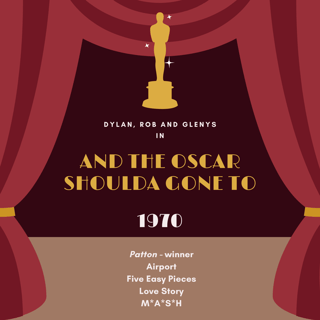
Speaker: ah Next year is 1970. Woof, woof. Excuse me. A lot of dogs. um So the winner for 1970, which is what we're doing next, was Patton. And the nominees were a MASH, Love Story, Airport, and Five Easy Pieces.
Speaker: Thank you, everyone, for listening. We'll see you next month for 1970. Thanks for joining us. And until then, keep watching those movies.
Speaker: you