Transcript
Speaker: who the Oscars went to, but should they have gone there? Welcome to And the Oscars Should Have Gone To, a place where we discuss, debate, and decide certain Best Picture races from the Academy Awards, and then reveal who we think should have been awarded the Best Picture Oscar that year. Maybe our Best Picture pick was clearly the movie everybody loved that year.
Speaker: Maybe it was an influential work that filmmakers still discuss years later. Or maybe it's just the movie that everyone re-watched year after year As always, we recommend that you folks at home watch each nominee so you can make your own determination and then let us know how wrong we are. And with that, we thank the Academy. Let's start the show.
Speaker: Welcome back to The Oscar Should Have Gone To. I am Dylan in Los Angeles, and to my left is... Glennis and Rob. We don't know what your left is. We're both to your left. Right. Yeah. So you answered correctly. you in los angeles yeah ah I'm Rob. She's Glennis.
Speaker: And where are you from, Rob? I'm from the Boston area. My goodness. And Glennis, you're from Canada, correct? No, I'm in Los Angeles. Oh, goodness. How dare you? Okay. ah So this year is 1970.
Speaker: Interesting year. It's out of our control. Out of our control. If you want to complain about how we view these movies, you can always email us at the Oscars podcast at gmail.com, but do not complain about the movies themselves. As Rob said, that this is not our choice. So 1970, the winner that year was Patton, which is a epic biographical war film about US s General George S. Patton during World War II and stars George C. Scott as Patton and Carl Malden as General Omar Bradley.
Speaker: Airport is a disaster film written and directed by George Seton, based on Arthur Haley's 1968 novel, which originated the 1970s disaster film genre and is the first of the four films in the Airport film series.
Speaker: Five Easy Pieces is a road drama directed by Bob Rafelson and starring Jack Nicholson as a surly oil rig worker, Bobby Dupier, whose rootless blue collar existence belies his privileged youth as a piano prodigy.
Speaker: Love Story is a romantic drama directed by author Hiller about but a relationship between two students at Harvard College, the upper class Ryan O'Neill and the working class Allie McGraw that is eventually affected by tragedy.
Speaker: And MASH is a satirical black comedy war film directed by Robert Altman that depicts a unit of medical personnel stationed at a mobile army surgical hospital, MASH, during the Korean War.
Speaker: Well, let's just let's just rip the bandit off. So, Rob. Yeah. What did you think of boy, oh, boy. Where do we go from here? Where do we start? Folks, let me just pause here. This is not a break. I just want to say Patton, Airport, Love Story, and MASH were some of the biggest movies that year in the box office. They were legitimate, huge hits. Just want to get that out of the way. So, Rob, what did you think of Airport?
Speaker: airport okay well first i was disappointed disappointed that it was an airplane i got all excited right so we're gonna review airplane i'm like yes surely you can't be serious but no we were serious and it's airport so like dylan said it was first of four films in an airport film series i haven't seen all four i saw airport a couple of times um It's about Burt Lancaster's character. Actually, it's got an all-star cast of characters, but Lancaster being one of the major characters trying to keep his airport open during a major snowstorm, and that's kind of the running theme throughout. um Won a couple of awards. Helen Hayes won Best Supporting Actress for her role. But the you know the major
Speaker: the the major plane that this story is about has a bomber on board. And, you know, they're trying to enlist some help to try to get that bomb from going off and to get the runways open. And there's chaos and confusion and adultery and all all kinds of things like that going on. It took place at the fictitious Lincoln International Airport, which doesn't really exist. um one complaint i had about this movie is um really lacks suspense because i think you kind of know how it is is going to end i mean i think everyone will agree that you the whether the bomb goes off or not they're not going to like kill everybody on board and have it be ah like a real tragic you know story where there's no characters left on the plane you know we we know how it's going to end so yeah
Speaker: But the cast is amazing. You can't go wrong with these people in the in the cast. And I think they pulled it off. it's People like in movie theaters, I guess, when it came out, they were clapping at the end um of the movie. But it was kind of a...
Speaker: and know In a way, kind of a long, like torturous way to get to the applause at the end. Burt Lancaster even called it a piece of junk, despite being his most successful money-wise movie. This was junk. Yeah, yeah. Good information. I'm just imagining it, yeah. Yeah. Yeah. And George Kennedy, to his credit, appeared in all four films. So I think. Oh, wow. Did he? It speaks for itself. You know, you can kind of draw your own conclusions there. But it earned over $128 million on a $10 million budget. So you got to give it some props for that.
Speaker: um I don't know how I felt about it. I'm kind of on the fence, thumb sideways in this movie. It's just, it's really, it really was a little cliche and predictable. Yeah. um it was the same time mildly entertaining so um would i see it again probably not i've seen it twice think that's enough wow and um and uh you know i don't know i i don't if recommend it or not i'm kind of in the middle so what do you guys think what do you think glenis First of all, like Rob, I was sad that it wasn't Airplane, which was the movie, only one of those kinds of movies I had seen until we just watched Airport not long ago. And I think I was expecting much more disaster. And this was way more drama about keeping the airport open and all the little side dramas. a bunch of stories going on at once. And then, of course, the bomber on the plane, but that took forever. It was kind of towards like the last third of the movie where the action was finally starting to happen. like, finally. And even that wasn't that exciting. So it just was not the movie was expecting to watch. However, I could see how in 1970 this was probably the most novel thing. Was it like the first disaster movie or something? Yeah. I mean, of this scale...
Speaker: Yeah. So I can see how this would have felt very modern at the time, but as I was watching it, it also very much felt like it was still a movie of the sixties. Um, so it had its foot in both cultural styles of, you know, the, those two decades. Um, So I just found was a little bit distracted watching. I just could not. Once I figured out, oh, we're really not going to get to a disaster anytime soon, I just kind of checked out and wasn't that interested, right? Because we've seen, mean, the disaster movie genre has grown since then and gotten way better. And so it just was having a hard time holding my attention.
Speaker: Bertland Caster is fun to watch. ah honestly the side story of the little old lady who's stealing stuff or something i don't know she's she's kind of that's kind of comical relief or she's a stowaway that was right see it's honestly the plot details are so you know inconsequential i i don't even really remember them i i just watched it recently so um it was i I watch airplane instead. Honestly, i think you're going to get a lot. You're going to get the same idea, but it's going to be funnier. It's obviously sending up airport, um, directly. And it's just a way better, funnier, awesome movie. Um, I, I was not the biggest fan of this movie. Didn't hate it, but I don't think it really, um, lasted. I don't think it had the legs to still be considered a great movie now.
Speaker: What'd you think Dylan? I mean, to put in context, it was the first of that big disaster movie. i don't know what had been before that, but it was definitely the first of that that has actually been a staple ever since in, in you know, box office, big budget movies. Yeah.
Speaker: So i I think it deserves credit for that. um i don't know how shocking it was back then to see like an airplane with a bomb on it and to see the hole in the plane. And I don't know the impact because it seemed really cheesy to me. But again, at the time, maybe it was very shocking. Everyone's like, oh, my goodness. Yeah.
Speaker: All Star cast is is fun to watch. I mean, it's always fun to see Dean Martin trying act. really I love it. And ah Bert Lancaster, yeah, he's always great. you know Get the snow off the runway or whatever. you know and yeah there I think i think you this was almost like a template that has been improved upon.
Speaker: So to give it its due, it it was groundbreaking probably at the time. and it it it And it started its own film genre, which we still have today. But to see it...
Speaker: Straight up as it is, it was really and really cheesy and not exciting. And may be unfair to compare it to modern movies, but it's not just the special effects or thing. The the acting's really bad and the writing's really bad and the direction's really I would agree with all that. Yeah. So kudos for starting starting the trend. That's pretty good. But just as a movie itself, it's it's just not a good movie.
Speaker: So I would not recommend seeing it. I would see Airplane because you'll get everything you need to out of it. And it's actually a funnier, better movie. Excellent. Well said. ah So let's see.
Speaker: Glennis, how about five easy pieces? Hmm. With Monkees director Bob Riefelstein. know you're both excited about that. Why don't you this you put this between your legs?
Speaker: Literally the only interesting scene in this whole movie. I... I kind of thought, oh, Jack Nicholson's in it. Bob Rafelson's directing it. He's kind of done some interesting things.
Speaker: um But ultimately, I found this a very dull... tepid movie um about a guy who's rich but is really sad about it or something. You know, he's he's lost and trying to find himself in the underbelly of America, I think. And I just i found that a hard story to relate to, I think. You know, oh, poor rich guy. We feel so bad for you. And he's kind of an asshole. And ah he's not good to the people in his life. He seems kind of, you know, unredeemable, irredeemable, whatever the word is Irredeemable, think. Thank you. He seems kind of irredeemable. Yeah.
Speaker: he he plays piano that's what the title comes from five easy pieces which kind of an odd choice though don't you think yeah i thought it meant something different yeah to make him it took a while for that i i it took me a minute to pick up on that when they referenced yeah oh i i get it now yeah yeah honestly completely unmemorable and didn't like it and surprised it got, I mean, I guess this must have been just such a crappy year of movies for, for all of these movies that have been nominated, I think.
Speaker: Um, so no, I did not like this movie. You know I'm a big Jack Nicholson fan. So what a bummer, you know? Um, I don't have anything that good to say about it other than the acting is good. Sorry. Let me, let me say that the acting is good and it's pretty naturalistic for, for the time compared to some of the other movies. So that's great. But, um, I guess I'm failing to, I was failing to grasp or appreciate the finer, the subtleties of this movie.
Speaker: I think it's, so again, in context, it's well, it was an independent movie. Those guys were completely out of the studio system, like Rafelson and Nicholson. It's hard to believe that now, like Nicholson was independent movie actor. but So this was kind of the independent movie choice that year from these Hollywood outsiders. Oh, okay. Yeah, no, I know. And again, it's hard to,
Speaker: Yeah, the picture that but that was that that was the background for those guys. And ah I did not like the movie. I've seen it twice. um I get it. I just don't like it. I think it is. Again, these movies all maybe have something in common where they're setting these templates that are have been reused endlessly.
Speaker: he is the lost soul, the drifting guy who has it all and yet is not satisfied. That had been done in... John Updike. Yeah, literature had been exploring that already for a couple of decades. um But like you said, Gwyneth, John Updike and others. Even Catcher in the Rye, where it's like, what's what's this guy's problem? you know So, um I mean, five easy pieces turned into mad men. I mean, it it it did, again, to give it its due, it set this template of the the man who should have it all and yet is is lonely inside and hates himself and and slums and is trying to find himself... And that's all cool.
Speaker: But the movie is pretty dull. ah Nicholson's great. Again, it's it's nice to be reminded that he used to act um before he was he was Jack. and he's really good in this. And Karen Black's really good. And even though all the supporting people are really good in it. Tony Basil. Tony Basil, yeah yeah. Right, she was in the back of the car, right? yes Yeah, the second of the two girls. Yeah.
Speaker: So the acting is really good. And some of the vignettes are really interesting. Like Rob was just reminded, like when he picks up the two hitchhikers and they're talking, that ends up when they're in the restaurant, he tells the waitress to hold the chicken between her legs. And there's other instances of like, oh, that's an interesting scene. But again, just adds up to this kind of lost soul trying to find himself. And he never does.
Speaker: And again, that has been endlessly influential, especially independent cinema, um which I find a lot of for just that very reason. It's someone just being the difficulty of being human, like indeed, but maybe you can throw a plot in. I don't know. So I mean, this is, I think this is for cinephiles only to see Nicholson's kind of acting start to take off in the early seventies and see how he became a star.
Speaker: uh, Rafelson really, he never did anything this big again. He still made movies, but he never, this is easily his biggest movie. And, um, I don't, I really don't think there's a reason to see it unless you're interested in Jack Nicholson's career, honestly.
Speaker: But what do you think, Rob? No, I'm, I'm, I agree with both of you. i I'm kind of glad that you do feel the way you do because I, I feel a little, this movie is one of those movies that makes me feel a little bit left behind because i get confused as to why it's considered such a classic. yeah You know what I mean? It's a library. Congress has preserved it and critics love it.
Speaker: i think it's because rich people like stories about rich people who feel sad about being rich. That's part of it That's what I think. Although, again, I got to argue at the time it was probably blazingly original and shocking. He's got everything, but he's still he's got existential angst. Well, he's in the tone of it. It's like, well, nothing's kind of happening.
Speaker: Yeah, no, I mean, it's ah it's a bit pretentious, I think. I don't think it's as, you know, as is' an important movie as it really has been considered. um So, yeah, like I said, I agree with you both. um I mean, I like Nicholson. I think Bobby Dupie, am I pronouncing his name right? too I wasn't sure either. Yeah, he's like, they made him an accomplished pianist. He's kind of a drifter. He didn't know what he wanted, like, especially with with women. he's um didn't treat He never treated anyone too nicely in the movie. Although, know, the sandwich, the BLT scene was pretty funny, I thought. The highlight of the I guess. That's the whole movie right there. yeah It is. And it' it's kind of sad to say that the best scene is ordering a sandwich in a movie. like It just just doesn't says a lot about the movie, I think. But Nicholson played the part. He took piano lessons for the role. um
Speaker: ah Oddly enough, his biggest piano scene was on the back of a truck where there a piano on the back of a truck during a traffic jam. yeah Oddly enough. Yeah. What an coincidence.
Speaker: Yeah, the character character of Rayette played by Karen Black was kind of a sad character. I think we can kind of feel bad for her, like, you know, especially in the final scene where she's ah abandoned. I think Karen Black was you know great in that role. yeah I like the music, the Chopin, ba Bach, Mozart, Wynette, four songs by Tammy Wynette. Yeah.
Speaker: Yeah. And that's why I agree with both of you. um i just i I can't recommend the movie unless you're a real cinephile and just want to see these five movies to to follow us, of course. Yeah, exactly. All right. Well, we're all kind of agreed on that. um Yeah.
Speaker: The next one. Let us love story. What did you think about that? where do I begin? you do do Yeah. Good one. And then you see the movie and it definitely is, I think for 1970, it was probably a huge, um, breakthrough or, or I think, you know, probably revived, um, or, or, or made the love story, a modern thing. Like a lot of movies now take that template, like, you know, the two tragic characters and then something tragic happens and it's very sad, but it's very romantic. And, um
Speaker: I find this movie entertaining to watch, but it is really, really dated now. um The acting is really, seems really stilted. It's almost like they were trying to be super modern at the time. And it comes across as just ah awkward dialogue. A lot of really weird moments or weird things that they say, like love is, love has never happened to say you're sorry. It's like, oh, that's a terrible idea. Who wrote that? You know, but exactly but, but what a great line in a movie. Right. Um, um, yeah. So it's about, uh,
Speaker: rich rich man and a ah lower or working class woman and they meet and fall in love despite their differences and it's just very corny. Corny! That's such a good word for this movie. um that you know It's all the cliches of like, you don't understand the working class and you don't understand my struggles as a rich guy who hates his father. and it What a theme. Right. It's it's just... um I don't know. I think it's entertaining to watch as like a like it's a little museum piece of 1970 romance. But it's so corny um to watch now. and And you just kind of want to laugh out loud. It's almost like jeer at the the screen. um So I think it's... But, you know, it it probably was very ah novel at the time where you have like this tragic ending to, you know, this...
Speaker: wonderful couple you're rooting for. And then, you know, they overcome a bunch of odds and then spoiler, she dies tragically. Right. So um I'm sure that at the time that was just so amazing to watch. And I think it was hugely popular and a critical success, which sort of boggles the mind a little bit that it couldn't, that something that was that big just wasn't going to,
Speaker: It wasn't going to age well. So, um but I think it's still very entertaining to watch. So I might, I might recommend giving it a watch if you sort of want to see the history of the modern romance.
Speaker: okay yeah huh no well said i i uh i agree with with a lot of that um corny um silly look you know at times looking back i like the word you use template uh it was a template for that type of movie um and it's been used many times since then i mean this movie's been parodied a lot it's been remade into other movies a lot with different names and different characters some reason I just enjoy I don't know why. yeah Really?
Speaker: I did. I kind of want to see it again. i want to show it to to my wife. It's, you know, I mean, it's ah it' still agreeing with everything Glenna said. i ah I enjoyed it. um yeah It was like a pop culture sensation in the early 1970s because maybe they hadn't seen anything like this template of a movie before. I think Ally McGraw was amazing. I mean, Ryan O'Neill still can't act and never yeah was able to. but Right. You know, he he he did OK, I guess, in this movie. But she she she was she really carried the movie and she was a real spitfire of a character. And I really liked her performance. And maybe that's the reason I I ah I enjoyed it was her her performance, I would think. Interesting. Yeah.
Speaker: Interestingly, I think the reason she's in it is because she was in a relationship with the producer, Robert Evans. Is that right? If you read his book, The Kid Stays in the Picture, you get a lot of that great Hollywood detail of how The Godfather was going to be made with no Italian cast members and how Love Story, he was really rooting for Love Story because he just felt it was a great story. And course, Allie McGraw's in it and eventually he loses her to Steve McQueen. But... Yeah, I think that's, I don't know that I think she's such a great actress, but she's good for this movie. She's good for this movie. I would put that exactly like that. But I was surprised. I like that theme music. I'm surprised they didn't use the one with words. I mean, Andy Williams had a really big hit with this. Oh, really? There's words? Yeah. Where do I begin to tell a story of a love that's so blah, blah, blah, blah. Yeah.
Speaker: um Interesting. Yeah, Andy Williams. um A lot lot of people have recorded it, but he was the one that had the big hit with the words. um A lot of times in movies, like death scenes are like dragged out a little bit, which can be annoying. This one was just a little too short, I thought. It's very glamorous death, too. Yeah, she looked good right before her death. right um No death rattle there. And there were no HIPAA laws back then because he was the first one. Ryan O'Neill's character was the first one to find out about it. And the the doctor and he were like, how are we going to break this to her? you know yeah Let's yeah let's keep this this fatal illness see a secret from the patient so she can just... yeah
Speaker: die and be it have it be a surprise to her all right and we really didn't feel the the pain as a result of that i you know she had gotten the diagnosis and she started to falter in some way during the movie which she never did that probably would have been a little bit more angst and pain and that kind of kind of thing for the the viewer but that didn't really occur um But it's you know it's a classic opposites attract story. um I'm not sure I agree with the love never means having have love means never having to say you're sorry theme. I think that's kind of yeah kind of bizarre. Wrong. Love means saying sorry all the time. Daily. Hourly, perhaps. Right. Yeah. You bump into each other. What are you going to do i'm not saying sorry. yeah um I mean, the script that I was kind of reading, reading a little bit about it. It was rewritten seven times by Eric Segal. Uh, originally Jenny was Jewish, but became Italian Catholic. Um, her mother was in the movie and was deleted. And one of the rewrites, um, there was a lot more like rated R kind of like nudity and things like that that was all taken out, um,
Speaker: But they um for the the lead, they wanted Bo Bridges, who turned it down. John Voight turned it down. Michael Douglas turned it down. And then auditioning but didn't get it were Christopher Walken and Ken Howard.
Speaker: either wild or Probably except for Ken Howard, every one of those would have been better, probably. Oh, right all the white shadow? That would have been great. The white shadow, yeah. O'Neal, I guess, was hired for his ability to play an empathetic character. I mean, I guess he had that ability. Did he? Someday, I guess.
Speaker: Someone thought he did. Yeah, somebody. ah But, yeah yeah like Dylan mentioned at the beginning, big box office success. um I guess they say if in 2023 dollars, this movie would have made $1.3 billion, if you can wow imagine that. But one one interesting part I think you'll agree with is that before this movie came out, it was a lot of like ah easy rider type motorcycle piece movies. And then after this movie came out, um it was like special effects films. There was this kind of period right in the middle, this 1970 period that was just right for Love Story to be a big hit. yeah and it And it was. And it just the timing of this movie was just was just perfect.
Speaker: um like Most people say it's infinitely better than the book, um but you know criticize the characters and their development at the same time. So I would agree with that. But anyway, ah it gets a Rob recommendation just because it's the I like the corniness, I guess. Well, I mean, that's fair. Yeah. You made a good point, though. this Maybe this is like one of those cracks in Hollywood where these certain types of movies became really popular before certain...
Speaker: a certain attitude took over Hollywood. So that's kind of interesting. And it it should get credit again, like, like a few of these movies, it kind of set this template that like you said, Rob's kind of been endlessly repeated. It's always like the, the dying young heroine and how you're going to deal with it and, or star cross lovers and tragedy strikes. It's yeah. I mean, it's been endlessly repeated and for that, it should get a lot of credit, honestly. right And I can't, that I can't think of a mainstream movie that big that,
Speaker: was was similar with like two young stars and oh my goodness, you know, so tragic. i Yeah, so I didn't like it and I don't like these types of movies. So that's that's my problem. But sort of like Airport or Five Easy Pieces, i can see what's going on and I can respect it in context.
Speaker: But for me, actually seeing it just straight up, I don't think it's a good movie because the actors are terrible. and the directing's terrible, and the writing's terrible. But do you think that was all terrible for the time, or do you think it's just terrible because we've advanced so much?
Speaker: It's hard to tell because that was a bad year. i think it's unfair to compare Ryan O'Neill to Jack Nicholson, for example. So it's like, well, who do you compare it to? I guess Dean Martin in Airport, maybe. Or I don't know, right?
Speaker: Taking everything its in its totality. it it It seemed corny, but that might have been its strength. Like, Rob, you were saying, there's probably a counterculture. I mean, the year before, Midnight Cowboy won the Oscar, a fucking rated X movie about a male prostitute. So, I mean...
Speaker: Things are getting weird. So maybe as ah as a as a balancing act, Love Story comes along. It's very old fashioned. There's really no problems. Like as one of you said, like no nudity. Maybe it was an antidote to a lot of the craziness that was going on in Hollywood and maybe the country. So in that way, maybe it's purposely corny. and Well, obviously it's purposely corny, but almost almost old fashioned and stilted on purpose. Like this is not natural acting. This is not a naturalistic story. It's like from the 50s. It's like a Rock Hudson movie or yeah you know it was Douglas Sirk movies and stuff. So
Speaker: So maybe on maybe purposefully it is wooden. So it can be, you know, these kind of symbols of love and struggle that aren't necessarily flesh and blood, but you can enjoy it almost like a fairy tale, I guess, you know? So I don't, I didn't like it, but I'd recommend it for people are into this type of movie because it did set the stage for it. And it is, you know, it's a, I'm sure it's a very comforting kind of, you know warm blanket of a movie.
Speaker: where you're not gonna be challenged, but you're gonna be like, oh I'm gonna cry because young woman's dying and all that stuff. And I'm gonna cry because Ryan O'Neill has another line to speak. So yeah, I wouldn't recommend it. Many reasons to cry. Many reasons to cry. But you know you wouldn't recommend it.
Speaker: But i I would recommend it. Yeah. So take that as you will. All right, next mash. Glennis, what do you think of mash?
Speaker: oh um I am not a Robert Altman fan. We've talked about this a lot. He always gets nominated.
Speaker: And I think when we're looking at MASH the movie and MASH the series, MASH the series is obviously way better. I was kind of wishing MASH the series would have been this movie. With all the same characters, all the same actors.
Speaker: But given the year, this is's not it's a good movie, I think. um It's very Robert Altman-y. It's a bunch of vignettes, really. There's no real...
Speaker: arc or plot here. It's just a couple of surgeons, new surgeons show up at the, you know, at the base and, um or at the, arm the met what it what is it? A hospital? It's a- mobile army surgical hospital. MASH. At the MASH, right. They show up at the the army hospital and they're talented and shenanigans ensue and characters are wacky and, um,
Speaker: Yeah, that's all it is. it's There's no real story here. And then I think at the end, then they leave or something. that Maybe they go on to the next one. I can't remember. i I was struggling. Again, I'm struggling to pay attention to any of these movies. ah but I did...
Speaker: This was the first time I'd seen MASH the movie. So I've seen MASH the TV show quite a bit, but this was, and I always liked it. This is the first time I've seen the movie. And have to say, it's obviously inferior, inferior to the TV show that became so beloved and ran forever longer than the actual Korean war. Um, h it feels like it is probably a proxy or stand in for the Vietnam war. um But ah the acting is good. I think that the acting is good and very modern compared to the other movies. So compared to everything we've talked about so far, except for maybe five easy pieces, I guess, it's super modern. it it This feels like a movie of the 70s. This feels so much like a movie of the 70s, it's hard to believe that these are characters in the fifty s
Speaker: Right? It's set in the 50s. And, you know, it's just unbelievable hair. And is it's it's just not very believable as a movie from the 70s. So if you can kind of pretend that it's not about the Korean War, it's about the Vietnam War, I guess it actually makes a little bit more sense to me. um But... But yeah, I think it's, I don't know, i I guess I don't have a whole lot to say about this other than the acting is good. The bits, most of the bits are funny. Some of them are really dated, like the one about the um kind of the one that's pretty racist. um Oh, yeah. that It's just it's just a joke that goes on too long. That's not that funny.
Speaker: um I'm sure that was ultra modern at the time to be able to say, look, we're making jokes about racism. Right. That are also kind of racist. I think that must have been kind of very modern and seemingly progressive.
Speaker: ah Does not age well. But other than that, the other vignettes are kind of funny. It's very, there's like a lot of, you know, um references to sex and there's, you know, so uh it's okay it's for robert altman movie and i usually do not like robert altman it's it's okay it's sort of my i don't hate it but i don't love it kind of movie yeah rob yeah well i i hated it i sorry i i just uh yeah i don't see any many redeeming qualities in this movie i i And I think they had an idea, um that you know a good idea that they just didn't pull off, and in my opinion. um
Speaker: They banned it from showings in the military because it showed the military unfavorably, which is ridiculous because you can't really take this movie seriously. didn't take it seriously. um i just i i i the humor doesn't align with my own i think um you know it was very disjointed and disorganized and um very unfunny and and kind of all of the humor was was cruel humor which i guess is not the kind of humor that i like um
Speaker: But, you know, it's funny, though, because people who love the TV series seem to hate the movie and vice versa. But Altman was one of the people who hated the TV series. course he called it. I know, which makes sense. um You know, he said it was the antithesis of everything they tried to do in the movie.
Speaker: That's because it was actually a good series. And funny. um Yeah. Yeah, exactly. Yeah. Like you said, it went on longer than the Korean War itself. So it says something. But, yeah.
Speaker: Altman also hated the novel, said it was terribly it was just terrible. Altman hates everything except for Altman movies. Yeah, yeah. I'm starting to see that. but The doctors in the movie, they have like little respect for the rules of the military. They just spend their time drinking, breaking drinking breaking rules, womenizing, things like that.
Speaker: I guess Sutherland and Gould try to spend the entire time to kind of undermine Altman. um And you know they didn't care for him as a director as a person. And they just weren't getting along. And I guess years later, Elliot Gould wrote Altman an apology note and appeared in several of his movies, but Donald Sutherland didn't couldn't stand Altman and then they never worked together again. So... Thin-skinned Canadian. hu Yeah. I mean, it it was it was an interesting choice to put this movie in the Korean War when I mean, in 1969, 70, when the movie was made, shot and released, we were right in the thick of the Vietnam War. That war was like on everyone's minds. And they they put out a Korean War comedy like, hey, look, we're not laughing at the current war, but we can laugh at the last one. and It's just a little yeah a little strange. um
Speaker: But only it was the third highest gro grossing movie of the year. Only love story in the airport made more money, believe it or not. But people were saying that you know one of the reasons it is so so funny in their mind is because it's so desperate. And that's not an appealing characteristic to me, I guess. Well, i wonder what they mean by that, though. It's desperate for what? or desperate Desperate for laughs. Just, just yeah, really reaching. um And, ah you know, some people thought they pulled it off and some people don't. I just think they don't. That's really all I have to say about it. I'm never going to see it again. Oh man, that's a good one. um It is hard having grown up with MASH the TV series, which is one of the greatest television shows ever, and to watch this. i
Speaker: Robert Altman is not a are one of our heroes on this show. So getting that out of the way, that's a very raltman Robert Altman-esque movie, if you like that sort of thing. um Again, trying to put my mind into what it would have been like at the time. It's like you say, Glenn, so it's probably shockingly topical.
Speaker: topical Well, especially when we talk about Patton, you know, war movies did not do that. they They might be ones like Kelly's Heroes where they're like, they're rascals or the dirty dozen where it's like, oh, they're bad hombres or whatever. But this kind of showed them just goofing off and treating war kind of as ah as a joke.
Speaker: And that must have been, again, amazingly shocking at the time. But now we're so used to it it's hard to feel the impact. So just viewing it as a movie, i kind of agree, like the jokes don't really land, which maybe isn't the movie's fault. Like comedy doesn't really translate that well over.
Speaker: Over generations. I understand it was making obvious comments about the Vietnam War. I mean, that's obviously what it was when half of them are dressed like hippies, where it's like, you wouldn't have a big Zapata mustache. You know what mean? Big kudos, you know, when it showed the operating room, that was very realistic. and Even looking at now, it's like, wow, that is very bloody...
Speaker: um Almost like a documentary. So I think it should get credit for that. It it was it was probably the first American movie, maybe one of the first movies that show like, no, this is what it's really like operating in a battle theater. So that, you know, with thumbs up.
Speaker: But it just seemed like a series of skits to get from one skit to another. And none of them really held together except to show how wacky everybody is. And that's very Robert Altman. His movies rarely have plot. Yeah, see if you have to, but I don't think you have to.
Speaker: Watch the TV show instead. All right. Well, the big winner... Patton, I think I'll start. Yeah. Okay. Again, i can see for the time, it was probably very interesting and daring.
Speaker: You know, it's kind of not pro-war or anti-war. It really is just kind of a biography of George Patton, except it's not. It's really just him in the war. You don't really know about his personal life or his background or how he got there or why he was the way he was. So it's kind of a strange biopic. when don't learn anything about him except what he did in the war, which in 1970, that stuff would have been very fresh. Like there were still, there would have been like middle-aged men who had been in the war. it's it It seems like an ancient story, but back then it would have been only 25 years old. So in that sense, kind of current.
Speaker: um George c Scott, always great, always brilliant, ah famously won the Oscar and and refused to accept it. And he was great. Carl Malden, always underrated. He was great. So the acting is really good, actually. And the director is someone who does epics. He did Plan the Apes and Nicholas and Alexandra and stuff. So he knows his way around this. And I can imagine seeing the movies. It was probably like, wow, like you know it just overwhelming, all this great stuff going on.
Speaker: But I mean, in the end, it's just Patton running around kind of yelling at people. um He kind of has to have an uneasy alliance with with Omar Bradley, the Carl Malden character who was once under him and now is over him because Patton is was very...
Speaker: very obstinate and stubborn how he wanted to do things his way. And if he was proven right, it went outside like chain of command. So in that sense it was wrong. So, I mean, there's some interesting stuff, um but you you don't really learn anything about him. And it's really three hours of him barking around, giving orders and shit blowing up. And again, maybe at the time, maybe at the time is very realistic depiction of war. You know, they show like dead bodies and stuff like that. And, and maybe for someone who is probably, you know,
Speaker: revered as a hero, to do that in 1970 was probably kind of daring, like kind of taking him down a notch and showing like, well, he's not always right. In fact, you know he's he's as wrong as much as he's right and he's kind of a dickhead. And he doesn't exactly respect the army. He just wants to get he just likes fighting.
Speaker: But I mean, he would he would probably would have fought for the Nazis if he could have. You know, you get the impression he just likes fighting. he doesn't really have a clear view of what what the victory actually means for for people. So and again, in context, that was all probably very daring and nuanced. But I have to say, watching it 60 years later at you know, three hours, I just thought it was really dull.
Speaker: um And there was really no point to it. um So I, again... For a cinephile, probably check it out, but I would not recommend this. Again, not at three hours where really nothing happens. um He's kind of the same as he was at the beginning.
Speaker: And one more fight. That's just me, though. What do you think, Glenis? ah Yeah, not much to disagree with what you just said. George c Scott is great. um The cast is generally great.
Speaker: It does feel like a movie made in the 60s, although that's not bad considering it's a movie set in the 40s, right? So maybe that's sort of appropriate that it feels a little old-fashioned. But boy, what a... I think a a better title for this would have been One Battle After Another. um Just because it was one... was like, oh, here we go. Here's another battle that Patton's going to somehow lead or win or lose or something. But right it just got very tedious for me. um Very repetitive with, with you know, here's another you know here's another foray into the into the field and what's going to happen and et cetera. And I just... I didn't think that it had really impactful scenes, war scenes or action scenes, so that it kind of lost me there. um i think maybe the thing we're learning about Patton is that when he's at his greatest, he's great. And when he's at his worst, he's still pretty good and pretty pretty great. Even when he has to become a subordinate, he still does extraordinary things. Maybe that's what we're supposed to be taken taking away from it but um ultimately think that gets lost in the tedium of the whole thing so i would say there was a reason i'd never seen this movie and i don't think anybody really needs to watch this it's unless you are a real war um historian type fan uh and um you want to know more about patten but again i think you're right you don't learn a ton about the man himself so um i don't know rob what did you think
Speaker: I liked it probably a little better than than you guys did. um I think George C. Scott was just so amazing that it's one of those performances that carries the movie so much that it it makes for a good movie. um I've seen it three or four times, I think. I think was four. Yeah. You like this movie. I i i do. um Yeah, it's actually my father's favorite movie. A lot of like presidents historians through there is it like Richard Nixon, like would show this movie, like whenever people would come to the White House and say, hey you want to watch a movie? you know and it's joe patton he actually showed it on a a boat one time like like kissinger used to make fun of him because he'd always be showing you know patton instead of doing other things and discussing policy and but um i the original title you were talking about like what it should be the original title was blood and guts and they changed it so would have been awesome yeah
Speaker: But, and what's interesting too about this movie is that it's, a lot of it is guesswork as to what the conversations, well, conversations always guesswork during the movie, but the actual happenings were a lot of guesswork because they didn't have access to Patton's diaries, which they wanted. They wanted his family's cooperation. Patton died in 1945. So, you know, his wife died and refused to cooperate and she died in 1953. And then the rest of his family after his wife died also refused to cooperate. But one person who did cooperate was Omar Bradley and he was a consultant to the movie.
Speaker: And that's one of the reasons I think Kyle Malden's character of Omar Bradley um looks so good. Yeah, he comes off great. Yeah. yeah He's like, wow. Yeah, exactly. and And he also, you know, you can tell he admired Patton as well, but he also thinks he was bit flamboyant and a little over the edge, and he tried to portray that fairly. I think that was his his goal um because Patton had a lot of flaws. And, you know, one of the things, one of the character development issues in the movie was that was Patton realizing ah as the movie's unfolding like what his flaws were. Yeah, i was little confused if it's like, oh, is he getting some self-awareness or is he just like placating Karl Malden or Omar? Yeah, I mean, I like to think he's getting some self-awareness. um I think, you know, I guess it's never too late in life. I mean, gosh, the guy was a year or two away from death. Little did we know at the time. Right. And, um you know, he's a three star general. And I guess it's never too late in life to to gain some knowledge about yourself and your self-awareness. So I guess that's one of the one of the themes.
Speaker: um And another thing that's interesting, too, is at the end, when that ox cart comes by and almost kills him, he's like, oh, all I've been through in this war and this ox cart almost killed me. Then he did die in a car crash.
Speaker: So it's like, well, they didn't cover that. But a lot lot of lot of actors declined the role because um he was supposed to, I guess Patton in real life had kind of a higher, like squeakier voice and George Scott played him as very, very gruff. Yeah. Gravely, gravelly voice. I think that's probably how we like to picture a general rather than someone with the high squeaky nasally voice. So a lot of people turn turn the role down because of the lack of knowledge of Patton and the character they would have to play. And some of those people were Burt Lancaster. John Wayne turned it down. Robert Mitchum. rod steiger and lee marvin so i thought that was interesting all those people turning the role down because george c scott was so you know perfect in this role was yeah but but um that that opening scene uh in front of the flag uh they didn't george c scott didn't want to shoot that because he didn't want it at the beginning of the movie and when the director told him oh it's going to be at the end of the movie he agreed to do it and then he put it at the beginning and oh that's funny it's such a great opening
Speaker: Yeah, yeah, I agree. But shot at 71 locations in six countries. i Talk about like a wide, like epic of a movie. Yeah.
Speaker: If I had a criticism of it, I would say that it's um a bit repetitive. I think the second half of the movie doesn't really reveal any more than the first half did. Yeah. Unfortunately. So maybe it could have, like, I agree with the both of you that it was a little, a little long maybe and could have been cut down or at least revealed more in the second half to make it um ah a bit of a stronger movie. Yeah.
Speaker: But it's it's hard to think of a biopic where there is a stronger lead actor than than George C. Scott. I mean, you can you can name some strong ones, but I think this was ah this was one of the standout ones. I mean, it won seven out of 10 Academy Awards. They even made a sequel in 1986 called The Last Days of Patton with George C. Scott. Really?
Speaker: Yeah. Yeah. Okay. Yeah. But... um But we always we always seem to be critics during this movie, I think. I think it's up to us as the audience to continually evaluate his actions. And, um you know, most of the time we think he's, you know, a flamboyant, you know, goof of a character, but an incredible leader and an incredible um battle architect. um So, you know, we we form our own opinions. And I think that's one of the things that the movie allows us to do. is to form our opinions and not, it doesn't force feed us or spoon feed us what we should be thinking, should or should not be thinking in this movie. That's a good point. Yeah.
Speaker: Yeah. So i like I liked it. I recommend it. um I think it's an epic of a movie and in a year of weak movies, I think this stands out a bit. So well said. All right. Thank you. Well, Glennis, who should they have Oscar gone to?
Speaker: Oh, God. Why do I have to choose among all these terrible movies? um Because that's the process of elimination, yeah Yeah, I can't do that either because they all suck in different ways. so i Which sucks the least in its own way? there's there It's all equal suckage across the board. So I don't know. so But I do have an idea of who I'm going to pick. so But I've been struggling with this for a while. ah Let me preface this with I think none of the movies that were nominated were very good. This was just a torturous year to watch. um
Speaker: I don't like Patton. i don't really like MASH. I don't like Five Easy Pieces. And... ah Airport was disappointing. And Love Story I've seen a couple times, so maybe that's the least disappointing one to me. So fuck it. I'm picking Love Story. Even though even though i really i agree to some degree with Dylan that it is...
Speaker: Not great acting now. I think at the time, i bet that acting seemed very modern. It sounded like they were really trying to sound modern for the 60s or something. And I think that that's maybe why it sounds so, sorry, 70s. I think that's why it sounds so dated now.
Speaker: But I'm sure it was startlingly modern. And i I'm just picking it because I think none of these movies held up the test of time. um There were parts of MASH I appreciated, but fuck Robert Altman. Just get a you know get a story, right? like Just follow a story. just Can we have a narrative arc, please? Could we just have a...
Speaker: um a beginning, a middle, and an end that makes sense and it's going someplace instead of just a bunch of little little vignettes, a little sketch show um that's, like Rob said, not that funny. These things are not landing that well. And the one joke that they go on and on and on with is like kind of very racist. And um yeah so and it and again, superseded by the the TV show, after the Superior TV show after So if a TV show can be better than movie, then I don't think the movie was very good. I think for the time it was such a hit and critics loved it.
Speaker: Love story that i I just think, why not reward that? I thought Patton was so long and I didn't care and I didn't learn anything about the man. And I just got sick of watching these battles.
Speaker: Yeah. battles So i I can't reward Patton, although I see, I think they were giving it to George C. Scott. Did he get the ah the award that year, the Best Actor? Best Actor, yes. Well, that was one where he refused it because he didn't believe in competition among actors. Okay, well, good for him. But um I think maybe they're rewarding him twice because there's not much to Patton other than George C. Scott's performance, in my opinion.
Speaker: So... I'm picking Love Story because it was the most watchable of all of them. it was a huge hit at the time. so I think it just, I'm going to reward it for being a crowd pleaser and because none of these, none of these movies have stood the test of time.
Speaker: None of them, none of them are like good today. But I think Love Story is still watchable today. right. That makes sense. Rob, what do you what would you give it to? So before I get into what I would give it to, I think we've come upon theme for this year, 1970. And I think the theme, the word that's been thrown around is like template. I'd like to add like, you drawing board to the movie, to the theme, I should say. um i i think maybe giving this year a little bit even though the movies were subpar i think we can all agree on that i think giving it giving them some credit for being grounds groundbreaking a little bit uh even though they weren't have high quality um i think that can be a theme for this year but just wanted to kind of throw that out there um
Speaker: I would put Love Story second. um i think I don't think that's a terrible choice, Glynnis. I think it was probably a distant second in mind to the one I'm going to pick, which is Patton. um yeah I think I agree with Oscar. We were guessing your pick before. Yeah, it's just, to me, it's just an an epic of a movie that's that stands out. um You know, it does have its flaws, of course, um but it's ah it's it's one of the the few rewatchable movies, I think, of of the year. i wouldn't want them I might watch Love Story again, and i might and I probably will see Patton again. But, um you know, for all the reasons I stated in my book,
Speaker: my review um i i think it was the standout movie of the year and i think oscar got it right so i'm going with patten that's a good one huh thanks oh a game time decision it sounds like yeah i don't know because they all sucked like really badly yeah uh oh man I have to go with MASH. What? i i fucking Really? I loathe Robert Altman as a director and a person. Wow.
Speaker: He's such a shithead. He's so untalented. But, oh my God. i mean, personally, I don't know if he's a shithead, but. He was. I've been to him in interviews. He's just like, know, everyone else sucks but him. and Oh, he indeed is shithead. How dare Hollywood finance his movies and tell them what to do. He was an asshole. But, yeah.
Speaker: ah So first of you try to make this decision I'm giving you credit for launching Mashed TV shows are right there, okay right there. I'm glad it existed. okay It did launch the careers of Donald Sutherland and Elliot Gould and Sally Kellerman, even Robert Duvall to an extent. This was their, all their kind of, you know, big movies.
Speaker: garybergoff yeah Gary Gary Berghoff. Sorry, starring on Broadway, Death of a Salesman, Gary Berghoff. That never happened, never will. So, you know, leaving aside, yeah, a lot of the humor is so dated. You know, to be honest, though, it's like the the way they treat Hot Lips Houlihan, they still made sex commies in the 80s like that. So it was like, well, that turned out to be very influential. It was 20 years of of that.
Speaker: Like, oh, the girl's in the shower, you know, pull the curtain away. Ah, so... even that was, you know, Hollywood use that over and over, you know, it it made fun of God and religion very openly, which must have been very daring. Um, you know, uh, it made fun of the army, which again, very daring.
Speaker: i don't like it. And I don't like Robert Altman, but in context, it was pretty shocking. I imagine. um It was very bold. I have to give it that. He could have ruined his whole career putting this movie, The 20th Century Fox. say Oh, here's my movie that makes fun of everything you all believe in and everything middle America believes in. It was criticized in the Vietnam War.
Speaker: i have to give it credit for being very subversive and very shocking in its time. and launching these careers and of Robert Altman, who I hate, but is obviously a major director.
Speaker: um it's the it's the It's the least worst of a bad bunch. um Yeah, I guess I gotta give it to MASH, I guess.
Speaker: Why not? You don't sound too thrilled about having to do that. Yeah, I guess MASH. How's that? Okay. what What a bad year. What a terrible year. None of us feel, well, Rob feels okay about his choice, but I don't yeah i don't feel great about my choice. and Dylan, the look on your face is just like.
Speaker: I hate rewarding Altman, man. I'm refusing to reward him. But yeah it's like. I got to take a stand somewhere. Well, complained they don't pick these big movies, but they picked a bunch of hits. that You know, Love Story, Airport, MASH, Patton. Those are really big hits. i mean Yeah, they picked the hits. At least they picked the hits, yeah. Yeah, so am I going to say, you know? So, I don't know.
Speaker: There you are, folks. What a year. Wow, we all feel a little bit dirty inside today. gosh. Maybe not Rob. He feels... Yeah, I like that. Inexplicably. Boy, what a snooze fest. But anyway, you know... So yeah, if you want to tell us your favorite movie from that year or the one you hated the least, you can just email us at the Oscars podcast at gmail.com.
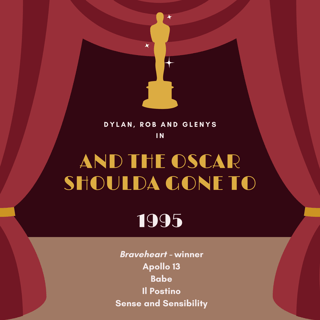
Speaker: Well, all right. That was, um, yeah what's next, uh, what's next next next episode is 1995. Yeah. Uh, so the winner was Braveheart the nominees were Apollo 13, Babe, Bill Postino and Sense and Sensibility.
Speaker: Any last words? Looking forward to 1995. It's got to be better than 1970. You are not wrong. All right. All right. Thanks for listening. Yeah. Thanks. Thank you so much.
Speaker: Bye. Bye.