Transcript
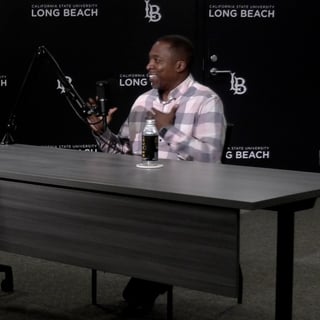
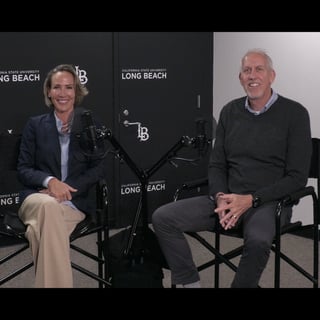
Speaker: Hello, I'm Dan Montoya, Vice President for University Relations and Development here at Cal State Long Beach, and welcome to At the Beach. My guest today is someone who has dedicated the better part of four decades to public service and higher education law.
Speaker: And who, when Cal State Long Beach needed steady principal leadership, he answered the call. Andy Jones has spent his entire career in service to students, institutions, and the public good.
Speaker: He earned his undergraduate degree in business administration from Cal State Long Beach. the very institution he now leads. Before going on to earn his JD from UC Davis School of Law, he began his legal career as some of Los Angeles most respected firms including Adams, Dookie & Hazeltine and Myers & Jones LLP before joining California State University System in 2000.
Speaker: Over the next 25 years, he rose to become Executive Vice Chancellor, General Counsel, and Secretary to the Board of Trustees for the entire CSU system.
Speaker: one of the most consequential legal and governance roles in California higher education. In August of 2025, he stepped into the role of interim president of Cal State Long Beach, serving as the interim CEO of the flagship university with more than 42,500 students and 4,000 employees.
Speaker: Andy Jones, welcome to At the Beach. Thanks, Dan. It's great to be here. I appreciate you taking the time to join us. And more importantly, want to thank you for your leadership during a really important moment at Cal State Long Beach.
Speaker: You stepped into the role of interim president at a time when the institution needed stability, clarity, and direction. And you brought all three. What I'd like to do today is focus on two things, really your journey and the time as a president. And what you saw, what you learned,
Speaker: and what's ahead. Well, thank you, Dan. it's I appreciate that. it's It's been a tremendous honor to serve this institution in this role, especially because it's Cal State Long Beach. There's just a real sense of mission and purpose here, and I'm grateful that I had the opportunity to be a part of that, even if it was for a limited period of time.
Speaker: Right. Well, let's start with your career journey and take you a little closer back into where it all started. So take us to where it started. What originally drew you into higher education leadership?
Speaker: Well, I think like a lot of people in higher education, i didn't start with a clear roadmap. I wasn't sure what I wanted to be when I went to college or what I wanted to do when I got out.
Speaker: But I was fortunate. When I was a student here, I was inspired by a Cal State Long Beach professor to go to law school. And so I did. And after that, I got on what I kind of think of as a career conveyor belt.
Speaker: You know, you do well in law school, you get hired by a big law firm, you start climbing that partnership ladder, which is like a seven or eight year process, and then you're all set.
Speaker: And so I did all of that and I got in at the big law firm and I climbed the ladder and I made partner. And I thought for a while that it was all set, but you know something was missing.
Speaker: And I couldn't figure out what that was. And it occurred to me at some point that it was a sense of purpose or mission. And then I poked around a little bit and I realized that I could use my legal experience to actually work to provide that same opportunity that I had for others so that other people could be the first in their family to go to college and have access to a great education. And so I found my mission.
Speaker: And once I did that, um it drew me in and it kept me here for all these years. Right. I can relate to that in... You know, graduating from a business school and then, you know, everybody says, oh, go work in the industry and and climb and all that. But I think like you, mission, it was important to me.
Speaker: So what were your pivotal moments that shaped how you lead today? That's a good question. you know, early in my career, um i was lucky. I got to observe a lot of different leadership styles and models from senior attorneys and partners in my early law firm days.
Speaker: I saw partners who liked to micromanage and be controlling and then look to blame other people or assess blame when things went wrong because things always go wrong.
Speaker: And then I saw those who provided direction and looked for solutions when things went wrong. Literally would say, well, can we fix it? And if the answer was yes, they'd say, well, then go fix it, as opposed to conducting some kind of an autopsy of what happened. right And then I knew at that time that I wanted to be more part of that that second model than the first.
Speaker: And then more recently, there were a few moments where i had to lead through times of tremendous uncertainty. There were challenging budget situations. There was, of course, the the COVID pandemic, and we did not have a playbook for that. Nobody knew what to do.
Speaker: um I also had to deal with high-level organizational change. And just moments where trust needed to be rebuilt. I think those experiences taught me that leadership is really less about control.
Speaker: and it's more about providing clarity and communication and consistency. Yeah, you you definitely charted some new territory for for the nation as a whole. So at what point did your leadership become more about service than advancement?
Speaker: I think that that shift happens when you realize that the role that you're in isn't about you. It's about the institution, the students, and the team and the people that you're responsible for supporting.
Speaker: Once that awareness clicks in, I think your decisions change. They become more grounded, more thoughtful, and more long-term in nature. And once you focus on the mission and on service and on problem-solving,
Speaker: I think the advancement part just kind of follows naturally. Right. So that foundation, you know, really shows up in the moments like the one that you stepped into here.
Speaker: So let's talk about the presidency and your time in the president role. When were you asked to step into the interim president role and what went through your mind?
Speaker: Well, I know what went through my mind. The very first thing that went through my mind was I needed to pinch myself and make sure I wasn't dreaming because it was it sounded just too good to be true. But I was asked if I would step into this role.
Speaker: It was literally one week before the convocation at the opening of the fall semester. And the chancellor asked me if I would consider doing this.
Speaker: And it took me um less than a nanosecond to say yes. Because I knew that it was just a dream come true. right So I dove into it and never looked back.
Speaker: In terms of what I thought about first when I accepted the role, I think I thought about responsibility. I'd advised a lot of CSU presidents over the years, and I understood the weight of the role and the importance of providing stability, particularly during this time of transition for Cal State Long Beach.
Speaker: I knew that this role was not going to be about making sweeping changes. It was about ensuring that the university continue to move forward with competence during this period of transition.
Speaker: Yeah. so So how do you define your role? How did you define your role in terms of what you were going to do when you stepped into it? Well, of course, I had a whole week to think about it, but I thought about it a lot during that week.
Speaker: I defined my role as being to to steady the institution, to support the leadership team. There was a great leadership team that I knew, And I knew it was already in place. I knew most of them personally. I knew that they were doing a great job. I needed to support them. And I knew that I needed to find ways to help keep the momentum going forward.
Speaker: I think that interim leadership, it's not just about, it is about stewardship, but it's not just about stewardship. It's true that you're holding the place. But you're also making sure that it's stronger when you pass it on.
Speaker: So while this role was not just about making sweeping changes, I also didn't want things just to remain stuck in neutral. That was important to me. Yeah. So what were your top priorities early on when you first walked into that role?
Speaker: I think my number one priority was listening. I knew this campus and I knew a lot of the key players here, but I also knew that I needed to listen. I needed to understand where the institution was in that moment, where the concerns were, and where the opportunities were that existed at that time.
Speaker: And from there, it was really just about alignment. It was about making sure that people were moving together in the same direction and in the right direction. That's great. um Now that you've had that perspective, I want to talk to you a little bit about what you saw here at the beach, you know, maybe some reflections on what really stood out the most about Cal State Long Beach and did it surprise you?
Speaker: What stood out most, I think that's pretty easy. What stood out most when I started in this role is the same thing that stands out the most now, and that's the people. I always knew that there were good people here at the beach, but serving up close in this role showed me that even more profoundly. There's a deep, deep commitment here on this campus to students and to access.
Speaker: It's a place that truly lives out its mission, and I have to tell you, Dan, that's just not something you see at every institution. Right. So where do you see the greatest strengths here at the beach?
Speaker: Wow. There's so much that's great here. There's probably too many strengths to list. But I think the topping the list would have to be the university's laser focus on student success.
Speaker: It's literally at the heart of everything that happens here on campus. Right. And there's also an amazingly strong community connection and a strong sense of identity. There's basically just pride here at the beach, and that matters a lot, now more than almost at any other time.
Speaker: Yeah, I can say that when I first came here and started. You you could feel the pride. it's It's just amazing, and people really love being here. so So where do you see the opportunities? The opportunities. You know, Dan,
Speaker: We're always going to dream big, and we're always going to want to do more things for our students and for their success than we're able to do at any given moment. So I think an opportunity is is continuing to build resources that match the ambition of the institution, whether that's through partnerships, philanthropy, or even innovation.
Speaker: ah There's so many great things we want to do at the beach, but we can't rely on the state to give us the resources that we need to accomplish those dreams. We've got to look elsewhere. So, you know, i love philanthropy. i mean, that's what I do every single day.
Speaker: So how did you experience the role of philanthropy and partnerships here? You know, some of that part of my role was new to me. It wasn't something I had done before, but it became very clear to me that philanthropy is absolutely essential.
Speaker: Public institutions like ours rely on those relationships to expand what's possible. Philanthropy isn't just about funding, which is kind of what I thought coming into it. It's really about getting others to share in our belief and our mission.
Speaker: And when that happens, I think long-term partnerships and giving just naturally follow. Right. It's one of the biggest things I've been trying to champion into the university is a culture of philanthropy, but I realize it's more of a shared partnership.
Speaker: So how important it is that philanthropy is it that philanthropy becomes a central component to the long-term strategy of the university? I think it's absolutely critical.
Speaker: I think now more than ever, it's just critical. If institutions want to be competitive and truly serve their communities, philanthropy has to be integrated into the broader vision. It cannot be treated as an add-on.
Speaker: Absolutely agree. And I know we'll continue to work on that as we go. So I want to transition a little bit. You've led through transition and that's where leadership is tested the most.
Speaker: So what does good leadership look like in uncertain moments? Well, I think in uncertain times you have to be calm.
Speaker: You have to be visible. And you have to be very focused on the mission, the North Star of what you're about. And you have to communicate. you have to You have to be honest about what the challenges are.
Speaker: about what we know and about what we don't know and about what we can and can't do. so That just doesn't happen enough sometimes. that You have to just be straightforward and transparent. People don't expect perfection, but they do expect clarity and honesty.
Speaker: Right. 100% agree. So now that you hindsight and looking forward, what advice do you have for Dr. Blanchard?
Speaker: Wow. Well, know Dr. Blanchard, and I have to tell you that President Blanchard is tested and he's an experienced leader. So he knows what to do. And I know from speaking with him that he's planning to listen first, which is, of course, the right thing to do. right And I know that he's going to work early on to understand the culture of Cal State Long Beach, to build trust early, and to be very clear about his priorities because that sets the tone for everything that follows. And I'm confident that that's exactly what he's going to do.
Speaker: Great. That's great advice. So what should not change about the beach?
Speaker: Well, there's so much that we're doing right, but if I had to pick one thing that should not change, it's absolutely the commitment to access and to student success. That is the core of what this institution is and how it should remain. It just absolutely has to be a steady focus, our North Star, as I said. right Everything else is secondary.
Speaker: Yeah. So I want to kind of dial in deeper into you. So before we close, I want to bring this more personal as a reflection to you. So what did this experience mean to you?
Speaker: Wow, that's really hard to put into words. This was a dream of a lifetime. It was literally a full circle moment for me. I got to come back and finish my career in the very place where it all started. I mean, who gets to do that?
Speaker: It was an honor of a lifetime. it was an opportunity to serve this institution that I love and care about so much in a very meaningful way. To help guide an institution during a transition,
Speaker: And to contribute to its continued success, that's something that I'm always going to value and I'm never going to forget. And so of all your time here, or maybe just a reflection, what are you most proud of?
Speaker: Most proud of. there's it's There's a long list of things that I'm proud of that happened this past year. Bringing back commencement, of course, is one of them that I think most people are happy about, but maybe not everybody.
Speaker: But if I had to say what I'm most proud of, I would say it's that we maintain momentum and stability. We just didn't keep things stagnant, but we we move things forward. I'm proud that the institution continued to move, that the people connected to the beach were The students, the faculty, the staff, and our very important community partners, I'm proud that they all felt supported during this time of transition.
Speaker: So what memories will you carry forward with you? So many. I mean, so many, Dan. But I think one thing that I'll always carry forward with me is a deeper appreciation of the weighty responsibility of leadership and the importance of staying grounded in purpose.
Speaker: That's just so critical. But I'm also going to carry with me a deep awareness of just how special the beach is. I always knew that, but I know it even more now. The people here are, they're just amazing.
Speaker: The students, they're energized. They're full of possibility. The faculty are engaged and focused on student success every single day. And the staff, we don't talk about the staff a lot. The staff here, Dan, care more about this place and our students than you could ever imagine. Absolutely. It's the people that make the beach special and the special place that it is.
Speaker: I'm always going to remember that. I'm always going to treasure the time that I had with them. Absolutely. And so I'm so excited that commencement is almost like the the ribbon on the present. And you will be there with us to celebrate all 13 ceremonies and and all the students that are are going to walk through that. So we're excited.
Speaker: Andy, thank you so much. um You have been here with the interim title, but your impact is lasting. And even in such a short time, you've accomplished so much. We appreciate your leadership.
Speaker: your service and the way you showed up for this institution. But more importantly, just thank you for being you and for being ah a great colleague, a companion, and a great friend to the university. And so we're so excited to to know that you're going to be close and that you will be with us always.
Speaker: And we look forward to engaging you in a different way because you are an alum. And, you know, it's a beach for life. And we'd like to finish this podcast with a Go Beach on 3.
Speaker: One, two, three. Go Beach!